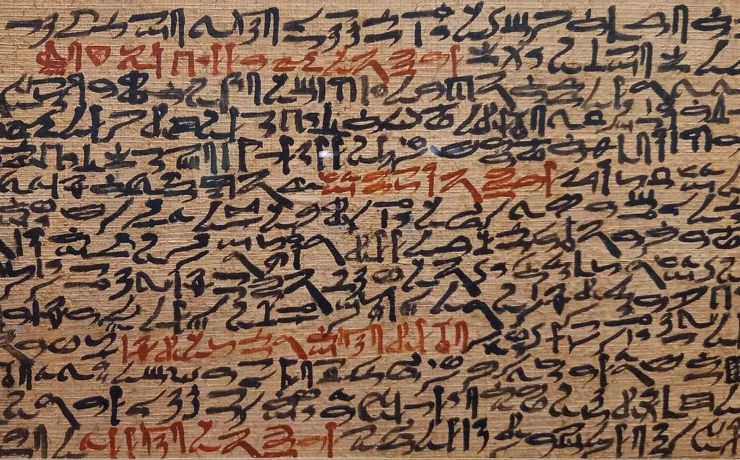
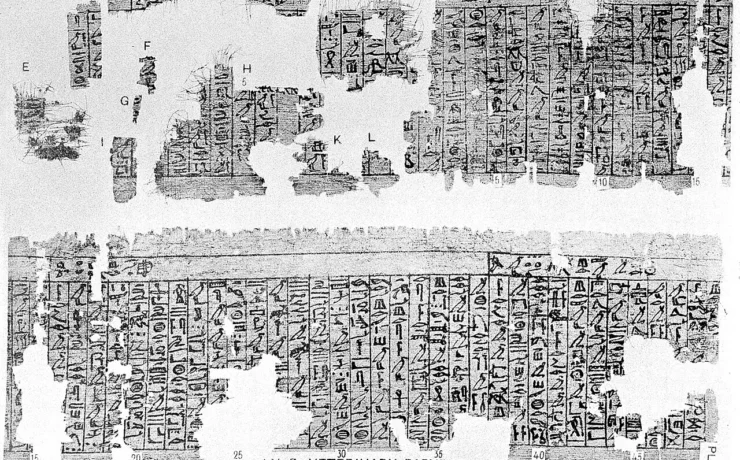
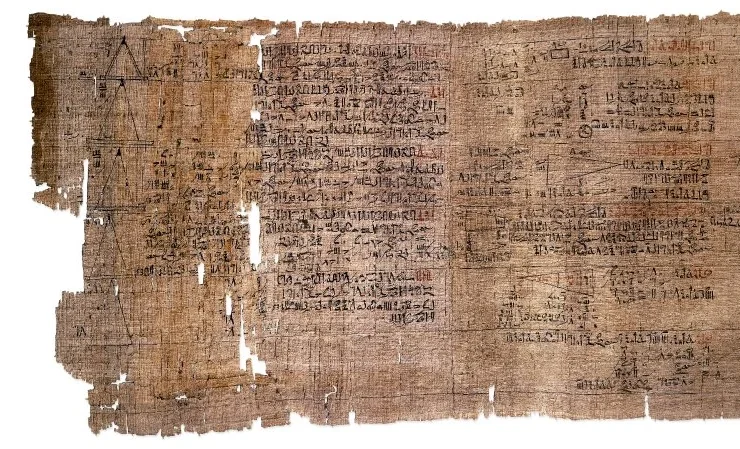
What is the Egyptian Book of the Dead? It is a changing collection of ancient Egyptian funerary spells, hymns and illustrated texts intended to help the deceased obtain protection, move safely through the afterlife and participate in renewed existence. It was not a single fixed book: surviving papyri differ in their owners, chapters and images. The modern name and numbered spell system were introduced by Egyptologists. Fitzwilliam Museum research explains this distinction.
Imagine unrolling an Egyptian funerary papyrus. A deceased person’s name appears beside columns of writing; gods may sit before offering tables, boats move through a sacred landscape, and carefully chosen formulas ask for a voice, a remembered identity and safe passage beyond death. That manuscript might belong to the tradition modern scholars call the Book of the Dead. Yet it would not contain one fixed story, one universal list of spells or a literal account of what happened after anybody died.
The ancient Egyptian name is usually rendered Book of Coming Forth by Day. Its texts sought to equip a person to continue existing and to move through a supernatural world. The surviving manuscripts differ in their selections, arrangements and artwork. The most reliable way to explore them is to start with actual objects, distinguish ancient religious hopes from historical facts, and explain where our knowledge comes from.
Explore two source-specific studies: For the people, spell sequence and museum history of a single historic scroll, read The Papyrus of Ani: an illustrated manuscript guide. For the very different question of agricultural life beyond death, explore the Field of Reeds and Book of the Dead Spell 110. These focused guides are companions to this corpus-wide introduction rather than substitutes for it.
Book of the Dead at a glance
1. What was the Egyptian Book of the Dead?
The familiar English name can be misleading. This is not an Egyptian equivalent of a modern novel, nor is it a death register or a secret manual discovered intact in one tomb. It is a changing collection of funerary compositions that may appear on papyrus, tomb walls, coffins, amulets and other objects. The intended effect of the words depended on Egyptian understandings of sacred speech, correct ritual, divine identities and the transformed condition of the dead.
Some compositions protect a person’s body or heart. Others enable movement, speech, recognition, access to food, divine company or participation in the solar cycle. The celebrated judgment scene represents only part of this larger tradition. A reader concentrating entirely on the balance and feather will miss the equally important concerns of breathing, remembering names, passing guarded places and sharing in cosmic renewal.
University College London’s Digital Egypt project explains that modern editors identify roughly two hundred compositions across the wider corpus, while individual manuscripts present selections. The numbers are editorial conveniences; they do not mean every owner received two hundred chapters in that order. UCL’s introduction to the corpus is a useful starting point.
2. From Pyramid Texts to funerary papyri: how the tradition changed
The Book of the Dead developed within a much longer history of Egyptian writing about the afterlife. The earlier Pyramid Texts, preserved primarily in royal pyramid contexts of the Old Kingdom, and the later Coffin Texts of the Middle Kingdom contain themes and formulas that help explain the subsequent repertoire. This is a history of adaptation rather than the replacement of one identical textbook with another. For an illustrated comparison of these earlier and related traditions, read our source-checked guide to the Pyramid Texts, Coffin Texts, Amduat and Book of Gates.
Forms that scholars associate with the Book of the Dead appear before the mature New Kingdom papyrus tradition, and decorated rolls became particularly prominent in elite burials during the New Kingdom and later periods. Over time, workshops combined different chapters and pictures, adjusted scripts and adapted the texts to owners. Certain sequences became more regular during the Late Period without eliminating differences between copies.
| Broad period | Characteristic evidence | What it tells us |
|---|---|---|
| Old Kingdom | Pyramid Texts in royal funerary monuments | Earlier sacred compositions about royal transformation and divine access |
| Middle Kingdom | Coffin Texts and burial objects | A growing and adaptable repertoire of funerary speech |
| New Kingdom | Personalized papyrus rolls and tomb scenes | Book of the Dead chapters circulated in illustrated, individually selected collections |
| Third Intermediate Period | Varying papyri for named owners | Religious images and spells remained versatile rather than uniform |
| Late and Ptolemaic periods | More regular chapter sequences in some manuscripts | Editorial ordering could become systematic without creating one canonical copy |
Chronology varies among scholarly systems and individual objects. For textual relationships, compare UCL on the Coffin Texts and UCL on the Book of the Dead.
3. A real manuscript: Nesiamun’s papyrus
The Metropolitan Museum of Art preserves a roll identified as Nesiamun’s Book of the Dead, accession 26.2.51, dated to the Twenty-first Dynasty in the Third Intermediate Period. According to its catalogue, the manuscript belonged to a priest and includes passages now numbered 23–28 and 162. Those formulas deal with such abilities as speaking, preserving memory and heart, and sustaining the deceased. The papyrus shows Nesiamun presenting incense before Osiris: an ancient image made for a named person, not a generic modern illustration of Egyptian mythology.
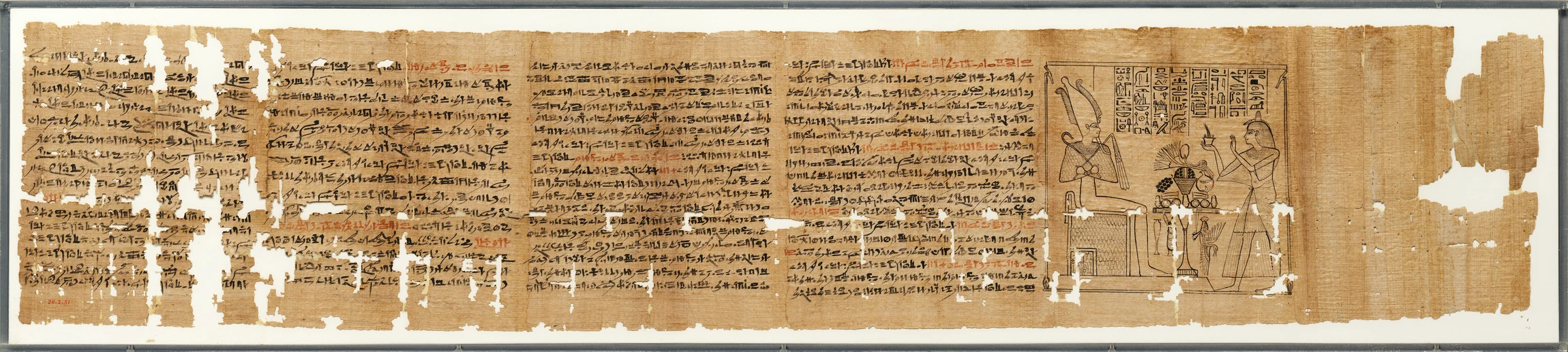
This example is especially valuable because its museum record links a physical artifact to identifiable passages. A real manuscript can be dated, measured and assigned an accession number; its text can be compared with other copies. The supernatural effect the owner hoped to obtain cannot be tested archaeologically in the same way. That difference is central to responsible Egyptology.
4. What did the spells try to accomplish?
Calling these compositions ‘spells’ does not make them all interchangeable charms. Some are hymns or declarations, some contain dialogue, and others instruct the owner to recite particular words or deploy an object. Egyptologists use the modern chapter numbering to locate recurring compositions across manuscripts, not to impose a single mandatory reading sequence.
| Example | Subject | Reason it matters |
|---|---|---|
| Chapter 1 | Funeral and entering the afterlife | Connects written speech with ritual action and the funeral |
| Chapter 6 | Shabti or ushabti figure | Asks a funerary figure to answer in place of the deceased for required tasks |
| Chapters 23–26 | Mouth, voice, powerful words, memory and heart | Shows that continued personal abilities were an important concern |
| Chapter 30 traditions | Protection of the heart | The heart could bear witness; protection was both physical and moral |
| Chapter 125 | Declarations and judgment | Famous for the hall of justice and associated weighing scene |
| Chapter 110 | The Field of Offerings | Represents hoped-for provision and existence in the next world |
This comparison is a guide to themes, not a claim that every surviving manuscript contains all six examples. The UCL chapter index supplies descriptions and references for individual compositions. For Chapter 6, its specialist entry explains the long history of the shabti formula.
5. What really happens in the weighing of the heart?
The best-known image associated with the Book of the Dead shows a judgment in the presence of divine beings. In many versions Anubis attends or manages the balance; the heart of the deceased is assessed against a symbol of ma’at, the Egyptian ideal of rightness, order and truth. Thoth may act as recorder, while Osiris is linked with the judgment hall. Particular manuscripts differ in their arrangement and visual details, so one popular textbook picture should not be treated as an exact template for every period.
Chapter 125 also includes declarations that the deceased has not committed particular wrongs. The phrase ‘negative confession’ is an academic shorthand for these denials, not evidence that we possess a court transcript of a historical trial. The image and words make a moral and religious claim about fitness for continued existence; they do not report an archaeologically observed event. UCL’s discussion of Chapter 125A distinguishes its sections and early evidence.
Two interpretive traps are common. First, ‘the feather of Ma’at’ does not mean every surviving balance picture contains an identical feather: artistic treatments vary. Second, it is misleading to reduce the whole religion to one pass-or-fail scale. Egyptian funerary writing also speaks of protective knowledge, ritual access and transformed identity. The balance belongs inside that broader system.
6. Khamhor’s Book of the Dead: an incomplete but informative archaeological record
The Met’s Book of the Dead of Khamhor, accession 25.3.212a–g, belongs to the Late Period, Dynasty 26. Its catalogue identifies the owner as an official from a prominent Theban family. The papyrus survives in several sections, and related material is held in other collections. Its discovery history involves material associated with the entrance to a tomb and later disturbance, making it a reminder that museum objects have complicated archaeological biographies.

This roll cannot be read as though every missing part has been reconstructed beyond doubt. A responsible account states what survives, what the museum identifies and where specialists propose an association. It also shows why today’s library or museum location must not be confused with the manuscript’s original burial context.
7. Why the body, heart, name and voice mattered
Egyptian ideas of the person did not map neatly onto a simple modern division between body and soul. Funerary sources draw attention to the named individual, preserved remains, heart, mobility, memory and multiple aspects of continued existence. The Book of the Dead belongs beside material practices such as burial preparation, protective amulets and funerary offerings, although the wording of an incantation and the physical action of preparing a body are different kinds of evidence.
For example, chapters related to recovering speech or guarding the heart make sense in a setting where a person hoped to retain recognition and agency. Shabti formulas concern activities the deceased might otherwise be required to perform. Solar hymns look toward renewal with the sun, while passages about protected passage through dangerous places are concerned with knowledge and safe movement. Those themes explain why the corpus has so many different kinds of composition rather than a single narrative from death to final reward.
For the god at the center of much of this religious landscape, consult our separate evidence-based guide to Osiris. For the wider mythology and its varied textual sources, see the Isis and Osiris story. Neither article is a substitute for reading an actual funerary manuscript.
8. The importance of the original papyrus fragments
Individual fragments may look less spectacular than a complete illustrated roll, but they can prove that a particular composition was copied at a particular time and place. The Met’s fragment 28.3.297 comes from the Ramesside New Kingdom and can be dated and described independently from a modern reconstruction of an imagined complete papyrus. Its survival gives material evidence of the tradition’s circulation rather than an invented full text.
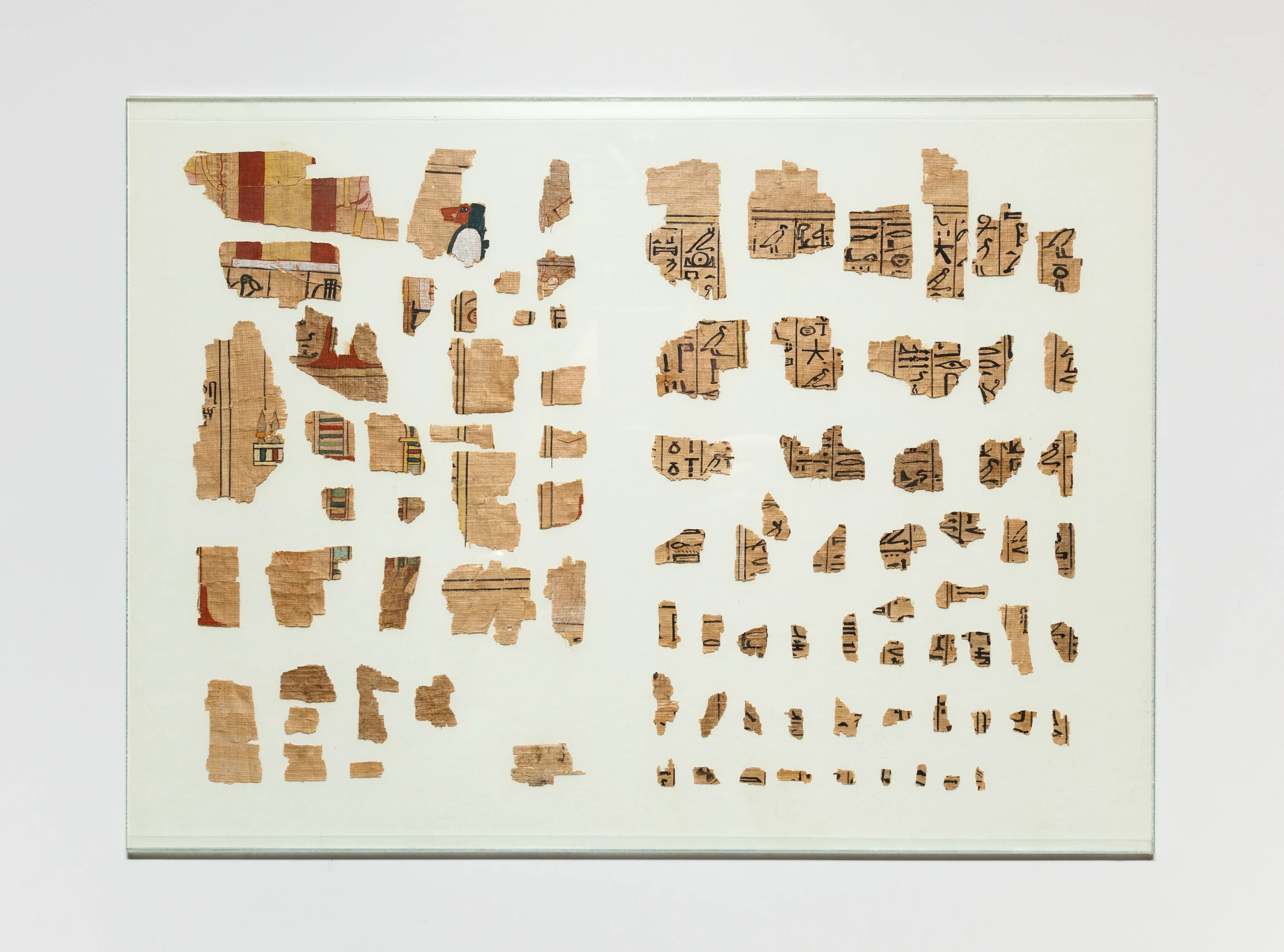
Another Met fragment, accession 15.10.77b, is catalogued as portions of chapters 23 and 26. These concern abilities such as speech and the heart, subjects also represented on the Nesiamun manuscript from a different period. When readers compare accession numbers, paleography, dates and compositions, they can see both continuity and change without pretending the surviving fragments all belonged to one scroll.
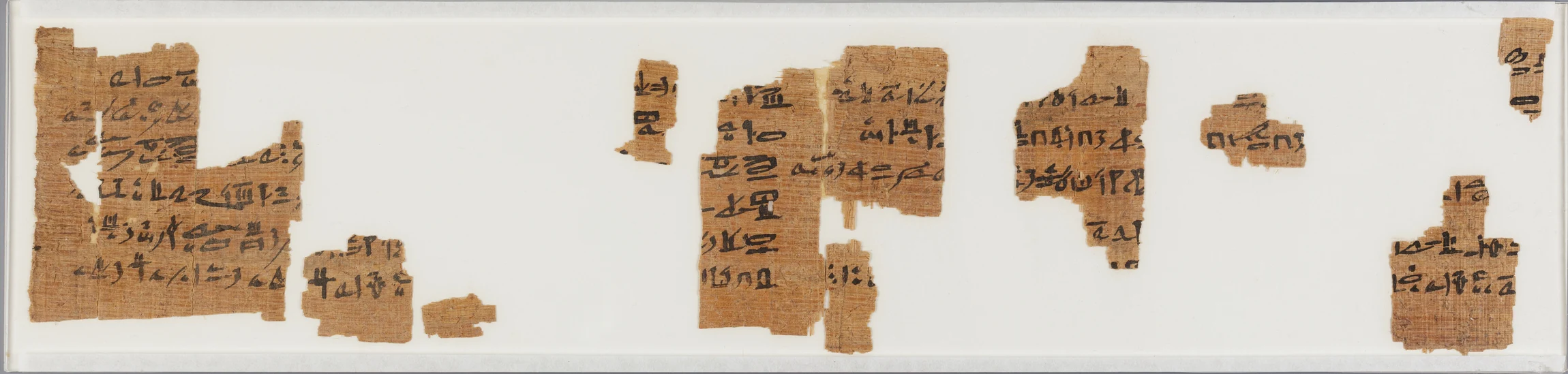
Do not assume adjacent photographs are pages of one papyrus. Here they come from four separately catalogued museum objects. The objects may differ substantially in physical dimensions, date, preservation and archaeological context.
9. Was there one official Book of the Dead?
No single surviving master manuscript can be called the one authorized Egyptian Book of the Dead for every era. Modern editors gave recurring compositions numbers so scholars could compare texts across hundreds of sources. New Kingdom rolls can differ from Late Period manuscripts, and even copies created within a narrower period can contain different choices and picture arrangements.
A standard sequence emerged more clearly in some later traditions. That is an important historical development, but it does not erase local practices, omitted compositions or later adaptations. The apparent numerical precision of a chapter label is a modern tool. It should never be turned into the claim that every ancient Egyptian carried a neatly numbered book or that all Egyptians could commission such a manuscript. Surviving personalized papyri are especially well represented among groups with the resources to obtain specialist funerary equipment.
As the Digital Egypt numbering guide explains, the modern numbering itself was built through successive editions. This history matters whenever websites quote a supposed universal chapter total.
How was the Book of the Dead used in an Egyptian burial?
A Book of the Dead was not a book read from a fixed beginning to an identical ending at every funeral. Texts were selected and copied for individual deceased people, and some decorated manuscripts were deposited in their burial equipment. Archaeological and museum evidence records different writing surfaces and arrangements at different dates.
| Surviving surface | What it tells us |
|---|---|
| Linen shrouds and wrappings | Some early New Kingdom funerary compositions were written on linen placed with the prepared body. |
| Papyrus scrolls | From the New Kingdom onward, selected spells and illustrations were copied for named people and could be placed in a burial. |
| Coffins and tomb walls | Related compositions also appeared on funerary objects and built surfaces; not every burial included a complete papyrus. |
These material differences are described in the Fitzwilliam Museum’s account of Egyptian funerary literature. To inspect the actual owner, date and illustrated sections of one surviving manuscript, compare the Papyrus of Ani. For the specific agricultural afterlife image, see Spell 110 and the Field of Reeds. Neither example represents every Book of the Dead manuscript.
10. Are the Book of the Dead and mummification the same thing?
They are related but not interchangeable. Mummification involved treating and wrapping human remains according to practices that evolved across regions, centuries and social circumstances. Funerary texts supplied prayers, ritualized identifications and imagined protection or renewal. Some papyri were deposited in burials; others transmitted closely related compositions in different material forms.
The result was not one unchanging ‘standard package.’ The presence of a decorated roll cannot alone tell us exactly how a body was prepared, what every relative believed or which rites occurred on a given day. Conversely, a surviving mummy does not prove a Book of the Dead scroll was included with that person’s burial. Archaeologists need burial records, associated artifacts, textual evidence and often scientific analysis to make such arguments. For the physical stages of ancient Egyptian mummification and seven documented embalming artifacts, consult the separate archaeological guide.
11. How to read a Book of the Dead image like an Egyptologist
Start with the object’s physical identity. Ask for its accession number, museum, accepted date, original findspot when known, material and state of preservation. Then inspect the characters, their orientation, the distinction between a scene and its caption, and whether the museum identifies specific chapters. Do not interpret a papyrus only from a cropped picture found on social media.
Next, separate three levels of statements. An observation might be that a priest makes an offering in an image. An interpretation might identify a religious hope conveyed by the scene. A mythological claim, such as a god’s journey or judgment in the afterlife, is part of what the ancient texts represent rather than something a photograph independently verifies. Keeping these layers distinct makes the material both more compelling and more useful to students.
Finally, compare a second manuscript. A disagreement can be evidence of textual change, workshop practice or a different editorial tradition, not necessarily an ancient mistake. To understand what Egyptian scripts do and do not encode, visit Kemet Vault’s Egyptian scribes and writing guide, then explore the hieroglyphic sign reference. A sign index is not an automated translation of a papyrus.
12. Four myths that need correcting
| Popular claim | What the sources support |
|---|---|
| Every Egyptian owned the same Book of the Dead. | Manuscripts vary and personalized copies were particularly associated with people who could obtain them. |
| The book tells one fixed story from beginning to end. | It is a flexible compilation of compositions with different functions and arrangements. |
| Chapter 125 is the whole book. | Judgment is famous, but many chapters concern speech, movement, protection, offerings and transformation. |
| A museum image proves the afterlife was real. | It proves that ancient people made, used and valued such objects and represented those beliefs. |
13. Questions readers often ask
Who wrote the Book of the Dead?
It was assembled through long-standing Egyptian textual and scribal traditions. There is no single historically identifiable author of the entire corpus. Individual rolls were prepared for named owners, and their selection of compositions may differ.
How many chapters does it contain?
The answer depends on which manuscripts and modern editorial numbering system are being counted. Scholars describe a broader repertoire numbering roughly two hundred compositions, but no single ancient papyrus contains that entire repertoire as a compulsory sequence.
Is the Book of the Dead a historical eyewitness account?
No. Its words and artwork are historical evidence for Egyptian religion, practices, language and material culture. The supernatural events they describe remain part of the ancient religious worldview, not independently verified occurrences.
How was the Book of the Dead used in ancient Egyptian burial rituals?
Selected spells were copied for an individual deceased person. Some texts appeared on linen shrouds, and papyrus rolls with writing and illustrations were placed in certain burials; related compositions also occur on coffins and tomb walls. The aim, within ancient Egyptian religious belief, was protection, movement, nourishment, identity and successful passage beyond death. Manuscripts differ in contents and order, and not every burial included a scroll. The Fitzwilliam Museum documents these changing material forms.
Where can the original papyri be seen?
Many survive in museum collections, sometimes as fragments, and some are exhibited while others remain in storage. The four objects documented here have official Metropolitan Museum online catalogue records; exhibition status can change and should be checked with the institution.
14. Sources, object IDs and further research
This guide was written from museum collection records and university research references rather than a fictional reconstructed narrative. Photographs are of separate physical objects and were imported into Kemet Vault’s own media library only after the museum’s official API reported public-domain availability.
- UCL Digital Egypt: Book of the Dead introduction
- UCL: Modern chapter numbering and individual compositions
- UCL: Judgment of the dead, Chapter 125A
- UCL: Chapter 6 and the shabti tradition
- The Met: Nesiamun, 26.2.51
- The Met: Khamhor, 25.3.212a–g
- The Met: Ramesside fragment, 28.3.297
- The Met: Chapters 23 and 26, 15.10.77b
Continue exploring: Read about Osiris and funerary transformation; study the mythological cycle of Isis and Osiris; or inspect genuine Egyptian objects in our Digital Museum. The original manuscripts discussed here and their modern photographs remain attributed to their documented source institution.