The opening of the Instructions of Ptahhotep sounds almost painfully familiar. An elderly official tells the king that his body is failing. He describes the burdens of age and asks to pass on what he knows. The king tells him to teach his son. The result is a collection of advice about listening, speaking carefully, handling status and dealing with other people.
It is tempting to call this the world’s first self-help book. That would miss what makes it interesting. The text belongs to a world where hierarchy mattered, where a person’s words could affect their livelihood, and where literature gave ideals of behavior an authoritative voice from the distant past.
A famous old vizier in a later manuscript
The literary frame places Ptahhotep at the court of King Djedkare Isesi in Egypt’s Fifth Dynasty. But that does not establish the historical date of the words we now read. Egyptologist James P. Allen, in Middle Egyptian Literature, argues that the surviving compositions are Middle Kingdom works written in Middle Egyptian. Their narrative claims of older authorship helped give the instructions authority.
That is a fascinating literary strategy. A text could present itself as the wisdom of an ancient court figure even if the version we study was composed centuries later. It may preserve older social ideas, but the existence of an old name in a literary prologue is not proof that every maxim is a Fifth Dynasty autograph.
The best preserved early witness is Papyrus Prisse, held by the Bibliothèque nationale de France in Paris. The manuscript was written in hieratic and is usually dated to the Middle Kingdom, probably around the reign of Amenemhat III. It also includes the end of another instruction associated with Kagemni. The two works share a roll, not an author.
Look at the real writing rather than a modern quotation card
The first image below shows an actual part of Papyrus Prisse. The lines were written by an ancient scribe, not printed in a modern typeface. Once a manuscript is reduced to a handful of attractive sayings, it becomes easy to forget that copying, damage and translation affect the words we read.
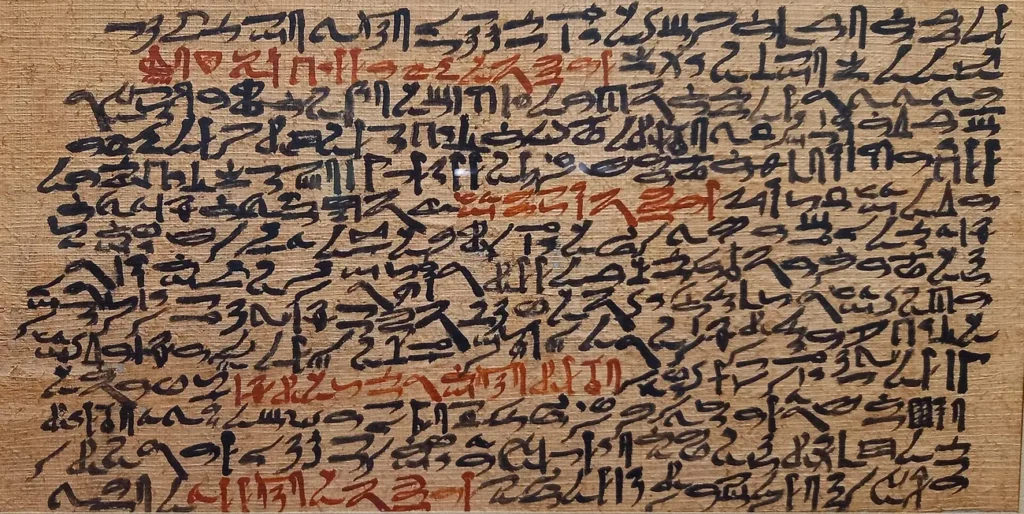
Allen notes that Papyrus Prisse is organized across eighteen pages, with the surviving Ptahhotep instruction occupying most of them. Later New Kingdom copies survive on papyri and other writing surfaces, and they do not all agree word for word. Their differences matter to translators. A memorable English quotation taken from a social-media graphic may conceal the fact that several ancient witnesses and modern interpretations exist.
For the physical document, the BnF educational record and its manuscript images are better starting points than paraphrases circulating without a source. If the exact wording of a maxim matters to you, check which translation and manuscript version the author used.
Why Ptahhotep keeps returning to listening
Much of the instruction concerns how a person should behave when another person speaks. Listening is treated not as politeness for its own sake, but as a practical skill for anyone navigating relationships, work and authority. An arrogant official who cannot listen is likely to make poor judgments and create conflict.
Yet the advice is not simply a modern argument for equal rights. The text imagines a society in which people occupy very different ranks. Those differences shape who is expected to listen, when a person should speak and how one should address someone more powerful. Its ethical ideals are embedded within a hierarchy rather than written against the very idea of hierarchy.
The word maat, associated with truth, justice and order, is often used to frame these ideals. In practice, fair conduct could include restraint and appropriate treatment of those below you, while still accepting inequalities of office and status. The text is valuable precisely because it forces us to examine those tensions instead of assigning ancient writers entirely modern values.
Words, pride and the risks of public behavior
Ptahhotep warns against boastfulness and the careless use of speech. Those passages give us a sense of why controlled language mattered at an elite court: reputation, relationships and a person’s position could depend on the ability to avoid insult or needless confrontation.
The advice also deals with household life and encounters with people of different standing. Reading such passages requires caution. They show social expectations promoted by an educated writer, not a census of how every Egyptian family behaved. Women, workers and poorer households rarely speak in these instructions in their own independent voices.
That is one reason the work belongs beside documents such as the Heqanakht letters. A literary instruction describes behavior as it ought to be. A practical household letter records a particular person’s demands and frustrations. Compare them and the distance between ideal and everyday life becomes more visible.
Why scribes kept copying the instruction
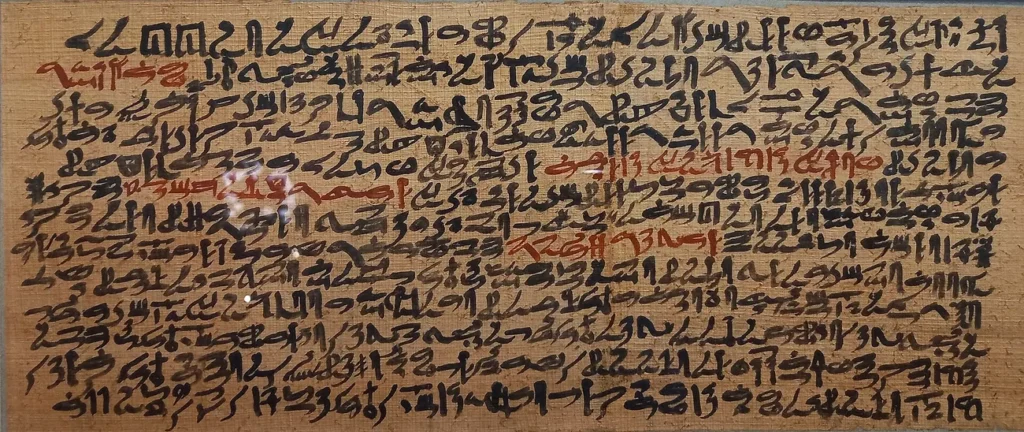
Literature like Ptahhotep’s could serve the education of scribes, who needed familiarity with formal language and elite conventions. A surviving New Kingdom copy in the Egyptian Museum in Turin, CGT 54014, preserves part of the opening and bears features associated with scribal practice. The copy is incomplete; it doesn’t retain the full sequence of maxims.
The Turin fragment is especially useful because it demonstrates that the instruction circulated long after its Middle Kingdom composition. The survival of a fragment does not prove that every school in Egypt used it, but the manuscript tradition shows that later scribes repeatedly found it worth copying and adapting.
Hieratic may look very different from the temple signs tourists recognize. Our guide to Egyptian writing explains the basic system behind these scripts. It cannot replace specialized study of a damaged literary manuscript, but it helps a new reader understand why an ancient text requires more than simply matching symbols to alphabet letters.
What the text actually tells us about Egyptian life
| Evidence | What it supports | What it does not prove |
|---|---|---|
| The prologue’s elderly vizier | A literary ideal of experienced knowledge passed to the next generation | A verified Fifth Dynasty transcript |
| Advice about listening and speech | Values promoted within educated elite society | That everyone behaved as the text recommended |
| Papyrus Prisse | A Middle Kingdom manuscript witness to the literary composition | The exact date of every earlier idea within it |
| Later copies | Continued transmission and scribal interest | A single unchanged text across all Egyptian periods |
What makes Ptahhotep worth reading today isn’t a claim that every line predicts modern psychology. It is the combination of familiar human problems and an unfamiliar social setting. People worried about pride, careful speech, authority and old age. But they understood those problems through a different framework of rank, learning and justice.
For a translation grounded in the manuscript tradition, James P. Allen’s scholarly edition is a useful guide. The older authority claimed by the narrative and the later date of the surviving composition can both be true, as different kinds of historical statement. Keeping them separate is where responsible reading begins.