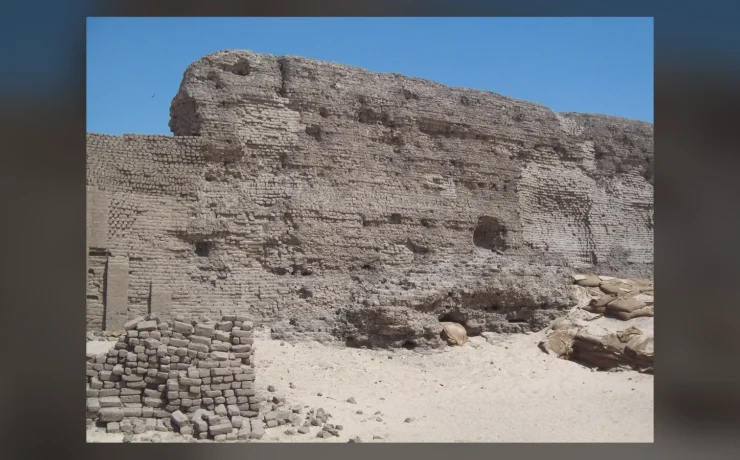
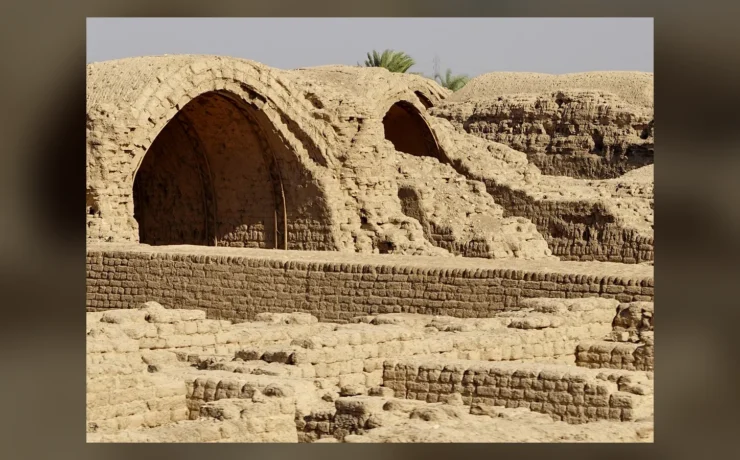
The Fifth Dynasty papyri from Neferirkare Kakai's mortuary temple at Abusir preserve a rare view of ancient religious administration. Behind offerings to royal statues stood named workers, rotating duties, accounts and inventories, with even an unperformed task marked in red. This independent research article applies Barry J. Kemp's questions about how Egyptian institutions sustained sacred traditions, then follows specific papyrus records identified by University College London, the British Museum and the Louvre. It uses original images of papyrus fragments and actual Abusir archaeology, carefully separating those sources from general reconstructions of temple life.
A temple that needed an office as well as priests
An Egyptian royal mortuary temple was a sacred space, but its cult could not function on recitation alone. Bread, meat, oil, flowers, equipment, labor and schedules needed organization. The Fifth Dynasty papyri from Abusir provide unusually direct evidence of that work. The archive comes from the mortuary temple of King Neferirkare Kakai, where officials recorded offerings, inventories and service rotations. Barry J. Kemp's Anatomy of a Civilization explores the institutions through which Egyptian religious ideas were expressed, including the architectural and ritual development of temple settings. The Abusir texts answer a different but complementary question: how did people maintain a royal cult day after day? A partially preserved roster with columns and marks can be more useful than a later romantic account of priests chanting perpetually. This article connects ancient religious representation with real administrative paperwork without pretending the book itself reproduces every papyrus.
A royal mortuary temple was not a modern parish
The Abusir pyramid cemetery near Memphis preserves several Fifth Dynasty royal complexes. A mortuary temple associated with a king's burial was intended to sustain his cult and offerings after death. That institution must be distinguished from a city temple serving a range of local deities, even though their personnel and economic activities might intersect. Neferirkare's complex changed during and after his reign, so not every surviving document should be dated to a single construction season. Museum records assign many Abusir papyri to the Fifth Dynasty and to temple contexts associated with Neferirkare. They describe practical administration rather than a theoretical royal law code. What we can establish is that maintaining the cult required supplies, equipment and people who appeared on service records. We cannot calculate the complete income of all Egyptian temples from this one exceptional surviving archive.
How the Abusir papyri were found
The surviving manuscripts were discovered during work in the temple complex and subsequently dispersed among institutions, including the British Museum, the Louvre and University College London. Their fragmented condition is part of their history. Many sheets survived only in pieces, while the original order of all archive documents cannot be reconstructed with complete certainty. A museum photograph captures ink and papyrus as they exist now, but does not magically restore missing columns. Specialists compared handwriting, recurring officials' names and similar table formats to interpret individual fragments. The archaeological findspot is significant because it links the writing to a specific cult institution rather than an imagined generic treasury. The archive illustrates what Egyptian administrators actually recorded, though its preservation gives a partial view of a system that once used many documents now lost. A responsible website identifies published sheet numbers rather than treating all fragments as one intact scroll.
The difference between an offering and its record
In a royal mortuary cult, offerings could be presented in a religious sequence whose words and images carried symbolic power. A scribal list documenting offerings served a different function: to account for goods that were due, present or distributed. The record's entries do not automatically prove that every intended ritual was completed exactly as prescribed. Officials might list equipment held, record what was received or note what was missing. It is therefore useful to ask whether one line is an instruction, inventory, roster or acknowledgement. UCL's Digital Egypt publication of Abusir fragments reveals this documentary variety. A temple was not sustained by objects named in a formula alone. Grain had to be acquired, food prepared and personnel assigned. By putting administrative paperwork beside cult imagery, the history of religion becomes a history of coordinated labor and material resources as well.
A rota of temple duties
The UCL Abusir papyrus catalogued as UC 32366, sometimes called University College Sheet B, preserves fragments of a table. In parallel with better-preserved examples at the British Museum and Louvre, scholars interpret it as a roster listing staff and responsibilities across several days. A horizontal line can represent a day while vertical columns correspond to duties. These include bringing offerings to statues on festival days and transferring goods from another institution. The damaged parts do not tell us every person's full career or the duration of every shift. Nonetheless, the format is striking: temple labor could be scheduled, observed and recorded rather than being left to spontaneous devotion. It also suggests that different workers could repeat responsibilities over time. This document is an administrative source from within a sacred institution, not a modern labor contract.
The absent worker marked in red
One detail in UCL's translation is particularly revealing. On the eighth day of a fragment, an official named Izy apparently did not complete an assigned task, and the recording scribe placed a red stroke where a name might otherwise appear. This is a stronger anecdote than an invented story of a lazy priest. It comes from a documented palaeographic reading, although the precise circumstances of the omission cannot be recovered from the short mark alone. Did Izy fall ill, receive different instructions or fail to attend? The sheet does not say. The notation is valuable because it indicates that performance of an assigned duty could be differentiated from the expected schedule. Religious service had a recordkeeping dimension capable of recording nonfulfillment without preserving a narrative explanation. Careful historical writing keeps the mark's evidence and the possible reasons for it separate.
A named official is not necessarily a priest for life
Names in duty rosters help identify individuals who worked within a temple system, but a name appearing repeatedly does not prove the holder spent every year in permanent full-time service. Egyptian temple personnel could include people with varied tasks and differing relationships to the institution. UCL's interpretation identifies individual names across multiple cells of the preserved table. The surviving fragments are incomplete and their readings can be uncertain. A sequence of repeated names can show allocation and rotation; it cannot establish private beliefs or the complete family histories of everyone mentioned. This is precisely why the term priest should be used with care. Some responsibilities were explicitly cultic, while others involved moving goods, keeping records or maintaining equipment. Temple operations were social and economic practices embedded in a royal institution. The documents allow historians to study those practices directly, rather than relying only on idealized scenes of ritual purity.
Where the sun temple entered the supply chain
The UCL translation describes a duty to bring meat and flower garlands from a sun temple named Setibra. This suggests connections between royal cult institutions, rather than a completely self-sufficient mortuary temple producing every item at its own doorway. Such interconnections must be interpreted in light of the specific text and date. A named sun temple in an account should not be confused with a statement that the papyrus was excavated in that sun temple. The source belongs to the Abusir mortuary archive; its recorded activity mentions another institution. Barry Kemp discusses sun-temple architecture and the places where official ritual took shape, but the particular delivery comes from the papyrus study, not from his broader philosophical model. Moving ritual goods from one establishment to another required personnel, a schedule and the practical handling of perishable materials.
The British Museum's sheet ten
The British Museum catalogues Abusir papyrus EA10735,10 as a Fifth Dynasty temple administration document, dated approximately to 2360 BCE. Its record relates to the funerary cult of Neferirkare Kakai and is written in hieroglyphic and hieratic signs. The museum describes the Abusir archive as containing personnel rosters, offering lists, inventories, correspondence and permits. The sheet's preserved state cannot be read as a complete temple ledger covering every year. Its importance lies in the physical trace of administrative habits, with columns and content associated with a particular royal institution. Digital photographs of such sheets may remain subject to collection-specific rights; a responsible illustrated article does not take an image merely because it is visible on a museum website. Instead, its research value is established through the accession number and link to the official record.
Monthly account tables: sheet seven
Another British Museum papyrus, EA10735,7, preserves two monthly account tables and an additional record. This gives a more specific glimpse of time-based accounting than the general statement that Egyptians were organized. A month could be a meaningful unit for compiling obligations or resources, while daily rosters tracked other categories of activity. We should not assume that the same sheet represented every temple department or that its measurements map straightforwardly onto modern accounting columns. Parts are fragmentary, and the museum's dating is cautious. Still, sheet seven is direct evidence that the cult employed recurring documentary forms. A schedule and an inventory served different managerial purposes, just as they do in many institutions today, even if their content and social meaning differed. This is the operational reality behind the symbolic idea of perpetual offerings.
Inventories and the value of surviving objects
Temple inventories could describe items kept for ritual or practical use. They might include equipment or goods whose movements needed monitoring. An inventory is not necessarily an exhaustive census of a temple's wealth; it may be periodic, selective or connected to one department. Nor does its existence prove the inventory always matched the storeroom perfectly. Nevertheless, the act of writing such lists demonstrates an institutional concern with continuity. A cult whose service extended beyond the reign of its founder had to retain tools, identify personnel and replace consumables. The papyri make those practical obligations tangible. The distribution of sheets across museum collections also complicates a modern reader's view, since documents originally related in one temple are now studied through separate accession numbers. Linking those records accurately is an educational task in its own right.
The Louvre fragment and its correct context
The Louvre's collections include documentary papyrus E 25416 C, recovered from Neferirkare Kakai's mortuary temple at Abusir and attributed to the Fifth Dynasty. The collection record identifies its writing as hieratic and the text as including accounts, an inventory and a service table. Its modern photograph has its own reproduction rights, and the museum catalog should be linked rather than silently copied. The object's dimensions and identification are concrete evidence, but the record alone does not reveal every entry in translation. A smaller fragment E 25416 A 3 is separately catalogued as an accounting text. The existence of different sheets reinforces the fact that the Abusir archive was not one universal scroll. Each piece needs its own provenance and interpretation before it can support a detailed claim about deliveries or staff assignments.
A genuine Abusir papyrus photograph
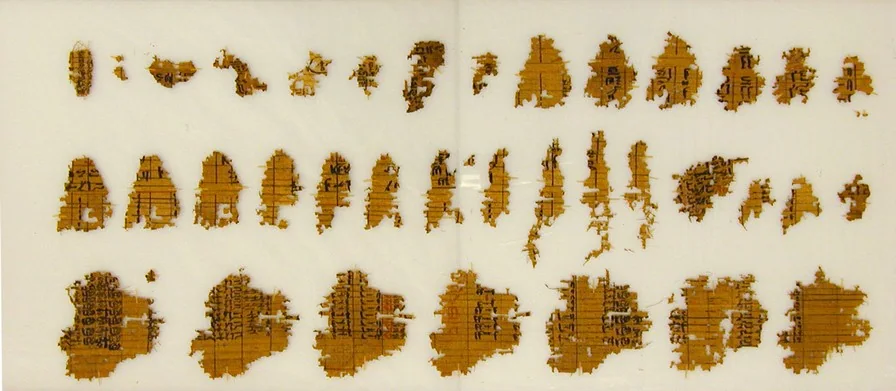
The first article image reproduces real photographed fragments of Abusir papyri through a public-domain Wikimedia file whose source is identified as UCL's Digital Egypt resource. It shows ancient papyrus material, not a newly invented handwritten page. Because the montage consists of fragments rather than one intact sheet, the caption does not mislabel it as British Museum EA10735,7 or Louvre E 25416 C. Exact transcription and reading should follow the original scholarly edition. This restraint makes the image useful: it shows the material limitations that administrative history must confront. What now appears as broken lines of ink once belonged to a system of repeated transactions and official routines. The absence of complete pages is not permission to supply imagined names, account balances or orders. The manuscript's fragmentary condition is an essential part of the evidence.
The temple building survives as a different kind of source
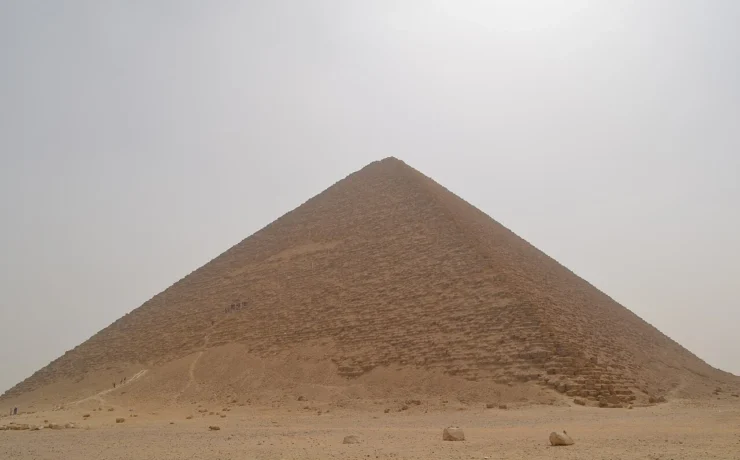
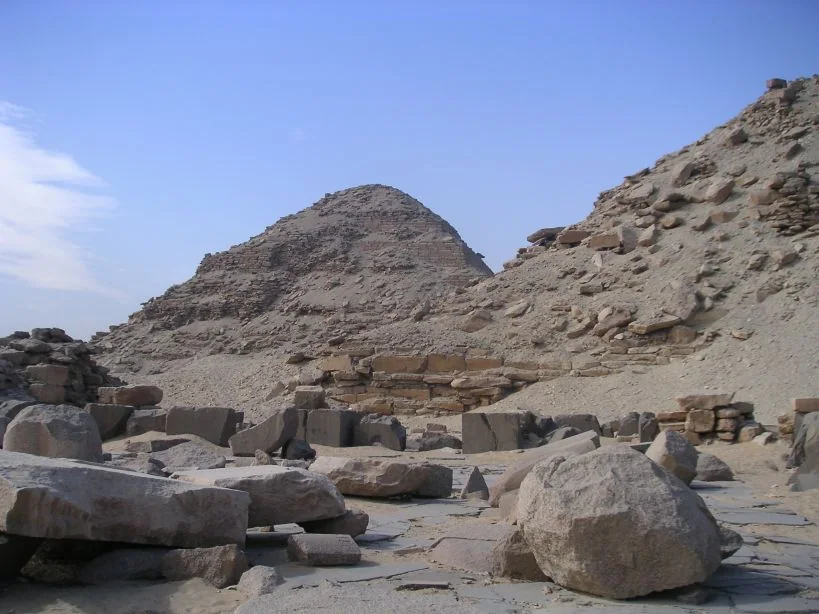
The second photograph shows the pyramid of Neferirkare at Abusir from the area of a neighboring royal mortuary temple. It is a modern photograph of authentic ancient remains, not a picture of the papyrus when it was written. The photographer's original public-domain dedication allows accurate reuse with attribution. Architecture and paperwork reveal different things. The ruined stone structures locate the royal cult in a monumental landscape; the papyrus fragments show how some of its daily responsibilities were recorded. A view of a pyramid cannot identify the official Izy or the recipients of one delivery. Nor can a table of names restore every vanished building. Their juxtaposition is legitimate only when the distinct provenance and limitations of each visual are clearly explained. This combination is more faithful to archaeology than an illustration of anonymous priests performing invented actions.
Was the mortuary cult economically independent?
Neferirkare's temple required offerings and therefore drew upon relationships extending beyond the precinct. The mention of deliveries from another royal sun temple is one clue. However, it would be too strong to claim that the surviving papyri establish the entire estate, tax income or total employment of the cult. Some revenues may have come through royal domains, institutions and dedicated arrangements documented elsewhere in Old Kingdom sources. The Abusir archive should be read as a window into management, not as a national economic survey. Nor should one exceptional temple stand for every Egyptian sanctuary in every dynasty. Institutional forms changed over the course of millennia. Kemp's analysis is useful precisely because it invites comparison between ideas of sacred kingship and the structures through which societies acted on them. A papyrus roster shows one such structure in operation.
What Abusir contributes to the history of work
The papyri tell a story of people assigning responsibilities and tracking resources within a place dedicated to a dead king's continuing cult. Their columns preserve the practical side of a religious institution: who was expected to act, what was to be brought, what equipment existed and what could be recorded as incomplete. The historical lesson is neither that religion was merely a business nor that temple officials acted outside economic life. Both extremes obscure the evidence. Ancient Egyptians maintained sacred practices through skilled administrative and material tasks. A duty marked on paper could intersect with offerings to a statue and with a delivery from a different institution. An encyclopedic article gains originality when it follows the museum catalogue and papyrological reading closely, identifying every quoted detail and acknowledging damaged text. That is a stronger explanation of temple economy than a dramatic but unverified estimate of its riches.
Evidence at a glance
| Evidence | What can be concluded |
|---|---|
| UCL UC 32366 | Fragments of a duty-roster table, including a documented red omission mark. |
| British Museum EA10735,7 | Fifth Dynasty hieratic sheet with monthly accounts. |
| British Museum EA10735,10 | Temple administrative papyrus with hieroglyphic and hieratic inscriptions. |
| Louvre E 25416 C | Royal mortuary temple fragment catalogued as accounts, inventories and service table. |
| Kemp p. 311 | Context for royal cult and solar temple architecture, not a translation of the Abusir archive. |
Frequently asked questions
What are the Abusir papyri?
Old Kingdom administrative fragments associated with Neferirkare's Fifth Dynasty mortuary cult, including duty rosters, offerings, accounts and inventories.
Did temple workers work shifts?
The duty tables record names across days and assigned duties, consistent with scheduled and repeated service in this specific institution.
What does the red mark beside Izy mean?
UCL interprets a red stroke on an eighth-day entry as noting a task left undone. The reason the person did not perform it is unknown.
Are the photographed papyri the same as the British Museum sheets?
The published collage shows genuine Abusir fragments, but is not identified as one of the specific British Museum or Louvre sheets. Museum records are linked separately.
Sources and image provenance
This article uses the historical source listed in the bibliography as a research starting point, specifically PDF pages Barry J. Kemp, Anatomy of a Civilization, Arabic translation PDF p. 311 (printed p. 309), discussion of royal sun-temple ritual spaces and officials. Individual Abusir papyrus texts are independently sourced from UCL, British Museum and Louvre, not attributed to Kemp's page.. Its historical rhetoric and older interpretations are not treated as conclusive archaeological evidence. The external museum and research records below are linked for independent checking.
- UCL Digital Egypt, Abusir Papyri Sheet B UC 32366 with line-by-line interpretation
- British Museum EA10735,10, Fifth Dynasty Abusir temple administration papyrus
- British Museum EA10735,7, hieratic monthly temple accounts
- Louvre Papyrus d'Abousir E 25416 C
- Louvre accounting fragment E 25416 A 3
- UCL Digital Egypt, archaeological papyri and their contexts
- Wikimedia provenance for photographed original Abusir papyrus fragments
- Wikimedia documentary archaeological photograph from Abusir
- Photograph: Genuine fragments of the Abusir papyri reproduced through Wikimedia Commons from UCL Digital Egypt. The photograph is not identified as one complete British Museum or Louvre sheet., Ancient unidentified Egyptian scribes; historic papyrus photographed in UCL Digital Egypt resources, public-domain Wikimedia reproduction, Public domain
- Photograph: Original archaeological landscape photo of Neferirkare's pyramid at Abusir, taken from the temple of Nyuserre. Public-domain image by Sebi. It does not depict the papyrus archive itself., Sebi / Neithsabes, modern documentary photo of Neferirkare pyramid from Nyuserre temple grounds, Public domain