An official could be buried elsewhere in Egypt yet acquire a memorial presence at Abydos, where later Egyptians believed Osiris was buried. By the Middle Kingdom, families established chapels and carved stelae along a sacred processional landscape. This independent archaeological study draws its framing from Barry J. Kemp's account of Egyptian religious traditions, then investigates real memorial monuments and excavated chapels. The Metropolitan Museum of Art preserves two unusually revealing stelae: one commissioned by a brother many years after an official's death, and another awarded by Senwosret I to a royal steward. Together they illuminate pilgrimage, family remembrance and the difference between an actual tomb and a cenotaph.
A sacred journey toward an ancient royal grave
Abydos had been associated with Egyptian rulers long before it became a major center of pilgrimage to Osiris. In the Middle Kingdom, this older royal landscape acquired a new significance. People treated a tomb in the cemetery of Umm el-Qaab as the god's burial place and sought to join, observe or remain symbolically present at processions moving through the area. Barry J. Kemp examines the development of Osirian worship at Abydos as part of the broader history of Egyptian sacred ideas. The shift cannot be described as one decree that instantly converted a royal cemetery into a universally shared religious destination. Temple activity, narratives about the dead, official patronage and the choices of individual families contributed over time. One of the richest kinds of evidence is a memorial stela installed far from the owner's actual grave. Such a stone could make someone's name and offerings part of the holy landscape without burying the person there.
Abydos before Osiris became central
Umm el-Qaab contained tombs of the earliest kings of Egypt, while the town and northern cemetery developed their own temple and settlement histories. An early local divine figure, Khentyamentyu, was associated with the westerners, a term linked with the dead. The later association of this cult with Osiris transformed the religious identity of the site. University College London's Digital Egypt notes that Abydos became a nationally important Osiris center through developments spanning the late Old Kingdom and First Intermediate Period. A common mistake is to transfer a fully formed Osiris festival backward into the age of Narmer. That would confuse different evidence and dates. The graveyard of early kings was already ancient when Middle Kingdom officials came to memorialize themselves. Religious innovations often work by reassociating an old place with a newer or changing sacred story.
Was King Djer actually Osiris?
A First Dynasty tomb at Umm el-Qaab, conventionally assigned to King Djer, later became identified with the legendary tomb of Osiris. Modern archaeology and Egyptian theology answer different questions about that place. Excavation may attribute the tomb to a historical ruler; myth and cult can identify a divine burial with the same location. Neither claim cancels the other, but the later sacred identification should not be reported as an independently excavated body of the god. The Brown University Abydos project describes how the royal funerary setting helped foster beliefs about Osiris and annual processions. That later belief was historically powerful. It attracted memorial monuments and visitors and changed the meaning of the surrounding wadi. The site thus illustrates a central theme of Kemp's civilization study: a physical environment can carry different cultural associations as institutions and religious narratives develop.
The road of the annual procession
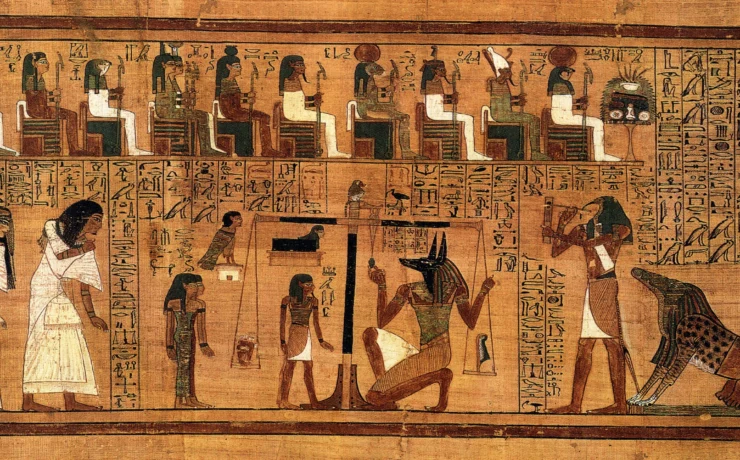
The principal festival route connected the Osiris temple area of the town with the desert tomb that worshippers identified as the god's resting place. Participants traveled through a wadi toward Umm el-Qaab, and ritual events reenacted parts of the god's mythical death, struggle and restoration. The evidence comes from texts, monuments and archaeology rather than a preserved film of one complete procession. Scholars may differ over exact ritual details and changes between periods. Some objects were positioned where their owners might share in the route symbolically, even if they could not attend every festival. This produced an unusual religious geography: being located in the right place could matter to future offerings and remembrance. Describing the route does not permit a writer to invent a precise minute-by-minute itinerary. The procession's social significance is better supported than its every gesture in each century.
Why memorial chapels lined the landscape
During the Middle Kingdom, individuals and families built chapels or left stelae near the Osiris temple and the processional approaches. Some were cenotaphs, memorial structures without the actual body of the named person. These installations allowed commemoration in a privileged sacred landscape while burial might occur elsewhere. Brown University's archaeological overview and the University of Pennsylvania Museum excavation report describe this broad pattern. The word cenotaph is important. A visitor seeing a name carved on a stone should not assume the owner was buried directly behind it. The chapel could serve as a durable symbolic presence. Its construction required resources, craftsmanship and perhaps relationships with officials controlling sacred space. The archaeological record is uneven: surviving inscribed stones may be more visible than the people who could afford no such monument.
The excavated Middle Kingdom chapels
The University of Pennsylvania Museum reported finding mudbrick chapels under or near later Ramesside structures in the northern sacred precinct. Excavators dated their use through inscriptions and thousands of discarded offering vessels. Some were among the earliest scientifically recorded examples of the private cenotaphs already known from Middle Kingdom texts. The pottery is crucial evidence, not merely rubbish. Repeated deposits of offering jars and bowls suggest acts of commemoration over time. Yet a sherd does not automatically reveal the name of the donor or the ceremony in which it was used. Excavated context provides dates and spatial relationships, while inscriptions offer names and formulas. The interpretation depends on bringing both types of evidence together. Later building could accidentally protect older chapels even as it changed the site's architecture.
Rehuerdjersen and a stela made after his death
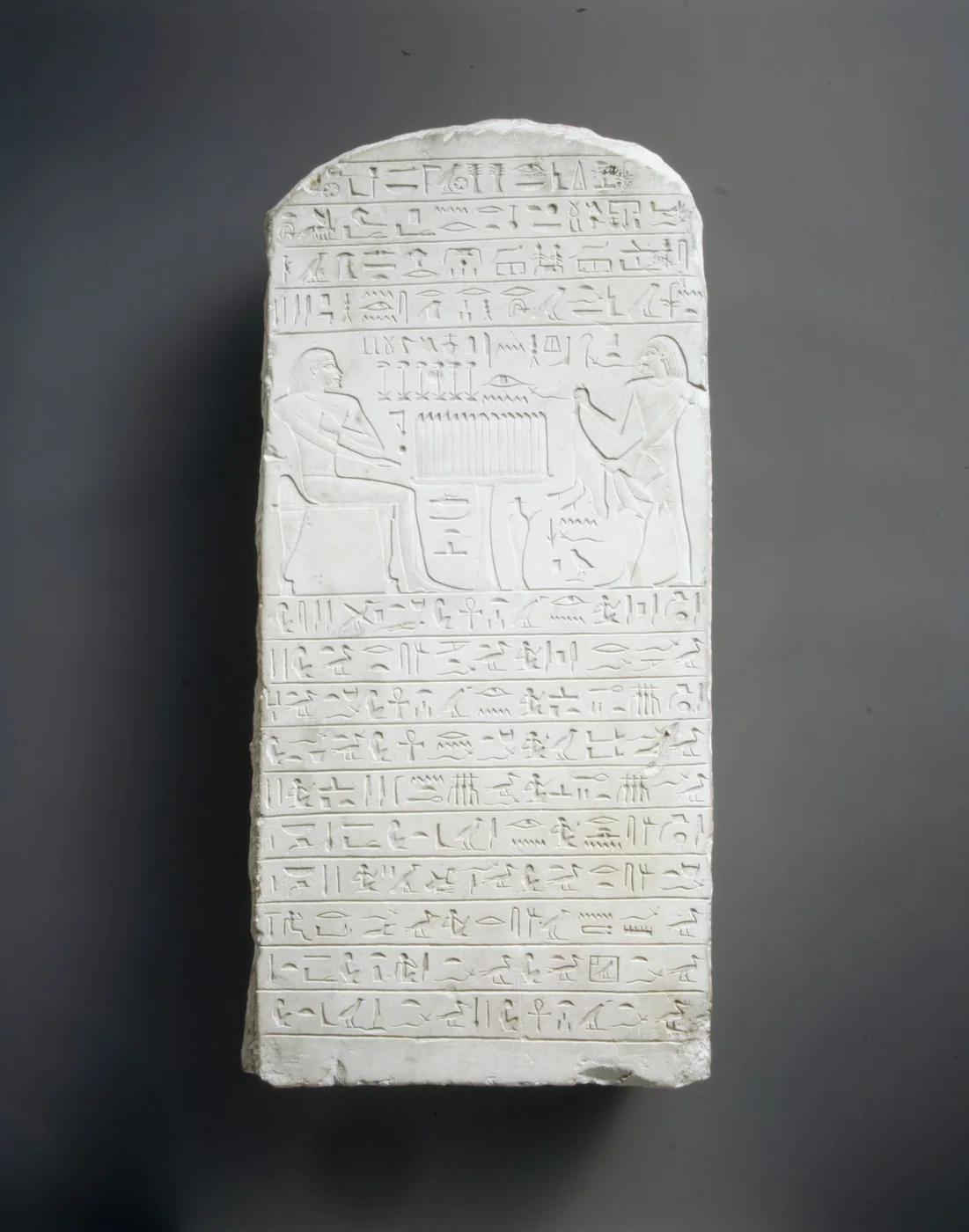
A powerful example survives in the Metropolitan Museum, accession 12.182.1, the limestone stela of Rehuerdjersen. The museum explains that he had served as treasurer under Amenemhat I and Senwosret I, but the stela belongs stylistically to the reign of Amenemhat II, roughly forty years after the official's death. His brother Heqatifi commissioned the monument, and family names fill much of the inscription. The stela came from a cenotaph at Abydos, not a securely excavated burial containing Rehuerdjersen's body. That difference makes it extraordinary evidence for family memory. Commemoration could be renewed by surviving relatives long after the individual's career ended. The object does not provide a transcript of a conversation among family members; its image and inscription demonstrate a later public act of remembrance.
What the offering table actually shows
On Rehuerdjersen's stela, the owner sits before a stylized table of loaves, while his brother appears carrying a bird intended for offering. The details of these figures form a readable visual statement about service to the deceased. Egyptian artists did not arrange every food item with modern optical realism; their conventions selected and emphasized features necessary to identify offerings. A depicted bird is not proof that a particular living visitor brought that exact animal every year. The scene creates an enduring image of abundance and remembrance. When paired with an offering formula, this visual program aimed to sustain the dead through religious practice. A museum photograph can reveal carvings, proportions and inscription layout, while the object's provenance and date establish who commissioned it and why it mattered. It is evidence for a representational ritual system, not an inventory of all actual meals consumed.
Mentuwoser's stela in a royal workshop
Another original limestone stela, Metropolitan Museum 12.184, honors the steward Mentuwoser. The Met dates it to year seventeen of Senwosret I and identifies it as an exceptional work made by royal commission. Its inscription records the official's roles and praises his conduct, while the sculpted scene depicts family members and offerings. The museum concludes that geographical references support an Abydos offering chapel rather than Mentuwoser's burial tomb as its intended context. This object reveals a different pattern from Rehuerdjersen's: royal patronage could help establish a named individual in a place of sacred significance during his lifetime or around his death. Yet the official's self-praise follows conventions. Claims of generosity and moral conduct demonstrate the values memorial art wished to project, not an independently audited biography.
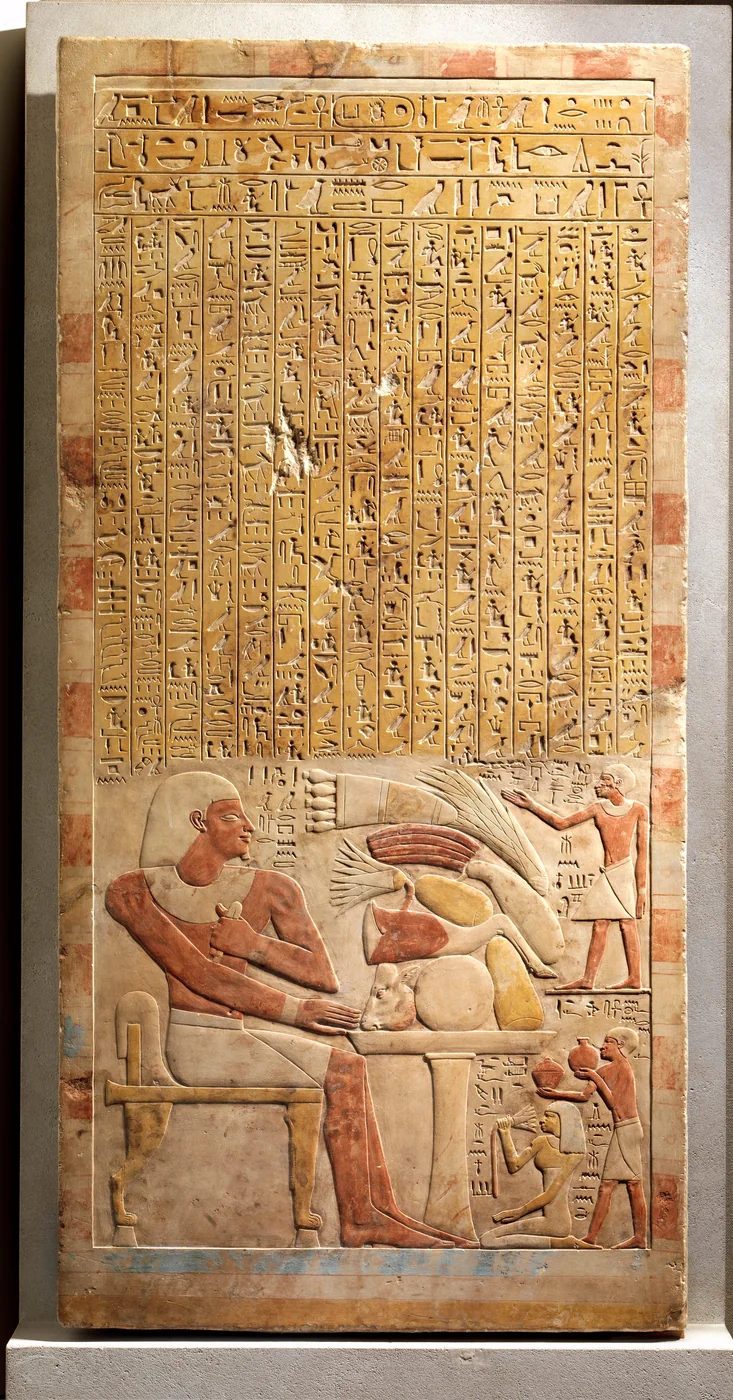
The remarkable year written on the stone
Mentuwoser's inscription identifies the seventeenth regnal year of Senwosret I. This is an unusually concrete chronological anchor for a stela connected with memory and belief. The date does not mean the entire shrine district was constructed in that year, but it establishes when this particular monument was commissioned or dedicated. The Met's educational resources explain the Egyptian writing of the regnal-year formula and the role of royal titulary in the same inscription. Chronology matters because Abydos' pilgrimage traditions changed. A stela of the early Twelfth Dynasty cannot stand for every prayer left during the New Kingdom or Roman Period. A focused encyclopedia should link object dates to actual reigns and not blend all images of Osiris into a timeless ritual. The dated monument makes a broad religious history testable at the scale of one artifact.
A family trying to be remembered
Both chosen stelae illustrate the role of relatives in memorializing the dead. Rehuerdjersen's brother commissioned a later monument, while Mentuwoser's offering scene includes family members associated with service and provisions. These images should not be treated as candid group portraits. They are compositions built to preserve relationships, names and desired ritual acts. That makes them especially valuable to historians interested in the social world surrounding religious institutions. A memorial chapel was not only an expression of theology; it was also a decision about family resources and enduring visibility. Families with greater means could commission larger and more accomplished works. The poorer and uninscribed participants in pilgrimage are harder to recover archaeologically. The visibility of an elite stela should not be confused with a complete list of people who held the same beliefs or visited the same sanctuary.
Who could read the carved inscriptions?
The Met's commentary on Mentuwoser's stela notes that the inscription distinguishes people who could read its text from others who would hear someone recite it. This is a rare glimpse of differing levels of literacy in the audience for a commemorative monument. A stela was not accessible only to those who could independently decipher every sign; spoken recitation could extend the reach of its message. Such reading practices do not prove the exact percentage of literacy in the population. They show that the text anticipated more than one way of receiving its claims. Barry Kemp's interest in writing and the authority of shared ideas helps frame the role of public inscription here. A sacred object could communicate through legible names, recognizable images, spoken formulas and the placement of the stone within a familiar ritual landscape.
What the thousands of offering vessels imply
Excavated pottery from the chapel areas provides a different kind of evidence from finely carved stelae. Numerous discarded offering vessels suggest repeated religious activity at particular places. They cannot identify every devotee, but their concentrations help archaeologists understand movement and the continued importance of the precinct. A chapel may contain one named commemorative stone while its surrounding deposits reflect many visits or acts of offering over time. Scholars assess the pottery's date, form and location rather than equating raw sherd counts with the total number of pilgrims. The material record complements written texts that describe processions but may emphasize official or elite participants. Comparing durable inscriptions with broken everyday ceramics provides a richer history of the site than either alone. The festival was both an idea expressed in text and a sequence of actions that left material traces.
Pilgrimage was not identical to burial
A person might be buried in one community while establishing a memorial at Abydos. A relative could later commission a monument, and a chapel might continue receiving attention after the owner's death. These practices explain why the northern sacred precinct included commemorative installations and burial areas that served different purposes. Some graves did belong to individuals buried at Abydos, while cenotaphs did not. Calling every memorial stone a gravestone would obscure this diversity. UCL's Digital Egypt survey distinguishes tombs from stelae and chapels associated with the processional route. This distinction is particularly important for anyone tracing the original context of a museum object. A stela removed to a modern gallery does not always preserve its full archaeological setting. Museum labels may record a reported source, a probable chapel or an uncertain findspot, and that language must remain visible.
From royal cemetery to national sacred destination
The religious history of Abydos is not a simple story of a king choosing a new temple. It spans earlier dynastic burials, the growth of Osiris-Khentyamentyu worship, processional traditions and generations of private memorial building. The cult drew upon a powerful landscape of old royal graves while creating new opportunities for families to participate symbolically. This change is a vivid example of cultural continuity through transformation, a theme Barry Kemp considers in his treatment of traditions. People could preserve the physical memory of an old cemetery while adopting new explanations for its significance. Ancient practices themselves evolved; the meaning attributed to one royal tomb could change dramatically. Recognizing that layered history avoids attributing all later Osirian ritual to the earliest kings or describing the sacred landscape as if it appeared in one completed plan.
The evidence left by two real monuments
Rehuerdjersen's stela and Mentuwoser's stela are surviving objects with separate accession numbers, dates, patrons and archaeological contexts. One commemorates an official decades after his death through a brother's commission; the other carries a dated royal grant to a senior steward. Together they document important ways families and the state used commemorative art to participate in the sacred geography of Abydos. They do not document the exact private thoughts of all worshippers or every stage of the annual Osiris festival. Their museum photographs, supported by published excavation research, provide concrete visual evidence without fabricating historical ceremonies. A sound reading keeps religious belief, physical burial, memorial architecture and later interpretation distinct. That makes the story of Osiris at Abydos more informative than a generalized legend repeated without archaeological context.
Evidence at a glance
| Evidence | What can be concluded |
|---|---|
| Met 12.182.1 | Cenotaph stela commissioned by Rehuerdjersen's brother decades after his death. |
| Met 12.184 | Dated stela of Mentuwoser, probably placed in an Abydos offering chapel. |
| Excavated chapels | Mudbrick structures and abundant offering vessel fragments attest to ritual commemoration at Abydos. |
| King Djer's early tomb | Historically a First Dynasty royal burial, later identified in tradition with Osiris. |
| Burial versus cenotaph | A commemorative chapel did not always contain the body of the person named. |
Frequently asked questions
Was Osiris physically buried in an Abydos tomb?
Egyptian tradition identified an early royal grave, usually attributed by archaeologists to Djer, with Osiris. That religious identification is not proof of an excavated divine body.
What is a cenotaph?
A memorial structure established for a person who is not buried within it. Families created such chapels and stelae to participate symbolically in Abydos ritual life.
Are the two stelae from the same time?
No. Mentuwoser's stela belongs to year seventeen of Senwosret I, while Rehuerdjersen's memorial dates to a later stage of Dynasty Twelve.
Are the pictures genuine?
Yes. Both are traceable CC0 museum photographs of different original limestone stelae, with separate accession numbers and accurate historical captions.
Sources and image provenance
This article uses the historical source listed in the bibliography as a research starting point, specifically PDF pages Barry J. Kemp, Anatomy of a Civilization (Arabic translation), PDF page 96 (printed 94): Abydos, Khentyamentyu, Osiris and evolving local sacred traditions; compare archaeological studies for later Middle Kingdom chapels.. Its historical rhetoric and older interpretations are not treated as conclusive archaeological evidence. The external museum and research records below are linked for independent checking.
- UCL Digital Egypt: Abydos in the Middle Kingdom and cenotaphs
- Brown University: Abydos royal past and Osiris procession
- University of Pennsylvania Expedition Magazine: excavated Abydos chapels and offerings
- Metropolitan Museum: Rehuerdjersen stela from Abydos 12.182.1
- Metropolitan Museum: Mentuwoser stela 12.184
- UCL Digital Egypt: early Abydos cult and Middle Kingdom pilgrimage
- New York University: Abydos excavations and Osiris landscape
- Photograph: Abydos cenotaph stela of Rehuerdjersen, Met 12.182.1, around 1900–1850 BCE. Commissioned by his brother Heqatifi roughly forty years after the official's death; not the person's excavated tomb., The Metropolitan Museum of Art, Open Access (CC0 / public domain)
- Photograph: Stela of Steward Mentuwoser, Met 12.184, dated to Senwosret I's year 17. Probably created for a commemorative chapel at Abydos, not the official's burial chamber., The Metropolitan Museum of Art, Open Access (CC0 / public domain)