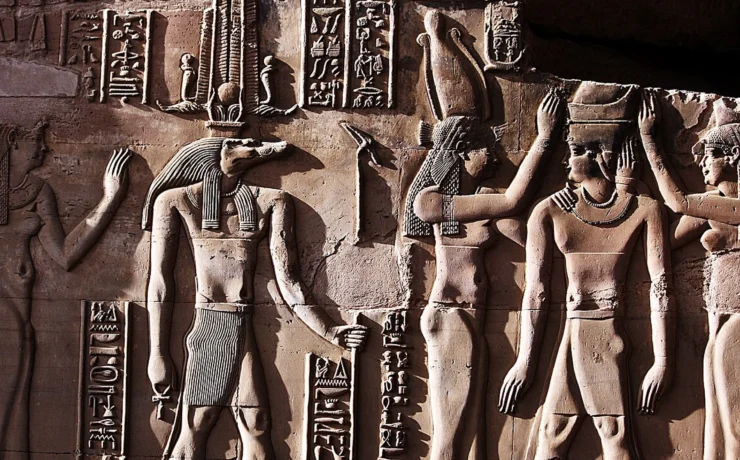
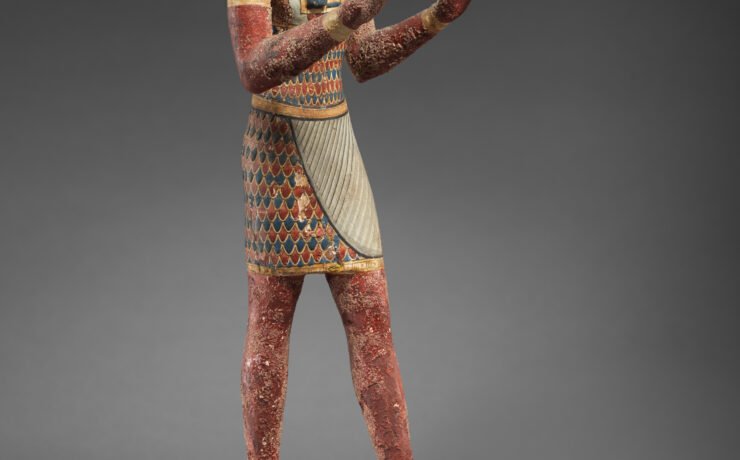
Osiris was a central figure in ancient Egyptian thought about death, transformation and legitimate rule. To explain him as a simple god of resurrection misses the complexity of his role. His authority is located among the dead, but his relationship with Isis and Horus also supplies a pattern for the continuity of kingship in the living world. Texts, objects and rituals reveal how different generations reshaped his meaning.
Osiris’ religious history belongs to several kinds of evidence: the developing Isis–Osiris narrative explains succession in myth, while the excavated memorial chapels at Abydos show how people commemorated the god and the dead. A story about divine events and a surviving pilgrim stela answer different historical questions.
Research quick facts
Who is Osiris in Egyptian religion?
Osiris is typically represented as a wrapped human figure with royal attributes, a visual expression of authority beyond ordinary mortal existence. Egyptian traditions present him as the deceased father of Horus and partner of Isis. He should not be treated as a dated historical ruler merely because a narrative describes him as king. His identity is reconstructed from multiple kinds of religious evidence produced in different centuries.
Osiris and the succession of kingship
The story of Seth’s attack on Osiris makes royal succession the central crisis. Horus’s right to inherit and Isis’s protective action help repair the threatened order. Osiris himself does not return to reign normally in the Nile Valley; he holds authority in the domain of the dead. The living king and deceased king could be understood through the complementary models of Horus and Osiris.
Death, restoration and the limits of the word resurrection
Osiris’s restoration involves divine aid and the continuation of power beyond death. The English term resurrection is convenient but can imply the wrong idea of a complete return to ordinary human life. Ancient funerary transformation carried its own language and ritual expectations. A scholar should therefore explain which source supports a particular claim and distinguish continued existence in the afterlife from a literal historical event.

Mummiform images and the royal insignia
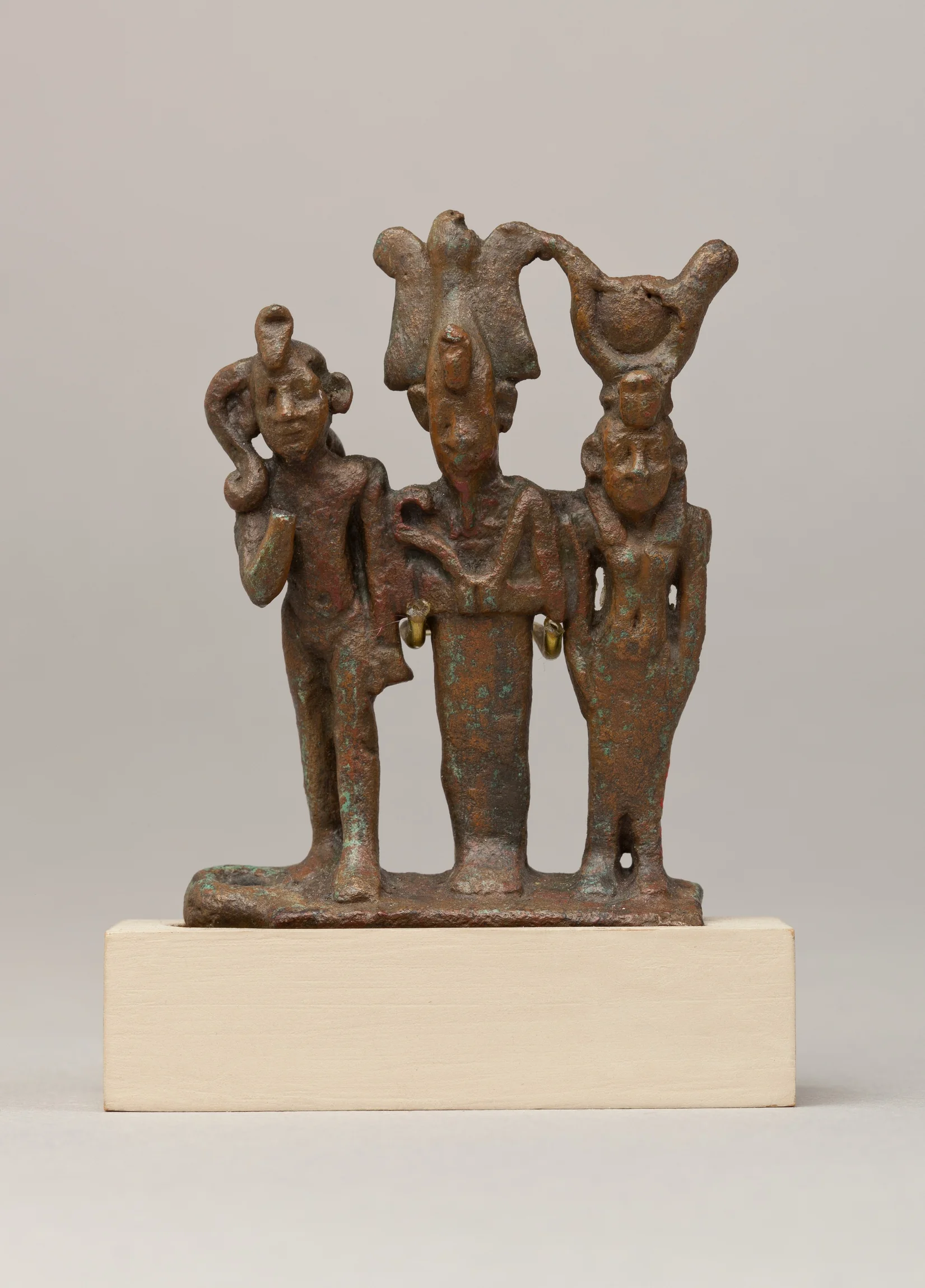
Statuettes commonly show Osiris wearing an elaborate crown, often with the crook and flail, his arms crossing the front of a wrapped body. These choices expressed enduring rule and funerary authority. The material of a sculpture matters, as does whether it was dedicated in a shrine, used in a burial or collected without clear provenance. A public-domain museum photo does not establish the object’s precise original ritual context unless the catalog supplies it.
Osiris and the funerary transformation of the dead
Old Kingdom royal funerary texts already associate deceased rulers with Osirian power and renewal. Middle Kingdom texts and later Book of the Dead manuscripts adapt funerary formulas for varied contexts. These documents were ritual compositions rather than modern travel guides to a single uniform afterlife. They help historians study religious ideas, while differences in date and ownership prevent easy claims about what every Egyptian believed.
The judgment of the dead: a developing religious image
Later funerary papyri often include scenes of judgment such as the weighing of the heart and the presence of Osiris as an authority of the other world. Such imagery should not be copied backward without qualification into every earlier dynasty. The iconography and accompanying spells developed, and each manuscript must be studied as a particular object. The weight of an image is not evidence that all Egyptians performed identical rites.

Abydos and sacred memory
Abydos became one of the great centers of Osirian devotion. Monuments, pilgrimage practices and festival traditions indicate how communities related sacred geography to the god’s death and renewal. The existence of a sacred route or commemorative ritual is historical evidence for religious life, not confirmation of the mythic events as physical happenings. Archaeological contexts and inscription dates remain essential.
The Khoiak festival and growing grain
Rituals performed around Khoiak could connect Osiris with renewed vegetal life. Seed-filled forms and ceremonial actions made regeneration visible through germination. This symbolism should not be flattened into a claim that the god was only an agricultural deity: his significance included funerary authority, kingship and ritual protection. Local forms of celebration varied, and researchers rely on dated liturgical sources.
Osiris and Isis: protection and continuity
Isis’s search for and defense of Osiris’s body is a central reason the god’s posthumous authority endures. Nephthys and other helpers also appear in different sources. The family narrative links protection of the dead to the eventual inheritance of Horus, providing a model for order despite violence. A deity’s functions emerge from a web of stories and rituals, not a single interchangeable family chart.
Osiris, Seth and the problem of disorder
Seth plays the enemy in the Osirian succession narrative, yet Egyptian religion also assigned him protective and politically important roles elsewhere. Calling him the Egyptian devil without qualification distorts the record. The conflict represents a particular theological problem around murder and succession. Students should compare the narrative context before declaring a god wholly benevolent or wholly malevolent across three thousand years.
Osiris in the visual record
Votive statues, papyri and reliefs show the god’s identity over time. The Met preserves a bronze Osiris figure and a separate metal figure, each carrying its own accession number and date. Their images can be compared for crown shape, wrapping and posture. This analysis is useful, but appearance alone cannot determine an object’s original sanctuary or the beliefs of its individual owner.
The Osiris Liturgies papyrus: direct ritual evidence
The Met’s papyrus 35.9.21a–o preserves six Osiris Liturgies dated to the early Ptolemaic era. A specific priestly manuscript documents prayers and ritual ideas concerning Osiris. It is not an original full prose novel of his life, and its manuscript date must not be mistaken for the starting date of the religion. Its physical form and catalog identification offer an excellent case study in source criticism.
The popular myth and Plutarch’s later account
Details like a specially fitted chest and the journey to Byblos are particularly familiar from Plutarch’s Roman-period Greek narrative. Much earlier Egyptian sources contain key allusions to Osiris’s death and recovery, but cannot automatically be equated with the entire later plot. Academic writing should identify these layers explicitly. A modern seamless retelling can be enjoyable while still being historically composite.

How Osiris’s meaning changed across periods
Egyptian religion was neither static nor completely discontinuous. Osiris appears in funerary materials spanning large stretches of time, but his cult, imagery and association with practices developed. A Fifth Dynasty pyramid inscription and a Ptolemaic devotional statuette should not be treated as two photographs of the same ritual. Comparative study makes historical continuity visible by also showing change.
Frequently asked questions about Osiris
Was Osiris a human pharaoh? He is a god of Egyptian religious tradition, not a ruler whose life can be independently dated. Does he rule the living world after being restored? No, Horus takes the living throne in the main succession traditions. What is the atef crown? A distinctive crown associated with Osiris. Is every mummy a depiction of him? No; a mummiform image needs attributes and context for identification. Are the myth and Book of the Dead the same text? No, different texts and genres preserve related beliefs.
Classroom method: identifying evidence
Take the official catalog for a bronze Osiris figure, record accession, object date and provenance, then compare it with a photograph of the Osiris Liturgies papyrus. State which source depicts the god visually and which preserves ritual language. Mark any modern reconstruction as interpretation, and explain why documents from different centuries cannot be assumed to describe one identical ceremony.
What an Osiris image can and cannot prove
An image of Osiris is valuable historical evidence, but it does not automatically document a single, fixed Egyptian story. A mummiform figure wearing a crown may identify the god through established iconography, while the object’s date, discovery location, material and accompanying inscription tell us how that image was used. A painted coffin panel, a temple relief and a small devotional object answer different questions. Their purposes cannot be made identical simply because the same deity appears on each.
The distinction matters especially when discussing judgment after death. The weighing of the heart is most familiar from illustrated funerary manuscripts, but not every Osirian depiction depicts that trial. Some images foreground rule, fertility, protection or the deceased person’s hoped-for transformation. The ancient record must therefore be read object by object and period by period, not assembled into a single universal sequence that every Egyptian supposedly believed.
For further study, compare the chapter on the Book of the Dead with its surviving papyrus illustrations, then return to individual museum catalog records. Distinguish an actual ancient inscription from a modern translation, an iconographic identification from an interpretation, and the date of an object from the date when a belief may have originated. This method gives students an evidence-based route through the changing traditions surrounding Osiris.
Reading the Osirian record across social groups
Royal funerary texts provide important evidence, but they cannot describe every burial in Egypt. Written spells, elaborate coffins and carefully commissioned paintings are disproportionately preserved from people who could obtain such materials. This creates a survival bias: absence of a text in a modest grave does not by itself prove that its owner rejected Osiris or lacked religious hopes. Archaeologists instead combine burial position, objects, inscriptions, preservation conditions and the cemetery’s broader history.
Modern readers should likewise separate a god’s theological titles from material practices. Calling Osiris a ruler of the dead tells us how Egyptian religious language presented divine authority; it is not proof of an observed supernatural event. The strength of Egyptology is that it can document how a belief was expressed, circulated and changed without pretending to verify the metaphysical claim itself.
Sources and critical reading
Reference objects: The Met accession object 570656; The Met accession object 570645; The Met accession object 549349; The Met accession object 551976. Historical and textual interpretation should be checked against individual funerary texts, original site inscriptions and established museum scholarship. The imagery is Open Access / Public Domain, hosted on Kemet Vault with archival copies and source rights retained. Modern descriptions are original explanatory writing, not fabricated translations of a single ancient manuscript.
Explore the related Isis and Osiris myth and the Egyptian timeline. Browse authenticated objects in our Digital Museum, with catalog links and distinct dates for the surviving artifacts. Objects from later periods must not be misidentified as images made when a myth first developed.