Why was the sacred ibis worshipped in ancient Egypt? The African sacred ibis (Threskiornis aethiopicus) was associated with Thoth, god of writing, wisdom, time and divine judgement. It appears in Egyptian religious iconography and hieroglyphs, and vast numbers of birds were mummified as offerings, especially in the Late and Ptolemaic periods. The fullest explanation comes from ancient texts, museum objects, catacombs and modern genetic and chemical research rather than one legend about snakes.
This research dossier assembles evidence for the real bird, its place in Thoth’s cult, named Egyptian and Greek texts, burial practices at Tuna el-Gebel, Saqqara and Abydos, and the current scientific debate over how the birds were obtained. It separates original sources, archaeological estimates and later claims and uses authentic wildlife and museum photographs with exact identifications and reuse rights.
Which ibis did ancient Egyptians consider sacred?
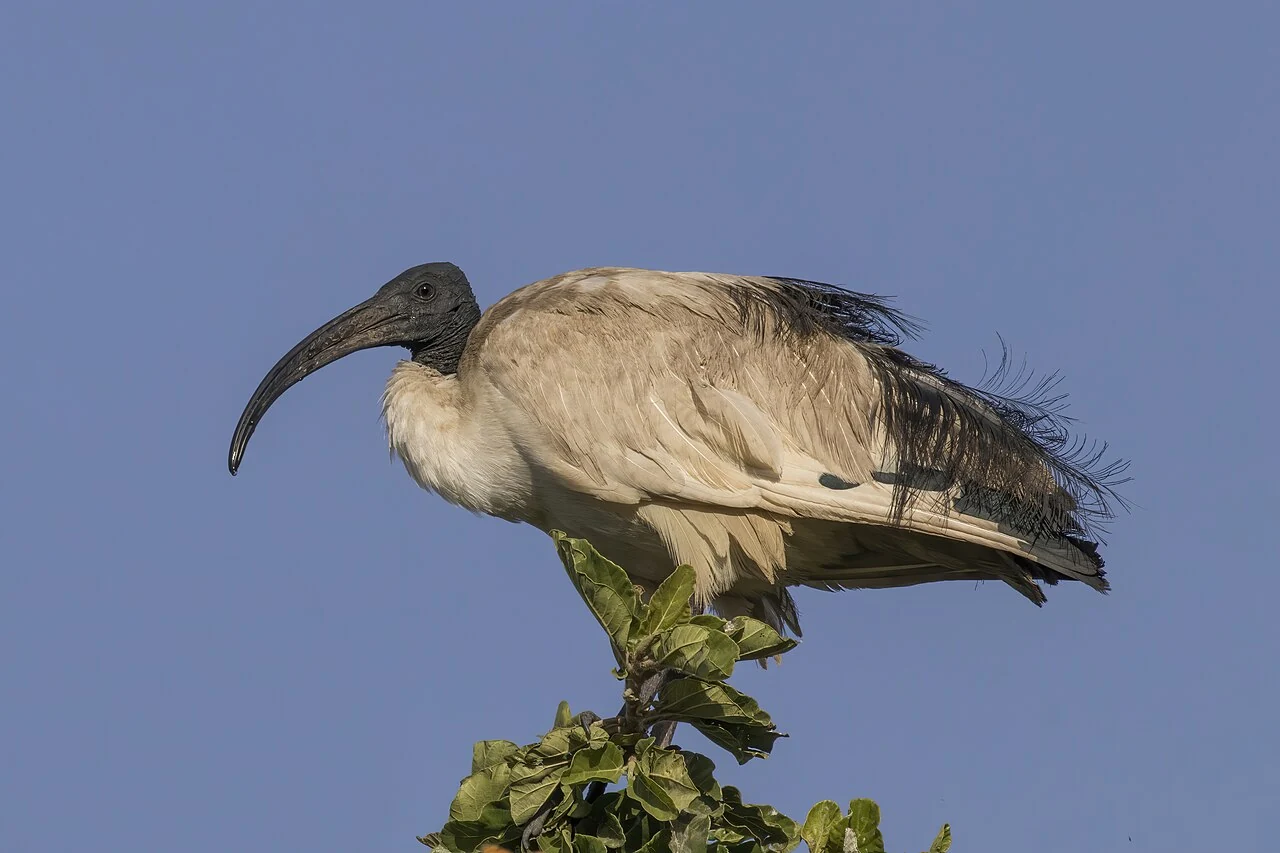
The principal bird associated with Thoth was the African sacred ibis, scientifically known as Threskiornis aethiopicus. Its white body contrasts with a black featherless head and neck, black wing tips and a long downward-curving bill. Herodotus, writing in the fifth century BCE, described those features for a familiar white-and-black ibis in his Histories, Book II, section 76. His description is useful historical testimony even though his knowledge of Egyptian animals mixed observation with stories he had heard.
Modern readers should not confuse this species with the glossy ibis, the northern bald or crested ibis, or the little cattle egret. Ancient Egyptian artists also pictured more than one ibis-like bird. The sacred ibis is the central animal of Thoth’s cult, but other species could appear in art, texts and animal deposits. The hieroglyphic sign G28 represents a darker ibis, while Gardiner G26 specifically shows a sacred ibis on a standard. Species identification has to consider the bird, the sign and the archaeological context together.
The living bird featured here was photographed at Lake Ziway in Ethiopia by Charles J. Sharp. This is an original modern wildlife photograph of the actual species, not a reconstruction of an ancient Egyptian marsh or a claim that today’s photograph was taken in Egypt. The species survives in parts of Africa even though it is no longer an established native breeding bird in Egypt.
Why was the ibis associated with Thoth?
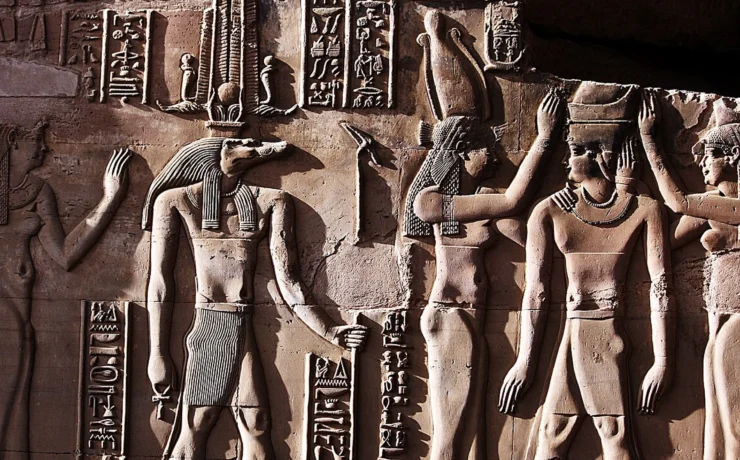
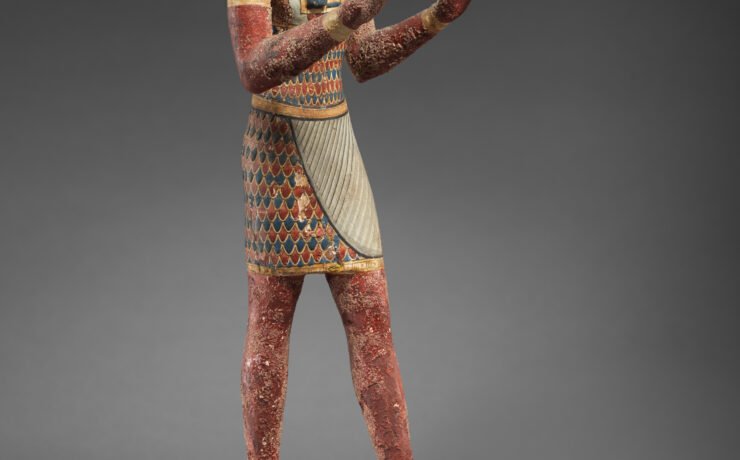
Thoth, whose Egyptian name is conventionally transliterated Djehuty (Ḏḥwty), was connected with wisdom, writing, reckoning, knowledge, sacred speech and the ordered passage of time. The Bibliotheca Alexandrina Antiquities Museum explains that artists could portray him as an entire ibis, as a man with an ibis head or as a baboon. Those representations were different ways of expressing the god’s divine qualities; the bird’s appearance did not mean that every ibis was understood to possess all of Thoth’s powers in an identical way.
The link between the curved bill and the writing instrument was especially evocative. A scribe’s reed pen, a sharp pointed implement used on papyrus, offers an obvious visual comparison with the ibis’s probing beak. But the association was not solely a modern visual guess: an Egyptian literary text explicitly connects the scribe’s working finger with the ibis’s beak. This relationship between the animal and responsible writing helps explain why bird imagery belonged in an intellectual as well as a religious world.
Thoth also carried lunar associations, was credited with measuring time and was invoked in stories about healing and restoring order. None of those roles requires us to conclude that all ibises were treated as human-style teachers. Worship focused on a divine presence and its ritual representations, not on ornithology invented in modern terms.
Did Egyptians worship the bird or the god?
The simplest answer is that sacred ibises were revered as creatures linked with Thoth, and a minority could be treated as living manifestations of the god. Ancient Egyptian animal religion operated through several categories. An individually selected temple animal might receive exceptional attention as an embodiment of divinity, whereas many other animals were prepared as votive offerings. That distinction matters because two physically similar ibis mummies can represent different kinds of ritual relationship.
A pilgrim who dedicated an ibis mummy was generally seeking religious contact with Thoth, not proclaiming that every ordinary bird in a field was a separate independent creator god. Conversely, the evidence for temple-maintained sacred birds indicates that the spiritual status of some living animals could be very high. Ancient practice varied by place and period; the modern phrase Egyptians worshipped animals can obscure the range of relationships between deity, animal image, individual creature, priest and visitor.
A useful comparison is Kemet Vault’s study of animal mummies and votive offerings. That broader article explains multiple species and the general categories of animal burial. The present dossier focuses on one species, its named god and its unusually abundant textual, archaeological and scientific records.
Thoth’s principal centre at Hermopolis
Hermopolis Magna, ancient Khemenu and modern el-Ashmunein near Minya, was a principal centre of Thoth’s cult. The Bibliotheca Alexandrina museum identifies the city as a major sanctuary associated with the god’s ibis and baboon forms. Nearby Tuna el-Gebel contained vast animal burial installations connected with the religious landscape of Hermopolis. These names describe related yet different places: Hermopolis was a major cult centre, while Tuna el-Gebel’s catacombs served as a particularly important burial zone.
Objects from the area can have specific archaeological provenances. For example, the Bibliotheca Alexandrina museum lists a bronze Thoth-as-ibis statue from the excavations at Tuna el-Gebel in 1942–1943. That information is much more useful than labeling every ibis-shaped Egyptian ornament simply found at an unspecified temple. The individual find history helps scholars connect workshop practice, votive dedication and place.
The site is also linked to the tomb of Petosiris, a priest of Thoth whose late Egyptian and early Ptolemaic art has its own history. Kemet Vault’s Petosiris tomb research explores his monument separately; this article does not repeat that tomb’s architecture or make him the inventor of the ibis cult.
The ibis in ancient Egyptian hieroglyphs
Egyptian writing did not assign a single English word to every visible animal sign. An ibis could function within a conventional sign system, serving the writing of a deity’s name or classifying a particular word. The scholarly Thot Sign List, compiled by researchers at the University of Liège and the Berlin-Brandenburg Academy of Sciences and Humanities, identifies Gardiner G26 as the sacred ibis standing on a standard: Unicode U+1315D, 𓅝. It records the sign in uses connected with Djehuty and the ibis.
The related G26A or G26a form represents the sacred ibis without the standard, Unicode U+1315E, 𓅞. These signs are not interchangeable with the owl G17, whose common phonetic contribution is m, or the darker ibis G28, associated with a different phonetic value. The distinction is significant for Kemet Vault’s 136-sign hieroglyphic explorer: a coded glyph is an index of a recognised sign form, not a universal translation or evidence that every inscription has the same word.
The god could also be represented as an ibis-headed human, for which other signs and images were used. Reading a name or funerary scene requires the original inscription, its reading direction, date and grammar. Naming G26 does not mean we have decoded every occurrence of an ibis in Egyptian art.
The Instruction of Amenemope: the ibis and the honest scribe
The Instruction of Amenemope, a work of Egyptian wisdom literature, contains a particularly illuminating passage about scribal ethics. In chapter 15 the teacher warns against dishonest use of writing and compares the ibis’s beak with the finger of a scribe. Its force comes from the association of Thoth with accurate records and moral accountability. The text does not tell us that an actual bird held the pen, nor that this comparison was the sole reason for its sacred status.
The surrounding instruction addresses corruption, false statements and the abuse of professional authority. This setting is crucial. A short sentence about the bird can be quoted in isolation as a charming symbol of literacy, but in its original context it warns that manipulating records and harming others have religious consequences. The passage demonstrates how the image of the ibis entered ethical teaching rather than only temple decoration.
Translations differ in wording and how they number columns or chapters. For the specific passage, readers can consult a published English rendering of chapter 15 and compare it with scholarly discussion of Egyptian instructional texts. Any precise interpretation should identify the edition rather than present a modern paraphrase as the exact hieratic original.
The Book of the Dead and the weighing of the heart
Thoth’s ibis-headed form appears in the judgement imagery associated with the Book of the Dead, especially the tradition surrounding Spell 125. In the scene of weighing the heart, the deceased faces a test of moral order represented by Maat, while Thoth records or announces the result. The Egyptian Museum in Cairo identifies the ibis-headed god in a Ptolemaic funerary papyrus of a priest named Djoser, where he holds scribal equipment near the balance.
This is not a picture of an ibis weighing a human heart with its feet. It is a representation of the god in anthropomorphic, ibis-headed form carrying out a written divine office. The actual scene involves several figures with different roles, including Anubis attending the balance and Osiris presiding over judgement. The role of Thoth belongs within that larger funerary composition and should not be separated from the ancient text as if it were a standalone bird myth.
For detailed context, see Kemet Vault’s research on the Book of the Dead and the Papyrus of Ani guide. Those pages study manuscripts and spells as a whole, while the ibis dossier isolates a specific divine image and its bird cult.
Bronze ibises and the material evidence of devotion
The Metropolitan Museum of Art holds numerous bronze and composite representations of the sacred ibis, some dating to the Late Period and Ptolemaic era. Their abundance is itself part of the archaeological evidence for widespread dedication to Thoth. A bird figure could be made of copper alloy, while a larger sculpture might combine bronze heads and legs with wooden or plastered bodies. These objects were often placed in or near religious spaces and animal cemeteries.
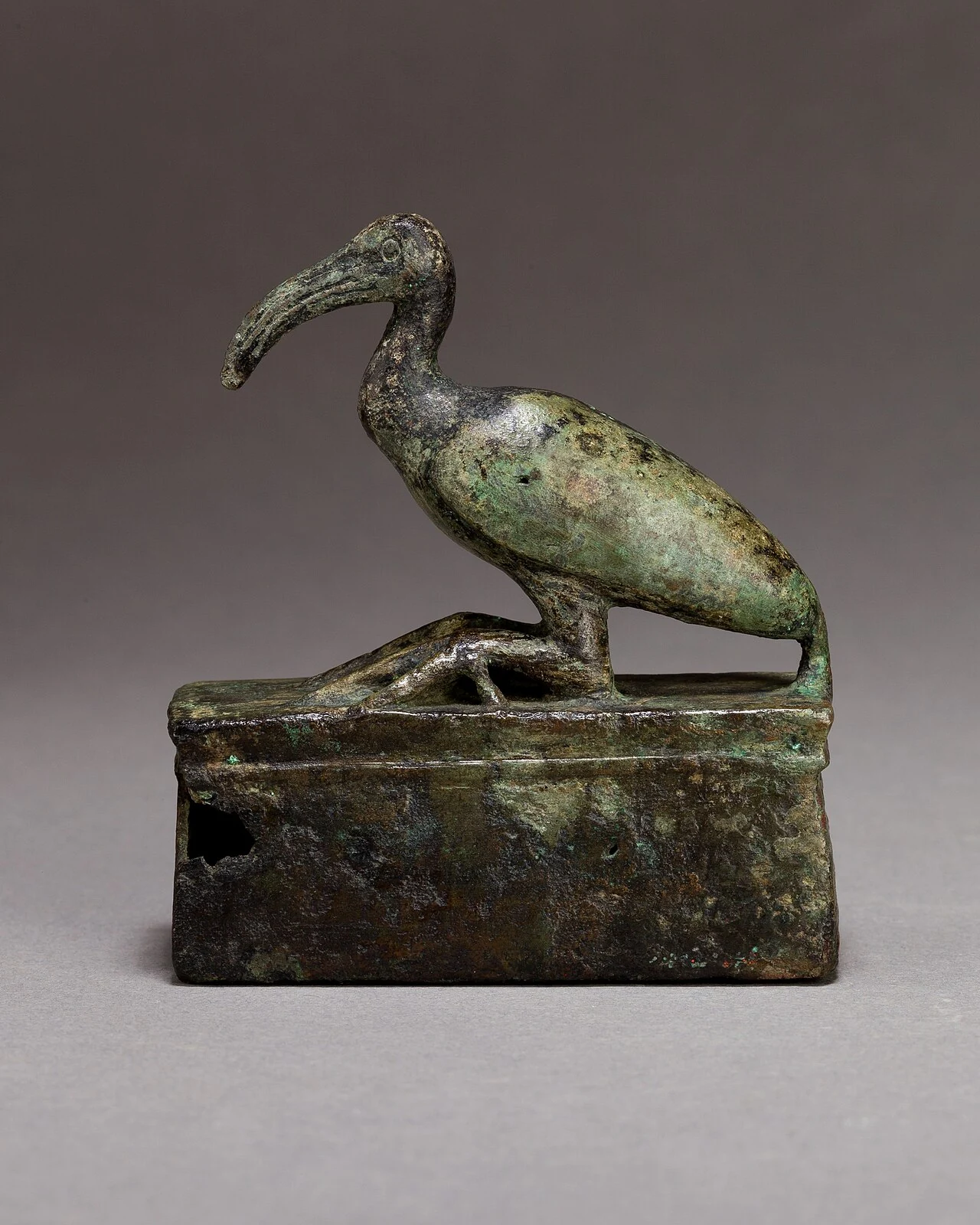
One especially informative example is a small ibis seated upon a shrine-shaped bronze box, Metropolitan Museum object 04.2.460. The museum suggests that a mummy could once have been inserted into the box through an opening at its back. This is a specific curatorial inference, not proof that the box always held an identifiable complete bird. The original open-access museum photograph shown in this article documents the precise object and its current appearance.
The forms of statues and miniatures also had social meanings: someone commissioned, acquired or deposited them. Prices, donors and workshop locations cannot be derived from appearance alone. An uninscribed bronze model offers different evidence from a base with a named dedicatory formula. We should avoid using one example to claim that all Egyptian ibis objects had identical ownership or ritual use.
When the great ibis-mummy cult expanded
Ibis devotion has earlier roots, but the most spectacular expansion of votive animal mummification occurred during the first millennium BCE. The PLOS ONE genetic study describes an especially intensive phase between the Twenty-Sixth Dynasty and the early Roman period, with radiocarbon studies placing a high point around 450–250 BCE. Thus the enormous bird catacombs do not represent a continuous, uniform burial rate from the earliest dynasties to the present.
The difference between a cult’s long religious history and a particular period of industrial-scale votive demand is essential. Thoth’s presence in older Egyptian religious thinking does not prove that priests were preparing millions of ibis mummies in Old Kingdom times. Archaeological deposits provide the main evidence for the scale and timing of later offerings. Each cemetery and assemblage requires careful dating.
A votive mummy could be prepared so a devotee could dedicate an offering to the god. Some temple animals had different careers and were mummified only after natural death. The two categories are both forms of sacred-animal practice but should not be merged into a single ritual procedure.
Tuna el-Gebel and the millions beneath Middle Egypt
Tuna el-Gebel, near Hermopolis in Middle Egypt, is famous for galleries and subterranean spaces associated with ibis and other animal burials. The 2019 PLOS ONE study cites an estimate of approximately four million sacred ibis mummies at the site. This number is an estimate built from archaeological interpretation and published scholarship, not a literal count of every individual mummy made in a single modern inventory. It illustrates the extraordinary scale of the cult while retaining the uncertainty that accompanies ancient mass deposits.
The catacombs formed a religious landscape tied to an important cult centre, and the birds’ preservation required workers, materials, containers and management. It is possible to trace the historical and social significance of those activities without speculating that hidden machinery or lost technologies were needed. The enormous number is dramatic enough without adding unsupported stories of sealed secret cities.
The burial system was not isolated from the living religious community. Written records, names of priests and accounts of feeding birds reveal administration, obligations and economic relationships. Some were maintained in temple environments, while modern genetic and chemical studies suggest that many others may have been supplied from wild populations.
Saqqara’s Sacred Animal Necropolis
Saqqara was another central location for ibis burials. The genetic research reports an estimate of roughly 1.75 million birds deposited in the Sacred Animal Necropolis, with a previously proposed annual rate of around ten thousand. Those values come from the archaeological literature and should be cited as estimates rather than precise universal totals. They relate to a specific necropolis, not to every bird buried across all of Egypt.
Saqqara also contains other animal cemeteries and varied funerary monuments, so a photograph of an Apis bull sarcophagus is not automatically evidence for the ibis cult. The Serapeum of Saqqara concerns the sacred bulls of Ptah/Apis in a different setting. Comparing the sites can clarify the range of animal religion without pretending that all catacombs followed one architecture or ritual plan.
Separate archaeological records also document ibis remains at Abydos, Thebes and elsewhere. An estimate for one cemetery should not be multiplied across every known site as if densities and periods were identical. A responsible account keeps the named findspot and its published range together.
Abydos: a jar with a genuine ibis mummy
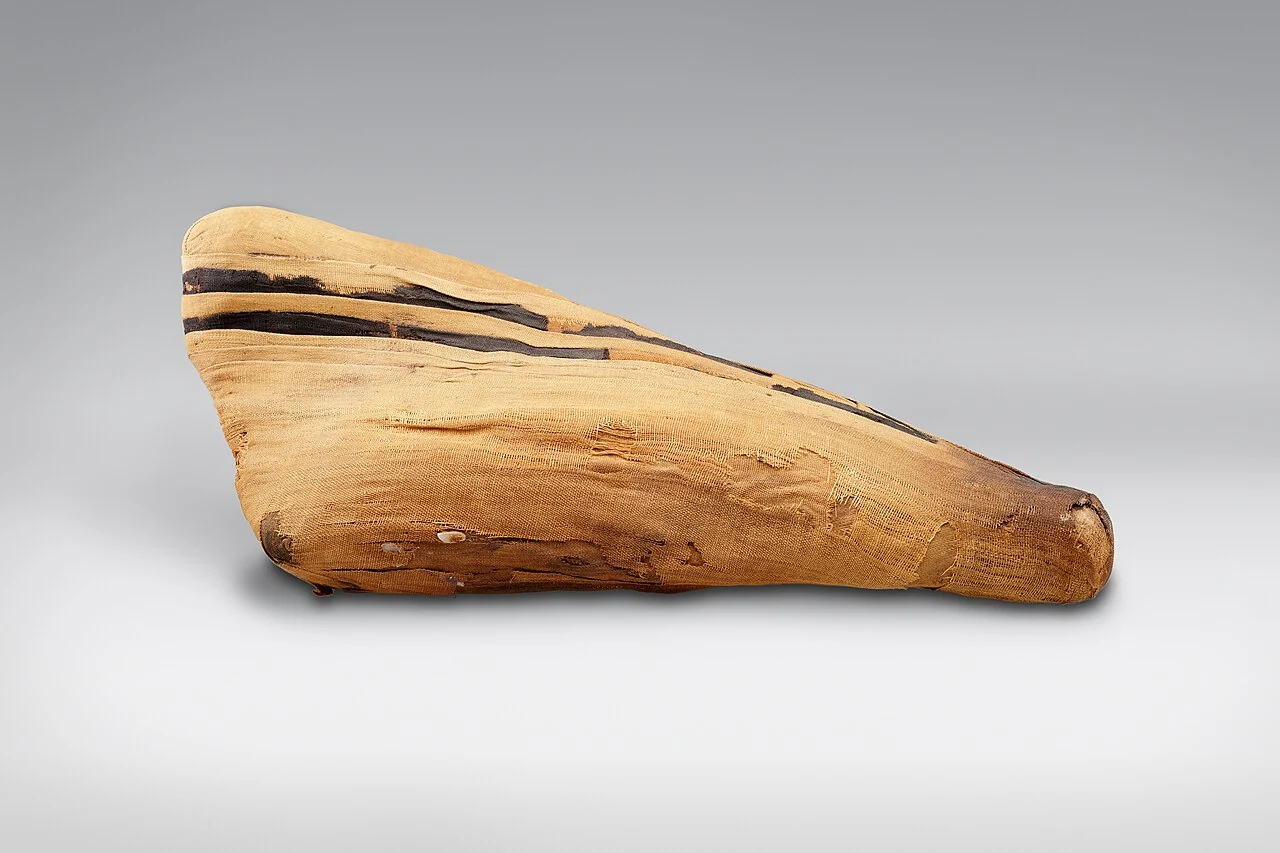
The Metropolitan Museum holds a pottery vessel from the ibis cemetery at Abydos, excavated by the Egypt Exploration Fund in 1912–1913. It contains a linen-wrapped ibis mummy, museum number 13.186.4a–c, dated approximately 400 BCE–100 CE. The museum explains that the lid was placed over the jar and sealed with plaster. This concrete object record provides more detail about burial than an undated claim that all ibises were placed in bronze boxes.
Abydos is particularly interesting because the museum notes that no temple dedicated to Thoth has been identified there. Scholars have suggested that ibis offerings may have been linked to the god’s role in legitimizing kingship and the rebirth of the dead in the Osirian landscape. That remains an interpretation based on the site’s religious context, not direct proof of what every visitor prayed for. It shows why the location of a mummy matters.
The article’s jar photograph is an original open-access museum image of this exact object, not a generic pottery vessel imported from another Egyptian cemetery. A separate image shows another wrapped ibis mummy from the Abydos cemetery, object 13.186.8. The two objects have their own museum numbers and distinct photographic records.

How an ibis mummy was made
The forms of bird mummification varied. Some birds were dried using salts and other preserving substances, wrapped in layers of linen and placed into ceramic containers. Resin, painted decoration, shrouds and patterned wrappings are documented in different examples. Others were enclosed in coffins or shrine-like containers. The goal and investment depended on the type of offering, the site’s practices and the resources available to the devotee or priestly institution.
The PLOS Biology discussion of animal mummy research describes wrapped ibises placed in jars, sometimes in groups rather than singly. Museum objects show that the same animal could be represented by a carefully finished outer package while its contents required imaging or laboratory methods to examine. Not every package was constructed by the same workshop or in the same century.
A CT scan may reveal bones, a complete bird, several partial remains or a package with less than an intact body. Such variation requires interpretation, not an instant accusation that every ancient priest was committing fraud. Modern research compares objects, scanning results, original excavation contexts and inscriptions before drawing conclusions about how an offering was assembled.
Were the birds bred on temple farms or captured?
This is one of the strongest modern research questions about the ibis cult. Written evidence indicates that priests maintained birds in temple-linked settings and could organise feeding and breeding. A Greek and Demotic documentary tradition records economic and personnel arrangements around ibis care. A priestly text associated with Hor of Sebennytos has been interpreted as describing very large numbers of birds being fed. But texts about temple management do not automatically prove that every mummified bird was born in captivity.
A 2019 PLOS ONE study analysed mitochondrial genetic material from 14 ancient sacred ibis mummies and compared it with 26 modern complete mitochondrial genomes from African populations. The ancient sample retained substantial diversity, making long-term centralized breeding of all mummified birds less likely as a universal explanation. The authors suggested that wild birds may have been captured or supplied through shorter-term management. This genetic study is evidence about sampled populations, not a census of millions of birds.
A 2020 Scientific Reports study examined isotopic evidence from mummified ibises and birds of prey and found variation compatible with many wild birds feeding on diverse resources. Its sample was limited, and not every mummy had a secure findspot. The research strengthens the case for wild capture while leaving room for temple keeping, seasonal feeding and mixed systems. The most defensible conclusion is that more than one method may have supplied the votive industry, with variation between locations and periods.
What Herodotus actually wrote about the ibis
Herodotus described Egyptian sacred animals in Book II of his Histories. In section 65, he claimed that killing an ibis or a hawk could carry a death penalty, regardless of intent. This is evidence for what a Greek writer reported about Egyptian practices in the fifth century BCE; it is not proof that the same penalty was consistently imposed in every Egyptian village, dynasty and century. Ancient legal practice cannot be reconstructed from one passage alone.
In sections 75–76, Herodotus explained the bird’s prestige through a reported battle against winged serpents approaching Egypt from Arabia. He described a darker kind of ibis said to combat those serpents and a white-bodied kind with a bare black head and neck. His physical observations and his story of flying snakes belong to different evidentiary categories. The snake tale is a narrative he relayed, not a zoological fact verified by archaeological science.
Herodotus remains valuable because his account shows the bird’s prominence in the world encountered by a Greek observer. It is equally important to recognise that Egyptian texts and museum objects provide independent sources. Greek storytelling should not displace the specific evidence of Egyptian religious practice simply because the serpent anecdote is memorable.
Why the long curved beak mattered
The ibis’s bill is physically adapted to probing shallow water and mud for food. For an Egyptian observer, the combination of distinctive silhouette, wetlands and a probing beak could carry strong associations. The image of a writing instrument was an especially intelligible connection to Thoth as the god who presided over the work of scribes. Ancient literature makes that link explicit, while the bird’s biology explains why the shape could prompt the comparison.
The beak should not be described as naturally forming the shape of every hieroglyph or as proof that the bird discovered medicine. Such claims are imaginative modern associations unless supported by an identified ancient source. Likewise, the bird’s feeding habits do not validate Herodotus’s tale of flying snakes. Good cultural history explains how natural features became religious symbols without requiring animals to perform miracles as ordinary biological behaviour.
Thoth’s other animal image, the baboon, is a reminder that a deity’s identity did not rest on one anatomical trait. Artists and writers could deploy different sacred forms for related divine functions, while particular animals remained recognisable parts of the natural world.
The ibis in Greek, Roman and early modern scholarship
Greco-Roman writers encountered an Egyptian world in which the ibis was deeply embedded in religious practice. Their descriptions sometimes explain sacred status through observed habits, but sometimes through inherited allegories. Herodotus is an indispensable early narrative witness, yet he does not reproduce the full religious doctrine of Egyptian priests. Later authors such as Plutarch interpreted Egyptian religious imagery through their own philosophical interests. Their explanations are evidence of reception and interpretation, not automatically descriptions of the beliefs of a scribe living two thousand years earlier.
The ibis also played a role in the development of modern comparative anatomy. Nineteenth-century naturalists examined Egyptian bird mummies and compared them with living birds. A PLOS Biology study traces how ibis specimens entered an early debate about species identity and the history of evolutionary thought, including past misidentifications of preserved remains. Such episodes are fascinating but belong to the modern scholarly reception of the ancient artefacts, not to the original religious purpose of the mummies.
The value of the later record is that it helps historians trace how one Egyptian sacred species was understood and sometimes misunderstood by outsiders. It should never be used to claim that the ancient Egyptians had already formulated a later European biological theory.
Where did the sacred ibis go in Egypt?
African sacred ibises survive in parts of sub-Saharan Africa, but the species no longer has the regular natural presence in Egypt described in ancient sources. Modern studies give somewhat different nineteenth-century dates for its disappearance from Egypt, with broad estimates around the middle or later decades of that century. The exact last local observation is more difficult to establish than a simple headline suggests. This is a local disappearance, not global extinction of the species.
Changing wetlands, hunting pressure and the loss of suitable habitat are frequently considered when discussing the fate of large waterbirds in the Nile landscape. It would be irresponsible to assign the local loss wholly to ancient mummification, which had declined many centuries earlier, or to say that the species vanished everywhere because of the cult. The archaeological and modern ecological timelines are different.
The live African sacred ibis photograph in this article is from Ethiopia, which is relevant because the species still occurs there. A present-day picture cannot reconstruct precise ancient migratory routes, flock sizes or breeding sites without independent environmental research. What it does establish is that the bird behind the ancient iconography is a real species still observable today.
Why ibis mummies are more than a religious curiosity
The catacombs reveal far more than an unusual habit of burying birds. They preserve evidence of organised labour, textile use, ceramic production, breeding or capture systems, transport, temple administration and people seeking favour from a deity. Some dedicatory inscriptions identify donors, priests and dates. Scientific studies add information about genetics, diet and the geographic range of the birds. The result is a layered archive connecting religion, ecology, economy and personal practice.
The objects also expose the limits of collection history. A mummy excavated with its sealed jar and recorded findspot can answer different questions from a bird bundle purchased on the antiquities market without documentation. Even a beautiful photograph becomes less informative when it lacks an object number or date. The museum records used here identify two different Abydos specimens, while the bronze model has another accession number and is not claimed to come from the same burial.
A reliable historian must resist attractive but unsupported claims that all catacombs were built in a single year, that exact millions have been individually counted, or that every mummy came from a captive breeding farm. Scientific disagreement is a feature of genuine evidence, not a defect that should be edited out of an encyclopedia.
The sacred ibis in a wider network of Egyptian belief
Thoth’s ibis cult intersects with many other aspects of Egyptian religion: the moral language of scribal training, the measurement of time, the written validation of royal acts and funerary judgement. At the same time, other sacred animals were linked to other gods, and their burial places formed distinct religious landscapes. The falcon of Horus and the jackal-headed Anubis provide examples of how particular animal forms operated within different divine offices.
Egyptian belief also changed over time. A bird figure from a Late Period votive deposit should not be used as if it spoke for every pharaoh of the Old Kingdom. Sacred representation, priestly institutions and pilgrim practice expanded, adapted and sometimes changed scale. This means the most accurate question is not simply why Egyptians worshipped one species, but what the ibis meant in a particular text, place and ritual moment.
The answer connects ancient words, genuine museum objects, excavated bird cemeteries and modern science. It also leaves questions open where the evidence does not permit a final conclusion, particularly about the exact contribution of temple breeding to the millions of later votive mummies.
Evidence checklist: facts, estimates and reported traditions
The Egyptian identity of the sacred ibis, its representation of Thoth and the presence of actual ibis mummies and votive sculpture are established by independent museum catalogues and archaeological study. Gardiner’s sacred ibis hieroglyph can be identified by an official scholarly sign database. The numbers given for Saqqara and Tuna el-Gebel are published archaeological estimates. Those categories should not be assigned the same level of certainty just because they can all be expressed in a short sentence.
Herodotus’s death-penalty claim and story about winged serpents are historical reports about beliefs or practices, not independently verified universal law or zoology. The debate about captive breeding and wild capture is an active research question tested with limited genetic and isotopic samples. A visitor or researcher benefits more from seeing these distinctions than from an infographic that presents every interpretation as established fact.
An evidence-led account of the ibis is therefore both culturally rich and scientifically cautious. It recognises devotion to Thoth, the skill of ancient artists and embalmers, the labour sustaining enormous cemeteries and the possibility that different regional practices coexisted over centuries. None of these aspects needs to be reduced to a simple statement that ancient people worshipped a bird because it ate snakes.
Primary texts, museum catalogues and peer-reviewed research
These sources allow the principal claims above to be checked independently, with documented differences between ancient testimony, religious interpretation and scientific analysis.
- Bibliotheca Alexandrina Antiquities Museum: Thoth as an ibis, object BAAM 0636 — iconography, Hermopolis and archaeological provenance.
- Egyptian Museum Cairo: Book of the Dead, Spell 125 — Thoth as recorder of the heart-weighing judgement.
- Thot Sign List, G26 (University of Liège and Berlin-Brandenburg Academy) and G26A — Egyptian sign identity and attested uses.
- Herodotus, Histories Book II, sections 65 and 75–76 — a fifth-century BCE Greek account; the serpent story is reported folklore.
- Metropolitan Museum object 04.2.460 — bronze ibis and possible shrine box.
- Metropolitan Museum object 13.186.8 — genuine wrapped ibis from Abydos.
- Metropolitan Museum object 13.186.4a–c — Abydos pottery jar containing an ibis mummy and its archaeological interpretation.
- Wasef and collaborators, PLOS ONE (2019) — 14 complete ancient mitochondrial genomes and comparison with modern African birds.
- Scientific Reports (2020), isotopic investigation of Egyptian mummified birds — independent evidence suggesting wild dietary origins in the studied samples.
- PLOS Biology: The Sacred Ibis debate (2018) — modern anatomical and scientific reception of Egyptian bird mummies.
- University of Birmingham Egyptology: Gifts for the Gods — interpretive discussion of ibis offerings, museum provenance and vessel burials.
Editorial distinction: the values around four million birds at Tuna el-Gebel and 1.75 million at Saqqara are scholarly estimates; Herodotus’s flying serpents are not established zoology; genetic and isotope findings derive from studied samples, not every bird buried in antiquity. The four media files are independently identified real photographs or museum reproductions with their own provenance and permission records.