What is the Serapeum of Saqqara? It is an underground burial complex built and enlarged over centuries for sacred Apis bulls, animals associated with Ptah, the major god of nearby Memphis. Within the desert necropolis of Saqqara, corridors lead past enormous stone sarcophagi that once belonged to carefully honoured bulls. The site was used from the New Kingdom, beginning under Amenhotep III, through later Egyptian and Ptolemaic periods. The Serapeum is not a royal pyramid, a human cemetery or proof of a vanished civilization with unknown machines.
This guide examines the archaeology of the chambers, the religious role of living and deceased Apis bulls, the inscriptions and stelae left by worshippers, and Auguste Mariette’s nineteenth-century excavations. The photographs show the real underground monument and retain their original licences. Readers researching nearby royal funerary texts should instead consult the Pyramid Texts of Unas; its stone inscriptions were made for a human king in a different setting.
Where the Serapeum lies within the Saqqara necropolis
The Serapeum lies in northern Saqqara, part of the Memphite necropolis west of the Nile. Memphis was a major ancient urban and religious centre, and the cult of Ptah played a substantial role in its sacred life. The Apis bull was associated with Ptah and was treated as a specially chosen living manifestation of divine presence. In death, the bull received elaborate funerary rites and burial. The Ministry of Tourism and Antiquities identifies the monument as underground corridors containing sarcophagi of mummified sacred bulls. That description should be distinguished from the broader Serapeum temple complexes found at other sites and periods. A reader seeing the name Serapeum in Alexandria is not automatically looking at this Saqqara cemetery. Likewise, the presence of royal pyramids nearby does not mean that the bulls were buried inside human kings’ pyramids. The archaeological landscape includes monuments of different dates and functions, often separated by many centuries.
The living Apis bull and the worship of Ptah
Ancient religious specialists recognised a living Apis bull through particular physical markings. The Metropolitan Museum of Art describes a selection system associated with distinctive white and dark markings and a chosen bull kept near the temple of Ptah. As a living sacred animal, it took part in ceremonies connected with fertility, regeneration and divine presence. On its death the community sought another eligible bull, and the deceased animal was given a special funeral. This does not mean that every cow or bull in Egypt was treated as Apis, nor does it demonstrate that all Egyptians followed the same rituals. The cult had a specific institutional and geographic context in Memphis. Small bronze depictions of Apis often display a solar disc and decorations, while the actual animal was a real living bull. The Met’s Apis statuette, number 04.2.483 documents the visual identity of the cult without being a photograph of a bull buried at Saqqara.
From the New Kingdom to the Ptolemaic period
The chronology of the Serapeum is not one construction date. The official Egyptian monuments service places its use from Amenhotep III in the Eighteenth Dynasty through the Ptolemaic era. Burial installations, chambers, surface structures and inscriptions were accumulated and modified over a very long span. One cannot infer that every enormous stone box visible today was made under Ramesses II, or that every passage was cut at the same moment. Changes in architectural scale reflect successive phases and the enduring importance of the cult. The Metropolitan Museum’s historical account traces the evolution from earlier Apis interments into an extensive underground complex in the Memphite necropolis. It is useful to distinguish the age of an individual bull burial from the date of a later passage built around or near it. Archaeological development here stretches across Egyptian dynastic divisions, political changes and the arrival of Greek-speaking rulers. Long use is part of the site’s value, not evidence for a single lost master builder.
Underground corridors, side chambers and monumental stone boxes
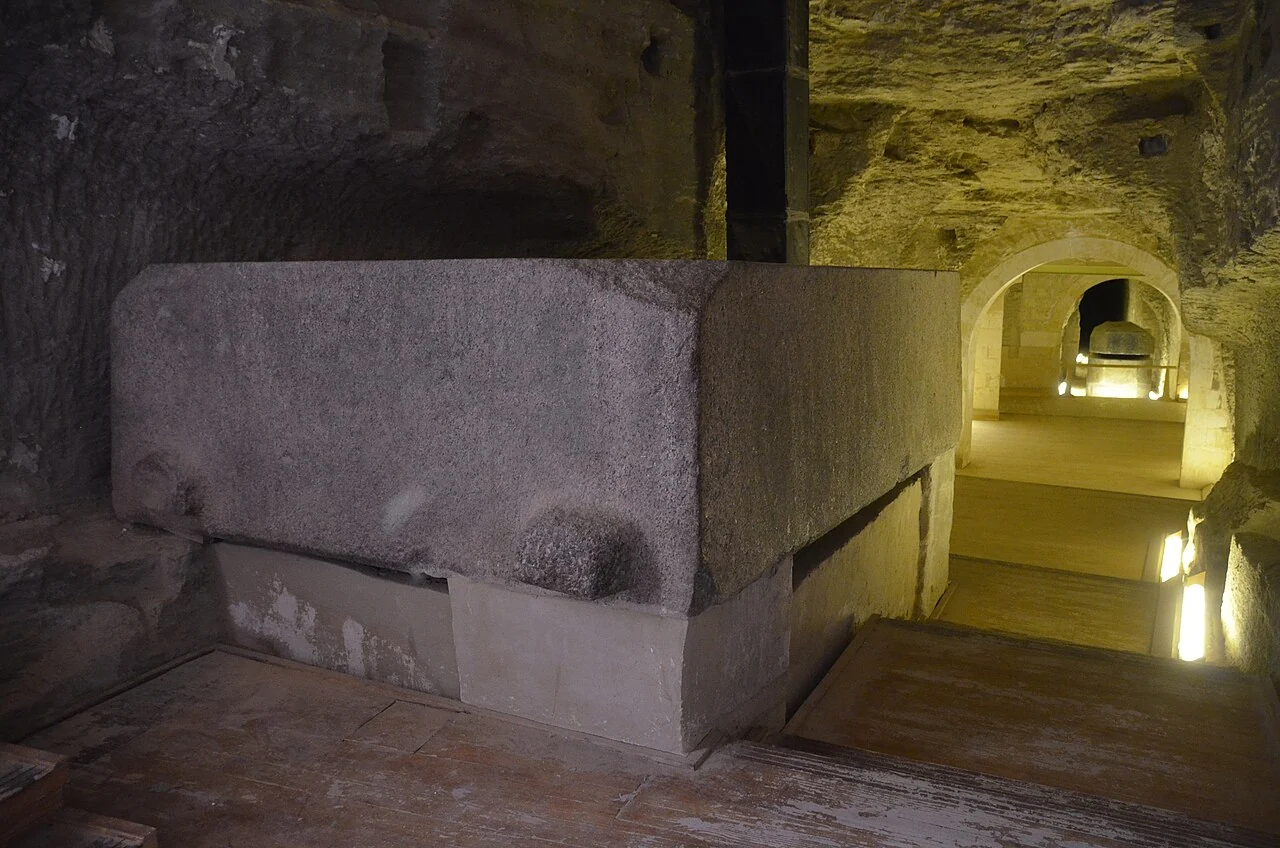
Inside the surviving complex, passages give access to chamber spaces holding massive stone sarcophagi. The images below show the actual site rather than a digital reconstruction. Huge stone containers had to be quarried, shaped, moved and lowered into a functioning underground burial installation, which points to planning and specialist labour. However, photographs and estimates of scale should not be used to declare an exact universal weight for every container. Different stone boxes differ in size, material and date, and accessible sections have changed during conservation and reopening. Visitors often see a dramatically lit gallery and infer that the entire Serapeum was always one continuous hall in its present form. Excavation history complicates that impression. Researchers distinguish earlier and later underground sectors, as well as surface features that do not appear in the famous corridor photographs. The best evidence comes from a particular box, its chamber, inscription and securely recorded relationship to other construction phases.
Why the enormous sarcophagi are not an unsolved technological mystery
The size and finish of the Serapeum’s stone containers are impressive engineering achievements, but a large polished surface alone does not establish that ancient Egyptians lacked the ability to make it. Quarrying and working stone demanded abrasion, tools, transport, manpower and repeated fitting. Historians avoid both exaggerated certainty about individual construction techniques and unsupported claims of alien equipment. The existence of a corridor with a granite box is a starting point for archaeological questions about access routes, slopes, burial chronology and working space. It cannot provide its own blueprint for every stage of production. Inscriptions and building phases can also reveal the activity of specific patrons. Some containers are not equally decorated or inscribed, which is important when interpreting the complex. The relevant question is not whether a modern person could lift one by hand, but what combined techniques and organisations were available in a society experienced in large-scale stone construction. Photographs are evidence of results, not proof of a particular imaginary technology.
What the Apis burials tell us about sacred animals
An Apis burial followed the death of an animal regarded as exceptionally holy, and the remains could be mummified and interred with honours. Religious images of bulls in Egypt are varied, so it would be inaccurate to identify every ancient depiction of a bovine as the specific Apis cult. The priests at Memphis had a special relationship with the living chosen bull, and the burial complex records that investment across generations. The Egyptian monuments service explains that the animal was privileged during life and celebrated at death. A comparison with human royal burial can illuminate shared ideas of protection and regeneration, but the two traditions were not identical. Small votive offerings, donor inscriptions and statues provide evidence for the wider social circle supporting the cult. Visitors should be cautious about descriptions implying that all underground containers still hold intact mummies today. Excavation, ancient disturbance, preservation and modern collecting affected what survives and what can be attributed with confidence.
Two photographs of the real Serapeum, not a staged tomb
The first photograph used here is a landscape view of the underground Serapeum made by Carole Raddato in February 2020, archived under Flickr identifier 50601646887. Its Wikimedia Commons record preserves the photographer, date, location coordinates and CC BY-SA 2.0 licence. The second is a different original photograph from the same documented visit, identifier 50601652437. They are photographs of the actual site and not generated images. The gallery lighting, pathways and modern access arrangements visible in photographs are part of the visitor presentation; they need not represent the original ancient illumination or corridor fittings. Captions identify the setting generically because a photograph alone does not prove the royal reign associated with a particular unlabelled stone box. This distinction matters particularly at a monument containing interments of many dates. Images can reveal scale and architecture, while excavated and museum records establish the archaeological context. Always distinguish original site photographs from the museum bronze Apis figurines that are separately catalogued objects.

Khaemwaset, Ramesses II’s son, and the burial tradition
The ancient cult also involved elite priests and royals. The Egyptian Ministry notes that Khaemwaset and Merneptah, two sons of Ramesses II, made donations associated with Apis burials, including jewellery and funerary objects. Khaemwaset is well known for his connection with Memphite religious monuments and the priesthood of Ptah. Such inscriptions can preserve names and titles in a way that an uninscribed stone box cannot. The statement that a named prince donated an object, however, is not proof that he personally carved every chamber. Patrons could commission or support works carried out by specialists. The same monument can contain contributions of several kings across generations. Chronological research uses inscriptions, stratigraphic context and cross-references to royal reigns rather than attaching all visible funerary equipment to its most famous ancient visitor. Archaeologists also consider how objects were moved in antiquity or after excavation. Royal names are important anchors, but they must be connected to specific archaeological records.
The commemorative stelae: named donors and dated evidence
Stelae from the Serapeum are particularly valuable because they record individuals, dedications, offerings and sometimes dates linked to Apis burials. The Louvre holds material that Auguste Mariette recovered from the Serapeum in the nineteenth century. Its Dynasty 22 stela record identifies an Apis offering scene from the smaller underground galleries, and includes museum references and acquisition history. A different Louvre stela fragment derives from the great underground galleries and belongs to a later historical context. These two records cannot be collapsed into one generic ‘Apis stone’. The name, find area, material, modern collection and inscription type each help reconstruct the monument’s development. They also show why claims that the Serapeum has ‘no writing at all’ are incorrect. Not every granite coffin carries a lengthy inscription, but the complex and its associated monuments preserve substantial epigraphic evidence.
Who was Auguste Mariette, and what was discovered in 1851?
The French Egyptologist Auguste Mariette began investigations around Saqqara after travelling to Egypt in 1850. The famous sequence involving a sphinx-lined avenue helped lead him to the Serapeum. The major discovery of the underground complex is generally associated with his excavations beginning in 1851. A scholarly reconstruction of the finds distinguishes the excavation of the great underground galleries in late 1851 and early 1852 from other investigations near the temple, dromos and perimeter walls. An 1986 study of newly discovered Serapeum stelae is useful because it reconstructs aspects of excavation history instead of repeating only its romantic anecdotes. Nineteenth-century archaeological practice was different from contemporary documentation, and objects also entered European collections during the period. The Louvre’s accession records are part of that historical process. The story of Mariette should recognise his discoveries without implying that the ancient Serapeum was built by him or that all subsequent finds came from one sealed chamber.
The Louvre’s Apis objects and the problem of provenance
Museum collections from the Serapeum include stelae, small bronzes, inscriptions and other dedicated objects. Their modern homes may differ from their ancient places of use, and some pieces were transferred after excavation. Christiane Ziegler’s study of bronze finds from the Serapeum shows that a remarkable range of divine figurines appeared in Mariette’s records. The objects do not all portray bulls. That variety cautions against describing the complex as a simple storage tunnel holding nothing but identical granite boxes. An Apis object could be dedicated by a worshipper, displayed or deposited in different parts of the sacred area. The Louvre’s modern collection number and excavation history are therefore essential context. A museum object marked ‘Serapeum’ might have been found near the temple rather than inside a particular underground sarcophagus. Responsible captions identify that distinction. It is equally important not to use a generic photograph of a bronze bull as though it were the original mummy of Apis.
Apis and Serapis are related names, not one unchanging institution
The sacred Apis bull belongs to a long Egyptian tradition of Memphis worship. In the Ptolemaic period, the god Serapis became associated with Greek and Egyptian religious life, with the name linked in part to Osiris-Apis. Later temples dedicated to Serapis appeared in different cities, including Alexandria. But it is historically misleading to pretend that the animal burial galleries at Saqqara and the famous Alexandrian Serapeum are the same excavated building. Their architecture, location, cult settings and development differ. The Saqqara galleries are part of an older, continuing Apis burial tradition and contain evidence from before the Ptolemaic dynasty. Alexandria, in turn, became an important centre for the separate but connected Serapis cult under Greek-speaking rulers. The study of Ptolemaic Alexandria covers the later city’s politics and religious setting. Names that sound similar need to be anchored in date and location before historical comparisons are made.
How to visit without confusing archaeology with a live ticket listing
The Serapeum is a real visitor monument within Saqqara, but access to underground rooms depends on conservation, maintenance and site management. The Egyptian Ministry’s monument page is the proper place to verify contemporary ticket categories and opening arrangements. This historical article does not present a price quoted months ago as a current guarantee. Visitors who are interested in engineering may focus on the enormous boxes, but the ritual context and stelae are equally important. Avoid touching ancient surfaces or entering restricted chambers to photograph inscriptions at close range. An organized visit should make clear which sectors are accessible and what areas remain closed. It is also worth remembering that galleries may be humid, uneven or low-lit, with modern walkways that do not reproduce an ancient route. For a culturally useful visit, carry a map of Saqqara and distinguish the Serapeum from the pyramid of Unas and other nearby burial monuments. Their proximity makes comparison possible without making them one complex.
Frequently asked questions
Were pharaohs buried in the Serapeum of Saqqara?
No. The underground complex is primarily associated with burials of the sacred Apis bulls. Kings and princes made donations and appear in inscriptions, but their own tombs should not be confused with the animal burial galleries.
Are the Serapeum’s granite boxes evidence of unknown ancient machines?
They are impressive stoneworking achievements, but their size alone does not demonstrate that a lost advanced technology or nonhuman construction was required. Exact techniques and construction stages must be evaluated through archaeology and comparative engineering.
Is the Serapeum in Saqqara the same as the Serapeum of Alexandria?
No. The Saqqara complex houses Apis burials associated with Memphis and Ptah. Alexandria’s Serapeum is a different cult and architectural setting, connected with later Serapis worship.
Primary museum and archaeological references
Ministry of Tourism and Antiquities: Serapeum of Saqqara; Metropolitan Museum: Apis 04.2.483; Louvre Apis dedicatory stele from smaller galleries; Louvre stele from the great galleries; Egyptological research on Serapeum stelae and excavations; Research on Serapeum bronzes and collection histories. The two photographs show the actual underground monument; their licensing and the museum objects’ accession histories remain distinct. Reviewed 31 October 2026.