What are the Pyramid Texts in the Pyramid of Unas? They are an extensive collection of ancient Egyptian royal funerary utterances carved onto the interior walls of the pyramid of King Unas at Saqqara during the late Fifth Dynasty, around the twenty-fourth century BCE. They invoke divine powers, protection, nourishment and the king’s passage to continued life after death. The inscribed chambers are the earliest surviving royal pyramid interiors to contain this substantial collection, but the individual compositions may preserve earlier traditions. They are not the later Book of the Dead and were not copied as one identical book in every tomb.
This guide examines the archaeological monument, placement of texts, the language of ascent and transformation, and how historians use the original walls and modern editions without pretending that we possess a complete text written personally by Unas. The comparative history of Egyptian afterlife writings covers several text traditions; here the focus is one specific royal pyramid and its surviving physical inscriptions.
Unas, Saqqara and the last king of the Fifth Dynasty
Unas was the last ruler of Egypt’s Fifth Dynasty. His pyramid lies at Saqqara, south of the step pyramid complex of Djoser. A modern view of the ruins does not immediately reveal what made the site remarkable: much of its exterior masonry was dismantled or damaged over time, while parts of its interior rooms preserve a wealth of hieroglyphic inscriptions. UCL Digital Egypt describes the complex as the earliest pyramid with the Pyramid Texts written inside, and the monument is traditionally known as Nefer-isut-Unas. The precise absolute dating of the reign varies among chronological reconstructions, so the broad twenty-fourth-century BCE attribution is more responsible here than an invented exact construction year. The place of the pyramid within the wider Saqqara landscape is important, too. Earlier royal pyramids had elaborate temples and funerary provisions, but their interior walls generally lacked this form of inscribed text. The appearance of written ritual inside Unas’s burial chambers documents a significant development without proving that religious recitations originated in his reign.
Why Unas’s pyramid is the earliest surviving major example
The term Pyramid Texts is a modern designation for a corpus of spells and ritual utterances preserved in a number of Old Kingdom pyramids. UCL identifies Unas as the earliest surviving example with this monumental wall programme. That does not mean nobody in Egypt recited funerary invocations before Unas, nor that the writing itself was invented for his burial. A ritual may be older than the earliest preserved inscription, and scholars compare expressions across later sources to reconstruct a developing tradition. The difference between origin and first surviving evidence is one of the most important lessons in archaeology. Modern articles often call the texts the oldest religious literature in the world, a claim that depends on how ‘literature’ and other cultures’ evidence are defined. The securely useful point is narrower: the Unas texts are among the earliest extensive religious compositions preserved on the walls of a royal tomb, and they shaped later Egyptian funerary writing. UCL’s Pyramid Texts overview outlines their later transmission.
Where the inscriptions appear inside the monument
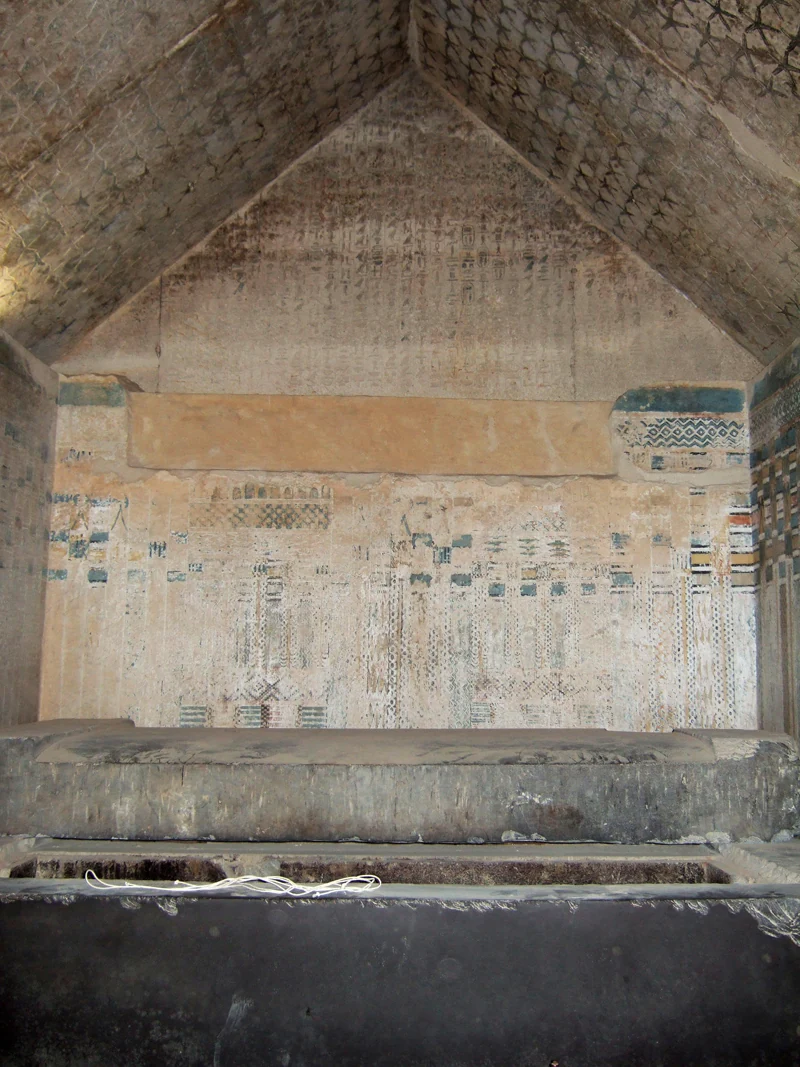
The texts were not placed randomly on the pyramid’s outside surface. They occupy internal areas associated with burial and passage, including the chamber with the sarcophagus, the antechamber and connecting passage spaces. Walls and their orientation matter because the words can relate to movement, transition, divine protection and the particular setting of the royal deceased. A simple website transcription that removes all architectural context risks losing this relationship. Modern photographs make the inscribed surfaces visible; they also show that hieroglyphic columns had to be planned around the room’s masonry, ceiling and decorative elements. The burial chamber contains an impressive dark stone sarcophagus, an imitation palace-facade treatment and a star-covered ceiling. An inscribed wall seen in a photograph is a material part of a funerary installation, not merely a loose papyrus laid against a display case. To read it well, identify which room is shown, rather than confusing Unas with the similarly decorated pyramid interiors of Teti or Pepy I.
A burial chamber under a star-filled ceiling
The surviving burial chamber presents a conjunction of architectural and symbolic features. The starry roof evokes the heavenly setting central to some royal afterlife hopes, while the sarcophagus and palace-facade details give the room its immediate funerary identity. A photograph made in 2011 by Vincent Brown documents these surviving features, with the artist’s modern camera perspective separate from the ancient carving. The image is not a reconstruction of a priest reading a spell. Its importance is that a visitor can see the relationship between text-bearing walls and the central burial equipment. However, the photograph cannot show the whole textual programme on a single screen, and light conditions can make hieroglyphic columns difficult to inspect. Museum and site photography must be supplemented by drawings, epigraphic copies and scholarly editions. The original physical room is the primary evidence, and later reproductions are ways of studying it, not replacements for its archaeological location. Comparing room photographs over time also helps document restoration, preservation and changes in access.
The formulae: food, rebirth, protection and royal ascent
The content of Pyramid Texts varies, but recurring concerns include feeding and renewing the king, avoiding danger, joining divine companions and reaching a blessed state beyond ordinary death. Some compositions use commanding language, others address divine beings or express transformations of the deceased. A reader familiar with later funeral papyri may expect a single narrative from judgment to paradise. That expectation can be misleading for this earlier royal material. The texts are a collection of utterances and ritual formulae, not a continuous story of a mortal traveller following one chapter sequence. The king can be identified with or associated with gods, celestial features and protective powers in ways that differ between compositions. Modern translations have to decide how to render ambiguous ritual terms and names, and particular passages can be difficult to understand without comparison. The Petrie Museum’s Pepy I fragment illustrates the importance of actual royal names and wording within the tradition.
Orion, the circumpolar stars and the problem of literal readings
Astronomical and celestial language has attracted particular interest in the Pyramid Texts. Images of ascent, starry destinations and association with sky deities have generated a wide range of interpretation. It is historically reasonable to consider how the royal dead were linked to the stars in some spells. But it is not valid to translate poetic celestial expressions automatically into coordinates for a hidden tomb or to claim that a specific constellation proves an exact construction date without architectural and astronomical evidence. The words can carry religious imagery and ritual purpose even when the sky phenomena to which they refer are identifiable. Some star groups, including Orion, feature in interpretations of Egyptian afterlife beliefs, but textual translations, linguistic dating and the changing ritual programme require careful treatment. The chronology research guide explains why exact ancient dates require multiple kinds of evidence. The Unas inscriptions should be read as ritual texts within an archaeological tomb, not as an invitation to modern numerology.
Green-filled hieroglyphs and the artistic organization of writing
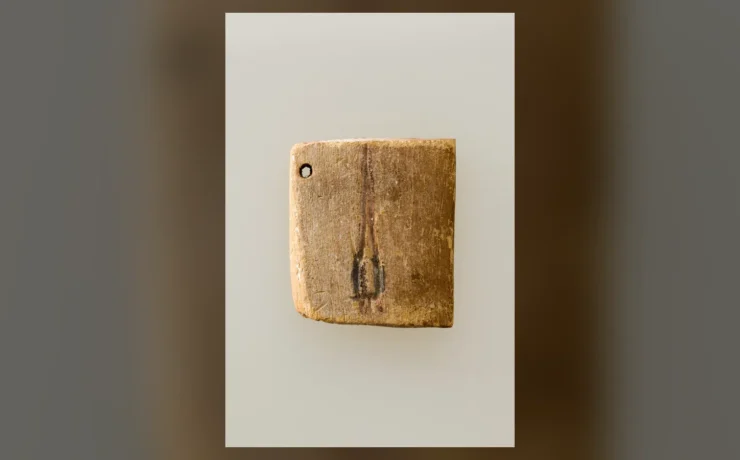
Pyramid interior texts were carved in columns of hieroglyphic signs and could be highlighted with pigment. The appearance of closely spaced writing on a limestone wall is an important practical achievement. Specialists had to choose the placement, scale, direction and arrangement of signs for particular surfaces. Later photographed fragments from the pyramids of other rulers, including Pepy I, have signs filled with green pigment. The UCL Petrie Museum preserves one such identified piece, UC14540, from a different monument. The difference matters: a photograph of Pepy I’s cartouches cannot be passed off as a fragment from Unas’s own walls just because both belong to the Pyramid Texts corpus. In Unas’s chambers, the arrangement participates in a larger architectural design. Different walls can have distinct ritual associations, but not every spatial reading is universally accepted. Photography allows close examination, while published epigraphic work helps distinguish original signs from damage, restoration and modern visual enhancement.
A second image: the pyramid interior seen in a historic archive
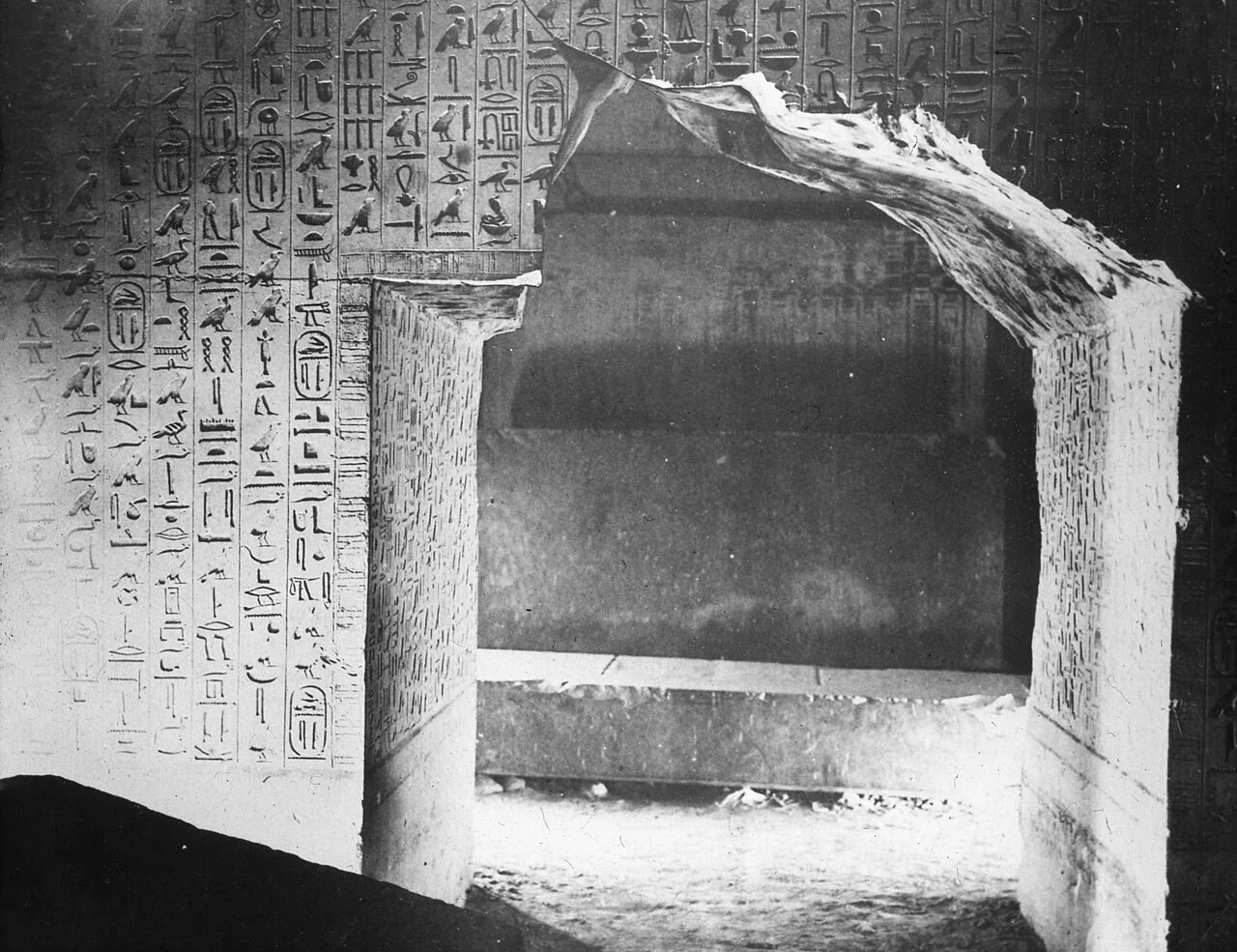
The Brooklyn Museum Archives hold an early photographic view of the antechamber and Pyramid Text inscriptions at the pyramid of Unas. The Commons reproduction is catalogued as ‘Unas Pyramidentexte’ and linked to the museum’s Lantern Slide Collection. Unlike the contemporary burial chamber image, this is an older archival picture that helps show how the monument was documented by earlier visitors and institutions. Its exact date within the photographic collection should be distinguished from the date of the carved stone. Reproduction of a historical photograph is not evidence for a new excavation discovery. Looking at the old image next to a modern one can be valuable, but differences of angle, lighting and print quality do not automatically establish that the chamber was altered. The two photographs in this study document a real inscription setting at Saqqara, and each retains a separately traceable licensing record. The original inscription is much older than either camera technology or the modern term Pyramid Texts.
Were the texts reserved for kings alone?
The earliest surviving pyramid interior inscriptions were part of royal tomb settings, which helps explain their strong emphasis on the deceased king and his divine status. But it is too simple to claim that similar ritual utterances never existed beyond the royal household. Funerary traditions could be recited, adapted or copied in forms that have not survived. Later, a number of royal women also received related Pyramid Text inscriptions in their own pyramid contexts, while variants of compositions appeared elsewhere. The Global Egyptian Museum’s overview describes the tradition’s appearance in some queens’ pyramids and its eventual use on elite coffins. A change in where texts survive is not necessarily a moment when religion suddenly became open to everyone. Access, literacy, wealth, ritual performance and preservation all influenced the evidence. Careful history distinguishes surviving written placement from the full range of spoken or practiced funerary rites.
What happened after Unas: Teti, Pepy and the queens
The Pyramid Texts tradition continued in royal pyramids of the Sixth Dynasty, including those of Teti and Pepy I, as well as other later royal contexts. The text selection, layout and surviving condition vary across monuments. The modern corpus is therefore built from several sources, not solely a transcription of the Unas pyramid. When scholars compare passages, they have to distinguish variant wordings and identify the actual royal name in each architectural source. A limestone fragment bearing Pepy I’s cartouche demonstrates precisely why monument identity matters. The Petrie Museum UC14540 is one well-documented example from a Sixth Dynasty pyramid. The expansion to later royal tombs also reveals a history of copying and adaptation. Some variations might be deliberate ritual choices; others may reflect the work of scribes, changed conventions or damaged evidence. Students should not assume that every photographed wall preserves all the same utterances as Unas’s chambers.
Pyramid Texts, Coffin Texts and Book of the Dead compared
The relationship between these text groups is historically complex. Some Pyramid Texts compositions appear in later contexts, including written on Middle Kingdom coffins. The materials conventionally called Coffin Texts include other compositions too, and are not simply the Unas inscriptions copied verbatim onto wood. Much later, the Book of the Dead became a flexible collection of funerary texts found on papyri and other materials, with its own manuscript traditions and numbered spells. UCL and the Global Egyptian Museum describe these long-term continuities while warning against treating each modern corpus label as the title of one fixed ancient book. The Kemet Vault Book of the Dead study provides the later papyrus context; the painted coffin symbols article examines inscriptions on actual burial furniture. Unas remains the key case here precisely because its carved royal setting is materially different from those later objects.
Numbering utterances is a modern research tool
Many Egyptological editions label units of the Pyramid Texts with modern utterance or spell numbers. Such systems allow researchers to compare passages across pyramids and translations. The numbers are not evidence that Unas’s original stone walls included a modern printed index or that every utterance was copied in a single fixed order across all monuments. Epigraphic editions differ in how they represent broken signs, column divisions and textual variants. The history of the corpus includes the pioneering work of scholars such as Kurt Sethe and later studies of spatial arrangement and translation. A scholar quoting an utterance should also say which monument or edition supports the particular wording. It is not sufficient to repeat a supposedly ancient sentence from an unattributed social-media post. The structure of the original stone inscriptions and the structure of a modern textbook are different things. The physical context and the critical edition should support each other without being confused.
The original chamber and responsible archaeological visiting
A visitor to Saqqara may be interested in seeing the Unas pyramid precisely because its ruined exterior conceals important interior inscriptions. Access restrictions, conservation programmes, ticket categories and public visiting routes can change, and this historical research article does not provide live hours or a promise that every chamber will be open. The Ministry of Tourism and Antiquities is the appropriate starting point for current practical information. Inside the monument, protective conservation is more important than obtaining a close photograph of a specific column at any cost. Graffiti, touching walls or excessive lighting can damage archaeological material. Documentary images and digital collections provide alternatives for students who cannot enter. When a site photograph shows the burial chamber’s starry ceiling and text-bearing surfaces, it should be read with the archaeological guide and reliable transcription. The original setting matters because religious writing was bound to a specific funerary architecture, not produced to decorate a modern gallery wall.
Questions about the Unas Pyramid Texts
Did Unas invent the Pyramid Texts?
No surviving evidence establishes Unas as the author of the religious compositions. His pyramid is the earliest major surviving setting in which they were inscribed onto internal royal burial chamber walls.
Are the Pyramid Texts written on papyrus?
In the pyramid of Unas the compositions survive carved on stone walls. Related material was later copied in other contexts, and researchers distinguish these inscriptions from much later papyrus collections.
Are the Pyramid Texts the same as the Book of the Dead?
No. The corpora are connected through the history of Egyptian funerary writing, but the Pyramid Texts belong to earlier royal settings and should not be treated as an identical book with the same owner and arrangement.
Original research, records and modern documentation
UCL Digital Egypt: Pyramid Texts; UCL: King Unas and his pyramid; Petrie Museum, Pepy I’s identified inscribed stone; Global Egyptian Museum: Pyramid Texts corpus; Khan Academy: Mortuary writings and the Unas royal burial. Image sources document Unas’s actual chambers; later Pepy I examples are identified as comparisons only. Reviewed 31 October 2026.