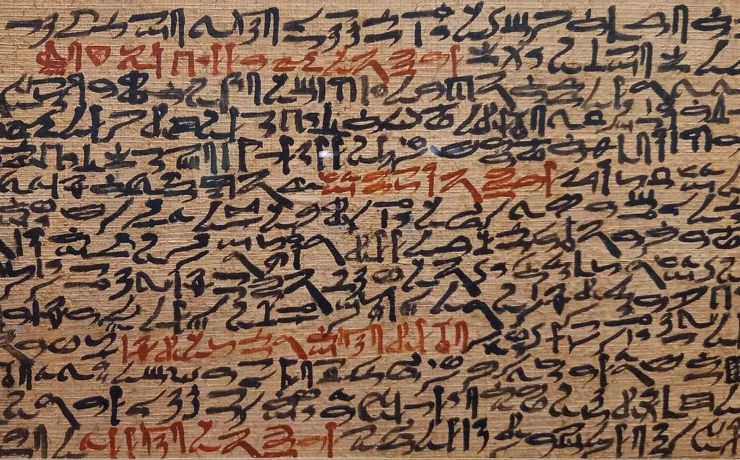
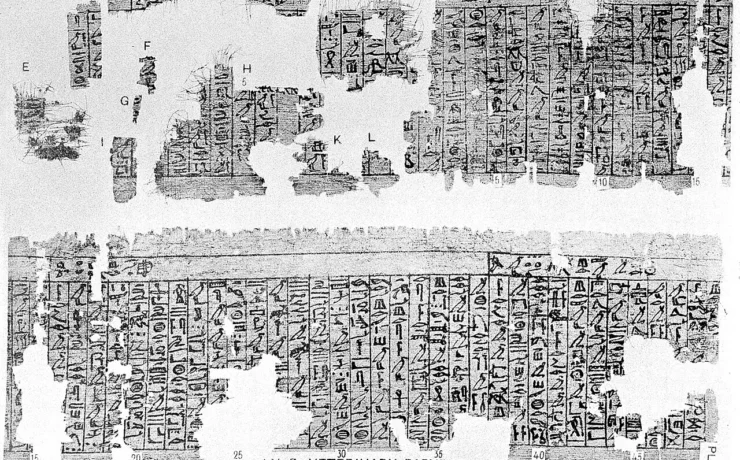
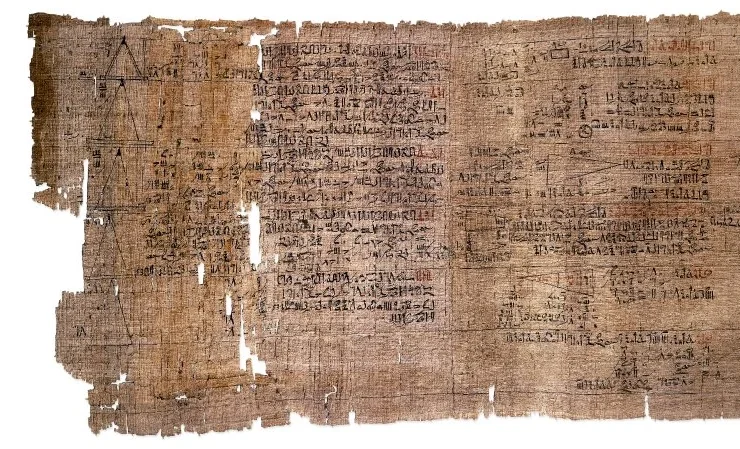
The phrase ancient Egyptian books of the afterlife sounds as though it describes a tidy library with an author, a numbered reading list and one consistent map of the world beyond death. The archaeological reality is far more interesting. Over many centuries, Egyptian scribes copied sacred utterances on pyramid walls, placed protective spells inside decorated coffins, painted elaborate accounts of the sun’s nightly journey in royal tombs and prepared personalized papyri for named deceased people.
Some writings concentrated on protecting identity, speech or access to offerings. Others described gates, gods and regions of the netherworld. No single collection displaced every earlier text; old formulas could be reused, revised and moved into new settings. This source-led guide shows the differences among the Pyramid Texts, Coffin Texts, Book of Two Ways, Amduat, Book of Gates and the better-known Book of the Dead, supported by five photographed museum objects and identifiable institutional catalogues.
Egypt’s afterlife texts at a glance
1. Why did Egyptians create so many funerary writings?
For an ancient Egyptian family or royal institution, caring for the dead was not necessarily limited to enclosing a body in a secure tomb. Texts and images expressed what a person or ruler hoped to retain: a name, recognizable identity, access to food, the ability to speak, protection from dangerous beings and involvement in cosmic renewal. These were historical expressions of religious expectations, not measurements of what physically happens after death.
Different textual genres served different tasks. A ritual utterance could be recited or inscribed; a list of offerings might sustain the dead in symbolic form; a decorated map might represent a dangerous journey. Religious phrases could also establish relationships with Osiris, Re, Horus and other divinities. Because beliefs and burial resources changed through time, there was no requirement for every surviving tomb to contain the same repertoire.
Even the English term “book” is a convenient modern label. The UCL Digital Egypt overview explains that several principal corpora are named after the material surfaces on which scholars encountered them most often. That does not make every composition on a pyramid unique to a pyramid or every later papyrus part of one authorized canon.
2. The Pyramid Texts: the oldest surviving major royal corpus
The Pyramid Texts are among the earliest substantial collections of religious utterances preserved in Egypt. Their first surviving extensive pyramid inscriptions appear in the burial apartments of Unas, a ruler of the late Fifth Dynasty at Saqqara. Later Old Kingdom pyramids of rulers including Teti, Pepi I and Pepi II preserve other versions and selections. These inscribed passages were part of royal funerary space, and their location mattered: readers should understand the architecture and chamber arrangement, not imagine a book lying open beside the sarcophagus.
They address many concerns, from protection and ascent toward the divine sphere to royal identity among the gods. Some texts present the dead king in relation to celestial powers and transformations. Their dramatic language does not supply a literal historical record of travel through the stars; it is an Egyptian religious vision designed for the burial setting.
A serious warning concerns exclusivity. The preserved Old Kingdom royal corpus is particularly associated with kings and royal women, but later copies and adaptations show the formulas circulating beyond their initial surviving contexts. The history is not a simple switch that permanently ended royal ownership. See UCL’s scholarly outline of the Pyramid Texts for named monuments and later reuse.
3. A real example of ancient textual reuse: Ramesses I
One of the most powerful pieces of evidence for continuity is not an Old Kingdom pyramid at all. A limestone relief from the chapel of Ramesses I at Abydos, now in The Metropolitan Museum of Art, includes funerary formulas that curators identify as deriving from the much earlier Pyramid Texts. The relief was produced in the Ramesside New Kingdom, long after the first pyramid inscriptions. In other words, an old sacred repertoire could be brought into a much later royal setting.

This object lets students test an argument. We can establish that a particular historical relief exists, identify its owner and approximate production period, and compare its recorded formulae with earlier texts. The mythological claims made by those formulas are a separate kind of statement. The object also disproves the assumption that ancient Egyptians discarded old texts each time they developed new funerary compositions.
Another caution is chronological: the chapel belongs to Ramesses I and was completed under his successor Seti I. A caption that treats every carving simply as an eyewitness picture painted by Ramesses I himself would erase that architectural history.
4. Coffin Texts: a much wider set of voices
In the First Intermediate Period and the Middle Kingdom, funerary formulas appeared prominently on coffins and in associated burial settings. Modern scholarship groups much of this material under the term Coffin Texts. Many texts adapt themes or utterances found in the earlier Pyramid Texts, while other passages introduce new concerns and ways of navigating existence beyond death.
These documents are often associated with officials, priests and other non-royal elites. That is an important social change, but it should not be marketed as proof that every ordinary Egyptian suddenly owned an illustrated coffin full of spells. Making and decorating a substantial wooden coffin required craftspeople, resources and access to scribal expertise. Preservation and excavation history also affect the sample modern researchers can study.
Coffin Texts can address offerings, protection, movements through hidden spaces, family reunions and transformations into other forms. Some elaborate the peril of dangerous beings or routes and emphasize the deceased’s capacity to operate in a transformed state. For an introduction grounded in Egyptian writing surfaces, start with UCL on the Coffin Texts.
5. The interior of a coffin was a reading space
At first glance a Middle Kingdom coffin may resemble a decorated box. Its interior, however, could be an organized surface of writing, images and object representations. The outer coffin of Hapiankhtifi from Meir illustrates the complexity. The Met describes hundreds of columns of cursive writing inside the coffin, together with a frieze depicting objects valuable for earthly or symbolic existence. Written words and depicted supplies were part of a coordinated funerary environment.
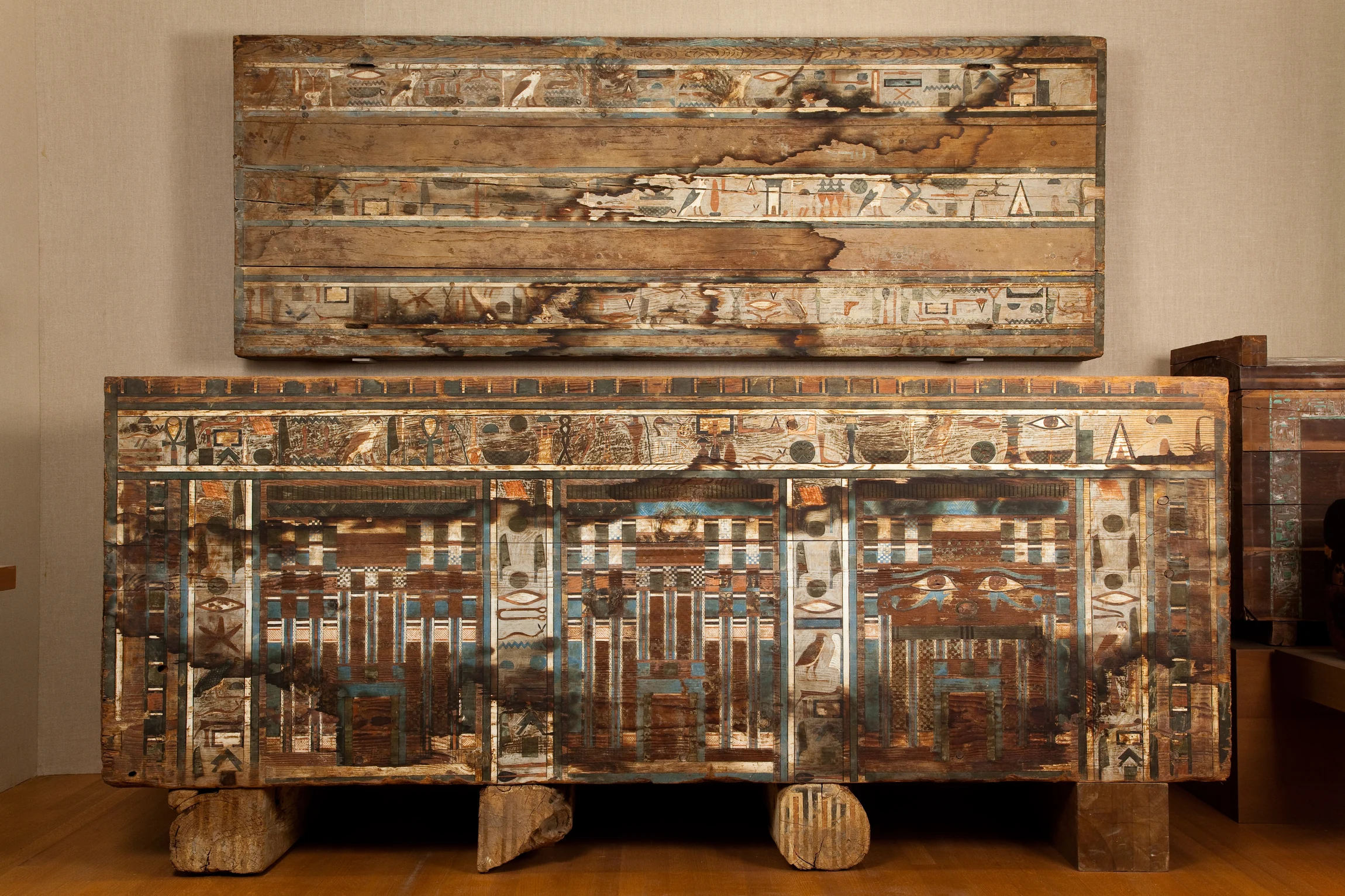
It would be misleading to say this coffin is “the Coffin Texts” in their entirety. It preserves a selection in the context of one named person’s burial. The fact that hieratic writing is more cursive than monumental hieroglyphs does not mean it was informal nonsense. Scribes had practical and carefully developed ways of writing long stretches of text on wood and papyrus.
Consider also the coffin of Nemtiemsaf, a priest whose name identifies its owner. The documented yellow-background inscription bands and painted Horus eyes show how text and image could work together. The painted eyes connect the deceased’s body with visual protection and the world beyond the container, but their exact ritual meaning must be read in context rather than through a universal modern symbol dictionary.

As with all artifacts, object condition matters. Restoration, display orientation and museum photography can make a coffin’s internal and external decoration look simpler or more complete than excavation records would suggest. A museum accession, material description and original findspot give researchers much stronger footing than an anonymous image circulated online.
6. The Coffin Texts did not stay only on coffins
One well-documented archaeological example complicates the neat categories still further. The Met’s statuette of the scribe Merer carries passages related to the Coffin Texts across the figure’s clothing. The object is neither a royal pyramid wall nor a coffin interior. Its inscriptions express divine protection for a named person in yet another physical setting.

This matters methodologically because modern categories are collections of related writings, not instructions about where all ancient copies must have appeared. The same or related utterance could be adapted to a wooden figure, painted panel or later manuscript. By comparing a coffin and a statuette, students can ask which words recur and which details changed with the medium.
We should also avoid assuming that a repeated spell has one fixed meaning irrespective of speaker and audience. A formula directed toward the deceased might be used differently when recited in a rite, copied on an object or combined with a different series of passages.
7. The Book of Two Ways: routes through the beyond
Among the most captivating features of some Middle Kingdom coffins are underworld route diagrams known as the Book of Two Ways. These are often discussed as early examples of cartographic representation because they depict alternative routes, regions and obstacles. At Deir el-Bersha, certain coffin bottoms carry designs in which land and water paths, barriers and labeled spaces guide the deceased through a supernatural geography.
That does not mean archaeologists uncovered a survey map of a real underground cave system. The routes belong to a religious model of the world beyond death. Nor should every coffin or every Coffin Text spell be assumed to include this map. Its distribution is specific, and its modern “earliest map” reputation should be qualified by explaining what kind of map it is.
Smarthistory’s illustrated mortuary-text survey reproduces museum examples and explains how different routes are organized. It is a useful specialist companion because it helps viewers interpret the real object rather than a generalized fantasy labyrinth.
8. The Amduat: twelve hours of the sun’s journey
The Amduat, often explained as “What is in the Netherworld,” belongs to a different but overlapping stream of Egyptian funerary writing. Its elaborate texts and images describe the nocturnal passage of the sun god through divisions of the netherworld. A sequence of twelve hours provides a structure for encounters with inhabitants, dangers and powers of renewal. Its principal royal tomb setting becomes especially prominent during the New Kingdom.
The Amduat is not simply a chapter of the Book of the Dead. Where a Book of the Dead manuscript assembles protective formulas and scenes selected for an individual, Amduat compositions describe an organized cosmic process and its divine participants. The two traditions could nevertheless appear in the wider burial culture of later Egypt, and elements of solar renewal influenced more than one corpus.
Crucially, the Amduat was not locked permanently inside royal rock-cut tombs. During the Third Intermediate Period, private funerary papyri could include Amduat material. One especially strong example is the papyrus prepared for Henettawy, daughter of Isetemkheb, dating to the Twenty-first Dynasty and now held by The Met.

The museum describes this roll as containing part of the tenth hour of the sun’s nocturnal journey, with blank space perhaps intended for further material. This is a good example of the limits of reconstruction. We can describe the extant images and catalogued owner; we should not invent missing scenes or silently call a surviving excerpt a fully preserved twelve-hour manuscript.
9. The Book of Gates: thresholds, guardians and recognition
The Book of Gates is another important corpus of underworld compositions. It portrays the sun’s passage through nocturnal regions separated by guarded gates. Knowledge, identification and orderly movement are prominent, and later royal tomb scenes explore judgment and cosmic renewal through a series of elaborate images.
Some popular summaries make its routes sound like a modern video-game puzzle in which a traveler recites passwords to advance. Such metaphors can help a beginner remember the visual structure, but they do not explain why a king’s tomb would display highly organized images of divine time, law and rebirth. The gates express ritual and theological order as much as dramatic peril.
The Global Egyptian Museum’s Book of Gates overview discusses its appearance in royal tomb decoration, including Horemheb and Ramesside successors, and the later use of particular scenes. This record supports a chronological argument while reminding readers that textual relationships and first appearances are sometimes disputed.
10. The Book of the Dead: a related tradition, not the same work
The famous Book of the Dead, also called the Book of Coming Forth by Day, expanded the tradition of selecting funerary compositions for an individual. New Kingdom and later papyri contain spells, hymns and images dealing with protection, identity, movement and judgment. Like earlier corpora, it borrowed, revised and recombined inherited themes. Unlike the grand Amduat narrative, its manuscripts were not all organized around the sun’s twelve night hours.
Modern chapter numbers make comparisons easier. They do not turn the tradition into a single ancient volume with one identical sequence bought by everybody. Some owners could afford long and lavish scrolls; others received different provisions, and the visible archaeological sample is uneven. The famous weighing of the heart belongs to the Book of the Dead’s wider repertoire, but it does not exhaust it.
For a full manuscript-by-manuscript exploration with four original papyri and a discussion of Chapter 125, read Kemet Vault’s illustrated Book of the Dead reference guide. That article examines the actual spells in depth; this page is a comparative map of several traditions and should not compete with it for the same narrow search query.
11. Compare the major texts without confusing their evidence
| Corpus or work | Principal surviving context | Main focus | Important qualification |
|---|---|---|---|
| Pyramid Texts | Royal pyramid interiors, Old Kingdom | Royal transformation and divine ascent | Old formulas survived and were reused later |
| Coffin Texts | Decorated coffins and other Middle Kingdom objects | Protection, offerings, transformations, routes | Non-royal evidence does not imply universal access |
| Book of Two Ways | Some Middle Kingdom coffin floors | Alternative routes through the supernatural realm | Symbolic cosmography, not a survey map |
| Amduat | New Kingdom royal tombs and some later papyri | Twelve hours of Re’s nocturnal travel | Later non-royal examples survive |
| Book of Gates | Royal tomb walls and later funerary contexts | Guarded thresholds, order and renewal | Compositions and scenes developed over time |
| Book of the Dead | Personal papyri and other funerary equipment | Selected spells, transformation and judgment | No single identical manuscript for all owners |
Notice how the media differ: stone walls, coffins, wooden figures, papyri and tomb decorations. The practical surface is itself evidence about where and by whom a composition was displayed. Chronology is necessary but not sufficient; a later stone relief may preserve an older utterance. Egyptian religion was a long sequence of changing conversations with inherited words, not a row of completely separate, mutually exclusive books.
12. A critical reader’s method: date the object, not only the spell
If an inscription associated with the Pyramid Texts appears on a Nineteenth Dynasty relief, its physical date and its literary ancestry are different facts. If a Twenty-first Dynasty Amduat roll copies royal underworld imagery, its owner, manuscript and represented tradition must be distinguished. Confusing those layers can produce enormous errors in explanations of Egyptian religious history.
Start with the museum’s object number and catalogue entry. Read what the institution says about the medium, inscriptions, findspot, excavation, repairs and probable dating. Then study the genre and compare it with an earlier attestation. Only after that should an article interpret the religious scene, separating physical description from reconstructed meaning.
| Question | Useful evidence | Unwarranted shortcut |
|---|---|---|
| How old is this papyrus? | Paleography, archaeological context and museum dating | Assuming the composition was invented when this copy was made |
| Who used the text? | Named owners, inscriptions, tomb context | Claiming it belonged to every Egyptian |
| Is this picture a historical place? | Represented deities, caption and comparative images | Calling supernatural regions excavated geographical sites |
| Is the manuscript complete? | Surviving sections, breaks, catalogued fragments | Filling gaps with an unlabelled modern reconstruction |
The archaeology of body preservation has a different evidence base. For what genuine natron bags, embalming swabs, linen and canopic jars reveal, use our mummification materials and methods study. This page concerns written religious traditions, not step-by-step body treatment.
13. How do these books relate to Osiris, Re and other gods?
Two broad patterns recur in different forms: the dead person’s association with Osiris, ruler of the dead, and participation in cosmic renewal linked with the sun. These are not competing modern scientific explanations. They are Egyptian ways of expressing the hoped-for continuity of life and order. Divine names and combinations varied, and a single surviving papyrus may emphasize one theological aspect more strongly than another.
The Amduat gives unusual visual weight to Re’s nightly passage and meeting with the powers of the netherworld. The Book of the Dead includes the much-discussed judgment of the dead in the presence of Osiris but also many spells not centered on that trial. Coffin Texts can contain transformations, offerings and other themes that later traditions reformulate. Historians trace those continuities through texts rather than claiming one secret doctrine remained untouched for three millennia.
For the changing historical image of the lord of the dead, consult our source-led Osiris guide. For the relationship between mythological narrative and attested manuscripts, read the Isis and Osiris myth study. Both distinguish religious claims from archaeological proof.
14. Other Egyptian books and texts worth exploring
Beyond the five main corpora discussed here, scholars study the Book of Caverns, Book of the Earth, Book of Day and Book of Night, among others. Some preserve elaborate depictions of the sun’s movement through cosmic regions. Others reflect theological responses to royal burial and changing temple practices. Their titles are modern conventions, their surviving copies can be incomplete and the internal organization varies.
Different textual genres also survive outside funerary settings: wisdom instructions, stories, hymns, medical and mathematical papyri, administrative accounts and school exercises. They should not be put under a single umbrella called “books of magic.” For example, instructional literature asks different questions from underworld cosmography, and a medical papyrus requires different standards of interpretation from a funerary spell.
Our guide to scribes, hieroglyphs and hieratic writing offers a foundation for understanding how such materials were prepared and read. The hieroglyphic explorer is a reference for signs, not an automatic translator capable of reading any papyrus from a photograph.
15. Frequently asked questions
Is the Pyramid Texts collection the same as the Book of the Dead?
No. Both belong to Egyptian funerary literature and some compositions are related, but their surviving historical contexts, period emphasis and forms differ. Royal pyramid inscriptions were not bound papyrus scrolls, while later Book of the Dead manuscripts frequently contain selections of spells and illustrations prepared for individuals.
Did the Coffin Texts make the afterlife available to everyone?
They provide remarkable non-royal elite examples and demonstrate a wider social distribution of some compositions. They do not prove that every social class had the resources or opportunity to commission inscribed funerary equipment. The archaeological record favors burials that were preserved and discovered.
Was the Amduat an actual map of the earth or a hidden tunnel system?
No. It portrays the Egyptian religious netherworld as part of the solar cycle, not a topographic survey of a place that archaeologists can visit. The twelve-hour structure is mythological cosmography. Ancient belief in the text is a historical fact; the supernatural geography is a religious representation.
Which Egyptian funerary text should students study first?
Begin with one identifiable object, such as an inscribed coffin or papyrus, and its museum record. Compare the object with the broad chronological guide here, then use a specialist scholarly edition for exact spell readings. This method is more reliable than treating modern internet translations as one complete ancient Egyptian scripture.
16. Sources, accession numbers and image rights
All five photographs on this page portray separately catalogued museum artifacts, copied to Kemet Vault’s own media library only after a public-domain license check. They are not artist reconstructions and do not imply that the website holds the original objects. Ancient dating varies between scholarly frameworks, so the broad chronological ranges in this article are approximate.
- UCL Digital Egypt: Egyptian religious texts and their surviving media
- UCL: Pyramid Texts and later copies
- UCL: Coffin Texts, period and manuscript contexts
- UCL: Book of the Dead and manuscript transmission
- Smarthistory: Mortuary texts and the Book of Two Ways
- Australian Museum: Egyptian funerary texts, Amduat and solar renewal
- Global Egyptian Museum: Book of Gates and tomb decoration
- The Met: Ramesses I relief, 11.155.3a
- The Met: Hapiankhtifi’s inscribed coffin, 12.183.11a.1, .2
- The Met: Nemtiemsaf’s coffin, 32.3.428a, b
- The Met: Statuette of Merer, 10.176.59
- The Met: Henettawy’s Amduat papyrus, 25.3.28
Continue reading: Book of the Dead and genuine papyri · Mummification and burial technology · Interactive ancient Egyptian chronology.