What is the Rhind Mathematical Papyrus? It is an ancient Egyptian mathematical text copied by the scribe Ahmes around 1550 BCE, with surviving sections catalogued at the British Museum as EA10057 and EA10058. It preserves tables and worked exercises in arithmetic, fractions and geometry; the British Museum describes 88 mathematical problems.
This source-led guide distinguishes the original surviving papyrus from a later published scholarly reconstruction. It explains the document’s writing, mathematical methods and museum provenance, and avoids mistaking modern symbolic translations for the notation of an ancient scribe.
What is the Rhind Mathematical Papyrus?
The Rhind Mathematical Papyrus is a surviving ancient Egyptian mathematical manuscript, now represented by the British Museum’s catalogued sections EA10057 and EA10058 and related fragments elsewhere. It was copied around 1550 BCE by a scribe named Ahmes or Ahmose, although the knowledge it preserves may be older. The manuscript includes numerical tables and worked problems concerning practical arithmetic, geometry and quantities. Its significance lies in providing direct written evidence of scribal mathematical methods rather than a modern list of discoveries attributed loosely to ancient Egypt.
Named manuscripts are especially valuable because their museum object identifiers, materials and surviving text can be checked. This distinguishes the Rhind Papyrus from generic claims that Egyptians invented every mathematical formula. Our study starts with the physical manuscript and selected problems, compares institutional and scholarly descriptions and explains where different popular summaries use differing problem counts. Readers can then examine the source record rather than accepting a convenient fact copied between websites.
The scribe Ahmes and the date of copying
The manuscript is associated with the scribe Ahmes, who recorded calculations in hieratic, the cursive script used for many Egyptian documents. Its copying is conventionally placed toward the end of the Second Intermediate Period, roughly 1550 BCE, while some internal wording and the mathematical tradition appear to refer back to an earlier source. A date attached to the surviving roll is therefore not necessarily the year in which every underlying rule was first invented.
This is a crucial distinction in the history of knowledge. A scribe can copy, reorganise or explain an older procedure, leaving valuable evidence of how mathematics was taught or transmitted in his own period. Without an independently datable original exemplar, it would be speculative to identify a single author of all problems. Ahmes is known through his role in this document rather than a fully recoverable biography of his education and career.
What the British Museum’s two inventory numbers mean
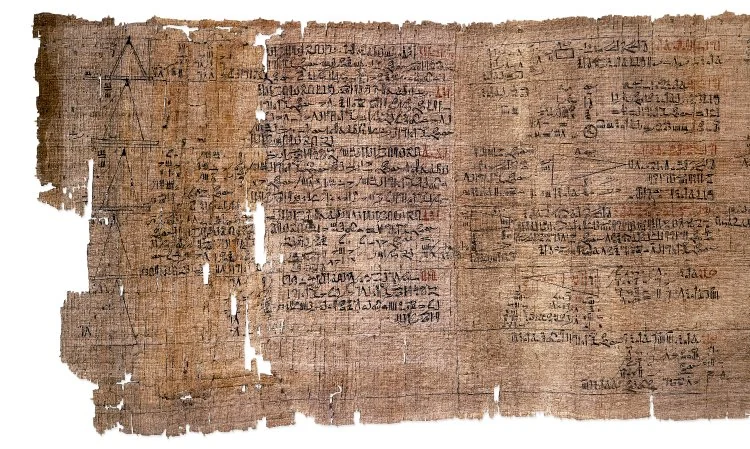
The surviving material is not one intact roll displayed under a single undifferentiated number. The British Museum’s records identify EA10057 and EA10058 as major parts, while smaller related fragments are held outside the main London collection. Wolfram MathWorld describes this separation and the nineteenth-century acquisition history. The exact museum record matters for photographs and scholarship: an image of one section should not be captioned as though it shows every surviving fragment.
Museum catalogues and archival facsimiles perform different roles. A catalogue record describes an object and its collection identity; a translation or printed reconstruction arranges the text for readers who cannot easily examine the fragile papyrus. Neither is the same as viewing the complete original with unrestricted access. Our illustrations deliberately separate an actual photograph of a papyrus section from a historical scholarly reconstruction of the fragments.
The history of the name Alexander Henry Rhind
The papyrus takes its modern name from Alexander Henry Rhind, the Scottish antiquarian who acquired the manuscript in Egypt during the nineteenth century. He did not write the hieratic mathematical text, and the name does not describe the people who first developed its procedures. The British Museum’s acquisitions later placed the principal sections in London, while other pieces entered separate collections. This history is part of the document’s modern provenance, not its ancient authorship.
Museum collection histories deserve attention because an artefact’s present location and its origin are different facts. The papyrus is Egyptian in language, subject and archaeological background even though parts are catalogued in the United Kingdom and United States. A source-based presentation names the original text, the copying period and the modern collectors separately. Confusing these roles would turn museum administrative labels into false accounts of ancient intellectual history.
Hieratic writing and the appearance of the calculations
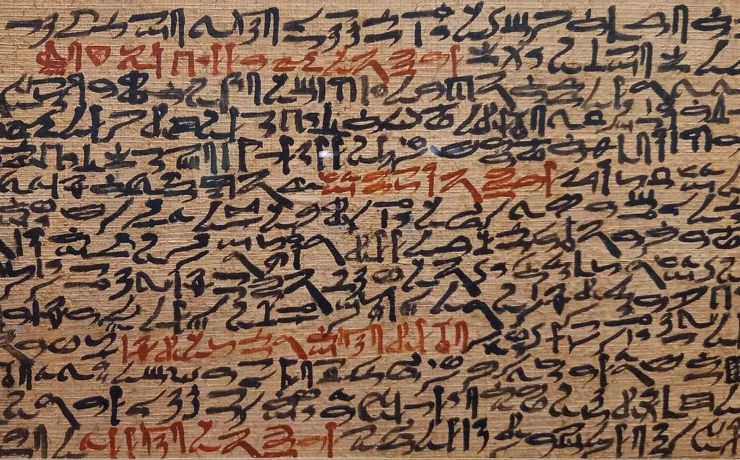
The manuscript was written in hieratic, not in the monumental picture-like forms most visitors associate with temple walls. The British Museum’s guide describes a pedagogical pattern in which methods and instructions can be distinguished through the use of red and black ink. Material features such as layout, columns, ink colours and alterations are part of the evidence. They reveal a working document designed to communicate procedures.
Transcription introduces a new representational layer. A scholarly facsimile may use regularised hieroglyphs or Roman transliteration to make the text legible, while a modern textbook may substitute familiar Arabic numerals and algebraic symbols. Those editorial choices can be helpful if made explicit. They should never be presented as proof that an ancient Egyptian scribe wrote equations in exactly the same notation used in a contemporary classroom.
Why accounts disagree on the number of problems
The British Museum’s exhibition guide characterises the manuscript as a collection of 88 mathematical problems. Other scholarly and reference summaries have counted the principal problems differently, depending on the treatment of tables, subproblems and fragments. A page that displays one single problem count without naming its convention may therefore appear to contradict another credible source. This article identifies the museum’s 88 figure and treats alternate counting schemes as a matter of editorial classification, not a new archaeological discovery.
The exact total matters less than the structure of the surviving evidence. The text includes arithmetic operations, fractions, geometry, quantity calculations and exercises that illustrate methods through worked examples. A numbered exercise can be subdivided or combined in later editions. Researchers should identify the edition when referring to a problem number. This care also helps avoid mixing a Rhind exercise with a famous calculation from another Egyptian manuscript.
Egyptian fractions and the 2/n table
One of the document’s striking mathematical features is its treatment of fractions. Egyptian scribal calculations commonly represented many fractions as sums of unit fractions, each with a numerator of one, subject to specific conventional exceptions. The Rhind Papyrus contains a 2/n table that helped organise such representations for certain odd denominators. It is a practical reference table rather than a mysterious code or a set of secret religious symbols.
Modern readers may prefer to express a result as a single fraction or decimal. Rewriting an ancient calculation in that form can be useful for checking its arithmetic, but the original representation should be explained too. Unit-fraction decomposition is not merely an awkward substitute for a modern notation; it is a consistent mathematical technique with its own conventions. A careful worked example shows the ancient procedure and then its modern numerical equivalent, identifying any interpretive step.
Multiplication, division and repeated operations
Egyptian scribal arithmetic often used methods that rely on doubling, decomposition and repeated addition. These techniques can solve multiplication problems without requiring a modern printed multiplication table in the familiar form. The Rhind examples allow historians to see how an instruction was organised and followed. Their significance is methodological: they show a procedure carried out in writing instead of a vague assertion that Egyptians had impressive mathematical knowledge.
A modern explanation should not pretend that all Egyptian merchants or farmers used the same written procedure in daily life. The papyrus is a specialist manuscript and may represent particular educational or professional practices. Other archaeological records would be needed to establish how widely those methods were used in different villages or centuries. A scribal notebook offers direct evidence of a learned tradition, not a statistical survey of every ancient person’s numeracy.
Circle-area approximation and the value of pi
Some Rhind problems describe practical ways of calculating areas, including a method for estimating a circle’s area by treating a fraction of its diameter as the side of a square. Historians often translate the rule into modern formulas and obtain an effective approximation of pi. The result is mathematically interesting, but the manuscript does not use the modern Greek symbol π or claim a decimal expansion identical to contemporary mathematics.
The Nature review of an early scholarly edition discusses the approximate value as about 3.160, which is close to but not identical with the modern value. It is misleading to say that the scribe wrote π to hundreds of decimal places or discovered a universal theorem using present-day algebra. The historically meaningful question is how a practical geometric procedure worked, what accuracy it provided and what that suggests about applied measurement.
Problems involving volume and slopes
The Rhind collection includes exercises about measurement and geometry, and scholars discuss ways Egyptian mathematics approached rectangular quantities and other practical forms. Popular summaries sometimes conflate the Rhind Papyrus with the Moscow Mathematical Papyrus, which contains a famous treatment of the volume of a truncated square pyramid. Keeping named manuscripts separate matters as much as separating their museum numbers.
Pyramid measurement can also be discussed through the Egyptian concept of the seqed, an expression relating horizontal displacement to vertical rise. The historical vocabulary and units require explanation before conversion to a modern angle. A source-based article avoids inventing a direct modern equation in the original script, and it does not use a worked geometry exercise as evidence that a particular pyramid at Giza was planned with an exact modern formula.
Photograph of EA10057 versus the scholarly reconstruction
The first image accompanying this article is a faithful documentary photograph of an actual portion of the Rhind Mathematical Papyrus associated with British Museum EA10057. It shows material papyrus and visible writing. This file is identified by Commons as a public-domain reproduction of the ancient object. Its value is that the reader sees the physical surviving source rather than a decorative illustration unrelated to the text.
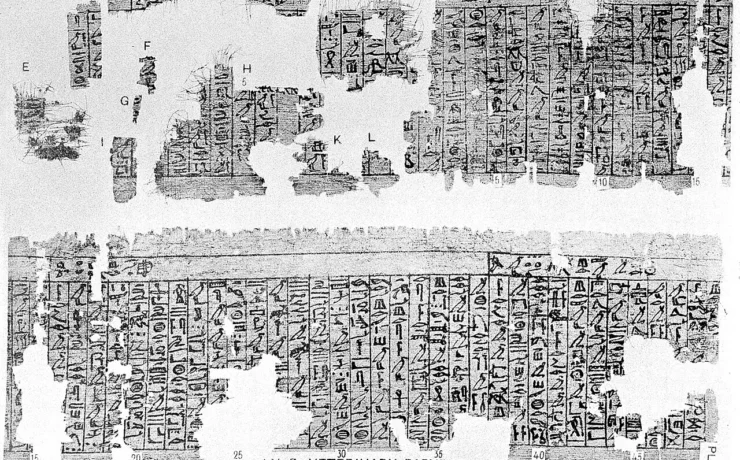
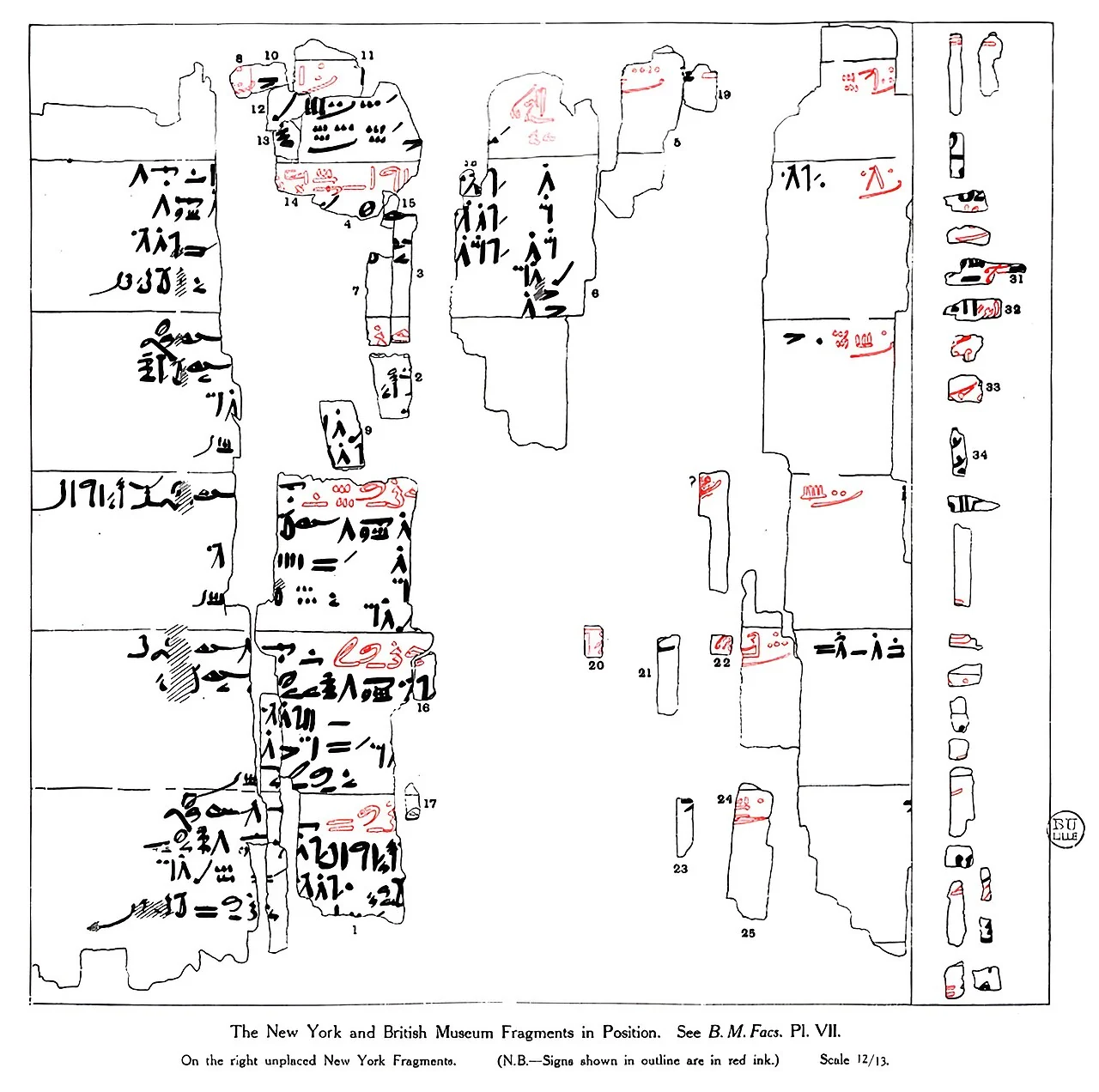
The second image is explicitly different: a scholarly reconstruction of papyrus fragments published by Thomas Eric Peet in 1923 and now available in public domain. Its drawing and transcription help the reader understand the arrangement of surviving pieces, but they are not an unaltered photograph of the original roll. Comparing the two teaches an important research skill: distinguish the object from an editor’s reconstruction or transcription even when both are historically useful.
How to use the Papyrus without overstating ancient science
The Rhind Papyrus illustrates mathematical competence and intellectual effort, but it is not an encyclopedia proving every scientific claim made about ancient Egypt. Its surviving contents support particular worked procedures. They do not settle how those procedures originated, whether every social group learned them or how they compared in every field with later mathematical traditions. Those require wider historical research across many sources and languages.
The document also has a physical preservation history. Handling, conservation, photography and the study of fragments can change what researchers are able to observe. A faithful digital image can support close reading, but an academic edition is still needed for a complete interpretation. The responsible reader distinguishes what the papyrus physically preserves from what a modern analyst calculates or infers using it.
The Rhind Papyrus within Kemet Vault’s evidence library
This dossier concerns one named mathematical manuscript, not a general page on all ancient Egyptian writing. For comparison, Kemet Vault’s Ebers Papyrus study examines an Egyptian medical text, while the Edwin Smith Papyrus article addresses surgical case records. These manuscripts have different subjects, object histories and evidentiary limits. Linking them gives readers a choice of original source types without repeating the same article under several keywords.
A different comparison comes from the overview of scribal writing and education. It explains the wider context in which cursive scripts and professional training developed. The Rhind Papyrus then supplies an unusually specific case of a preserved instructional text. This distinction makes a useful content cluster based on actual source objects rather than bulk-generated pages about interchangeable abstract topics.
Museum records and published historical sources
The surviving museum objects and general chronology are documented by the British Museum’s EA10057 catalogue, its 2022 exhibition guide, Wolfram MathWorld’s historical summary and the 1925 Nature review of Peet’s edition. The first image reproduces an actual ancient manuscript fragment; the second comes from Peet’s published scholarly reconstruction. Their different natures are stated in the captions.