What is the Edwin Smith Surgical Papyrus? It is an Egyptian hieratic manuscript copied around 1600 BCE and now held by the New York Academy of Medicine. Its principal text describes 48 conventionally numbered cases dealing with wounds and bodily trauma, offering observations, examination findings, prognosis and proposed treatment. Unlike many ancient medical texts, the main sequence pays unusual attention to practical examination and how the seriousness of an injury might be judged. That does not make its methods equivalent to modern medicine, and the manuscript also preserves spells and recipes on its reverse.
This study approaches the papyrus as a physical document and a historical witness to medical thinking. It explains the arrangement of cases, the importance of injured heads, necks and bodies, the manuscript’s damaged state, its modern collecting history and its relationship to other Egyptian writings. For a broader view of scribal tools and literacy, read the study of Egyptian scribes. The focus here is the surviving trauma treatise, not present-day medical treatment advice.
The manuscript, date and its current institutional home
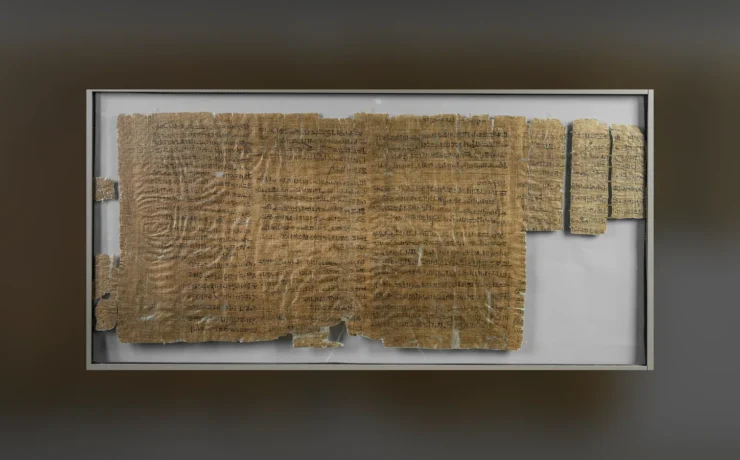
The New York Academy of Medicine identifies the Edwin Smith Surgical Papyrus as an ancient Egyptian hieratic document created around 1600 BCE. The date is an estimate based on its handwriting, and scholars believe parts of its medical knowledge may derive from earlier compositions. That possibility should not be turned into a certain date for a lost original. The papyrus was purchased in Egypt in 1862 by Edwin Smith, an American antiquities collector. Its present name commemorates that modern ownership, not the name of its ancient author. The Academy’s official account traces its later movement through collecting institutions and eventual accession into its own library. The ancient scroll and its modern photographic reproductions are different sources. Modern library photographs show the surviving papyrus; editorial facsimiles may show how scholars reconstructed columns and fragments. A credible study separates the approximate copying date, possible older textual stages and the much later year of modern acquisition.
A long roll broken into sheets and fragments
The manuscript was initially reported as a long papyrus scroll about fifteen feet in length, with some loose pieces. At a point in its collecting history the roll was cut apart, and it is now conserved in multiple sheets. The New York Academy of Medicine describes an original sequence of seventeen columns for the principal text; the National Library of Medicine’s catalogue also uses seventeen columns when listing the surviving manuscript. The beginning and end of the original compilation cannot be recovered with certainty. Physical damage matters: a column can contain incomplete words, and a case may break off before the reader learns the full reasoning or outcome. Modern catalogues sometimes differ on the number of physical sheets because of consolidation, repair or terminology. None of that establishes that the ancient writer planned a bound volume of precisely numbered chapters. Investigating the roll’s material form clarifies why published photographs often display rectangular sections rather than a continuous scroll on a modern reading desk.
The standard 48 trauma cases: what the number means
The Academy and the US National Library of Medicine describe 48 case histories in the principal trauma text. Scholars have established this conventional numbering for analysis, rather than finding a modern table of contents that the ancient scribe had printed in advance. Some modern research catalogues group damaged or incomplete material differently and discuss a possible forty-ninth unit. The sensible public description remains ’48 conventionally numbered trauma cases’, followed by an explanation of the manuscript’s fragmentary state. The surviving sequence moves broadly from the head downward through injuries of the face, neck, shoulders and upper trunk. It is not an encyclopaedia of every known disease in Egypt. The selection appears strongly concerned with physical trauma, such as wounds, fractures and dislocations. Its sequence and changing levels of detail help historians study the habits of teaching and observation. They do not give modern clinicians a validated treatment protocol to follow.
The repeated pattern: examination, prognosis and treatment
One reason the papyrus attracts medical historians is the deliberate arrangement of individual cases. A scenario describes an injury, describes observations to make, reaches a judgement about prospects and may recommend an intervention. The pattern makes clinical reasoning unusually visible for so early a manuscript. The Metropolitan Museum’s exhibition material notes cases arranged by description, examination, diagnosis and treatment, a practical structure distinct from much surviving ritual literature. The process was still embedded in an ancient intellectual and social world. Individual words are interpreted through translations that must account for lost text and older technical vocabulary. A phrase resembling a modern anatomical term should not be taken as evidence that an Egyptian practitioner held the same biological theory as a contemporary specialist. Historians can identify careful attention to signs and likely outcomes while acknowledging errors, uncertainties and the limited case range. The papyrus illustrates a method of thinking, not a certificate that ancient injury treatment was routinely successful.
Three possible verdicts and the ethics of prognosis
The case narratives distinguish situations that a practitioner claims to treat, situations where they will contend with the injury and situations considered beyond successful treatment. Such verdicts are striking evidence that the writer attempted to classify severity and acknowledge limits. The familiar English formulas appear in scholarly translations, not as timeless definitions equivalent to present-day treatment categories. They should also not be presented as one physician’s empirically verified success rates. The surviving document does not tell us how often the recommendation worked, which patients received it or how healers negotiated consent. In historical interpretation, the three verdicts are important because they suggest explicit reflection on prognosis: the likely course of a condition shaped the approach to it. That kind of reasoning existed amid religious practices and other forms of medical care. Modern readers can appreciate the intellectual history without turning descriptions of ancient wounds into DIY procedures. The original text was not written under contemporary safety standards or with modern diagnostic equipment.
Head injuries and observation of the nervous system
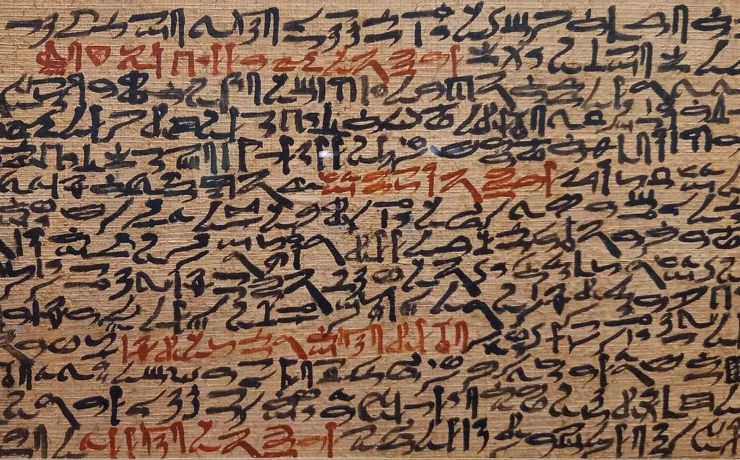
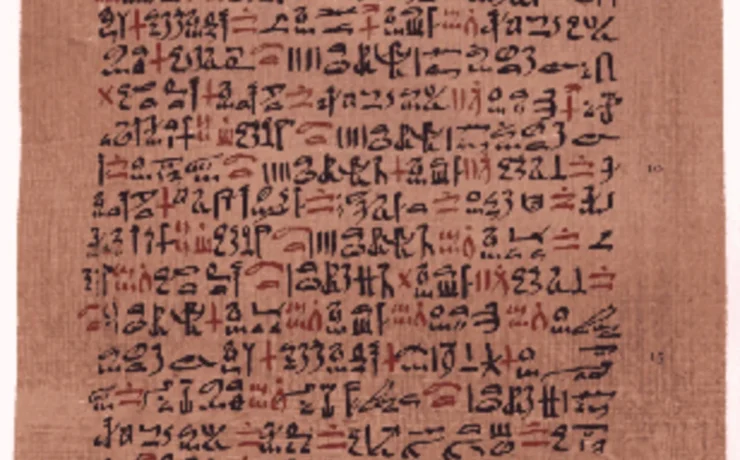
The first part of the trauma text spends considerable attention on the head and the consequences of injury. Scholars have noted discussions that may refer to neurological signs, the function of the brain or spinal injury, but the exact translation of ancient words requires caution. An observed symptom can be real even when the explanation offered in the ancient text differs from present-day anatomy. The Metropolitan Museum’s account of the papyrus emphasizes injuries beginning at the top of the head and moving downward. The manuscript therefore supplies evidence for physical examination, but it cannot diagnose a person living today. One should not reproduce recipes for binding a wound as contemporary first-aid guidance, nor infer that the ancient practitioner possessed a modern theory of neurons. The historical value lies in recording observations and categories in an early written tradition. The accompanying photograph of Wellcome’s documented cases captures real columns, not an illustration created to dramatize a healer at work.
Wounds, fractures and the environment of manual work
The cases include wounds and injuries that could have arisen through labour, accidents or conflict. The Metropolitan Museum observes that the types of trauma are compatible with injuries sustained in construction or warfare, but the text does not identify every subject as a soldier or pyramid worker. A written case need not describe one observed historical patient; it might also represent a teaching model or a compiled tradition. The words must be interpreted through the structure of the manuscript and any evidence of corrections. The range of possible causes is important because ancient Egypt relied on demanding physical work, transportation, farming and military service. The text’s chosen scenarios reveal concern with the effects of trauma without serving as a census of occupational injuries. To explore archaeological evidence for labor organization without conflating texts and sites, compare the Heit el-Ghurab workers’ settlement. An excavation of workshops, however, does not prove that the Edwin Smith Papyrus was ever used at those specific buildings.

A close view of the photographic evidence
The photographs reproduced in this article are not generic hieroglyphic decorations. One image is catalogued by Wellcome as case numbers 9–12, recto column 5, within an archival reproduction associated with James Henry Breasted’s work; the other documents cases 20–24, recto column 8. Their source titles and photographic identifiers distinguish one segment of the scroll from another. Modern image captions are essential because a viewer cannot be expected to identify the exact Egyptian case from the appearance of densely written hieratic lines alone. Neither image makes every word legible at a small display size. The pale papyrus, dark ink, red marks and material wear provide physical evidence for an actual scribal document. Some plates may have been photographed from edited publications or reproductions rather than directly from a current conservation mount. That difference should be recorded, because a facsimile is evidence for the modern publication history as well as for the ancient text it depicts. The underlying artifact remains in the New York Academy of Medicine collection.
Hieratic handwriting and the organization of a technical text
The manuscript was written in hieratic, an Egyptian cursive script related to hieroglyphic writing. Black and red ink helped scribes structure text, signal beginnings and identify quantities or categories. A red mark is a visible organizational feature, not proof that the corresponding diagnosis was right. Training and copied exemplars were crucial in the survival of technical knowledge across generations. A manuscript may combine a main copied text with corrections, notes or additions by different hands. Scholars examine handwriting and textual arrangement to understand how the roll was assembled. The study of Demotic writing offers a later comparison, while the scribe research guide examines writing equipment. Hieratic in a surgical text should not be mistaken for the Demotic band on the Rosetta Stone, or for an alphabet of medical symbols understood without grammatical knowledge.
The verso: spells, remedies and the false divide between magic and medicine
The reverse of the papyrus contains other compositions, including protective spells and recipes. The Academy explicitly notes their presence, providing a useful corrective to claims that the scroll is wholly independent of ancient religion. The coexistence of practical trauma discussion and formulae for protection reflects the diversity of Egyptian medical and ritual writing. It does not mean every case on the recto was magical, and it certainly does not prove that the reverse remedies were effective in a modern clinical sense. The original order and reasons for adding different texts require careful investigation. A roll could continue to be useful to scribes after its principal composition was copied. Modern categories such as ‘science’ and ‘superstition’ can hide the historically different ways people understood healing. It is better to ask what the scribe selected, how the text is structured and which types of explanation it offers. That approach takes the manuscript seriously without repeating extraordinary medical claims unsupported by the evidence.

Who wrote the text, and was Imhotep its author?
Popular accounts sometimes attribute the document’s underlying medical knowledge to Imhotep, the Old Kingdom official later celebrated for wisdom and healing. No inscription on the surviving papyrus securely identifies him as its writer. The idea that an earlier source lay behind parts of the roll rests on language, structure and scholarly reconstruction rather than a surviving signed manuscript from the Old Kingdom. Dating a possible source centuries earlier does not establish one original author. Historical writing should therefore distinguish an anonymous copied trauma text from later traditions about famous intellectual figures. This is particularly important when an article is intended for students: a memorable personal attribution is not a substitute for evidence. The ancient scribe may have worked from predecessors, copied a compilation and added material, but the names and social settings of these acts are not securely documented. Edwin Smith was the nineteenth-century purchaser, not the ancient surgeon or inventor of medicine. The original identity of the person who composed the cases remains unknown.
Edwin Smith, Breasted and the modern history of the roll
Edwin Smith purchased the manuscript in Luxor in 1862. After his death it entered institutional collections before the New York Academy of Medicine became its home in 1948, according to the Academy’s own provenance narrative. James Henry Breasted’s influential 1930 edition included facsimile, transcription, translation and commentary. Later scholarship, including work by James P. Allen, offered further examination and translation of the text. These editions can differ in terminology, reconstruction and interpretation. That is normal for a damaged technical manuscript whose ancient vocabulary does not map perfectly onto modern English. A reader should identify which scholarly translation they are citing rather than reproduce a quotation found in an unattributed online infographic. The material history also raises questions of antiquities collecting and conservation. It is helpful to ask how a roll found in Egypt became available in a New York institution and who has access to high-resolution images. Digital reproductions make study possible, but the object itself has a distinct custodial history.
How historians compare the Edwin Smith and Ebers papyri
The Ebers Papyrus is another famous ancient Egyptian medical text, often discussed alongside the Edwin Smith manuscript. But the works are not interchangeable: the Edwin Smith roll has a highly structured sequence of trauma cases, while Ebers is a much wider compilation of remedies and other health-related material. Neither can stand for every form of ancient Egyptian health practice. Surviving texts represent selective scribal traditions and do not reveal how often ordinary villagers consulted written instructions. The texts also cannot establish whether one manuscript was copied directly from the other simply because they belong to comparable broad periods. Medical historians compare formal features, terminology, language, material evidence and known provenance before proposing relationships. In the larger history of Egyptian written knowledge, the contrast reminds us that there were multiple kinds of specialist record: legal documents, funerary texts, accounts, letters and prescriptions. Different documentary genres need different interpretive methods. The papyrus is therefore a window onto the organization of medical knowledge, not a universal Egyptian doctor’s notebook.
Limits of the evidence and the danger of modern claims
It would be a mistake to describe the papyrus as proof that ancient surgeons possessed all modern anatomical knowledge or could cure conditions that remain serious today. The manuscript preserves a written approach to examining certain injuries, and historians must separate surviving words from interpretations based on later medical concepts. Claims about the ‘first operation’ or the ‘invention of surgery’ require much wider comparative evidence than one roll can supply. The physical papyrus is incomplete, the original author is unknown and some cases may represent teaching scenarios. Similarly, dramatic statements about perfect sterile techniques or controlled surgery do not follow from the surviving text. A responsible interpretation emphasizes what makes the document genuinely remarkable: attention to observation, classification of injuries, organised reporting and explicit prognosis within an ancient scribal tradition. None of the procedures in this article should be applied as present-day medical treatment. Serious injuries require modern qualified health professionals, not historical translations.
Frequently asked research questions
Is the Edwin Smith Papyrus a modern medical textbook?
No. It documents ancient Egyptian approaches to physical injury in a historical and incomplete manuscript. Its observations are valuable for the history of ideas but are not current clinical guidance.
How many cases does it contain?
The New York Academy of Medicine describes 48 conventionally numbered trauma cases in the main text. Some researchers discuss differences in dividing incomplete material; the number is a scholarly convention.
Where is the papyrus kept?
The original is held by the New York Academy of Medicine, which supplies its own collection history and links for research use.
Documentary sources and image provenance
New York Academy of Medicine: Edwin Smith Surgical Papyrus; US National Library of Medicine research; NLM manuscript catalogue; The Metropolitan Museum of Art: Art of Medicine in Ancient Egypt; Historical medical scholarship, PubMed. Museum photography and scholarly translations are different sources, and none provides contemporary clinical advice. Image rights: Wellcome Collection CC BY 4.0, separately linked in each caption. Reviewed 31 October 2026.