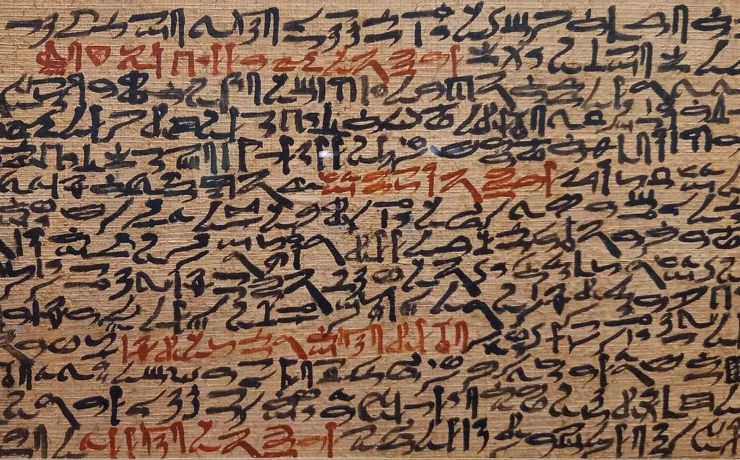
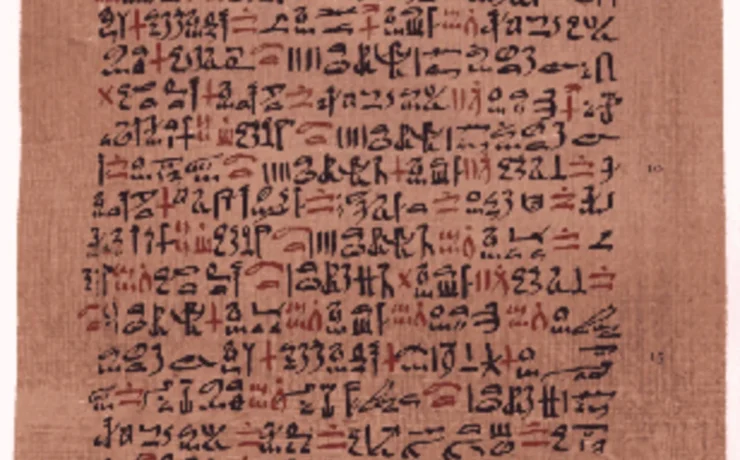
In the twenty-ninth year of Ramesses III, the specialist craftsmen who built royal tombs at Deir el-Medina stopped work and demanded overdue food rations. The Turin Strike Papyrus, a genuine hieratic document by the scribe Amunnakht, records an extraordinary series of protests that moved between temples on the west bank of Thebes. This investigation builds on Barry J. Kemp's questions about labor, resources and royal institutions, then follows the primary testimony in the Museo Egizio's own collection. The visual evidence consists of the original photographed papyrus and a correctly dated real view of the workers' settlement, not a reconstructed photograph of a strike that happened three millennia ago.
The oldest surviving work stoppage is not a slogan
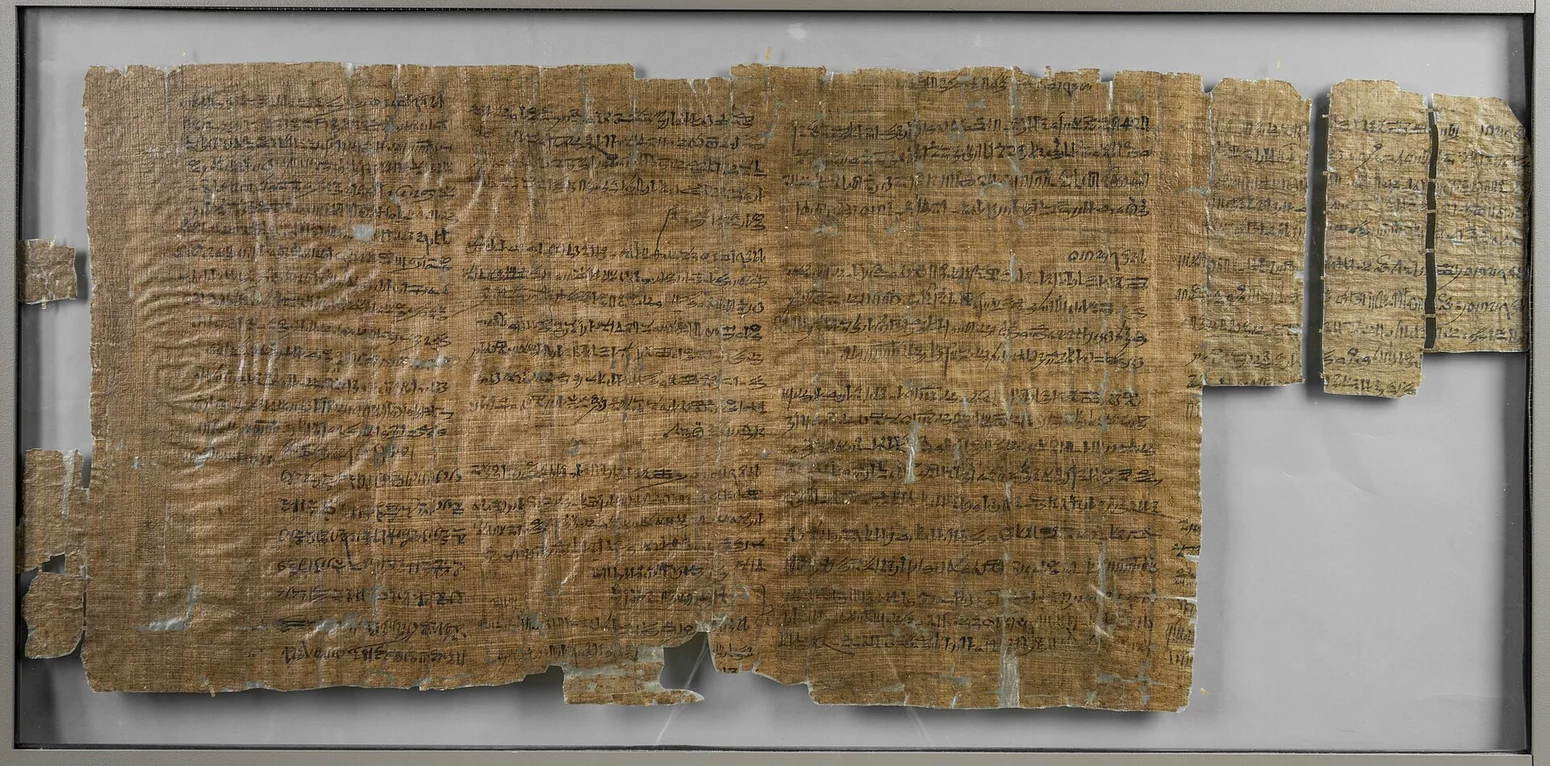
When workmen building the royal tombs of Thebes stopped working under Ramesses III, they left a record more specific than the familiar headline 'the first strike in history.' The Turin Strike Papyrus, Museo Egizio Cat. 1880, is an actual hieratic administrative document produced by a named scribe, Amennakht. It recounts a sequence of protests during the king's twenty-ninth regnal year, when delayed food rations threatened families who depended on their delivery.
Barry Kemp's Anatomy of a Civilization explores how Egyptian institutions coordinated labor and how ideas about divine royal authority interacted with the realities of social life. That framework helps pose a sharp question: what happened when an institution that mobilized skilled craftsmen could not pay them what they were owed? The precise account and quotations, however, come from the original papyrus and its museum edition rather than from a story borrowed from Kemp. It is worth reading the event as repeated negotiations over provisions, not as an invented modern union meeting transplanted into antiquity.
Deir el-Medina was not an anonymous slave camp
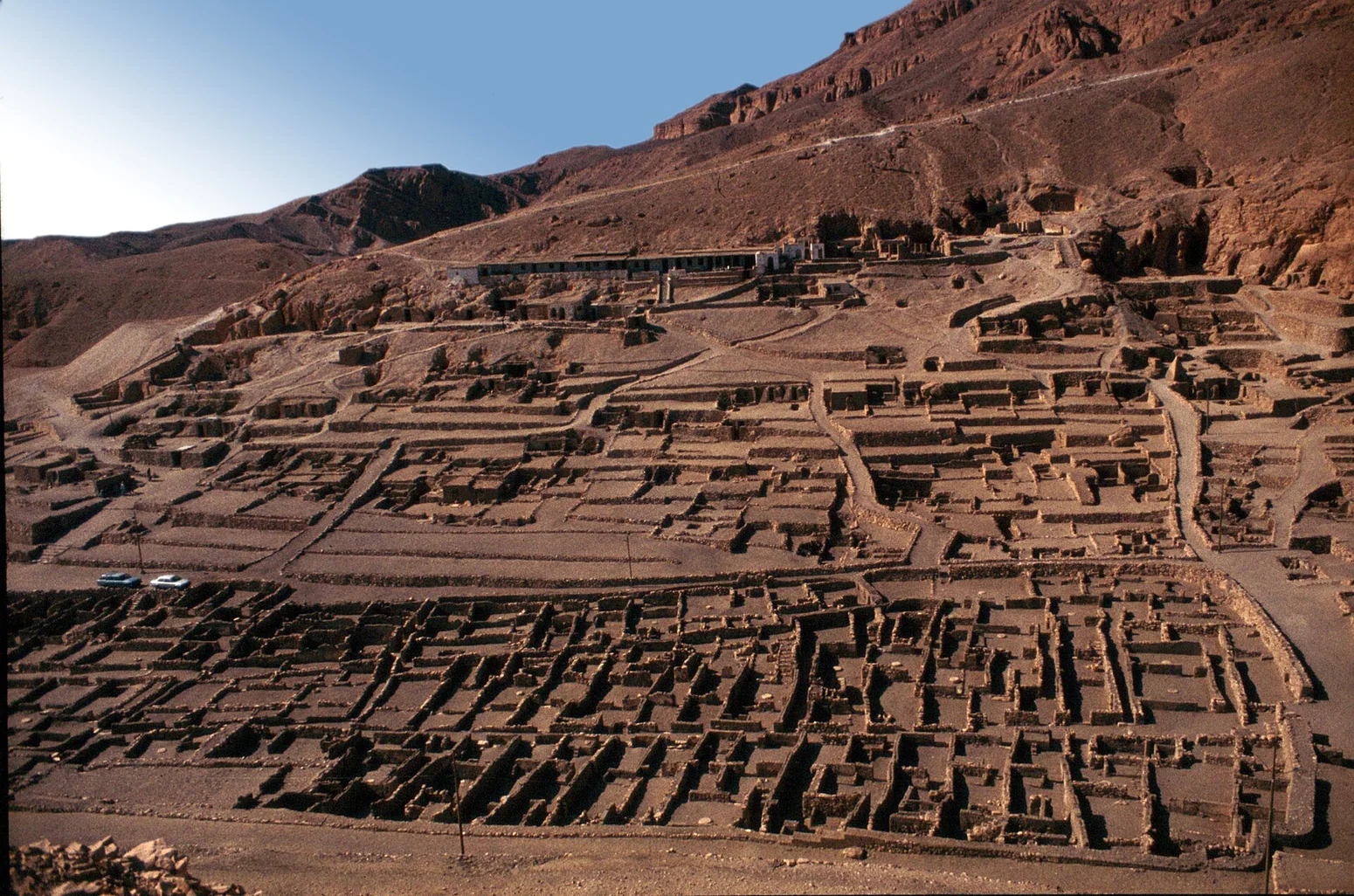
Deir el-Medina was a community of specialist artisans and their families on the western side of Thebes. The people who worked on royal tombs included painters, masons, draftsmen and others with knowledge not easily replaced. They lived in a compact settlement and left unusually extensive traces of their relationships with the state.
The Museo Egizio describes the community as supervised directly by the vizier's administration for work on tombs in the Valley of the Kings and Valley of the Queens. Such supervision could bring privileges and regular rations, yet also make a family highly dependent on official supply. This workforce should not be treated as a generic population sample of Egypt, or as people who always exercised free choice without pressure. Their occupational specialization and recorded settlement matter. A photograph of the modern ruins can show the close arrangement of houses but cannot reveal the private thoughts of a particular striker. The papyrus allows us to examine one documented conflict within a distinctive social setting.
A pay packet made of grain
The workers were not waiting for modern cash wages deposited into a bank account. Their remuneration included regular deliveries of grain and other goods. In an economy where grain could be stored, measured and distributed institutionally, missing a scheduled allocation was a serious threat. Delays affected households, not merely workers' professional pride.
The museum interprets the crisis within broader economic difficulties of the Ramesside state. That does not let us produce a complete chart of treasury expenditure or establish that a single royal festival caused this particular shortage. A ration system requires harvesting, collection, storage, transport and timely allocation, with several administrative steps where disruption may occur. Heqanakht's earlier Middle Kingdom letters illuminate different forms of grain management, but belong to a period many centuries earlier. The two bodies of evidence should not be merged into one national wage policy. Their broader lesson is that people could be paid in resources whose availability required real institutions and could become the subject of disputes.
Year twenty-nine, not a modern calendar appointment
The famous event belongs to year 29 of Ramesses III, usually placed in the twelfth century BCE. The papyrus dates an important action to the tenth day of the second month of the inundation season. Converting ancient regnal calendars into modern dates is a scholarly operation with assumptions, so a confident contemporary day-month-year date is not always appropriate.
The Museo Egizio explains that the stoppage began in November and continued through episodes reaching January of the next year in modern approximations. We should keep those modern approximations distinct from the Egyptian date as originally recorded. Regnal chronology can anchor a document in the reign of a named king without proving every event in his long administration occurred because of one personal order. The name Ramesses III identifies the political setting and the authority to whom complaints might be addressed, not necessarily the official who personally mishandled the first grain delivery. Precision about dates creates a better history than a vague tale beginning 'one day the workers rebelled.'
A controlled boundary that workers crossed
In the papyrus, the work crew passes a control post and takes its complaint beyond its normal working area. This is significant behavior in a community whose movement and labor were structured by official oversight. The point was not simply to drop tools for an afternoon. The group crossed boundaries and made its unmet demands visible to authorities and nearby temple institutions.
Modern descriptions often call their action a sit-in. That may be a useful comparison because the men occupied places and refused to resume work. It is not evidence that they developed a twentieth-century theory of labor rights or operated under a trade union charter. Their demands were framed in terms of supplies already owed and the obligation of officials to maintain them. The papyrus describes repeated movement to particular temple precincts. A specialist can compare the landscape of western Thebes with the recorded route, but no surviving contemporary photographs show the march. A current photograph of the settlement is contextual archaeology, not documentary footage of the action.
Behind the temple of Thutmose III
The document locates one episode behind the funerary temple of Thutmose III. That choice of setting matters. A royal memorial institution was a visible place associated with state authority and sacred legitimacy. Occupying such an area could turn an administrative shortage into a public embarrassment for the authorities.
The museum's translation includes the workers' declaration of hunger after a prolonged delay. The exact wording belongs to a published translation, and different editions may express it differently in English. We do not need to reproduce the dramatic phrases at length to understand their force. The men were demanding material supplies from people responsible for distributing them. Their chosen location also indicates a practical knowledge of the landscape: temples and officials were accessible points at which complaints might be heard. Yet the papyrus does not tell us how every passerby responded. The setting explains the leverage of the action without allowing a historian to invent a crowd cheering in the courts of the temple.
The sequence moved between temples
The Turin report describes a series of stoppages and attempts at conciliation. The workers did not merely announce one demand and return permanently satisfied. After receiving some overdue grain, they stopped work again and sought shelter or visibility in the temple of Seti I. The museum also refers to places connected with Ramesses II during the course of the dispute.
This shifting route is one of the most distinctive features of the document. It suggests a conflict that unfolded through stages as workers tested the responsiveness of different authorities. A payment could resolve an immediate need without fixing the circumstances that produced the delay. This is not a claim about the full economic structure of the New Kingdom. It is the documented pattern in one community and one period. A timeline of distinct temple locations is therefore more informative than the usual single photograph of workers' cottages with the caption 'first strike.' History becomes richer when we follow actions in sequence, while refusing to invent the missing minutes between papyrus entries.
What the men said they lacked
The complaint concerned much more than wounded dignity. The Museo Egizio's rendering describes hunger and thirst, as well as shortages of goods such as fish, vegetables and unguents. These items point to a standard of provision that the workers believed they were entitled to receive. The specific list should not be interpreted as a national minimum-wage law covering every Egyptian laborer.
The claim of entitlement is nonetheless important. It shows that a group could distinguish their ordinary agreed or expected provisions from a situation they considered unacceptable. We should not invent the exact daily caloric contribution of each named item or assume that all household members had identical distributions. Archaeology can recover food remains and vessels; administrative documents can identify categories of rations. The workers' own reported complaint shows how the failure of supply was publicly articulated. It is one of the rare times ordinary working people enter an ancient account not as anonymous labor in a royal image, but as a collective speaking about material needs.
Amunnakht: the scribe who recorded the problem
The writer of the Strike Papyrus is identified by the Museo Egizio as Amunnakht, scribe of the tomb. He belonged to the institutional environment that documented work, events, disputes and correspondence for the royal necropolis. His record allows the strike to survive, but it does not mean he sat in a modern journalist's office taking impartial interviews.
A scribe could be simultaneously participant, witness and official recorder, with responsibilities and perspectives that shaped what he thought worth including. Some complaints are preserved in striking language, while the reactions of family members and all administrators are not equally detailed. The document itself is damaged and belongs to a larger world of records that has not survived completely. Historical interpretation must therefore separate its direct report from later reconstructions of personal motivation. Amunnakht's handwriting makes an administrative conflict legible across three millennia. It also reminds us that state writing could preserve evidence of institutional failure, not merely praise for kings.
How did the officials respond?
The authorities made some payments and tried to persuade the workers to resume their assigned duties. The repeated nature of the protests suggests that immediate deliveries did not restore confidence or solve every problem. At times the workers sought to address complaints to higher authorities, including the vizier and the pharaoh as legitimate recipients of petitions.
This is a particularly revealing tension in Egyptian political culture. The same system that represented the king as sacred could provide a language for demanding that the king or senior officers meet their obligations. Protest did not necessarily amount to rejecting kingship itself. The men wanted the government to perform functions it was supposed to perform. Some popular narratives describe the strike as a complete victory or the birth of modern democracy. Neither conclusion follows from the surviving text. We can say that a collective action forced attention and led to provisions being delivered, while the full sequence of the economy's later problems remains outside one papyrus's reach.
Why it is called the first documented strike
Many human communities surely stopped work, refused demands or negotiated supplies before 1150 BCE, but most left no comparable written record. Describing the Deir el-Medina incident as the first documented labor strike refers to the earliest well-known surviving written account of a collective work stoppage. It does not assert that these particular Egyptians invented all forms of protest.
The distinction matters both historically and ethically. An exciting superlative should not erase earlier undocumented people or turn a papyrus into evidence for a universal sequence of labor activism. The Museo Egizio itself presents the document within the history of economic difficulty in the late Ramesside period. We can celebrate the survival of extraordinary worker testimony without assuming modern definitions of employment and rights translate perfectly. The striking fact is that we can identify the year, observe repeated collective acts, trace temple locations and read reported complaints from a named ancient scribe. That is historically remarkable even without turning the workers into our contemporaries.
The photographed papyrus is the actual evidence
The first image in this article is a CC0 high-resolution museum photograph of the Turin Strike Papyrus, catalogue number Cat. 1880. It was made available by the Museo Egizio through its open collections. The photograph shows the original hieratic writing that the museum identifies with Amunnakht's account.
This is not a decorative scroll inserted merely to make the article look ancient. It is the core witness on which the event's chronology and reported demands depend. The photograph alone cannot replace a careful edition or translation, since the writing can be difficult and damaged. The second image is a licensed photograph of Deir el-Medina in 1982 by Gerd Eichmann, documenting the present-day remains of the workers' settlement. The camera did not see the strike; its historical value lies in showing the places connected with the people whose complaint the papyrus recorded. This pairing deliberately avoids an AI-generated reconstruction of angry laborers that might look dramatic but falsely imply visual documentation.
Why the village survived better in text than most others
Deir el-Medina generated a particularly rich archive because its workers, scribes and families participated in repeated administrative and personal transactions. Ostraca and papyri record labor attendance, disputes, economic dealings, religious activities and other aspects of life. The strike account is famous, but it gains meaning when situated within this unusually literate occupational community.
We should not assume that all Egyptian towns generated the same surviving volume of writing. A royal necropolis workforce operated under distinctive institutions, and dry conditions helped preserve material that elsewhere could decay. Even within the village, certain people appear far more frequently than others because they wrote or were included in official records. The absence of a woman's direct speech in one strike entry does not prove that households were unaffected or uninvolved. The papyrus documents the workers' actions through one administrative witness. Other excavated texts can broaden the picture, but every source needs its own provenance and date. Selective survival is not the same as selective history.
What changes when we stop telling only royal stories
Ramesses III is familiar from military inscriptions and monuments, while his workers' complaints show the limits of administrative control from below. The same state could carve images of triumph and struggle to deliver grain to a specialized group. These facts are not contradictory; large institutions are capable of projecting stability while facing logistical and fiscal failures.
Kemp's framework helps us ask how labor, ideology and provisioning interacted in Egypt. The specific evidence of the 29th regnal year comes from the Turin papyrus and the archaeological setting of Deir el-Medina. The workers' action is not proof that all ancient Egyptian craftspeople were free in a modern legal sense or that food shortages were identical across the Nile Valley. It is powerful precisely because the claim can remain narrow: a named community interrupted work, gathered at significant places, demanded its overdue provisions and compelled official responses. Their story deserves to be told without modern speeches, invented leaders or oversimplified slogans. The surviving handwriting is compelling enough.
Evidence at a glance
| Evidence | What can be concluded |
|---|---|
| Museo Egizio Cat. 1880 | Actual hieratic record by Amunnakht about collective work stoppages and overdue rations. |
| Ramesses III year 29 | Ancient dating of the protests; modern calendar conversion is approximate. |
| Temple sites | Recorded actions around mortuary temples, including Thutmose III and Seti I, were stages of the conflict. |
| Initial grain payment | Supplies delivered following pressure, but repeated protests show a longer dispute. |
| Modern site photo | A genuine image of Deir el-Medina ruins, not a photograph of the historical action. |
Frequently asked questions
What was the Deir el-Medina strike about?
The royal tomb workers had not received their regular grain and other provisions, and they stopped working to demand what they considered due.
What year did the strike occur?
The best-known account dates the protests to Ramesses III's twenty-ninth regnal year in the twelfth century BCE.
Where is the actual strike record?
The Museo Egizio in Turin holds the genuine Strike Papyrus, Cat. 1880, and publishes an open-access photograph and explanation.
Was this definitely the first protest by workers anywhere?
It is one of the earliest surviving detailed written records of a collective work stoppage, not proof that nobody ever protested earlier.
Sources and image provenance
This article uses the historical source listed in the bibliography as a research starting point, specifically PDF pages Barry J. Kemp, Anatomy of a Civilization, Arabic scanned edition: analytical discussions of state labor, grain-based provisioning and specialist settlements; the specific strike episode and quotations are sourced independently from Museo Egizio Cat. 1880.. Its historical rhetoric and older interpretations are not treated as conclusive archaeological evidence. The external museum and research records below are linked for independent checking.
- Museo Egizio official original Turin Strike Papyrus Cat. 1880 object record
- Museo Egizio primary museum explanation and translated passages
- Museo Egizio papyrus textual edition Cat. 1880
- Egypt National Museum of Egyptian Civilization: Ramesses III and economic context
- Original CC0 Wikimedia photograph of the Turin strike papyrus
- Licensed site photo of Deir el-Medina by Gerd Eichmann
- Barry J. Kemp, Ancient Egypt: Anatomy of a Civilization, original historical framework
- Photograph: The actual Turin Strike Papyrus, Museo Egizio Cat. 1880, recorded by Amunnakht in the reign of Ramesses III; genuine open-access museum photograph, CC0., Museo Egizio, Turin, original Egyptian hieratic papyrus Cat. 1880, openly released CC0, CC0
- Photograph: Authentic 1982 overview of the surviving Deir el-Medina settlement, photograph by Gerd Eichmann (CC BY-SA 4.0). This is modern archaeological context, NOT an image of the strike itself., Gerd Eichmann, original overview of the real Deir el-Medina site, photographed 1982, CC BY-SA 4.0