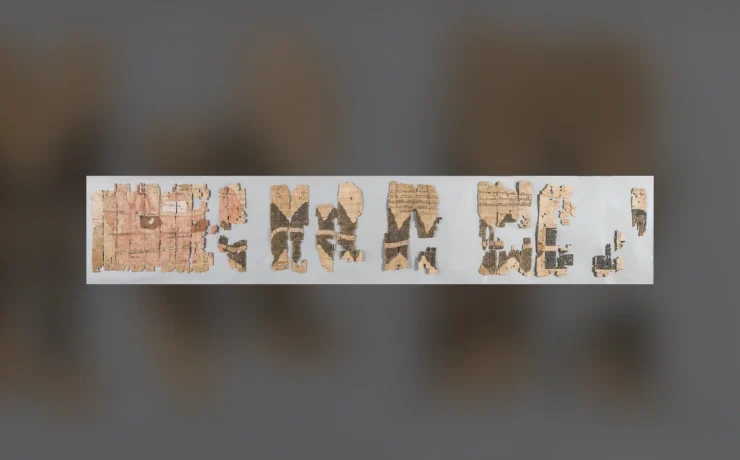
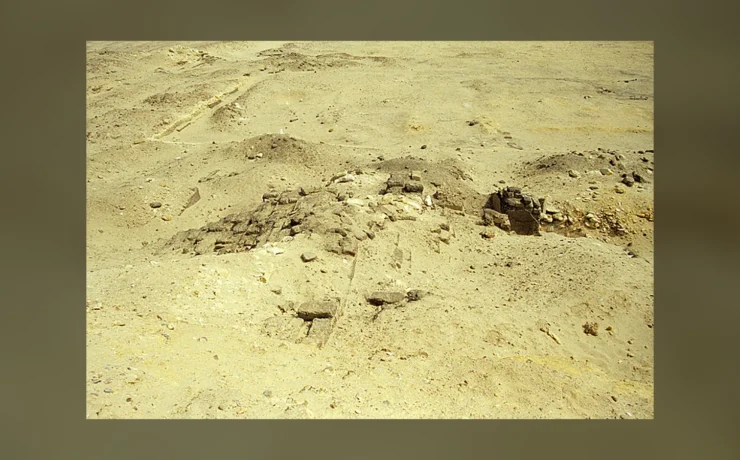
A few kilometers from Akhenaten’s royal buildings at Amarna, a small walled settlement sat in the desert, away from the Nile. Its residents lived in rows of compact houses, raised animals, stored water in large jars and built chapels just outside their walls. Archaeologists call it the Workmen’s Village. It is one of the rare places where we can study the routines of ordinary people in Akhenaten’s short-lived capital rather than relying on royal images.
The most interesting thing about the village is not its size. It is how a centrally planned settlement became a place where households made choices of their own, from altering rooms to keeping pigs and honoring their ancestors.
A village built on a strict plan
The Amarna Project’s excavation overview describes 72 small houses within a roughly square mudbrick enclosure. Most were built to similar plans, arranged along narrow parallel streets. One larger house near the southeast corner may have been associated with a person in authority. The site was set apart from the main city, an arrangement that made movement and supplies unusually important.
Its original function has often been connected with people working on royal tombs, though the precise occupations of all residents cannot be established from the surviving buildings alone. The archaeological evidence is much clearer about the houses, workshops and surrounding installations than it is about the names and job descriptions of their occupants.
The Harvard-supported study of the village excavations explains that the settlement was investigated in the early 1920s and then revisited from 1979 to 1986 under Barry Kemp. The later work recovered far more about everyday activities than the early clearance of house walls could show.
What a small Amarna house was like
A typical house followed a sequence of rooms from front to back. Space was limited, and some activities happened outside the residential enclosure. Yet people modified the standard plans. Excavations found traces of household work, food preparation and different uses of interior space, suggesting that life did not remain exactly as the original planners had imagined it.
The rooms do not come with written labels telling us where every family member slept. Archaeologists reconstruct functions from hearths, storage, installations, objects and comparison with other houses. That uncertainty is part of the evidence, not a failure to understand it.

The settlement’s isolation makes one fact especially striking: a family living there depended on a steady movement of resources from the Nile-side city. Food, pottery and water had to come from somewhere, while the villagers also found ways to produce and maintain things close to home.
Water was the problem nobody could ignore
The village did not have its own excavated well. The water table lay too deep for an easy local supply, and the Amarna Project describes the likely delivery of water from the Main City, probably carried in pottery containers. Archaeologists identified an area outside the enclosure where large water jars, known as zirs, stood upright in stone supports.
That arrangement is much more than a technical footnote. The distance to the river meant that every day’s drinking, cooking, washing and animal care depended on people transporting water. A study of water supply in ancient Egyptian settlements uses the sherds scattered along the route and around the village as evidence for this supply system.
We cannot put an exact daily liter total on every household from these finds. But the physical evidence does show a community whose needs could not be met simply by stepping outside to draw water. In a desert settlement, delivery was fundamental to social life.
Why were there pigs in the desert?
Just beyond the walls were animal pens, built with low masonry and recognizable courtyards. Excavators found dark bristles identified as pig hair, as well as pig bones among other animal remains. The pens’ design and associated troughs suggest that residents kept pigs close to the village.
Pigs need water, and keeping them in this environment would have increased pressure on the supply system. That is why the pig enclosures are significant to researchers: they connect animal husbandry with water delivery, household decisions and the wider economy of the city. Archaeological evidence is much better at establishing the animals’ presence than at telling us which family owned each pig.
Small cultivated plots and other installations beyond the walls point toward some local food production. The settlement’s residents were supplied by larger institutions, yet they weren’t simply passive recipients of state rations. They also organized parts of their daily economy on the desert margin.
Small chapels in the age of Aten
Akhenaten’s reign is famous for promoting Aten, the solar deity. One might therefore expect the religious life of workers near his capital to mirror royal ideology closely. The Workmen’s Village tells a more complicated story. Archaeologists found about 23 small chapels beyond the residential enclosure, many with benches and traces of gatherings. Their imagery included traditional religious motifs and deities, while direct references to Aten were notably absent.
The chapels appear to have belonged to the settlement’s working life, not just to a much later reuse. The Amarna Project suggests they may have been used for ancestor commemoration, including meals shared by families. A few were connected with tombs, and an associated cemetery lay nearby.
Those discoveries don’t prove that every villager rejected the king’s religious program. They do show that royal religious messages and personal practices were not identical. The way people remembered their dead, gathered at shrines and used traditional symbols persisted within the wider world of Amarna.
Why a different workers’ village makes a useful comparison
Deir el-Medina, near ancient Thebes, is another settlement associated with royal tomb workers. It is often used as a comparison because both communities were concentrated and relatively separated from major population centers. But Deir el-Medina has a different history and much richer surviving written evidence about individuals, households and work organization.
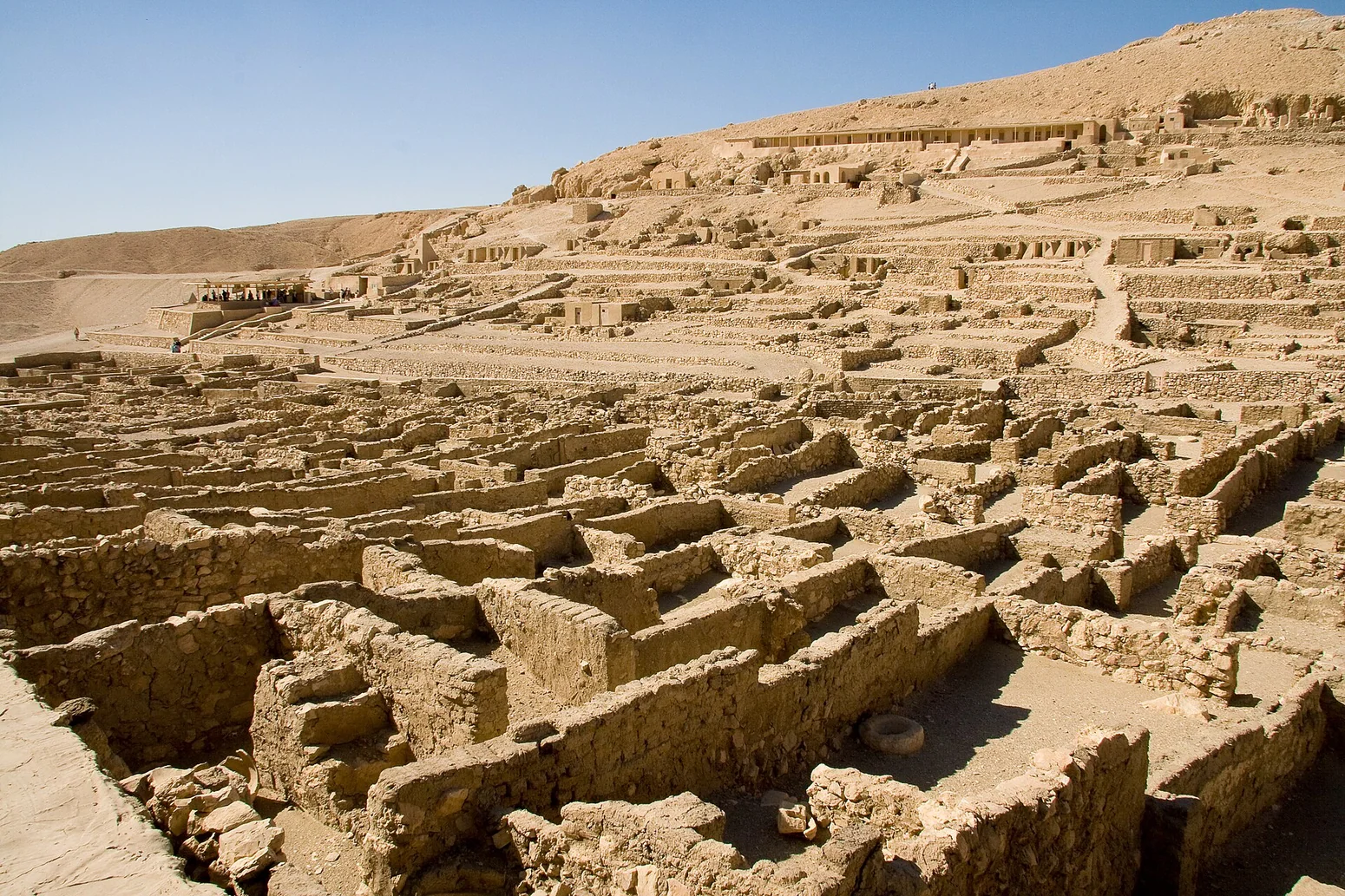
The second photograph here is of Deir el-Medina, not Amarna. Its value is comparative: the layout and ruins encourage questions about the organization of specialized communities, while their differences warn us against copying one village’s story onto another. Our Amarna letters guide covers a very different source tradition, the diplomatic correspondence of the royal court.
What excavation changed about our picture of Amarna
Earlier visitors often saw Amarna mainly through its royal art and religious experiments. The Workmen’s Village helped shift attention toward the people who had to live in the new capital. The published Amarna Reports cover domestic activity, chapels, animal pens, the water-storage area and other excavated contexts in unusual detail.
The evidence has limitations. There are no personal memoirs from every resident, and a pottery sherd cannot explain its owner’s private hopes. But wells that weren’t there, jars that were, pens built for pigs and spaces created for ritual gatherings all leave a connected story. They show a community shaped by royal planning but transformed through the daily needs of the people living in it.
That is what makes the 72 houses memorable. The village was built according to a plan; its inhabitants had to make a life within and beyond that plan. In those small adjustments, archaeology brings ordinary Amarna closer than another distant view of a royal temple ever could.