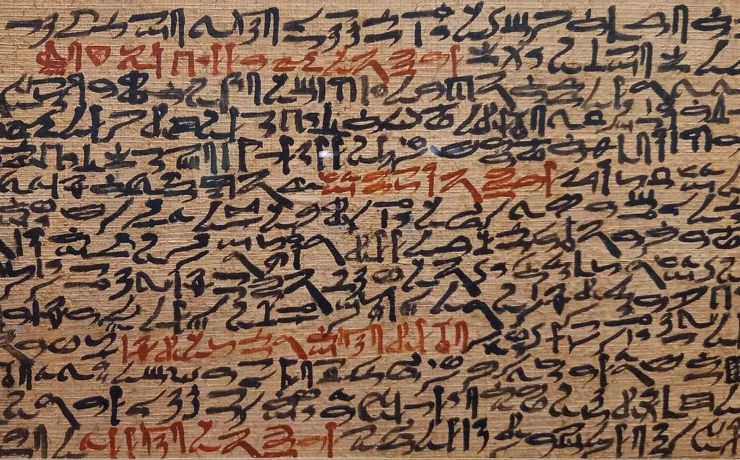
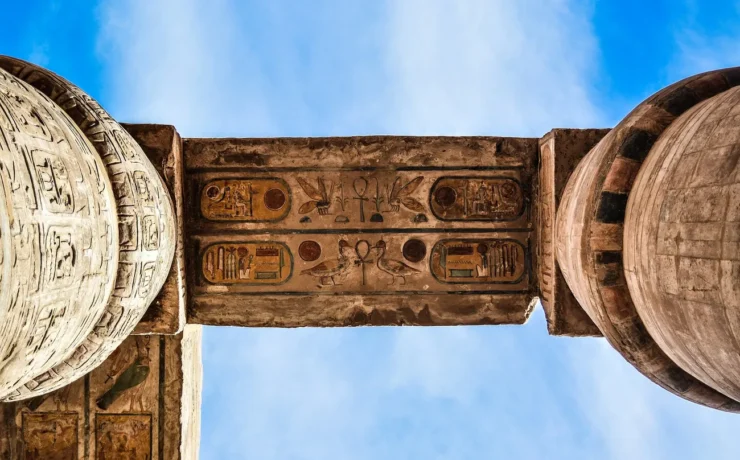
What is Demotic Egyptian? Demotic is a highly cursive Egyptian script used from roughly the seventh century BCE into late antiquity. It developed from hieratic and appears in contracts, tax receipts, letters, literary writings and religious texts. The Rosetta Stone preserves Demotic alongside hieroglyphic and Greek versions of a decree, but Demotic is neither a foreign language invented for the stone nor merely a simplified copy of monumental hieroglyphs.
Demotic was Egypt’s powerful cursive written tradition for contracts, receipts, letters, literary works and religious texts from the seventh century BCE into Late Antiquity. The famous Rosetta Stone carries Demotic in its middle section, but its historical importance extends much further than decipherment. Clay receipts show payments, papyri document family property and priestly rights, and temple inscriptions reveal how Egyptian writing continued under Greek and Roman rulers.
This article follows the real objects rather than a chart of invented sign shapes. Four authentic licensed museum photographs show a payment receipt, a priestly contract, a temple oath and the Rosetta Stone itself. Their separate accession numbers and historical periods are identified so that evidence for daily life is not falsely labeled as a royal decree or magic scroll.
Demotic: the script that recorded an Egyptian society
Demotic is often reduced to the mysterious middle band on the Rosetta Stone. In reality it was an Egyptian writing system used over many centuries to record payments, property transactions, letters, stories, temple contracts, medical knowledge and religious devotion. Its swift, compact signs developed from earlier hieratic handwriting, while the language written in it represented a later stage of Egyptian. Surviving texts preserve names of people far less famous than the pharaohs, giving historians ways to examine families, economic obligations and institutions. The traditional Greek label means “popular,” but it should not be mistaken for evidence that every farmer or merchant could read. Literacy still required training, and the surviving documents disproportionately represent institutions that made and preserved written records. The earliest securely attested Demotic developed in the seventh century BCE and the latest dated graffiti belong to the fifth century CE. Between those points the script changed shape and function as Egypt passed through Saite, Persian, Ptolemaic and Roman political orders. It is an essential part of the history of Egypt’s own language, not merely a subordinate handwriting style under Greek administration.
What Demotic means: script, language and social function
The word Demotic can refer to a set of written signs and, in scholarly contexts, to the phase of the Egyptian language that these signs commonly represented. The distinction matters because the same language can potentially be written using different graphic conventions, while an individual writing system can be adapted across linguistic changes. UCL Digital Egypt emphasizes that Demotic derives from a Greek term describing a popular or document-oriented script; an Egyptian expression associated with it refers to writing of letters or documents. Demotic was not the spoken name of every Egyptian dialect across a millennium. Nor was it a new language entirely unrelated to Middle Egyptian or Coptic. Linguistic features evolved across periods while the scribes developed an increasingly specialized cursive writing habit. A temple inscription written in hieroglyphs and a legal contract written in Demotic could coexist in one political era. That coexistence was practical and cultural, not a contradiction requiring an imagined switch of national languages. Proper terminology gives readers an accurate basis for understanding the texts before attempting to read any individual sign.
From hieratic to Demotic in the seventh century BCE
Demotic emerged from highly cursive forms of hieratic toward the seventh century BCE, especially in northern Egypt, according to Oxford and UCL research. The evolution was gradual: scribes shortened, linked and conventionalized signs in ways shaped by repeated use of brush and ink. UCL cites a particularly early Demotic papyrus dating to the twenty-first regnal year of Psamtik I, found at el-Hiba. That dated artifact helps anchor the emergence of the script more securely than an undated reconstruction of somebody practicing pen strokes. Regional administrative change and the unification of Egypt under the Saite dynasty provided an environment for new writing conventions to spread. Yet we should not describe the transition as one government minister abolishing hieratic in a single decree. Earlier writing continued to serve other functions, especially in religious settings. The signs’ shapes became increasingly compressed, but the principles of representing the Egyptian language retained connections with hieroglyphic and hieratic conventions. A good timeline distinguishes the first preserved examples from the unknown earlier experiments by the scribes who created the tradition.
Right to left: how the cursive writing was arranged
Demotic texts were normally written from right to left, continuing the orientation of much hieratic handwriting. A reader examining an ancient ostracon needs to know that direction before trying to interpret the sequence of signs. The visible lines can look like a dense, rhythmic sweep of ink rather than pictures of animals or plants. This is partly because writing was optimized for speed and familiarity among trained scribes. The script used phonetic signs as well as signs related to word meanings and categories, so it was neither a modern alphabet nor an arbitrary code. Many signs are reduced enough that their shapes can only be understood through paleographic comparison with dated examples. Orientation matters especially when a fragment lacks its original margins, or when a modern photograph has been flipped. Museums typically provide recto and verso designations based on the physical papyrus and its fiber orientation; these are curatorial terms, not labels meaning “important side” and “unimportant side.” A responsible image caption therefore records which object and face is shown instead of manufacturing a modern-looking transcription from unidentified squiggles.
Papyrus, potsherds and stone: the material forms of a script
Demotic appears on papyrus sheets, pottery fragments known as ostraca, wood, stone and sometimes linen or other materials. Different surfaces served different costs and functions. A short receipt on a reused pot fragment might be easier to produce than a long legal contract on carefully prepared papyrus. A prestigious decree might be carved in stone, requiring a change in the way the fluid signs were executed. UCL and the Global Egyptian Museum both document the range of media, while museum collections provide individual accession records that specify material more precisely. Material also affects preservation. Papyrus survives well in some dry Egyptian contexts but can decay under damp conditions, making surviving archives uneven evidence of what was written across Egypt. A large number of texts from a desert settlement does not necessarily mean that more people there were literate than in a humid Nile Delta town. Archaeologists evaluate findspot, surface, writing direction, residue and documentary date together. The difference between a photographed museum object and a digitally redrawn alphabet chart is important: this article uses original ostraca and papyrus rather than imagined facsimiles of Demotic handwriting.
Scribes, education and literacy without easy percentages
Demotic’s speed and common use in transactions can create the false impression that it was universally readable. The presence of written contracts suggests that some Egyptians had access to trained scribes, not that every contracting party necessarily read the whole document independently. Scribes learned signs, formulas, dates, numerical entries and particular conventions used for professional purposes. Their training could be associated with temple environments, administrations and legal offices, depending on time and place. Researchers can identify repeated hands and formulas within archives, but they cannot derive a national literacy rate simply by counting papyri held in museums. Nor is it justified to imagine every person writing private diary entries like a modern blogger. Documents could be dictated, witnessed or prepared by specialists for other people. The study of handwriting and recurring names sometimes permits researchers to reconstruct individual scribal practices, a much stronger method than assigning literacy to a whole class from one royal decree. We should distinguish professional competence in a specific documentary register from the ability to read all kinds of religious or literary writings.
Legal contracts: the writing of obligations and witnesses
Legal papyri are among the most valuable Demotic sources because they record transactions that mattered to particular Egyptian families. Sales, loans, gifts, mortgage arrangements and annuity contracts appear in surviving archives, according to the University of Chicago’s study of the Hawara papyri. These texts did not necessarily conform to one fixed modern contract template. Different dates, local jurisdictions and formulaic practices shaped how parties, obligations and witnesses were recorded. A surviving signature or witness list can sometimes help locate people within a family network, but an untranscribed line cannot be assumed to contain a familiar modern surname. The papyri illustrate that ordinary economic relationships had formal written dimensions long before contemporary bureaucratic systems. They also reveal a multilingual environment: some families used Demotic, Greek or a combination, reflecting practical circumstances and institutional demands. A historian should not infer that every Egyptian document was written in Greek simply because Greek became powerful under the Ptolemies. Demotic remained a significant medium for local legal and economic transactions, and its survival gives people outside the royal court a documentary presence.
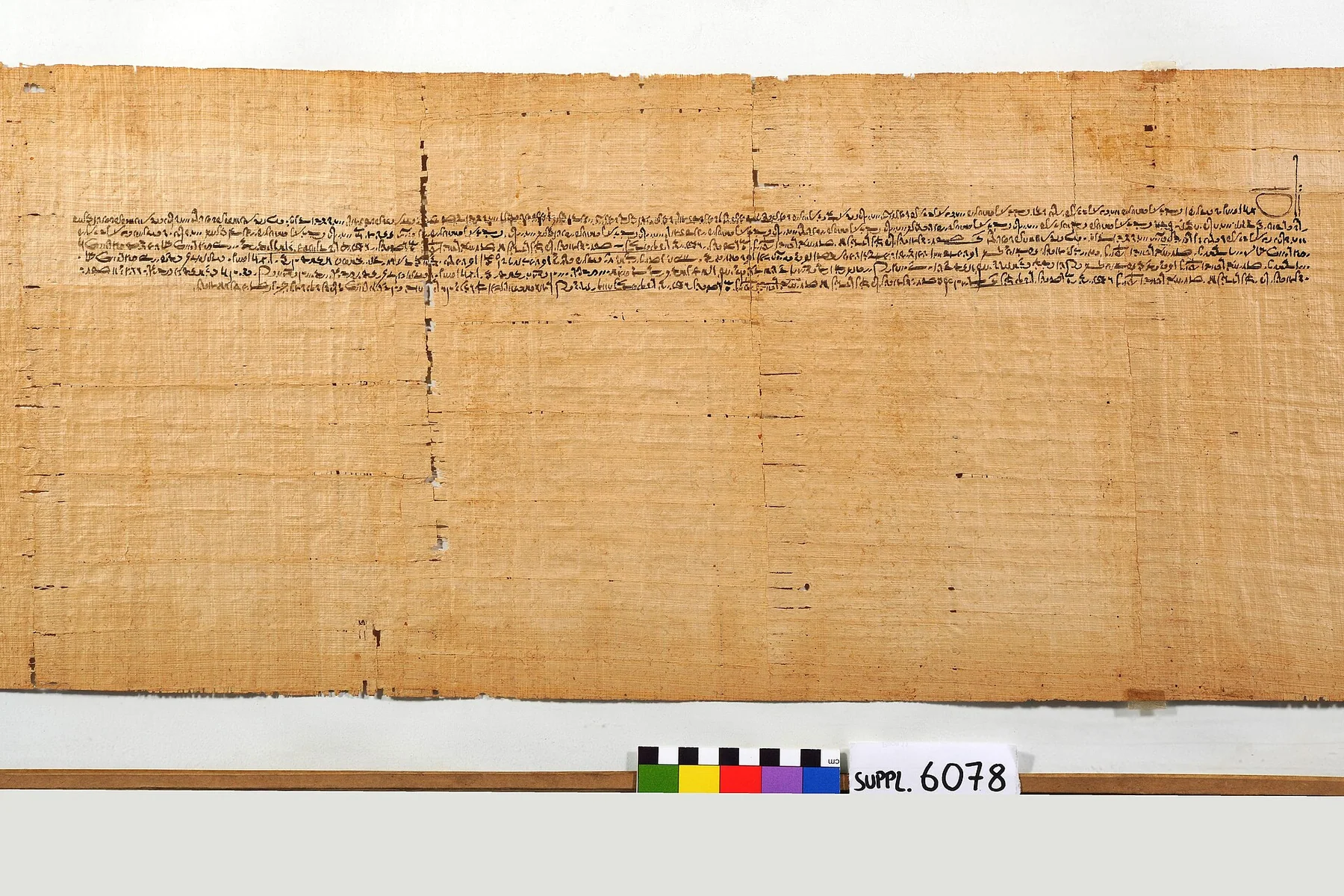
A real contract from Deir el-Medina: Museo Egizio S.6078
The Egyptian Museum of Turin’s catalogued papyrus S.6078 is an especially useful example of how a legal document related to temple life. Its recto records a contract among priests of Amun, Hathor and Min-Hapy concerning the grant of religious services, while the verso contains lists of witnesses. The museum identifies the wider group as an archive of fifty-three Demotic and Greek papyrus scrolls found at Deir el-Medina, dated across approximately 188–10 BCE. They were discovered together in large sealed jars and connected to a family of priests. That setting makes the material a rare source for studying institutions and families, not just isolated words. The exact date of every scroll should not be set equal to the entire archive range, and the photograph of one face should not be mistaken for a picture of all fifty-three. The original licensed museum photograph below shows one real part of this particular papyrus. Its ink strokes, fibers and damaged edges are historical material that can be matched to the accession record. Readers can trace the object instead of trusting a generic picture labeled “ancient Egyptian contract.”
Receipts: taxation and the reality of everyday accounting
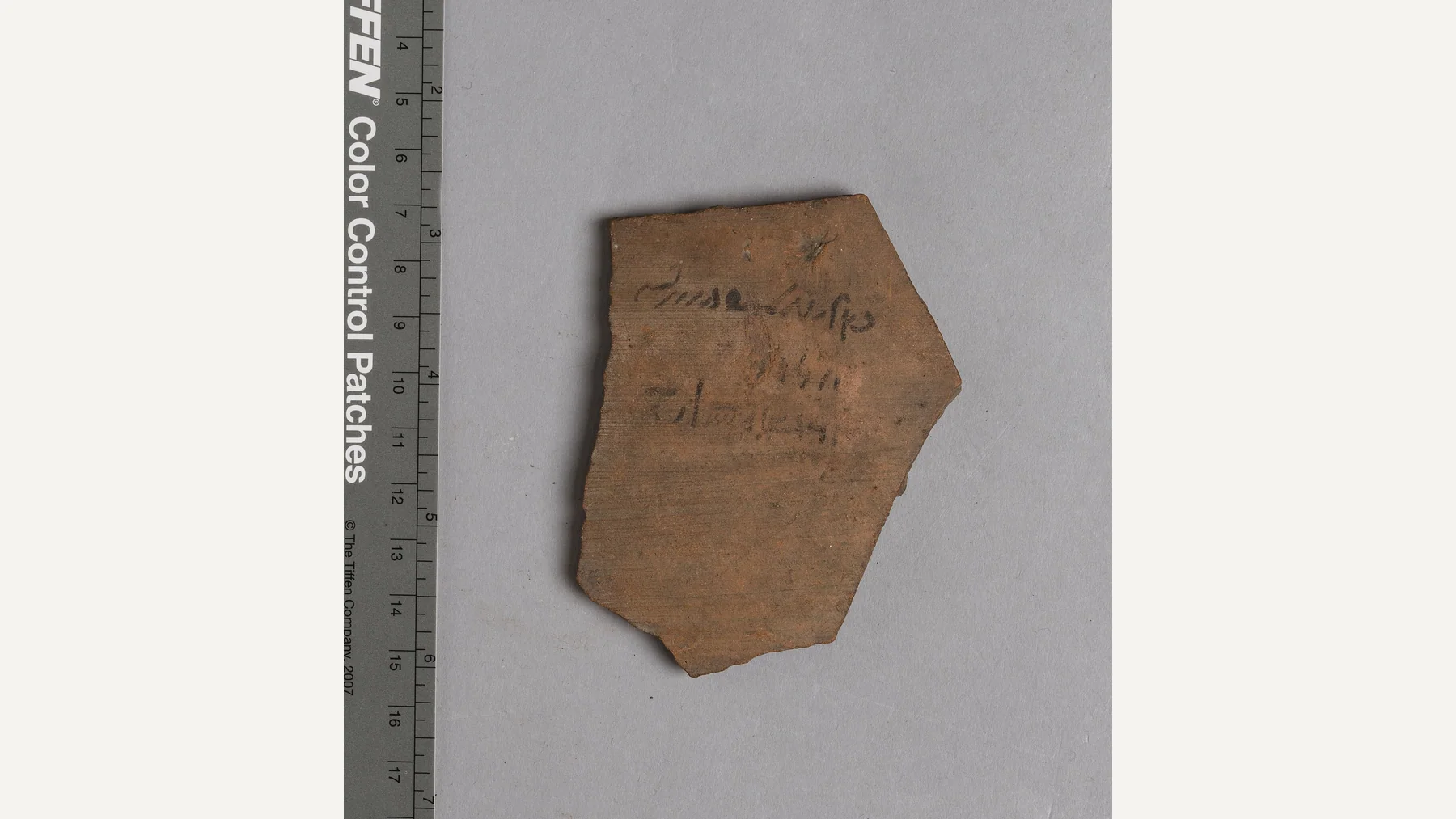
Payment receipts show another side of Demotic writing. They could document a tax or other obligation with names, amounts and responsible parties. A small surface might contain information that specialists can use to reconstruct economic practices on particular dates. The Ptolemaic ostracon in Turin, object S.12701 B, is catalogued as a Demotic payment receipt dating broadly to 200–100 BCE. The surviving item is a clay fragment bearing ink, not a scroll and not a royal temple monument. The precise wording and amount on that one item require its published reading; we should not invent a tax collector or a payment in silver because the image resembles other receipts. The photograph illustrates how a real surviving object can reveal the infrastructure of transactions. Compared with monumental inscriptions, these humble records tend to preserve the activity of people whose lives were structured by payments rather than royal ideology. Such objects are also plentiful because a written acknowledgment could be made on inexpensive material. Their archaeological value depends on the context of discovery and specialist transcription, not on visual extravagance.
Temple oaths: words with social and religious force
Another Turin object, S.12685, is a clay ostracon dated to 98 BCE and catalogued as a Demotic temple oath. The phrase signals a connection between an affirmation or obligation and a sacred institutional setting. It does not mean the ostracon was a magical charm or that its owner held one unique priestly title. Textual evidence is needed to understand the wording and parties in the oath. Such documents show that religion, law and social trust could overlap in Egyptian practice; the categories were not always divided like separate departments of a modern state. A temple may have provided a place for solemn commitments, witnesses or other forms of enforcement. But one object cannot prove that every Egyptian dispute was settled by a priest or that all oaths were written in Demotic. The photograph reproduced here is the actual S.12685 accession, not another ostracon whose inscription happens to look similar. Its text belongs to a different genre from the payment receipt and the priestly contract, allowing readers to compare the physical forms of real everyday writing.

Families and land through the Hawara Demotic archive
The University of Chicago’s Oriental Institute published a group of Demotic and Greek texts from a family archive at Hawara in the Fayum, spanning the fourth to third centuries BCE. The documents include annuities, donations, sales, mortgages and loan repayments. This is a rich source for family history because transactions can preserve multiple related names and commitments across time. It is not a complete census of Hawara, and the survival of one archive may reflect fortunate burial or storage conditions. Yet the accumulation of legal records opens questions about property, gender, kinship and the economic choices of household members. Historians can reconstruct relationships by comparing scribal formulas, witnessed transactions and recurring personal names. They must also pay attention to changes in chronology and legal practice under Greek-speaking authorities. The documents challenge the assumption that the familiar images of Ptolemaic kings tell us everything worth knowing about their subjects. As Kemet Vault’s study of property and temple estates under the Ptolemies explains, written records matter because institutions did not simply own and manage every field in the same way.
Greek and Demotic side by side after Alexander
Following Alexander’s conquest and the creation of the Ptolemaic kingdom, Greek gained major roles in government and public life, but Egyptians did not instantly abandon their own written traditions. Demotic continued in legal, economic, religious and literary contexts, sometimes alongside Greek on related documents. The Chicago Hawara publication demonstrates one family archive involving both languages. Bilingual evidence is particularly valuable because it helps scholars study how contracts, names and administrative expressions operated across linguistic communities. Nevertheless, a Greek text and a Demotic text on one sheet are not automatically line-by-line literal translations. Sometimes they have different functions or preserve different parts of a transaction. The reader must inspect the document and published edition. Likewise, the presence of a Greek personal name does not prove a particular person’s biological ancestry. Names, legal status and spoken languages could overlap in complex ways. Demotic’s persistence reveals that Egyptian institutions retained written practices under a different royal administration, even as Greek grew important in broader state structures. The script was one way Egyptians carried their language into a new political environment.
The Rosetta Stone: one decree in three written versions
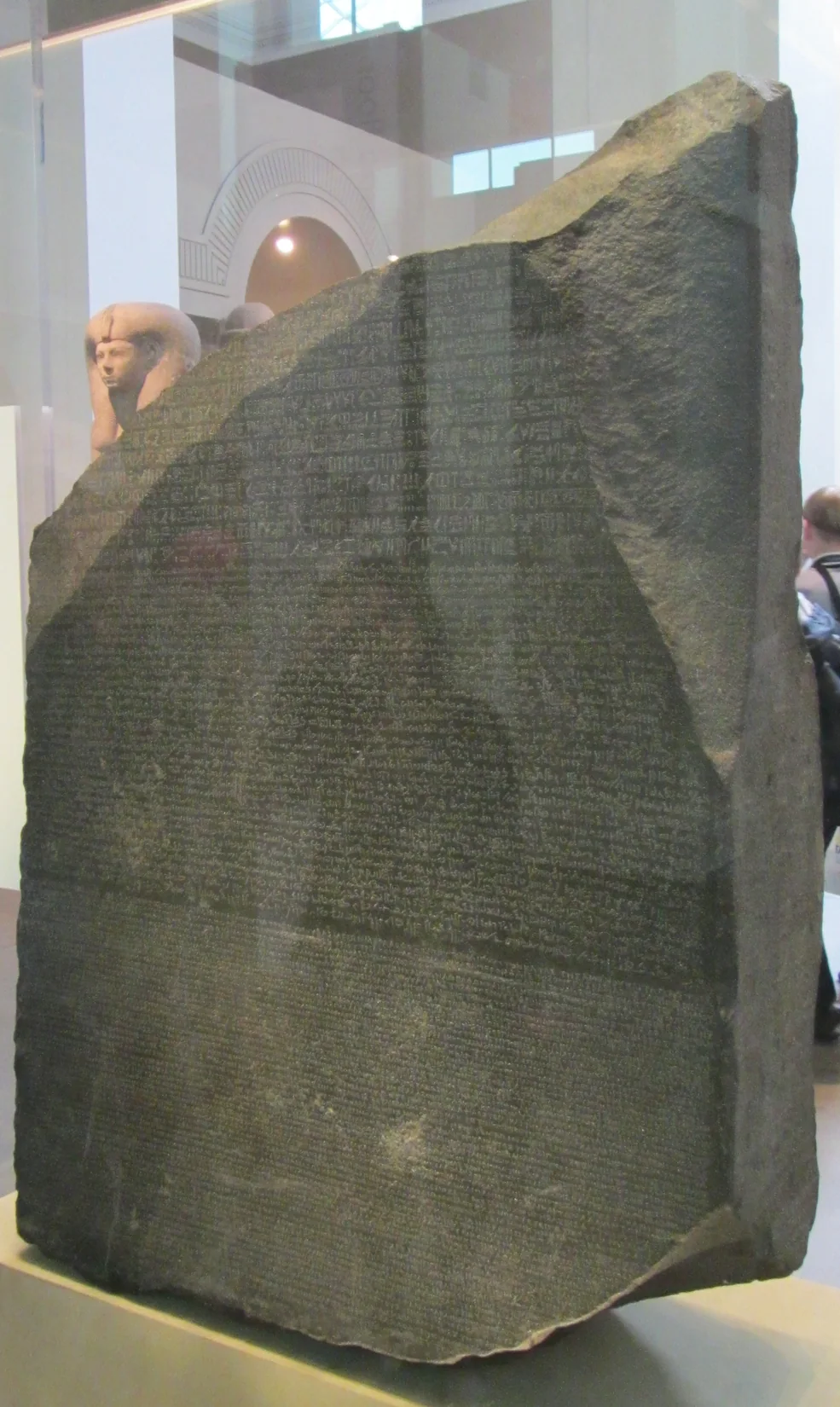
The Rosetta Stone dates to 196 BCE, in the reign of Ptolemy V, and contains a priestly decree presented in hieroglyphic Egyptian, Demotic Egyptian and Greek. Its Demotic text occupies the middle register; the hieroglyphic section is at the top and the Greek text below. The British Museum identifies the stone as object EA24. The decree was issued by Egyptian priests at Memphis and praised the king while specifying religious honors. It was not composed as a school exercise for future French scholars, nor is the Demotic section a transliteration chart of a modern alphabet. Its significance to decipherment is that related content appears in distinct scripts, allowing scholars to compare names and statements. The actual museum photograph below shows the ancient carved stone, taken by a modern photographer in 2012. It is important not to confuse the inscription’s date with the much later discovery near Rashid in 1799. Kemet Vault already has a dedicated Rosetta Stone decipherment article. The present study treats the stone as one example within centuries of Demotic documentary practice rather than duplicating that earlier narrative.
What the stone did and did not accomplish for decipherment
The three-script decree helped scholars compare Egyptian and Greek texts and was crucial to the eventual recovery of Egyptian writing systems. Yet the process took decades and built on work by multiple researchers. Thomas Young and Jean-François Champollion made important contributions, while Champollion’s knowledge of Coptic and analysis of royal names were especially consequential. Describing the stone as a codebook that instantly translated every hieroglyph in 1799 is wrong. Greek supplied a language that scholars could read, but the Egyptian versions still required understanding phonetic and semantic conventions, names and grammar. Demotic itself was not simply a middle-language English gloss of hieroglyphs; it belonged to the same Egyptian linguistic tradition in a different script and register. Modern Egyptology continues refining readings through newly published texts and lexicography. The British Museum’s exhibition guide distinguishes discovery, subsequent interpretation and the actual contents of the decree. Respecting that sequence keeps the history from turning into a tale of a single miraculous discovery by one individual. Decipherment opened access to archives of human activity much broader than royal names alone.
Demotic literature, stories, medicine and religious knowledge
Demotic was used beyond accounting and contracts. Oxford and Chicago scholars document religious, literary, medical, astronomical and magical compositions in the surviving corpus. Some texts survive from Ptolemaic times, while many known narrative works have Roman-era copies. This is a different kind of evidence from short tax receipts because stories and instructional compositions demand extended reading and often preserve scribal literary traditions. But not every ancient composition found on papyrus should automatically be labeled Demotic; Greek, hieratic and later Coptic also appear in Egyptian archives. Researchers identify the script and language of each manuscript before interpreting the genre. A text about a deity may reflect ritual, narrative art or specialist scholarship rather than a transparent record of popular belief. The Chicago Demotic Dictionary includes evidence from a wide range of manuscripts and gives readers a way to connect individual words with their documented contexts. The breadth of the corpus is what makes Demotic so useful: economic and literary history emerge from the same broader tradition of Egyptian writing.
What changed during the Roman occupation?
In the Roman period, Greek remained strong in official administration, and Demotic gradually lost much of its earlier documentary role. UCL Digital Egypt observes that Roman state administration accepted fewer Demotic documents beyond certain receipts; research on bilingual receipts shows the transition in more local detail. Around Thebes, some early first-century tax receipts continued to be written in Demotic, while Greek became more prominent in subsequent decades. This did not mean that every Egyptian instantly changed their household language. Script use is a record of what institutions rewarded, tolerated or taught, and it may change long before daily speech does. Temple environments continued preserving Demotic for religious and scholarly functions even when its state administrative role decreased. The transition should therefore be described as a long process with regional differences. The surviving papyri show fewer examples over time, but preservation also affects the numbers. It is more responsible to link dates to particular corpora than to claim that the last person who could read Demotic died in a precisely known Roman year.
Philae in 452 CE: revisiting the latest dated inscription
The latest securely dated Demotic graffiti are at the Temple of Isis on Philae, in southern Egypt. Older summaries and some museum descriptions refer to an inscription dated 11 December 452 CE. Specialist Eugene Cruz-Uribe has explained that a separate graffito, designated GPH 365, was reread and dated to 12 December 452 CE, making it a day later than a text paired with Greek. This is an unusually precise example of why historical dating depends on decipherment and should not be repeated mechanically from an older guide. The later reading does not mean Demotic abruptly vanished across Egypt at midnight. It identifies a surviving, dated monument inscription, not the final person to write the script. Philae’s continuing sacred role in Late Antiquity provided conditions for older writing traditions to persist after their use had declined in many administrative contexts. The location also connects this article to Kemet Vault’s archaeological account of Philae, which treats the temple and Nubian religious setting rather than the broader documentary history of Demotic.
Demotic and Coptic: change in script did not erase Egyptian language
Coptic represents a later stage of the Egyptian language and is commonly written with letters adapted from Greek plus additional signs derived from Demotic. The relationship is an important example of cultural and linguistic continuity through major religious and political transitions. However, it would be misleading to present Coptic as a simple visual redesign of every Demotic character. The writing systems differ fundamentally in appearance and convention, and the Coptic alphabet’s main foundation is Greek. Its distinctive extra letters helped represent sounds that Greek letters alone did not cover. Egyptian language history cannot be reduced to a simple straight arrow in which one national government discarded hieroglyphs, then Demotic, then Coptic on specified dates. Several scripts coexisted for generations and served different functions. Coptic became particularly important for Christian Egyptian literature and liturgy, while Demotic survived longer in some traditional temple settings. The study of Egyptian phonology across these phases is complex, relying on texts, spellings and comparative linguistics. Recognizing continuity without pretending the scripts are identical helps explain how scholars eventually recovered the ancient language.
Reading a museum ostracon responsibly
An ostracon with cursive marks can be visually appealing, but an editor cannot translate it simply by magnifying a photo. Identification begins with the accession number, estimated date, writing surface and reported findspot. Museum catalogue language may refer to a genre such as “receipt” or “temple oath”; that gives a grounded description while leaving the exact text to specialists who publish transliterations and translations. Our objects from Turin illustrate how one museum preserves separate categories of material: S.12701 B is a Ptolemaic payment receipt; S.12685 is a temple-oath text dated 98 BCE; S.6078 is part of a papyrus contract among priests. The distinction matters, because putting the caption from one object under the photo of another would invent a source. Museum images can show ink traces and papyrus fibers, but the visible surface alone cannot establish who signed every line or why a dispute arose. For close study consult the Museo Egizio object records or scholarly editions rather than online character-recognition guesses. The photographs are actual documented artifacts, released under specified open licenses, not typographic facsimiles generated from font characters.
How researchers build the Chicago Demotic Dictionary
The Chicago Demotic Dictionary project at the University of Chicago’s Institute for the Study of Ancient Cultures brings together lexical evidence from Egypt’s Demotic corpus. Rather than inventing a standard modern spelling for every difficult sign, researchers document variants, meanings and occurrences within actual texts. A word may have changing written forms across regions or centuries, and its meaning may depend strongly on a legal or religious context. Building a dictionary therefore requires paleography, grammar, translations, photographs and references to published editions. Digital research can help specialists search and compare examples, but the tool is not an automatic translation machine that makes damaged papyri transparent. The project’s publication helps students and scholars investigate economic, social, medical and literary history using attested words instead of relying on a single popular glossary. In this sense modern lexicography is continuing the scholarly task that began with nineteenth-century decipherment, although it now draws on a far wider set of preserved objects. The most valuable outcome is not a headline about a forgotten secret language; it is clearer access to real evidence of Egyptian people and institutions.
Demotic is a historical bridge, not just the middle band on a stone
The surviving texts provide a remarkable alternative to telling later Egyptian history only through the dynasties. Receipts show payments, contracts record legal obligations, oaths link institutional life with sacred settings and stories reveal literary creativity. They also reflect unequal access to literacy and the preservation biases of archaeology. The script developed from older Egyptian handwriting, expanded during the Late Period, persisted under the Ptolemies and declined gradually through Roman times, with inscriptions surviving in the fifth century CE. The Rosetta Stone is a powerful and famous example because of its role in modern scholarship, yet most Demotic evidence is less monumental and sometimes more intimate. Studying a papyrus from a family archive can tell us how ordinary names appeared across generations, while studying an inscription can place those lives in wider temple and political systems. For an introduction to the underlying principles of Egyptian hieroglyphs, see Kemet Vault’s phonograms and determinatives guide. The different scripts deserve separate attention so readers understand both continuity and change rather than compressing Egyptian writing into one set of mysterious pictures.
Demotic evidence through time
| Time | What the evidence establishes | Interpretive caution |
|---|---|---|
| Seventh century BCE | Demotic develops from cursive hieratic in northern Egypt | Transition gradual; earlier scribal experimentation not directly dated |
| Sixth–fifth centuries BCE | Increasing administration and local documentary use | Not evidence of universal literacy |
| Fourth–first centuries BCE | Greek and Demotic archives, contracts, receipts and literature | Two scripts and languages may have different social functions |
| 196 BCE | Rosetta decree in hieroglyphic, Demotic and Greek | Not an ancient teaching alphabet |
| First–third centuries CE | Gradual decline of Demotic administration, continued religious and literary uses | Regionally uneven and affected by survival bias |
| 12 December 452 CE | Latest currently known dated Demotic graffito at Philae, according to revised reading | Not proof that no one wrote Demotic later |
Scholarly references, museum accession and image-rights notes
UCL Digital Egypt: Demotic writing; Oxford University: Demotic project overview; University of Chicago ISAC Chicago Demotic Dictionary; ARCE Demotic: History, Development and Techniques; Chicago ISAC Hawara papyri Demotic Greek family archive; Museo Egizio Turin S.6078 actual Egyptian legal papyrus; British Museum hieroglyphs exhibition Rosetta Stone official record; Brill Eugene Cruz-Uribe The Last Demotic Inscription scholarly correction; Oxford Handbook of Egyptian Epigraphy Demotic research; Cambridge scholarly Greek-Demotic bilingual documents and disappearance; Global Egyptian Museum Demotic glossary. The four pictured objects are separate actual museum artifacts with their metadata and rights displayed beneath the original photograph. The latest Philae graffito date follows Cruz-Uribe’s published rereading, not an outdated chronology. Editorial review 25 October 2026.
Frequently asked questions about Demotic
Was Demotic a spoken language or a script?
Both terms are used in scholarship: Demotic names an Egyptian script and a phase of the Egyptian language written in it. It developed from hieratic rather than being a modern alphabet.
Was Demotic written left to right?
No. The standard orientation of Demotic text is right to left, as in much earlier hieratic writing.
What is the middle section of the Rosetta Stone?
Demotic Egyptian, part of a three-script priestly decree of 196 BCE under Ptolemy V. The other registers use hieroglyphs and Greek.
When was the last dated Demotic inscription written?
At Philae in December 452 CE. Specialist rereading identifies GPH 365 as dating to 12 December, correcting older summaries that named 11 December.