Egyptian hieroglyphs are not a collection of decorative pictures that translate neatly into modern English words. They form a writing system with signs that can represent sounds, classify meaning or operate in other conventional ways. Understanding these functions is the first step toward using a hieroglyphic explorer responsibly.
The difference between scripts and language
Egyptian was a language written over a very long period using several scripts. Hieroglyphs are familiar from monumental inscriptions; hieratic was extensively used for cursive handwriting, and demotic later developed in different social and administrative settings. Coptic preserves a later stage of the Egyptian language using a primarily Greek-derived alphabet with additional signs. Calling hieroglyphs 'the Egyptian language' therefore confuses a writing system with the spoken and written language it represented. Script choice also depends on context, date and material. A temple inscription and an everyday account could use different hands or signs while still belonging to Egyptian linguistic traditions. Good digital learning tools make that distinction visible.
Phonograms and sound values
Many hieroglyphic signs represent one, two or three consonantal sounds rather than the object drawn. The writing system commonly omits vowels, so a modern pronunciation is an educational convention, not an audio recording of a Middle Kingdom speaker. A bird-shaped sign may have a phonetic value in one context while participating in another type of writing function elsewhere. Reading begins by identifying sign sequence, orientation, transliteration and grammatical setting. It is not enough to point at a recognizable object and use its English name as the ancient Egyptian word. For that reason, automatic emoji-style substitution is not a reliable translator and often produces misleading results.
Egyptian writing is a language system, not picture guessing
Ancient Egyptian hieroglyphs form a structured writing system capable of recording speech and meaning rather than a collection of decorative scenes. A bird sign can be used for its sound value, for a word associated with that creature, or within a conventional pattern whose interpretation depends on context. It is therefore unhelpful to assign each visual symbol a fixed English word and expect the resulting string to form a translation. Egyptian also developed over millennia, and the grammar found in Old Kingdom texts differs in significant ways from later stages of the language. Scribes followed conventions shaped by purpose, medium and historical period, not by modern assumptions about letter-by-letter alphabets. Beginners should start by separating Egyptian language from hieroglyphic script and by learning that signs may function differently in different words. A reliable learning tool offers attested examples with transliteration, dating and a museum source instead of a visual dictionary that makes unsupported promises.
One-consonant, two-consonant and three-consonant signs
A central feature of classical Egyptian hieroglyphic spelling is that signs can express one, two or three consonantal values. Textbooks call these uniliteral, biliteral and triliteral phonograms. The familiar alphabet chart often lists one-consonant signs, but that chart does not mean the complete language was written with one character per sound. Biliteral signs can encode two consonants as a unit, and triliteral signs encode three. A word may combine multi-consonantal signs with additional characters, leaving learners puzzled if they expect every sound to appear once and only once. Understanding the categories provides a foundation for reading without resorting to invented picture translations. University College London's Digital Egypt project gives examples of the three phonetic groups and distinguishes them from classifiers. A serious encyclopedia should show genuine words and source contexts before asking beginners to memorize large lists of sign values.
The phonetic house sign and the rebus principle
The conventional house-plan sign is a useful demonstration because the Egyptian word for 'house' is commonly transliterated pr. The sign can represent the word 'house' in one context or contribute the consonantal sequence p-r in another. That is a form of phonetic rebus usage, where a symbol associated with an object also represents sound values. The Global Egyptian Museum explains this principle with the house sign. It is an ideal antidote to claims that every symbol must always mean the depicted thing. The distinction also helps explain why a photograph of a text cannot be translated by identifying familiar animals or buildings alone. Other signs, grammar and surrounding written content must be considered. Beginners may use examples of pr, but should not infer that English letters 'p' and 'r' reproduce a fully known ancient pronunciation, because vowel notation and historical phonology complicate that assumption.
Determinatives: visual clues to meaning, usually not pronounced
Determinatives, also called semantic classifiers in some linguistic discussions, are signs that help situate a word in a general category of meaning. A seated-person sign may classify a word relating to a person, while other signs point toward places, actions or abstract concepts. They are not simply pictures to be translated as separate English words each time they appear. Their selection can be flexible, and an individual word may show changes across periods or scribal practices. Determinatives are especially important because conventional Egyptian spelling generally omitted ordinary vowel information, leaving consonantal sequences that could correspond to different lexemes. Context, spelling conventions and classifiers help distinguish interpretations. A meaningful reading lesson should show the full sign group and an authentic transcription, explaining which signs carry sound and which serve classification. An isolated bird icon without context cannot establish the function it performs in a particular word.
Ideograms and logograms are not the same thing as determinatives
Another source of confusion is the relationship between signs used to represent whole words and signs used only as classifiers. A pictorial sign may function logographically in some settings, but that does not make every use of that sign a word-picture. The conventions of classical Egyptian allowed phonograms, logograms and determinatives to combine within the same writing system. Academic discussions sometimes distinguish terminology differently depending on the historical phase and theoretical approach. Rather than force one simplistic definition, a good guide explains the function of a sign in its context and labels the category used by a particular grammar. The Oxford Handbook's discussion of early Egyptian writing emphasises how the distribution and use of sign types changed over time. Learning to classify a sign correctly is often more important than memorizing an attractive illustration. It also prevents the mistaken claim that hieroglyphs were 'primitive pictures' waiting to become a supposedly superior alphabet.
Direction of reading and the orientation of living signs
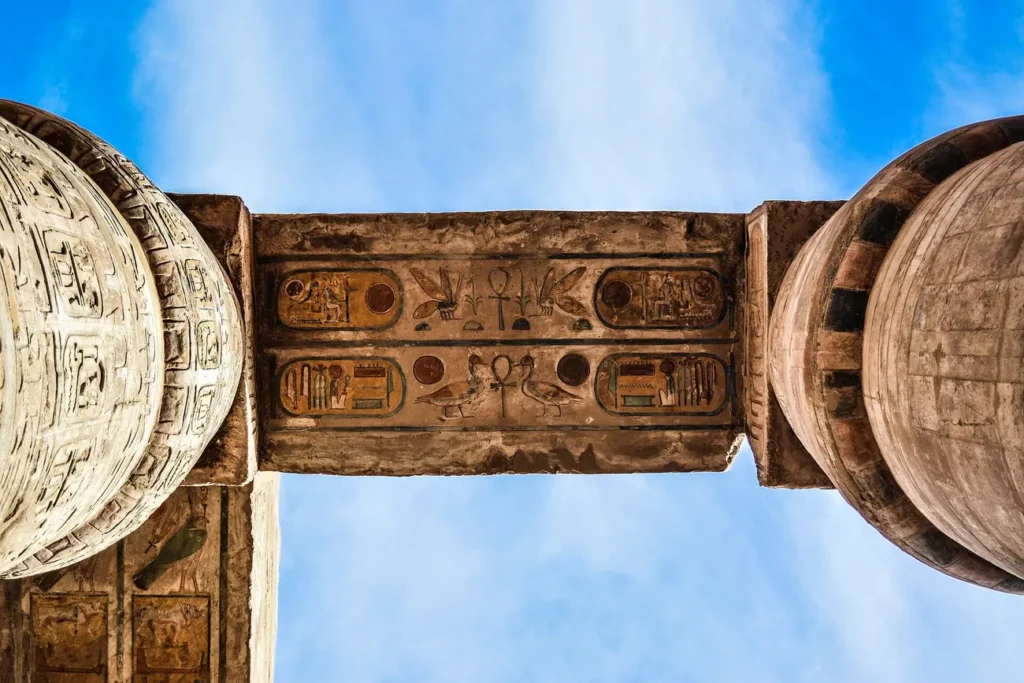
Hieroglyphic texts can run in horizontal lines or vertical columns, and their orientation may be left to right or right to left. Human figures, birds and animals generally face the beginning of the line, so readers often read towards their faces. This is a practical guide, not a rule that removes every problem of damaged or unusual inscriptions. Signs associated with a larger sculpted scene can be oriented in relation to the depicted figure, and symmetrical compositions can create visually balanced text blocks. University College London's discussion of orientation and art explains such relationships. A beginner should inspect the whole inscription before assigning reading direction, including columns, figure position and line breaks. The lesson is most effective when paired with a real photograph of monument text, not a uniformly arranged computer font sample. Monumental writing was part of designed visual space, and layout could contribute to how it was experienced.
Determinatives and the classification of meaning
Determinatives are generally unpronounced signs that help indicate a semantic field or resolve ambiguity among words written with similar sound values. Their presence may clarify whether a sequence concerns a person, place, movement, abstract action or another category. They are part of the word's written interpretation, not a secret second language. The same sign can have different functions in different contexts, and scribal usage changed across periods. A useful sign explorer provides sign classification along with examples of attested words and inscriptions; it should not insist that every pictured animal encodes a universal spiritual meaning. The actual inscription remains the best test of what a sign does.
Orientation, grammar and context
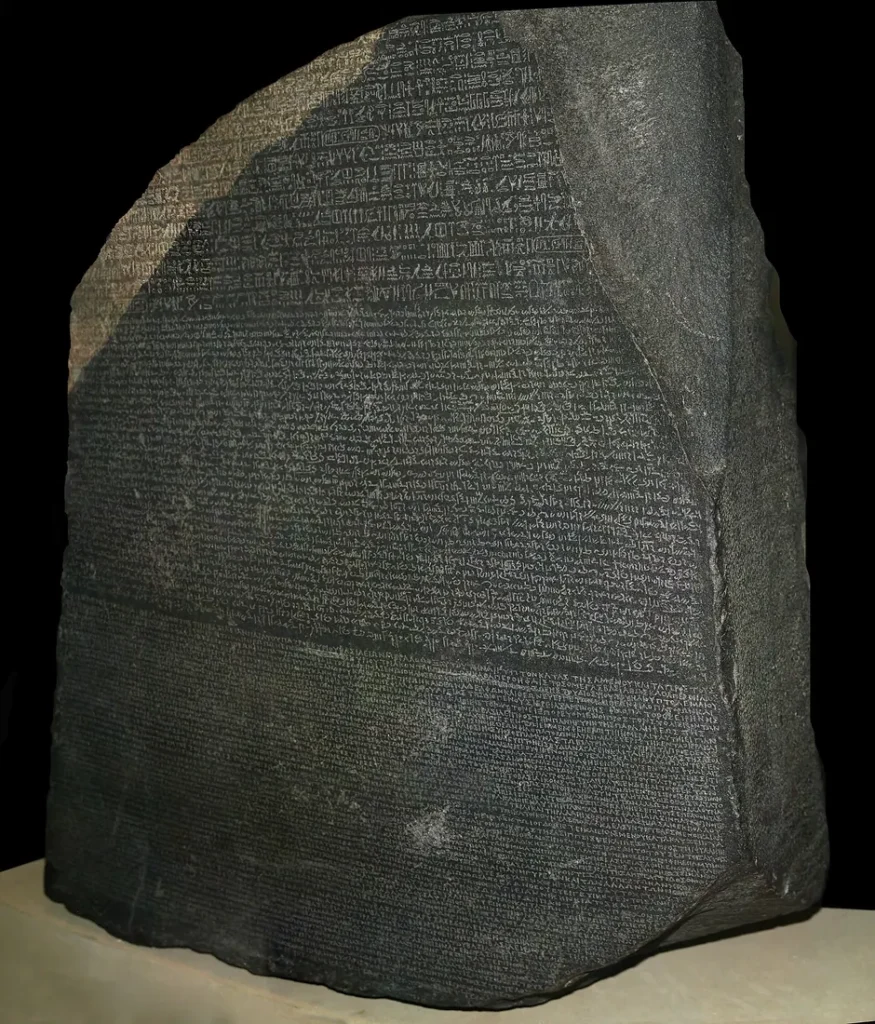
Hieroglyphic texts can be arranged in rows or columns and read in different directions, usually guided by the orientation of human and animal signs. However, direction alone does not deliver translation. Grammar, word boundaries, damaged signs, names and conventions of royal titles require expertise and attention to context. Cartouches enclose certain royal names and became important in the modern decipherment of Egyptian writing. The Rosetta Stone's multilingual inscription was crucial because Greek, demotic and hieroglyphic texts could be compared within a documented historical setting. It did not reveal every reading instantly, and decipherment grew through sustained linguistic analysis.
How to learn with museum objects
Begin with a photographed inscription whose date, provenance and accession are available. Identify its orientation, write a cautious transliteration, compare an established translation and inspect the role of individual signs within complete words. The British Museum's introductory resources offer a helpful overview of handwriting and scripts, while the Rosetta Stone record gives a celebrated example of why parallel texts matter. A tool that declares uncertainty and links to real examples is more educational than a one-click generator promising to translate arbitrary English sentences into 'perfect' ancient Egyptian.
Why the vowels are missing from most writing
Conventional Egyptian writing usually records consonantal information without marking vowels in the way a modern learner might expect from English orthography. Consequently, modern Egyptologists often use an academic transliteration system that records consonantal signs and reconstructed conventions rather than a full original pronunciation. A word frequently written in books as 'nefer' should not be interpreted as a sound recording from an ancient speaker. Coptic, which represents a later stage of the Egyptian language with a different writing system, helps researchers reconstruct aspects of pronunciation, but the process is not simple or uniform over thousands of years. Greek transcriptions and comparative linguistic evidence can also be informative. An educational website should distinguish conventional Egyptological pronunciation used in classrooms from historically reconstructed speech. Without that distinction, an interactive 'pronounce this hieroglyph' button can misleadingly imply certainty that scholarship does not possess.
Cartouches and royal names in their actual historical context
A cartouche visually encloses particular royal names in many periods of Egyptian history, making it a rewarding feature for beginners learning to navigate inscriptions. But not every oval design on a monument is a cartouche, and the presence of a royal name does not establish that the individual personally carved or visited the surface. Royal titles, epithets and names can occupy different positions, and later rulers sometimes reused or modified earlier monuments. To read a cartouche, learners need an authoritative sign-by-sign transcription rather than a modern logo generator offering a decorative translation of a visitor's personal name. Comparing photographs from a well-documented temple or museum object with published royal titulary illustrates the method. It is useful to begin with one known example and label its historical date and location. Overconfidence about a recognizable name can obscure surrounding grammar and religious formulae that carry much of the inscription's meaning.
How the Rosetta Stone contributed to decipherment
The Rosetta Stone bears a decree presented in multiple scripts, including hieroglyphic, demotic and Greek, and played a key role in the modern decipherment of Egyptian writing. Yet the story is not that scholars found a stone which assigned one English word to every hieroglyph. Researchers compared names, recurring formulae and other textual evidence while building on earlier work and linguistic insights. Jean-François Champollion's achievements were major, but the historical process involved multiple investigators, additional inscriptions and an evolving understanding of Coptic and Egyptian. A real photograph of the stone is useful because it lets readers distinguish the scripts and see their physical arrangement. The stone itself is held in the British Museum, and a detailed historical dossier should examine both the object's ancient political setting and its modern collecting history. For a beginner, it is an example of how bilingual or multilingual evidence can unlock a writing system, not a complete workbook.
Writing on temple walls, papyrus and everyday objects
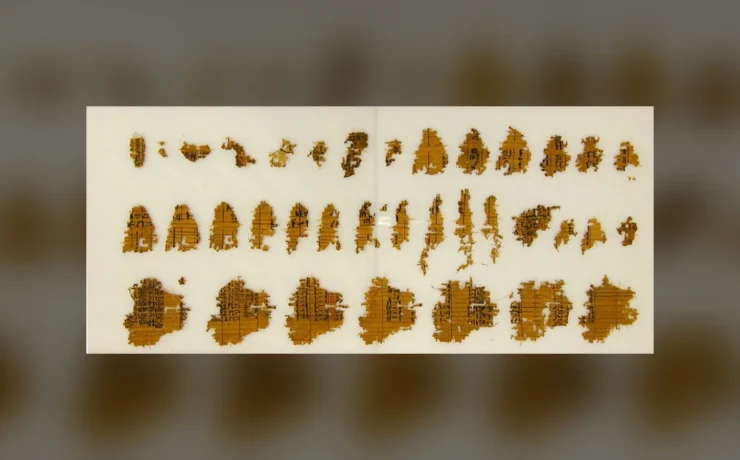
Hieroglyphs are frequently associated with temple pillars and monumental inscriptions because such surfaces survive conspicuously. Egyptians also wrote using different scripts and on different media, including papyrus and ostraca. Hieratic and later demotic scripts played major roles in administration and literary transmission, while monumental hieroglyphs could present ritual formulae, royal titles and texts intended for particular settings. A picture of colourful Karnak hieroglyphs documents one form of public sacred writing, not the handwriting of every ancient scribe. An inscription carved in stone and a manuscript written with a brush or reed follow different practical constraints. This diversity matters for historical literacy: scholars read text through its function, material, script and date. A digital explorer should link an image to a museum object, a scholarly transcription and a description of the medium so users understand what it documents.
A beginner's method for reading one authentic inscription
Start by choosing an inscription whose museum or archaeological context is reliably documented. Identify the date or broad period, the type of object and the physical direction of the signs. Next, distinguish likely words and sign groups through a published copy or transcription rather than trying to segment the text from appearances alone. Learn the phonetic values of a manageable number of signs, and note where a classifier or logogram changes how the group functions. Compare with a specialist translation, paying attention to pronouns, prepositions and verb forms as grammar rather than treating the result as a word list. Mark uncertain readings explicitly, particularly if signs are damaged or the photograph is incomplete. This method takes more effort than an online chart that promises instant translation, but it is how a serious reader develops independent skill without pretending to be a professional epigrapher after one afternoon.
Building an interactive hieroglyphic learning tool responsibly
A credible interactive tool should identify exactly which corpus, grammar stage and published sign list it draws on. The user might click a sign to see its conventional transcription, phonetic function, determinative use and actual object examples. It should never silently map every pictogram to one English word or invent translations of names that have no historical Egyptian attestation. A useful exercise could compare two authentic spellings of the same word or ask learners to determine reading direction from bird orientation on a real photograph. The tool should keep links to the original museum records and use properly licensed images, accessible text alternatives and clear statements about reconstructed pronunciation. Students should be able to move to related articles about the Rosetta Stone, scribal culture and literary texts. This transforms a decorative chart into a genuine educational reference integrated into the wider KemetVault encyclopedia.
Evidence comparison and key distinctions
| Topic | What the evidence establishes |
|---|---|
| Uniliteral phonogram | One-consonant sign value in conventional transliteration |
| Biliteral phonogram | Conventional value representing two consonants |
| Triliteral phonogram | Conventional value representing three consonants |
| Determinative | Semantic classifier usually not independently pronounced |
| Logogram | Sign representing a word in a particular context |
| Direction | Often read toward the faces of depicted living signs |
| Pronunciation | Consonantal evidence is much clearer than original historical vowels |
Frequently asked questions
Is every hieroglyph a picture-word?
No. Signs can carry one or multiple consonantal values, classify meaning or represent words in specific contexts.
Do ancient Egyptian texts record vowels like modern English?
Usually not in classical hieroglyphic spelling, so much historical pronunciation is reconstructed.
How do I tell which direction an inscription reads?
Look at the orientation of living signs and the layout of the whole text, with context.
Can the Rosetta Stone translate every hieroglyph automatically?
No. It was a major source in decipherment; grammar, other texts and sign-function analysis remain necessary.
References, museum evidence and photography credits
All cited providers and institutions should be consulted at their original sources. Photographs depict documented museum objects, Cairo monuments or Nile vessels at named dates, never imaginary scenes or guarantees of a current service.
- British Museum — Hieroglyphs unlocking ancient Egypt
- Kemet Vault — Rosetta Stone research guide
- University College London Digital Egypt — Hieroglyphic Writing System
- UCL Digital Egypt — Orientation of Egyptian text and art
- Global Egyptian Museum — Introduction to hieroglyphs
- Oxford Handbook — Origins and Early Development of Writing in Egypt
- Metropolitan Museum — The Orientation of Hieroglyphs, Part 1
- Egyptian Hieroglyphs.jpg — Sandy Gamal, CC BY-SA 4.0.
- Rosetta Stone.JPG — Hans Hillewaert, CC BY-SA 4.0.
Historical-source cross-check and further reading
Evidence and dating note (23 October 2026): Hieroglyphs include phonograms representing one to three consonants, determinatives signaling semantic fields and ideograms; treating every sign as a picture-word is incorrect.
Original institution or academic research record: https://www.ucl.ac.uk/museums-static/digitalegypt/writing/system.html
Scholarly reading / comparative reference: British Museum, Hieroglyphs: Unlocking Ancient Egypt exhibition guide (2022).
Scope: a source comparison of the named historical point, not independent scholarly approval of every claim or every image in this article.