The Rosetta Stone changed how the modern world studies ancient Egypt. Found near Rashid in 1799, it contains a decree of 196 BCE written in Egyptian hieroglyphs, Demotic and Greek, enabling scholars to compare unfamiliar scripts with a text they could read. But its real significance goes far beyond a popular tale of one magical key unlocking every symbol. The stone illustrates how language, political power, ancient religious institutions and nineteenth-century scholarship came together. This guide explains what is actually inscribed on the object, the contributions of Thomas Young and Jean-François Champollion, and why translation remained a complex scientific endeavour long after the celebrated 1822 breakthrough.

What is the Rosetta Stone?
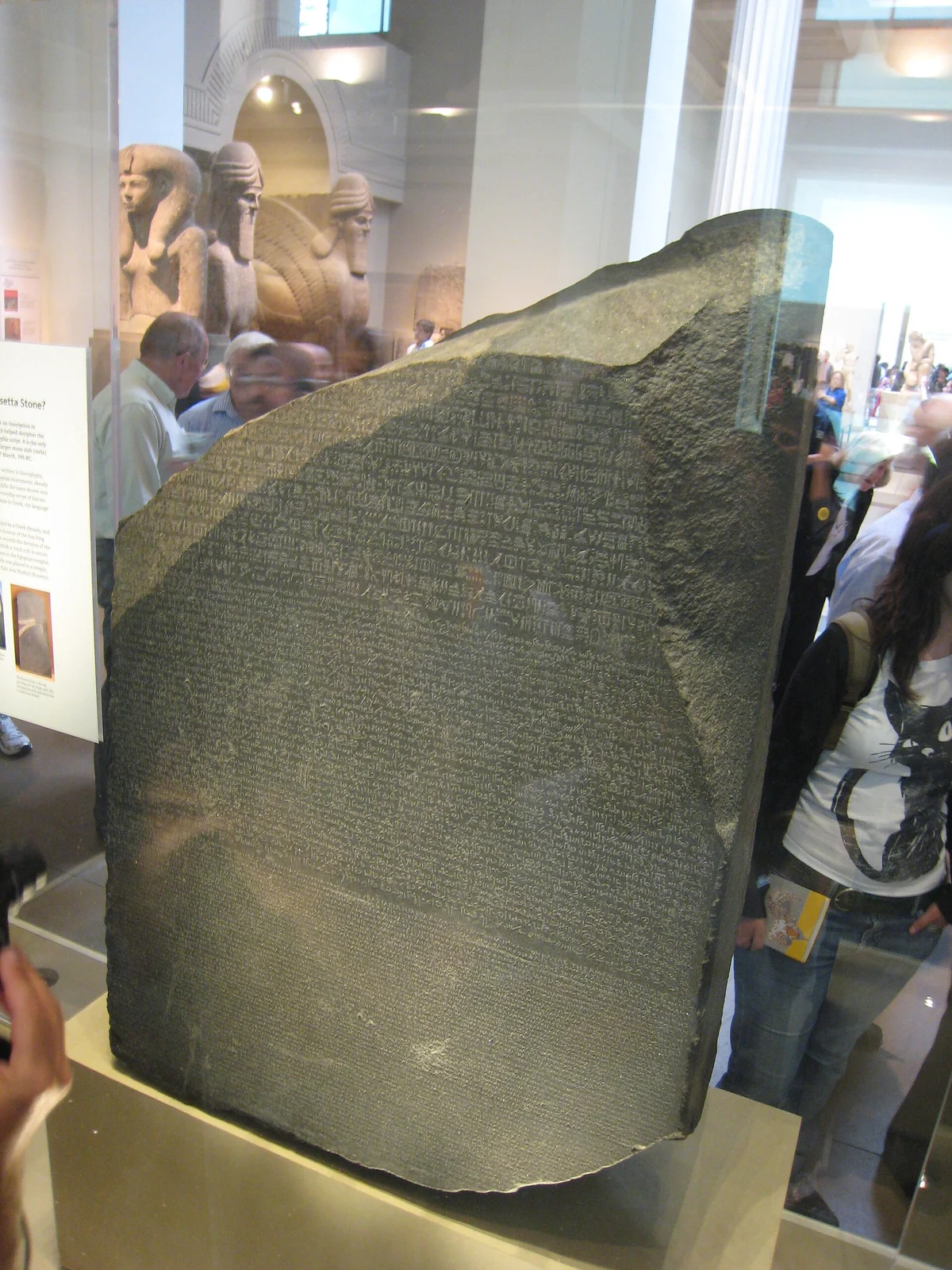
The Rosetta Stone is a broken granodiorite stele bearing a priestly decree issued in 196 BCE under Ptolemy V Epiphanes. Its surviving surface contains three registers of writing: Egyptian hieroglyphs, Egyptian Demotic and ancient Greek. These were not three unrelated messages placed together by chance. They represented related versions of the same formal decree, written for different audiences and institutional contexts.
The stone is not a dictionary, a beginner’s alphabet chart or a map of hidden pyramids. Its importance comes from the possibility of comparing text that scholars could read in Greek with scripts whose phonetic and grammatical workings had become difficult to understand.
Today the original is held in the British Museum as object EA24. Modern questions about its location and repatriation are distinct from the historical process of decipherment and deserve discussion without distorting what the inscription says.
Why the decree was written in 196 BCE
The decree was issued by a council of priests at Memphis during the reign of Ptolemy V, a king of the Macedonian-origin dynasty that ruled Egypt after Alexander the Great. It describes honours associated with the ruler, temple privileges and the religious presentation of kingship.
The original full stele was larger than the surviving broken piece. The inscription’s three scripts reflect a multilingual, administratively complex society. Greek served important governmental and elite functions, while Egyptian could be written in traditional hieroglyphic or faster Demotic forms depending on purpose.
Calling the three registers ‘three languages’ is therefore imprecise. The inscription is commonly described as bilingual in Egyptian and Greek but using three scripts. The Egyptian versions are not necessarily word-for-word identical to the Greek in every grammatical detail.
Hieroglyphs, Demotic and Greek: three registers, different uses
| Register on stone | Writing system | General historical context |
|---|---|---|
| Top | Egyptian hieroglyphic | Traditional monumental and sacred script; much is missing |
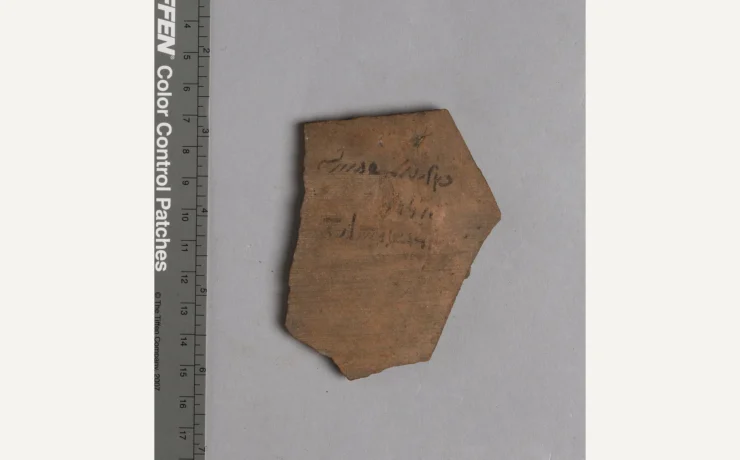
| Middle | Egyptian Demotic | Later cursive Egyptian script used in varied documents |
| Bottom | Ancient Greek | Language and writing system readable to scholars of the early 1800s |
The Greek section helped researchers identify the contents and royal names. The Demotic and hieroglyphic sections allowed systematic comparison. Yet translation was not a simple letter-by-letter substitution between three alphabets: Egyptian scripts include sound signs and signs contributing meaning, and the language requires grammar, context and knowledge of how writing changed through time.
Damage to the hieroglyphic register limited how much of that portion survived. Scholars used additional monuments, personal names and knowledge of Coptic to extend their understanding beyond the Rosetta Stone.
The stone’s discovery at Rashid in 1799
The stone was recovered in July 1799 near the Egyptian town of Rashid, called Rosetta in European usage. French troops working on fortifications found the inscribed fragment reused in an older structure. Its unusual combination of writing systems attracted interest quickly.
The dramatic rediscovery belongs to the history of military occupation and European scholarship in Egypt. It should not be mistaken for the moment the original decree was composed: the stele had already existed for nearly two thousand years.
The stone later came under British control following the French defeat, and entered the British Museum collection in the early nineteenth century. Its current location is part of a wider debate about colonial-era acquisition and the ownership of Egyptian heritage.
The great challenge: pictures that were not just pictures
Before successful decipherment, many European writers assumed Egyptian hieroglyphs were entirely symbolic images expressing mystical concepts. In fact, the script can use signs for sounds, concepts and combinations. The appearance of a bird or tool does not automatically mean the text is literally talking about that animal or object.
Recognising phonetic signs was essential. A name may be spelled using sounds while other signs help classify meaning. Later Egyptian language history supplied additional clues, especially Coptic, the last stage of Egyptian written in a different script.
The achievement was not that one scholar suddenly assigned a modern letter to every pictured sign. It was the gradual recovery of principles that allowed scholars to read names, words, grammar and ultimately large bodies of texts.
Thomas Young and the importance of royal names
Thomas Young made major contributions by comparing scripts and analysing royal names, among other evidence. Cartouches, oval enclosures around royal names, offered especially useful test cases because some names such as Ptolemy could be independently recognised from Greek.
Young’s work helped establish phonetic values and connections between Egyptian scripts, but it did not amount to a complete decipherment of hieroglyphic language. The history is best understood as cumulative rather than as a simplistic competition in which everyone except one genius guessed blindly.
Students should also distinguish the role of a cartouche in the ancient monument from its role in nineteenth-century scholarship. For Egyptians, it was a royal naming device within inscriptions; for modern researchers, it became one promising anchor for deciphering unfamiliar signs.
Champollion’s breakthrough and the 1822 letter
Jean-François Champollion is most closely associated with the decisive breakthrough in deciphering hieroglyphs. In 1822 he announced conclusions about phonetic writing in Egyptian royal names, helping transform the study of ancient Egypt into a discipline capable of reading original inscriptions.
His understanding of Coptic provided crucial linguistic context. Egyptian was not merely a set of symbols to be translated from Greek; it was a language whose sounds and grammatical structures could be investigated. Further work after 1822 developed the picture and continued to correct readings.
Giving Champollion his due does not require erasing Young or other contributors, nor does it imply that scholars could instantly translate every text by the end of that year. Decipherment opened a research programme that remains active as specialists study difficult manuscripts and inscriptions.
Why the Rosetta Stone was a key but not the only key
The stone made it possible to check Egyptian registers against a known Greek version, but Egyptian inscriptions came from many different eras and genres. A royal decree of 196 BCE cannot directly translate a Middle Kingdom story or an Old Kingdom funerary spell without further linguistic work.
Researchers used other bilingual texts, cartouches, names, Coptic, comparative grammar and additional archaeological discoveries. Later scholarship refined the reading of many signs and texts. The Rosetta Stone’s fame reflects its decisive role in making the problem tractable, not its capacity to provide a complete dictionary on its own.
A responsible guide should distinguish this contribution from the modern myth of an instant ‘code-breaking stone’ that renders every Egyptian symbol transparent.
Reading the physical object: what to look for
When looking at the original or a good photograph, note the broken top and rough edges. The stone survives as part of a larger stele. The upper hieroglyphic portion is incomplete, which explains why the top register contains relatively little surviving text compared with the others.
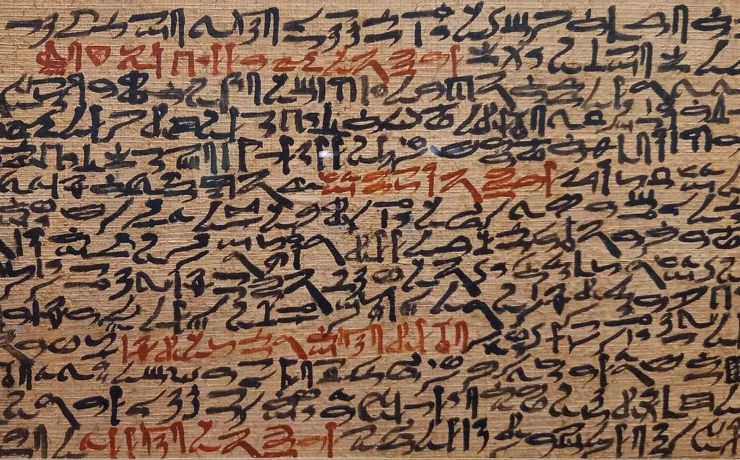
Look for differences in the size and density of signs across the three registers. Hieroglyphs appear as recognisable carved forms, Demotic as tightly written cursive signs and Greek in alphabetic letters. The contrast is visually striking, but it tells us about script systems, not the ethnic identities of every person in Egypt.
The inscription’s material, chiselling and damage are part of its archaeological biography. A museum photograph documents the modern condition; it cannot recreate the entire original stele without explicit hypothetical reconstruction.
The politics of where the stone is displayed
The Rosetta Stone is kept in London, but its origin is Egyptian. Questions about rightful custody, the circumstances of transfer and potential repatriation are debated by museums, Egyptian advocates, historians and the public. A balanced account separates legal arguments, ethical concerns and the historical facts of discovery and removal.
The role the stone played in European decipherment does not mean ancient Egyptians were incapable of reading their own language. The loss of the ability to read hieroglyphs happened through long transformations in writing and religious institutions; ancient scribes understood the scripts during the periods when they were in use.
Scholarly and public access also matters. High-quality images and object records can help students anywhere examine a major source, even if they cannot see it in person. Digital access does not settle the physical ownership debate, however.
What the stone did not reveal
The inscription is not a lost creation myth, a prophecy about future events or a secret warning about the pyramids. It is a formal political-religious decree connected to a specific Ptolemaic king. Its significance lies in language history and the circumstances of the decree.
It also does not prove that hieroglyphs were an alphabet with one symbol for each English letter. Some signs represent consonants, others combinations or meaning categories; vowels generally are not recorded in the same fashion as in modern English.
Claims that the Rosetta Stone was found inside a pyramid or created by Cleopatra should be rejected: it dates to Ptolemy V in 196 BCE and was rediscovered near Rashid in 1799.
How this discovery transformed Egyptology
Once longer Egyptian inscriptions could be read, researchers could test ancient royal names, titles and narratives against the physical monuments. Temples, tombs, administrative documents and literature became historical sources with their own language rather than collections of mysterious drawings.
Decipherment did not eliminate the need for archaeology. A readable inscription can describe a royal claim, while excavated evidence can confirm, qualify or contradict it. Translation and material context work together. A boast about a battle, for example, is not automatically an impartial report of what happened.
For a different perspective on ancient text production, see our ancient Egyptian scribes guide. For religious manuscripts that became readable through these advances, see the Papyrus of Ani study. They cover separate topics and are not competing versions of this article.
How to study the scripts without inventing translations
Begin with a reputable sign list and a clear distinction between Egyptian language stages. A modern image search for ‘hieroglyph alphabet’ often supplies charts that hide complexities such as multi-consonant signs and determinatives. They may help with basic names but should not be treated as tools for exact translation.
Study a small, documented object and its published transcription first. Compare the original marks with a scholarly transliteration and translation. Ask which signs carry sounds, which clarify meaning, and whether gaps have been supplied by the editor.
A learner can use a Hieroglyphic Explorer as a sign-browsing aid, but a sign browser is not a complete translator and cannot replace knowledge of grammar or manuscript context.
Frequently asked questions
What three scripts appear on the Rosetta Stone? Egyptian hieroglyphs, Egyptian Demotic and ancient Greek. It contains related versions of one decree.
When was the stone written? The decree dates to 196 BCE during the reign of Ptolemy V.
When and where was it discovered? It was recovered near Rashid (Rosetta), Egypt, in July 1799 during French military works.
Who deciphered Egyptian hieroglyphs? Thomas Young contributed important findings and Jean-François Champollion is associated with the decisive 1822 breakthrough; other research continued afterward.
Where is the original Rosetta Stone today? The British Museum in London, inventory number EA24.
Does it translate every ancient Egyptian word? No. It was a key comparative text, not a complete dictionary or a one-to-one alphabet.
Sources and original-object photograph
British Museum Rosetta Stone object EA24; American Research Center in Egypt: Foy Scalf’s account; Smarthistory: Rosetta Stone analysis; British Museum 2022 teaching guide.
Cover photograph: real detailed image of the Rosetta Stone taken by ProtoplasmaKid, available under CC BY-SA 4.0 (source). The additional full-stone photograph from June 2008 by Syced is released under CC0, original photograph and source licence. The image is a photograph of the historic object, not a modern illustrated reconstruction.