A digital museum can be beautiful, but an attractive collection of photographs is not yet a reliable research resource. To understand an Egyptian object, a visitor needs to know what it is, where it came from, how it was dated, which institution documents it and whether the displayed image is genuine photography or a reconstruction.
Why provenance matters
Provenance is the documented history of an object's collection, ownership and archaeological context. An inscription from a secure excavation can support different inferences from an object whose early collecting history is unknown. Records might identify a tomb, town, period, collector, excavation team or later museum acquisition, but the completeness of those details varies. A catalogue should record what is actually known rather than filling gaps with plausible narratives. Some antiquities have complicated histories of excavation, export and collecting; the presence of a high-resolution photograph does not resolve those ethical questions. The careful museum visitor learns to evaluate a label with the same interest as the physical object.
What an accession number does
An accession or inventory number allows the reader to find a particular institutional record. The same kind of artifact may exist in hundreds of collections, so a generic title such as 'Egyptian statue' is insufficient. A stable identifier links object photographs, material descriptions, dimensions, acquisition information and changing research interpretations. The Metropolitan Museum of Art's online database, for example, provides object numbers for many Egyptian items, allowing scholars and readers to distinguish an actual piece from a similar artwork. Some identifiers contain punctuation or multiple components and should be reproduced carefully. A third-party encyclopedia should link to the museum's record rather than creating the impression of owning the institution's catalogue.
A museum object is not just its thumbnail
An online museum record begins with a specific physical object, not a generic keyword. To identify an artifact responsibly, record the holding institution, accession number, medium, measurements, period and attribution before choosing an illustrative photograph. Even two boat models of similar appearance may differ in tomb association, date and modern collection history. A picture-search result can tempt a publisher to relabel an attractive object to match an article's headline. That practice destroys the distinction between evidence and decoration. The Metropolitan Museum of Art, for instance, provides stable object identifiers and an Open Access policy for many works, enabling researchers to link images back to the actual catalogued pieces. A sound digital encyclopedia preserves that link in captions and reference lists. Readers should know whether they are seeing an object still preserved today, a scholarly drawing, a replica or an imaginative reconstruction. When these categories are kept separate, the photograph becomes an entry point into real historical knowledge.
Case study: an Egyptian model boat with a museum identity
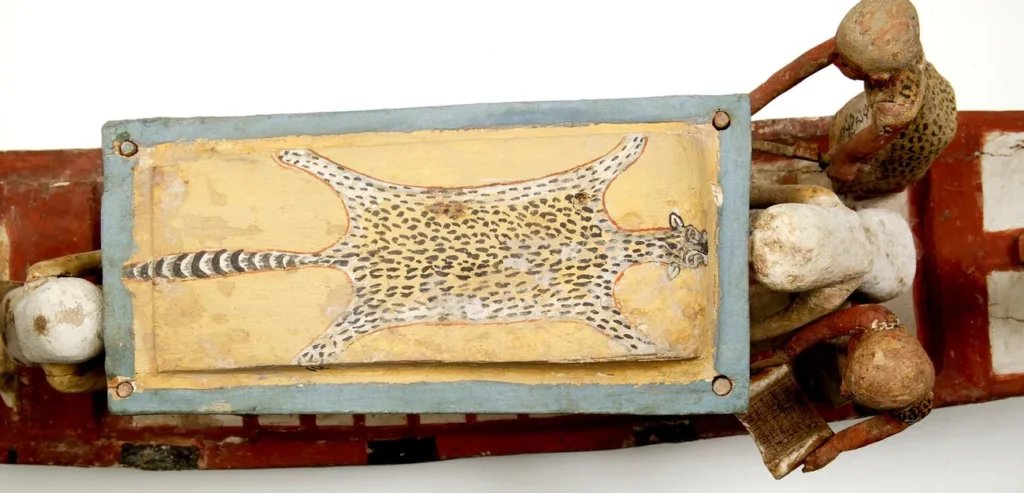
The first photograph documents the actual Model Boat of Ukhhotep, Metropolitan Museum of Art accession 12.183.3, associated with the museum object record 545439. It is an ancient artifact in a named institutional collection, not a freshly discovered boat or a full-scale vessel sailing today. Its form can help readers discuss how boat models represent transport, work or funerary expectations, but those interpretations require archaeological and art-historical context. The object was photographed by the museum's open-access documentation and made available under CC0. The accession number is more informative than a vague title because it separates this model from other Middle Kingdom boats, including works that may have different provenances. A catalogue entry should show the object type and material, the claimed date and any qualifying uncertainty before adding broader interpretations. This photograph is useful because it is traceable to a distinct inventory record, not because it merely resembles an imagined pharaonic river scene.
Reading an accession number without treating it as an ancient date
An accession number is a modern museum identifier. The Met's 12.183.3, for example, is a collection reference, not an ancient Egyptian regnal year or a calendar date. Museums use their own accession conventions; some include acquisition years, internal sequence elements or object-part suffixes, but outsiders should not infer an object's origin solely from the code's punctuation. Correct transcription matters because a missing digit may lead to another object entirely. Museum object IDs for online systems can be different from printed accession numbers. The first can connect to a website database while the second may be used on gallery labels or scholarly publications. Both should be stored where available, and neither should be silently replaced by the digital museum's own invented ID. Stable outbound links can remain useful even when the museum revises the object's dating, title or display location. Record revisions openly rather than hiding catalogue history.
Case study: a real papyrus from Meketre's tomb
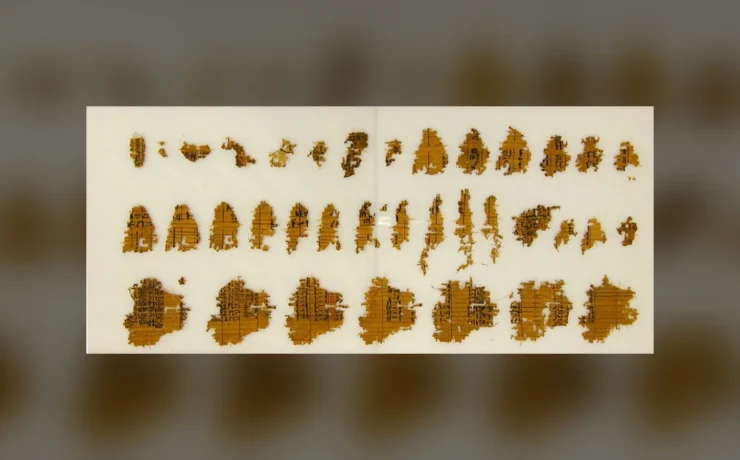
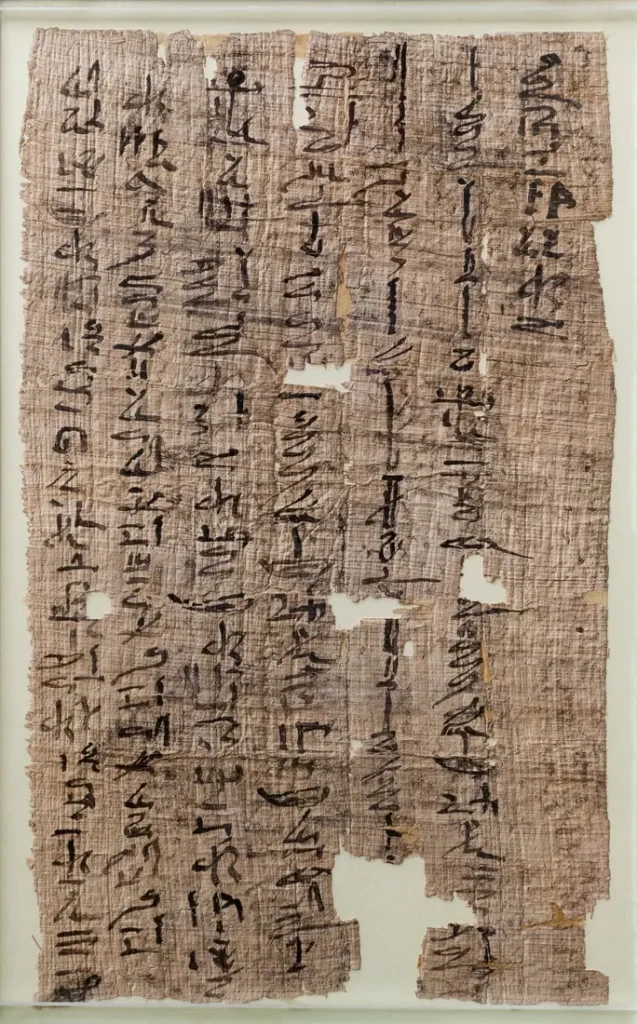
The second image depicts an ancient papyrus associated with Meketre's tomb, recorded by the Metropolitan Museum as accession 22.3.524 and linked to object 545453. Its object history identifies the Southern Asasif burial context at Thebes and excavation by the museum expedition in 1919–20. These specific identifiers make the photograph more valuable than a generic image captioned 'Egyptian papyrus'. A museum dossier should distinguish this historical findspot from the object's present repository in New York and the year it entered the collection. The photograph does not prove that every papyrus fragment from Meketre's tomb bore the same content or served the same role. Interpretation should come from the institution's description and specialist scholarship, especially when a fragmentary object requires decipherment. An image of real fibers and ink is physical evidence; its visible appearance alone may not settle the document's exact writing, use or date. Precise provenance limits overconfident storytelling.
Excavation provenance and collecting provenance answer different questions
Archaeological provenience asks where an object was found within the excavated context: a tomb chamber, deposit, architectural unit or stratigraphic layer. Collecting provenance traces the object's subsequent custody, acquisition, transfers and documentation. These histories overlap but cannot be merged into one vague field labelled 'origin'. A catalogued artifact might have a well-documented tomb findspot yet also require a separate explanation of excavation division, purchase or transfer to its current institution. Another object may have an excellent ownership history but only a broad regional archaeological origin. Neither condition should be erased to make a database visually uniform. An honest digital entry has separate fields and leaves unknown values visibly unknown. It also identifies source documents and the dates of collection revisions. Ethical and legal questions relating to export, excavation histories and restitution cannot be answered by a photograph alone; they require dedicated archival and legal research rather than speculative claims about a particular museum.
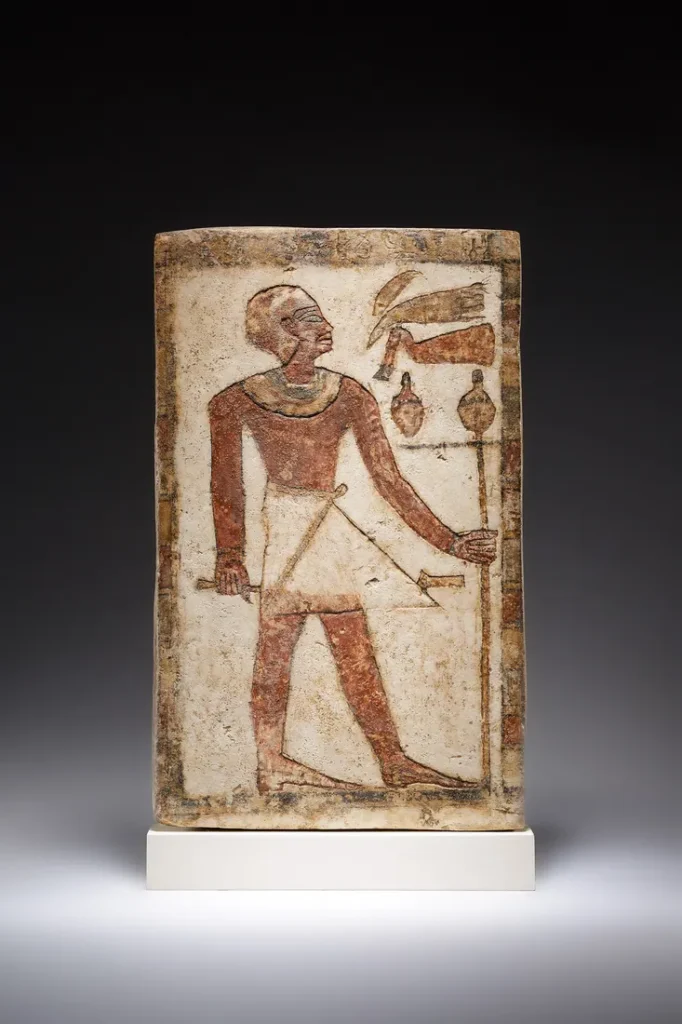
Case study: a stela and the limits of a short museum title
The third object is the Metropolitan Museum's Stela of a Man, accession 27.3.65, with online object identifier 556778. A modern short title supplies an accessible starting label, not a full historical biography of the person portrayed. Stelae may combine images, inscriptions and commemorative conventions, and their meaning depends on individual text, material and context. An editor should never assume that every male figure represents a king or a well-known named official. Even when the institutional catalogue gives a dynasty or regional association, further claims about authorship and exact ritual purpose need evidence. The Met photograph is available through an Open Access CC0 record and therefore provides a properly traceable visual. Its accession number also prevents confusion with another stela of similar composition. In a digital gallery, the viewer should be able to move from the overview photograph to the institutional record and then, where available, to an accurate transcription or scholarly study of the inscription.
Photography, reconstructions and reproduction rights
Photographs provide evidence of the object's present physical appearance, often from a particular side and under particular lighting. Restorations, missing fragments, mounts and conservation choices may influence what is visible. Drawings, facsimiles and AI-generated reconstructions can serve legitimate educational purposes, but only when unmistakably identified. An image claimed to show a newly excavated find should come from a verifiable release or collection; an unrelated artifact should never be passed off as that find. Images also have legal conditions independent of the age of the object. Museums, archives and photographers may have different access and reuse requirements, which should be checked before publication.
Dating is a conclusion, not a decorative badge
Museum labels sometimes provide a dynasty, date range or style attribution based on inscriptions, associated finds and expert comparison. A stylistic date is different from an excavated date, and a later inscription on an older object may complicate interpretation. Our digital entries should distinguish the date of manufacture from the date of later use, deposition and modern discovery. Likewise, a sculpture labelled 'Middle Kingdom' does not necessarily depict a precisely identified historical person. Where an institutional catalogue revises a date or attribution, the encyclopedia should update the entry rather than preserve an obsolete claim for visual consistency.
How to explore the evidence through connected entries
An effective digital museum links each object to a period, place, material, technique, person where known, and related texts. Visitors could compare multiple objects associated with mummification, look at museum photographs of hieroglyphs next to a reading guide, or explore how the same deity was represented in different centuries. These connections are educational only when based on catalogued records rather than superficial image similarity. A well-designed entry makes source provenance easy to inspect and gives every uncertain claim an explanation. That is the foundation for the interactive galleries KemetVault can build without sacrificing scholarly care.
How artifact dating is argued and why ranges change
A museum date is a conclusion supported by evidence such as excavated association, inscriptional names, material technique or stylistic comparison. Different methods have different strengths. An object recovered from a securely dated archaeological layer may have stronger contextual dating than an unprovenanced sculpture assigned to a period by style alone. Inscriptions may provide royal names, but an older object can be reused or inscribed later. Digital entries should distinguish manufacture, use, burial or deposit, discovery and accession rather than compress those events into one year. Historians also revise the boundary dates assigned to dynasties as new evidence emerges. A trustworthy gallery can show a conventional approximate period and attach a citation explaining the dating method. It need not pretend that an uncertain attribution is a laboratory measurement. Storing a range rather than one fixed year enables meaningful chronological filters without inventing certainty.
Rights to photograph and rights in the ancient work are separate
The fact that an artifact is thousands of years old does not automatically settle the legal status of a modern photograph. The museum may issue Open Access photographs under CC0, another institution may require attribution, and a third may restrict particular images. A user can often link to an object record without possessing the right to republish every photograph on that page. The three case studies here use files identified by the Met's Open Access programme and shared under Creative Commons Zero, with the original institutional source and object ID retained. It is still good practice to record the photographer or institutional source where available, date and image-transform notes. If a photograph is cropped or converted to WebP for accessibility and loading speed, the caption should not imply the unmodified original was uploaded verbatim. Artistic reconstructions, photogrammetry models and composite diagrams require their own authorship and rights checks. Good galleries document reuse rather than assume it.
A clear distinction among photograph, facsimile and AI reconstruction
A real object photograph documents a surviving object's condition under particular lighting, angle and conservation circumstances. A facsimile may reproduce a surface in ways that improve legibility, while an archaeological drawing can selectively clarify damaged lines. A modern 3D reconstruction adds interpretive decisions; an AI-created illustration may represent a hypothesis or scene with no physically surviving original. All can be educational, but they must never be interchangeable in captions or search previews. A visitor who sees a digital image of a newly uncovered tomb is entitled to know whether the image comes from field photography or represents an artistic reconstruction. For Kemet Vault, the practical editorial rule is to give each image an explicit evidence class, source URL and reuse status. The hero image for an object dossier should ordinarily show its actual featured artifact, while creative reconstruction belongs within a clearly labelled explanatory context. Visual accuracy is part of intellectual integrity.
Museum metadata design: which fields should be mandatory
A useful museum record should store institution name, accession or inventory number, a stable object URL, a short title, materials, known or estimated date, findspot precision and collection provenance status. Other useful fields include dimensions, technique, inscriptions, collection department, photographs, rights and bibliography. Crucially, each factual field should be capable of citing the source from which it came. Unknown measurements must not be populated with invented estimates for the sake of database completeness. The public interface can group complex data into readable tabs or collapsible panels, but the underlying distinctions should remain accessible to researchers. Search filters for period, material or site should behave according to recorded evidence rather than superficial automated image similarity. A source link should lead to a real institutional record, not a fabricated URL formed from guessed identifiers. Every record should have a last-checked date so users can understand the age of information.
Cross-linking manuscripts, inscriptions and models by documented relationships
Digital museum objects become more useful when connected to related sites, practices and historical questions. A model boat can link to an article about tomb equipment and Nile transportation, while a papyrus can lead to a guide to scripts, conservation and literary or administrative texts. A stela may connect with Egyptian epigraphy or the chronology of its assigned period. These relationships must be based on specific documented features, not generated simply because two thumbnails look similar. The same deity appearing in different centuries may be an informative comparison precisely because the works come from different contexts. A good interface shows why an association exists and whether it is a firm contextual link, a thematic comparison or a scholarly hypothesis. Such relational paths help students investigate an artifact without conflating objects from separate museums. Internal links should improve interpretation instead of functioning as a mechanical SEO network.
A repeatable research checklist for students and museum visitors
Choose one object and begin at its official holding institution. Record the title, accession number, stable object URL and the museum's proposed date and provenance, including any qualifications. Check whether the image is an official photograph and identify its license before using it in coursework or publication. Read the object's detailed description, then consult at least one independent archaeological or Egyptological source before making a wider historical claim. Keep the findspot separate from the present museum location and the date of discovery separate from the object's ancient date. If the record contains gaps, state them instead of filling them with a probable-sounding narrative. For Kemet Vault, this method can be practiced with the Model Boat of Ukhhotep, Meketre papyrus and the Stela of a Man, each linked to an actual Met object identity. It turns a digital gallery from attractive browsing into testable historical research.
Evidence comparison and key distinctions
| Topic | What the evidence establishes |
|---|---|
| Institution accession | Stable identifier printed by the holding collection; not the ancient artifact's date. |
| Online museum object ID | Record identifier used by an institutional website or public API; may differ from accession. |
| Findspot or excavation locus | Supported original archaeological context, as precise as the source permits. |
| Collecting provenance | Documented chain of acquisition, custody and collection history; distinct from findspot. |
| Object dating | Evidence-based date or range, not synonymous with modern discovery or accession. |
| Image reuse | Separate modern image license and attributions; the object's ancient age does not settle photo rights. |
| Material and dimensions | Documented technical descriptions with units and independent source reference. |
| Museum interpretation | Hypotheses or textual translations attributed to the issuing scholar or institution. |
Frequently asked questions
Can the same accession number be used for several unrelated objects?
Museums aim to assign identifying records, but accession conventions vary. Use both the complete number and the holding institution to avoid ambiguity.
Does a museum photograph prove where an artifact was excavated?
No. Provenience depends on excavation and collecting records, not what can be inferred from the object's appearance.
May CC0 museum photographs be reused?
The three specified Metropolitan Museum Open Access images are released as CC0, but other institutions and files may have different legal terms.
Are digital Egyptian museum illustrations always actual artifacts?
No. Labels should distinguish documentary photographs, facsimiles, modern digital restorations and creative reconstructions.
References, museum evidence and photography credits
All cited providers and institutions should be consulted at their original sources. The photographs document three separately catalogued Metropolitan Museum artifacts. Accession numbers, excavation context and reuse rights are kept distinct from any modern reconstruction.
- The Metropolitan Museum of Art — Collection
- Grand Egyptian Museum — Official website
- Metropolitan Museum of Art — Model Boat of Ukhhotep, object 545439
- Metropolitan Museum of Art — Meketre papyrus, object 545453
- Metropolitan Museum of Art — Stela of a Man, object 556778
- Metropolitan Museum of Art — Open Access policy and CC0 images
- Metropolitan Museum of Art — Search the Collection
- ICOM — Code of Ethics for Museums
- University College London — Archaeological dating
- Model boat of Ukhhotep MET 12.183.3 detail.jpg — The Metropolitan Museum of Art Open Access, CC0.
- Meketre papyrus MET 22.3.524 3193.jpg — The Metropolitan Museum of Art Open Access, CC0.
- Stela of a Man MET LC-27.3.65 EGDP025782.jpg — The Metropolitan Museum of Art Open Access, CC0.
Historical-source cross-check and further reading
Evidence and dating note (23 October 2026): Museum holding location, recorded findspot, antiquity/date, acquisition provenance and accession identity are distinct; an artifact in a museum is not necessarily excavated where it is displayed.
Original institution or academic research record: https://www.metmuseum.org/art/collection
Scholarly reading / comparative reference: The Met official object accession catalogue and collections metadata.
Scope: a source comparison of the named historical point, not independent scholarly approval of every claim or every image in this article.