Meketre’s Tomb Models: An Illustrated Guide to Middle Kingdom Work and Funerary Beliefs
Among the most revealing surviving objects from ancient Egypt are small painted models rather than giant royal statues. The tomb assemblage of Meketre, a high-ranking official whose career crossed the transition from the Eleventh to the Twelfth Dynasty, includes boats, workshops and carefully staged scenes of production. These objects make a useful case study in how archaeological evidence connects daily work with funerary beliefs.
The objects at a glance
These are original ancient objects photographed by their holding museum, not AI-generated reconstructions or decorative stock scenes.
Who was Meketre?
Meketre served as a royal chief steward during the closing part of the Eleventh Dynasty and into the early Twelfth Dynasty. His rock-cut tomb was in the Southern Asasif area of Thebes, on the Nile’s west bank. Archaeological teams associated with The Metropolitan Museum of Art found a hidden chamber containing an exceptional group of models in 1920 while clearing accumulated debris to document the tomb.
The importance of this discovery lies not simply in preservation. A group of objects recovered together from a recorded archaeological setting offers more interpretive value than a model with no known origin. The hidden chamber contained scenes that complement one another, giving researchers a wider picture of the ideas selected for an elite Egyptian burial.
How the find was made
Meketre’s tomb at Thebes had been known before the remarkable group of models was recognized. In 1920, The Met’s expedition found the hidden chamber, preserving an assemblage that allows researchers to consider different kinds of activity within a connected funerary context. The precise find location, object materials and post-excavation conservation are essential to understanding what the models can and cannot tell us.
The models were not made as modern museum dioramas. Their original audience was the deceased and the ritual world of burial. The artistic decisions visible in them must therefore be interpreted alongside Egyptian beliefs about continued sustenance and movement in the afterlife.
Objects as historical evidence
Tools, figures, boats and animals can represent recognizable practices, offering clues about techniques, occupations and material culture.
Objects as symbolic provision
The tomb setting suggests that many scenes served ideals of lasting access to supplies, transport and service. The models need not portray a literal day at a specific real workplace.
Boats as more than miniature transportation
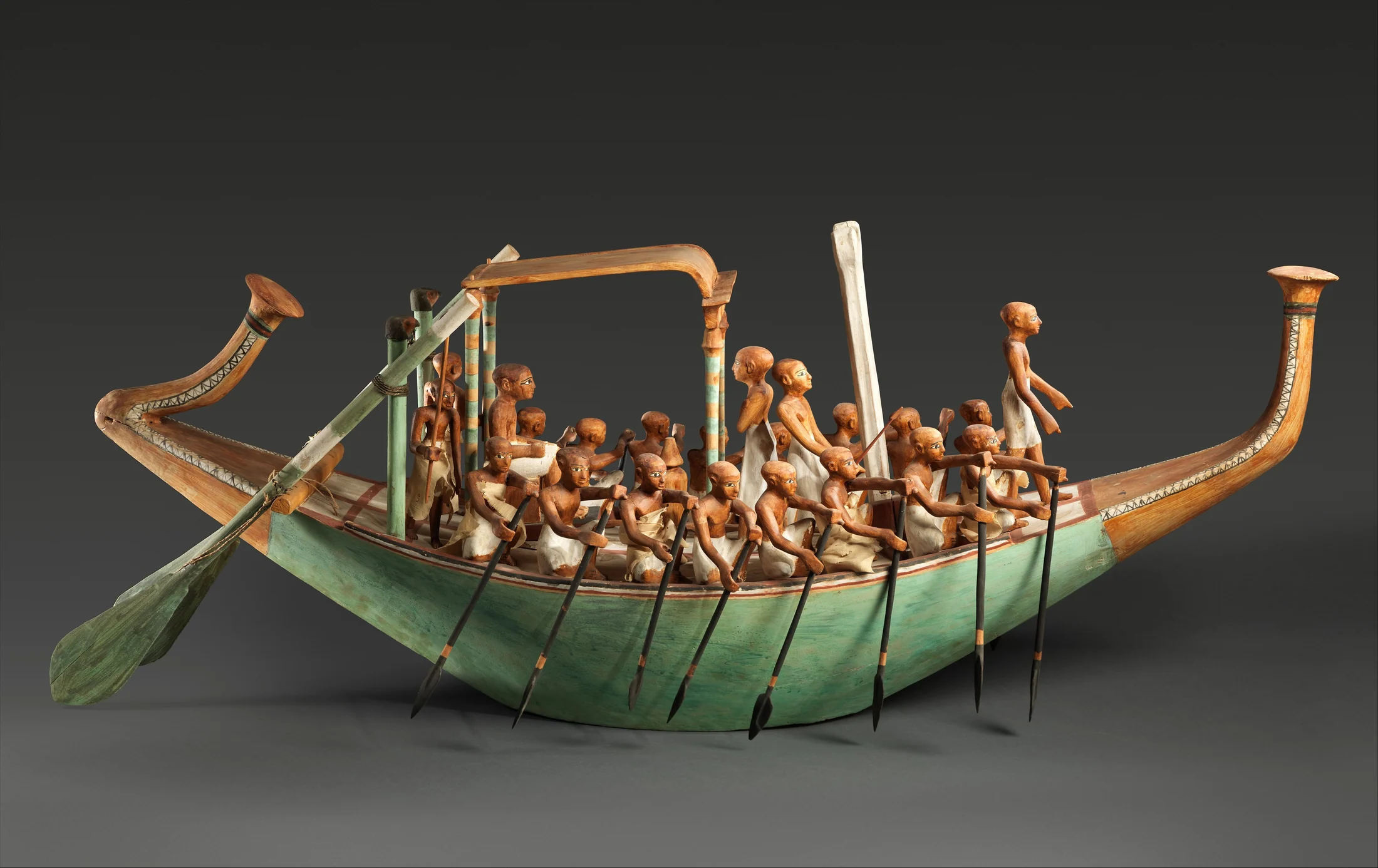
One of the best-known models is a paddling boat, catalogued by The Met under accession number 20.3.5. It includes a crew arranged to suggest movement and a covered space occupied by a statue representing Meketre. Its design evokes the traditional Egyptian boat, but it is not merely a demonstration of river technology.
The Met associates the boat models with the symbolic journey to Abydos, an important center of the god Osiris. Another model represents the return journey under sail. Interpreting the two together helps explain why river transport could carry ritual meanings beyond its ordinary economic use.
The Nile connected Egyptian regions, but a funerary boat model also offered a way to imagine travel, continuity and participation in sacred events. That distinction matters: a model can contain accurate practical details and still belong primarily to a religious setting.
Comparing the different boat models
The Met catalog distinguishes boat models by precise accession numbers. That matters: labels such as “Egyptian boat model” can refer to several objects, different constructions and even other tombs. The model paddling boat 20.3.5 should not be conflated with the model sailboat 20.3.4. Both belong to Meketre’s assemblage and are generally associated with his ceremonial journey to and from Abydos.
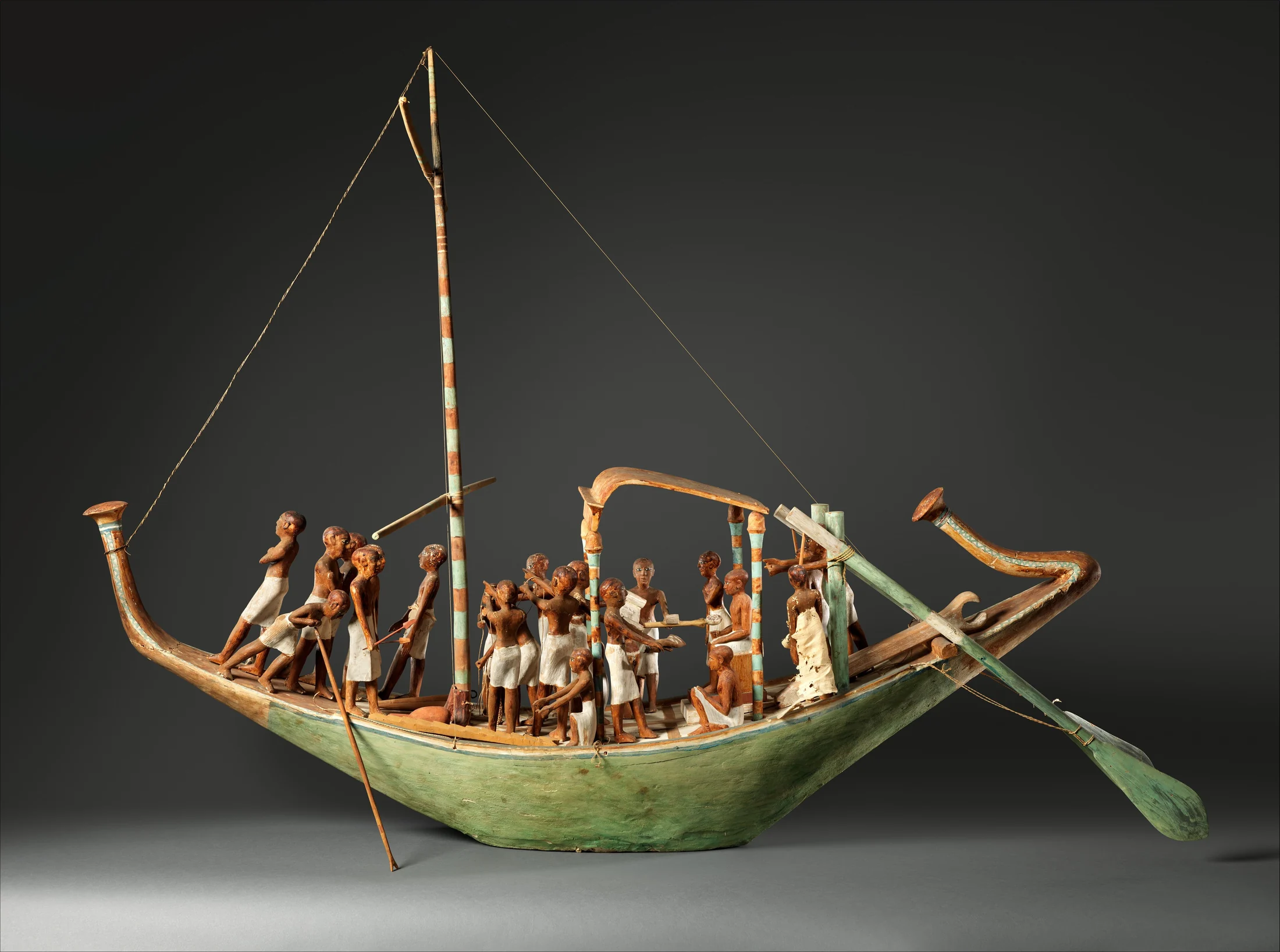
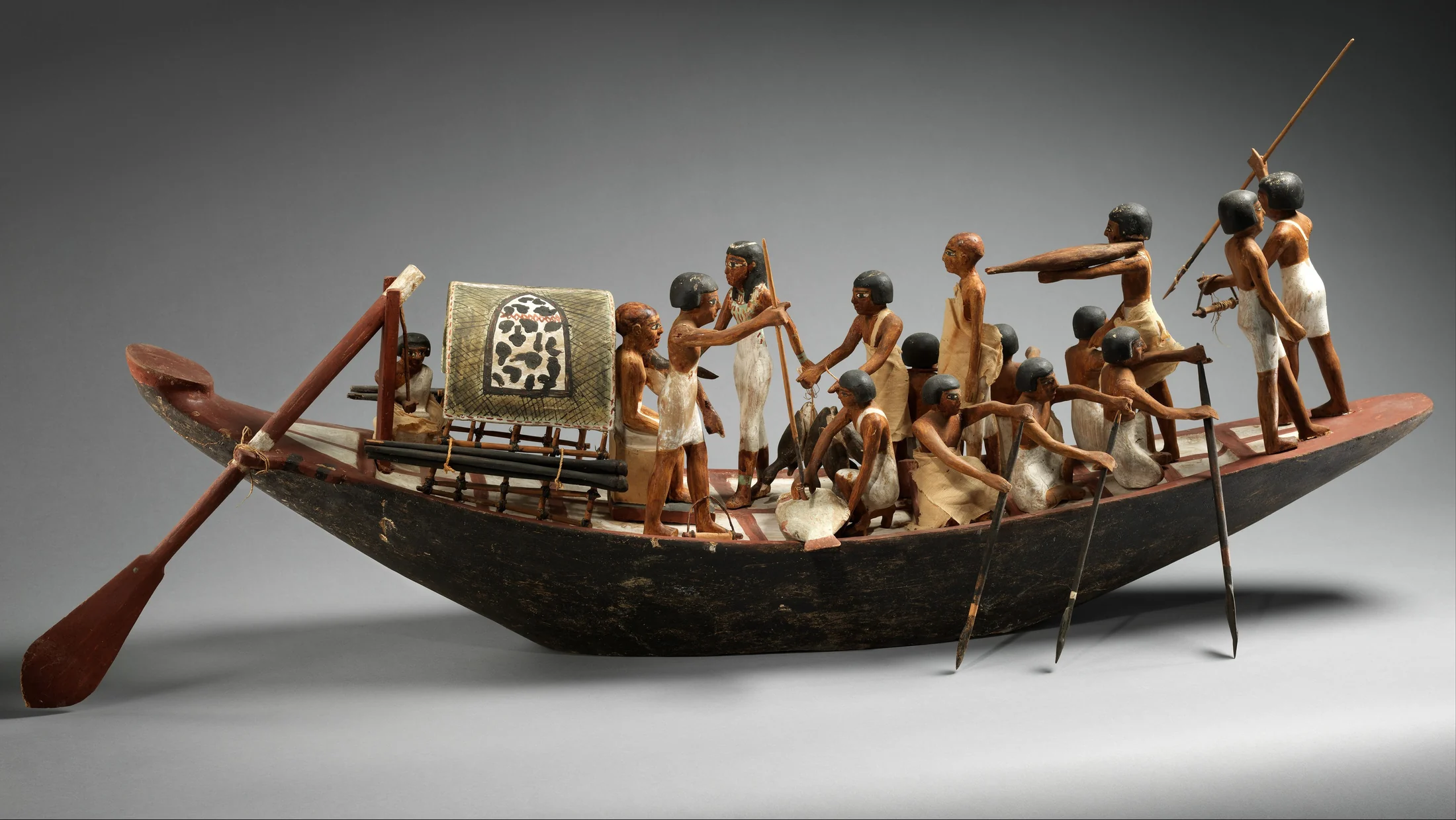
Students can compare the size and position of crew figures, rigging elements, clothing and boat fittings to ask which details echo practical river craft and which have primarily a ritual or commemorative role. Descriptions should always state the museum’s material and dating rather than inferring them solely from photographs.
Workshops, animals and controlled abundance
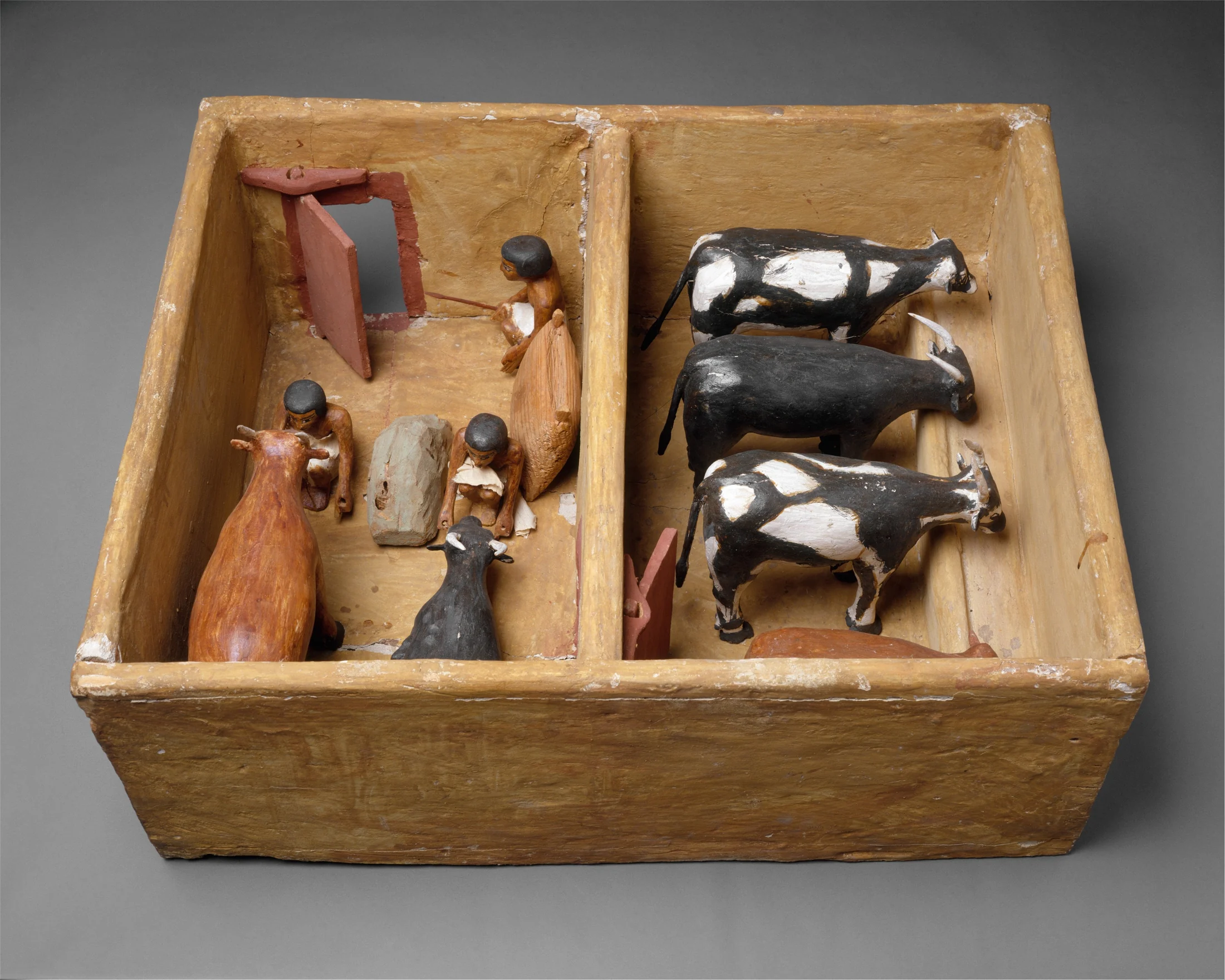
The scene of a cattle stable, accession number 20.3.9, shows animals being tended and fed under the supervision of workers. A model of a slaughter house, accession number 20.3.10, likewise depicts a highly organized activity with attendants and oversight. These are detailed representations of economic processes, not neutral snapshots of a village.
They were placed in an elite tomb and should be read in that context. Their presence could express the continued availability of food, labor and resources to the deceased. At the same time, their figures, tools and spatial arrangements provide comparative evidence for how Egyptians imagined and represented specialized work.
Food production as a funerary theme
In a tomb, a miniature food-production setting may represent the continuation of nourishment beyond death. Models of food preparation and animal husbandry fit into wider Egyptian funerary concerns about sustenance. They also depict distinctive tasks, spaces and roles that researchers can compare with other evidence for early Middle Kingdom life.
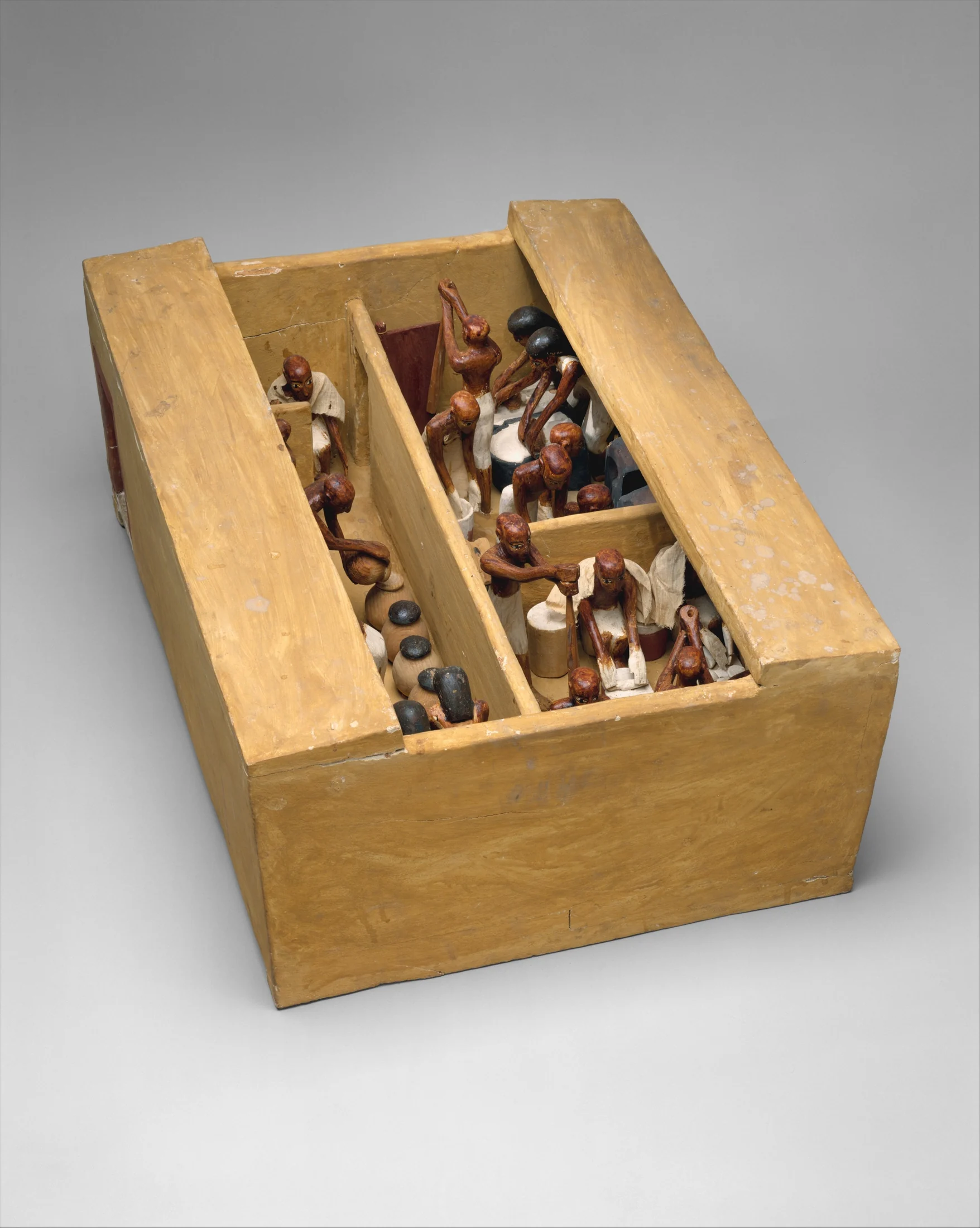
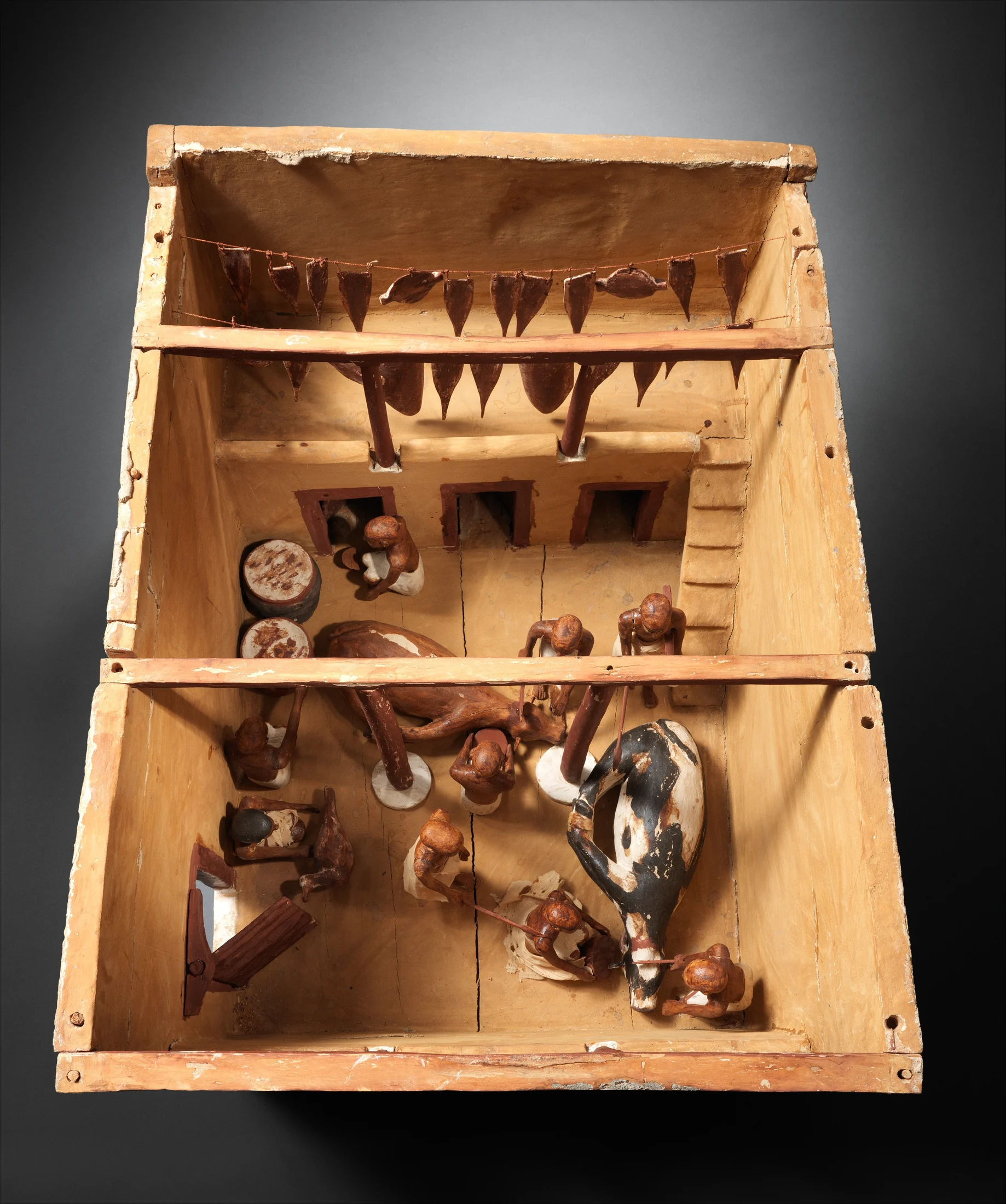
These models cannot be converted into simple numerical estimates of ancient labor force sizes or food consumption. The figures are representational and selective. Their particular historical value lies in the relationship between the depicted roles, the tools and spaces represented, and the objects’ securely recorded archaeological context.
What archaeologists can infer, and what they cannot
The models show that ancient artists could represent carefully differentiated workers and occupations. They also indicate the importance of provisioning and ordered activity in a tomb owner’s funerary environment. But one should not use a single tomb assemblage to claim that everyone in Middle Kingdom Egypt ate, worked or lived exactly as the miniature scenes suggest.
Several interpretive questions remain essential. Who commissioned the models? How closely do they reproduce real contemporary structures and equipment? Which elements were selected because they symbolized the owner’s social standing or an ideal provision for the afterlife? How did museum conservation and later restoration affect the objects we see today?
Those questions do not make the models unreliable. They make them sources that require context, comparison and clear distinctions between observation and interpretation.
How to compare objects in the classroom
Record an accession number
Note 20.3.4 for the sailboat, 20.3.5 for the paddling boat and 20.3.12 for the bakery and brewery. This prevents confusion between objects that have similar names.
Describe what the photograph actually shows
Separate directly visible colors, figures and components from proposed interpretations about ritual or work. Museum photography can show details clearly but does not replace an archaeological field record.
Check archaeological context
Ask how the model was recovered, whether it came from an undisturbed group and what conservation history is recorded. A single object may be interpreted differently when removed from its original relationship to other finds.
Compare with texts, tools and other finds
Models work best as one type of evidence among several. Do not claim that one wooden figure establishes a universal working practice for the entire Middle Kingdom.
Reading an object record responsibly
The Met’s online catalog gives the title, chronological classification, materials, dimensions and accession number for each object. The accession number is particularly helpful because similar descriptions such as “model boat” can refer to entirely different archaeological finds. A catalog number enables visitors and researchers to return to the exact item.
A useful object profile therefore contains more than an attractive photograph: it identifies the museum, the source record, the findspot when known, the materials, the dating convention and the image rights. Kemet Vault stores its approved public-domain display photographs on its own domain, while keeping the institutional records as citations for verification.
Making a miniature: materials and craftsmanship
The Met’s records for Meketre’s boats and work scenes list materials such as painted wood, plaster, linen and other components. These material choices matter because the models are constructed objects: craftspeople shaped the parts, assembled figures and accessories, and added paint to indicate clothing, tools, architecture and equipment. Their tiny size does not make the craft simple.
For historians, distinguishing the original manufacture from modern stabilization is part of responsible analysis. Museum objects may have undergone conservation after excavation. An image of an apparently complete boat should not automatically be treated as a photograph of an untouched object exactly as found. When possible, researchers compare the modern catalog with excavation and conservation documentation.
Models also present an interpretive challenge: a carefully rendered oar or vessel can reflect real technology, but the purpose of the assemblage was funerary. Representational accuracy in a detail does not imply that a scene records a unique event, named worker or precise working schedule.
Why the tomb context matters so much
An object without archaeological context can still be beautiful and informative, but the relationship among objects can explain a great deal about why they were selected. Meketre’s hidden chamber offered a group of boats, provisioning activities and figures recovered together. Studying the group provides a stronger basis for discussing themes of movement, sustenance and status than any single image would offer on its own.
That context makes the accession number especially important. The inventory and excavation record connect an individual item to the broader assemblage, even when the objects are now stored in different locations or discussed in separate publications. An isolated catalog description should therefore be treated as one entry in a larger research story.
Religious interpretation: what did the models provide?
Egyptian funerary practice included the provision of food, supplies and ritual care to sustain the deceased. Scenes of agriculture, livestock, kitchens, bakeries, breweries and boats can be understood within this belief system. The precise relationship between model scenes and everyday economic organization, however, is a topic for comparison and interpretation rather than a literal report.
What can be observed
A particular model’s figures, layout, paint, materials and recorded archaeological context. The Met accession numbers make these features verifiable in official photographs and records.
What must be interpreted
The full spiritual purpose of each scene, the extent of realistic representation and how typical the displayed activities were of other Egyptian households or work sites.
Middle Kingdom society and the limits of miniature scenes
Models from an elite tomb are evidence of an elite funerary environment. Their selection may reflect ideals of controlled production, access to labor, ritual travel and permanent sustenance. They cannot simply be treated as a cross-section of all Egyptian society. Women, children, agricultural workers and craftspeople may be represented selectively according to funerary conventions rather than demographic balance.
Even so, they invite useful comparisons. What vessels appear in bakery and brewery models? How are cattle supervised? What differences appear between a paddling boat and a sailboat? Are figures arranged as individual actors or as part of a rhythmic composition? These questions turn photography into structured observation while keeping interpretations transparent.
Short classroom exercise: evidence versus inference
Pick one object with a known accession number
Use The Met 20.3.12, the bakery and brewery model, or 20.3.5, the paddling boat. Note the exact name and materials provided by the museum.
Write down what you see without explaining it
Describe figures, tools, containers, sails or architectural boundaries visible in the authentic photograph. Do not begin by guessing the model’s religious meaning.
Form a testable historical question
Ask how a particular depicted activity might have related to Middle Kingdom technology or burial beliefs. Identify what other evidence would be needed.
Explain what remains uncertain
A good answer distinguishes the visual evidence from modern interpretation and states why a single model cannot establish a universal social rule.
Explore the models in the museum
The Kemet Vault Digital Museum introduces original object photographs and identifiers, while the Interactive Timeline places the early Middle Kingdom within the broader sequence of Egyptian history. For broader material culture, see Artifacts & Museums and Daily Life & Culture.
Primary collection sources
- The Met, Model Paddling Boat (20.3.5).
- The Met, Model Cattle Stable (20.3.9).
- The Met, Model of a Slaughter House (20.3.10).
- The Met, Model Sailboat (20.3.4).
- The Met — Model Bakery and Brewery, 20.3.12.
- The Met — Model Sporting Boat, 20.3.6.
Editorial method: original explanatory writing based on identifiable museum catalog records. Photographs are CC0 and hosted on Kemet Vault. The site’s editorial team does not claim museum partnership or exclusive ownership of public-domain images.