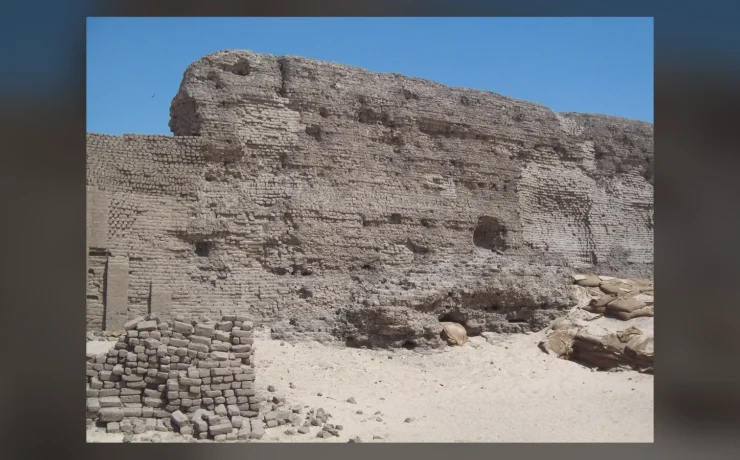
A historical timeline looks precise when every ruler is assigned one starting year. Egyptian history is rarely that simple. Dates are reconstructed from king lists, inscriptions, archaeological sequences and scientific evidence, with different levels of confidence across periods. A reliable interactive chronology must show what is known, what is estimated and why alternative ranges sometimes coexist.
Regnal years as ancient timekeeping
Egyptian documents commonly dated events according to years of a reigning king, not according to the modern BCE/CE calendar. An inscription stating 'year X' does not always supply a modern date until scholars identify the ruler and fit the reign into a reconstructed chronological framework. Co-regencies, damaged names, uncertain succession and differing readings can complicate that work. Later king lists are valuable sources, but they were compiled for particular purposes, and some omit rulers or present ideologically shaped histories. The chronology of one dynasty can be relatively firm while a transition into another remains more debatable. A digital timeline that hides these differences gives an impression of certainty the original material does not support.
Relative and absolute dating are different
Relative chronology establishes that one phase or object preceded another, often through stratigraphy, ceramic comparisons and archaeological associations. Absolute dating attempts to place evidence within a calendar. Radiocarbon dating provides probabilistic ranges for certain organic materials, but an associated measurement must be interpreted in its archaeological context. If material was reused, displaced or deposited long after manufacture, its measured age might not equal the construction date being investigated. Several independent lines of evidence can strengthen a reconstruction, particularly when researchers explain the assumptions involved. Neither inscriptions nor laboratory measurements make uncertainty vanish; good historical presentation tells the reader how the evidence converges.
What a museum date really means
A year printed on a museum label normally summarizes several historical arguments. An inscription might give a ruler's name, a festival or a regnal year without any BCE date. A modern scholar has to link the record to a royal succession and anchor that succession to an external calendar. Confidence varies dramatically from one century to another. Readers should ask what the original Egyptian record says, how historians placed it in a sequence, and why a modern year was chosen. A date may be precise within its ancient source but approximate when converted into BCE. Museum labels quite reasonably provide convenient conventional dates, while catalogues may list rival scholarly proposals. An encyclopedia should make both levels intelligible. The danger is not using a single year as a navigation aid; it is silently implying that a disputed reconstruction is a direct observation. Any chronological claim should carry its evidence trail.
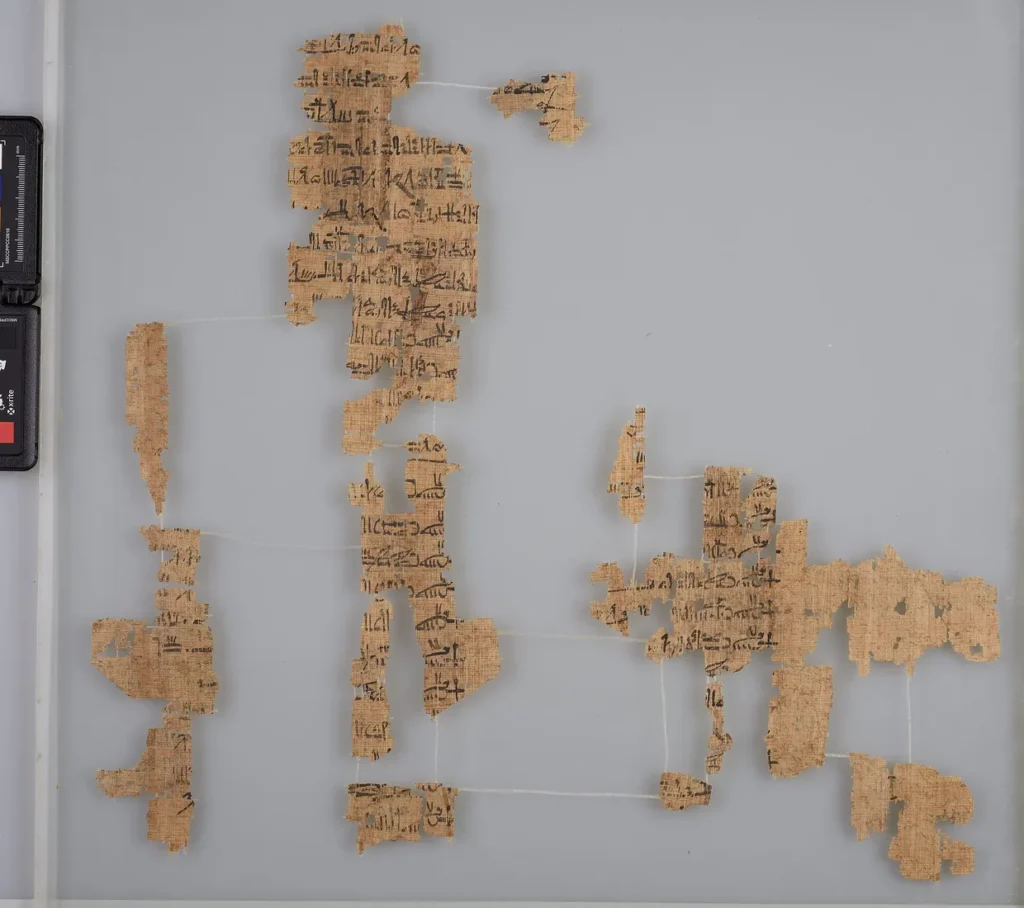
The Royal Canon of Turin: a manuscript with missing pieces
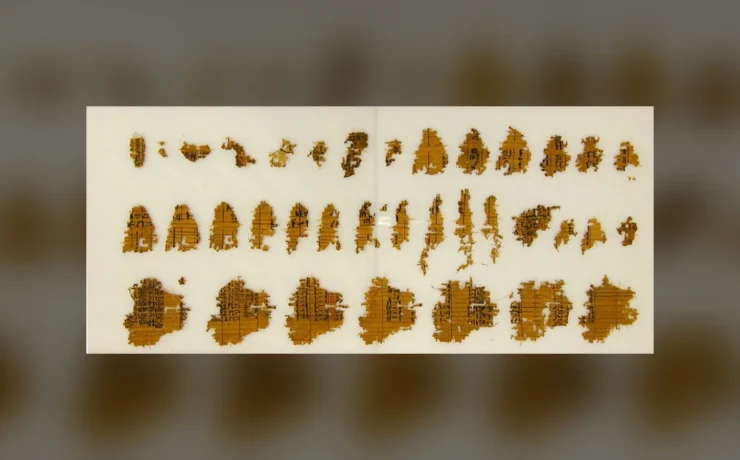
The so-called Turin King List, held by Museo Egizio under inventory Cat. 1874, is a genuine Ramesside-era papyrus with a remarkable sequence of rulers and, in some cases, recorded reign lengths. The surviving document is fragmentary, and its modern arrangement depends on scholarly analysis of the pieces. It uses hieratic, the cursive Egyptian script suited to documentary writing. Unlike a modern database, this manuscript was copied long after many reigns it describes. It is an ancient historical selection, not an automatic record generated every time a king succeeded another. Names and durations damaged by the papyrus's condition can generate competing readings. Its importance comes partly from preserving information omitted from monumental inscriptions. Conservation and reassembly create opportunities for better understanding without restoring every lost line. The accompanying object photograph shows a museum-held papyrus fragment, not a modern illustration. Always distinguish the ancient surviving marks from reconstructed text in published editions.
The Abydos King List is royal memory, not a census
In the temple of Seti I at Abydos, an ordered procession of royal cartouches helped express the king's relationship to selected predecessors. It was a monumental and ritual statement designed for a particular context, not a comprehensive roster of everyone who had governed Egypt. Several politically awkward reigns or periods do not fit its presentation. Consequently, absence from this list cannot prove that an otherwise documented ruler never existed. The image of the real relief is important: names are carved into religious architecture, surrounded by a political programme in stone. Seti I's chosen representation tells historians much about Nineteenth Dynasty memory and legitimacy. To reconstruct actual political history, scholars compare the list with administrative records, excavation contexts and alternative king lists. A modern timeline must mark the difference between a named predecessor acknowledged in a temple and an independently documented reigning authority. The two categories often overlap but are not interchangeable.
The Palermo Stone and the difficulty of royal annals
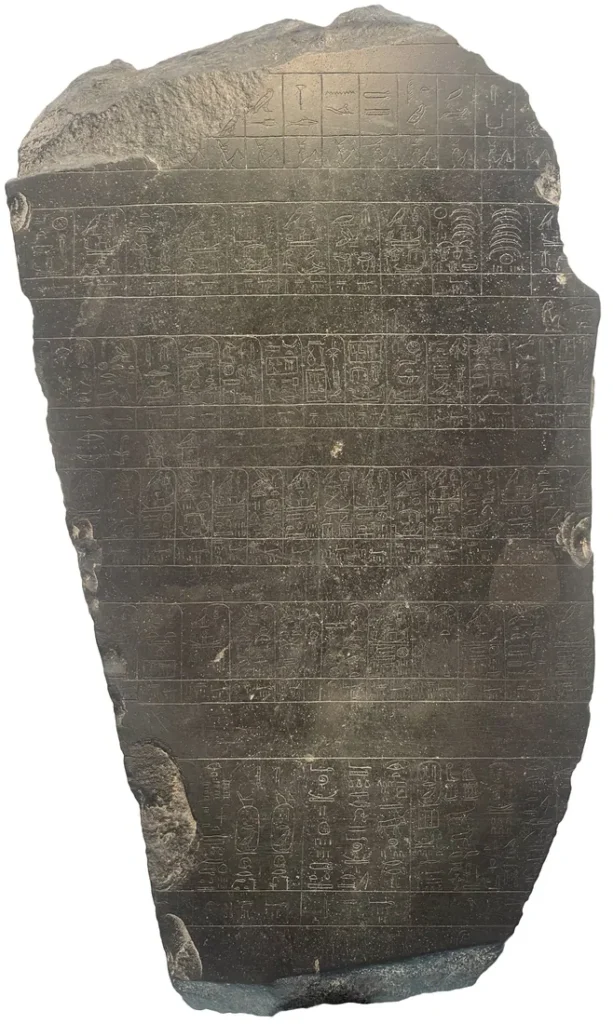
The Palermo Stone preserves part of an early royal-annal tradition recording events associated with earlier kings. The surviving original is damaged and incomplete, while other annal fragments complicate attempts to infer the extent of the lost original record. It offers a different viewpoint from later king lists: an annal may preserve particular activities or occasions without providing an uninterrupted chain of modern years. A photographed artifact can be strikingly tangible while its chronological interpretation remains unsettled. Researchers have to identify registers, signs, reign divisions and the relationships between fragments. That work is checked against seal impressions, royal burial contexts and early administrative marks. Neither the existence of a carved entry nor the survival of a recognizable royal name automatically supplies an unambiguous BCE date. It is therefore misleading to describe the Palermo Stone as a complete Egyptian calendar. The object provides rare and valuable evidence about early record-keeping precisely because so much corresponding evidence has vanished.
Manetho and the origins of the familiar dynasty system
The common numbering of Egyptian dynasties owes much to the historian Manetho, active in Ptolemaic Egypt. His original historical work is not preserved as a complete independent text. Much of its influence survives through later writers who quoted, abbreviated or transmitted versions of material attributed to him. Variant spellings, royal totals and reign lengths follow from this complicated history of transmission. Dynasty divisions are a valuable method of organizing a large and uneven archive, yet they are not a law of nature. Dynastic changes need not align with an immediate transformation in language, material culture or provincial administration. Nor should a modern numbered dynasty be projected uncritically onto the political vocabulary used by every ancient participant. The best approach retains these labels for clarity while checking the underlying royal succession independently. It also allows students to notice when two scholars disagree about a transition because they define the boundary differently, not because one accidentally forgot a pharaoh.
Pottery sequences, tomb contexts and relative dating
Before assigning a modern year, archaeologists often establish which objects and buildings came first. Stratigraphy, ceramic variation, burial assemblages, architectural repairs and seal impressions can indicate a reliable relative order even where no named king appears. Such approaches are essential for Predynastic and Early Dynastic Egypt. A sealed excavation context can be more informative for chronological analysis than an expensive artifact purchased without a documented findspot. Objects may remain in use for decades, be reused in later buildings or move downward into earlier deposits through disturbance. A radiocarbon sample from a reused beam, for example, need not establish the date when the surrounding wall was built. Careful excavation records allow specialists to identify those complications. This is why provenance belongs in a timeline's evidence model. It links the archaeological sequence to laboratory measurements and eventually to textual records of rulers. Relative chronology is not inferior history; it answers a different question.
Why ancient periods overlap in different references
Terms such as Old Kingdom, First Intermediate Period and Middle Kingdom are convenient modern frameworks, but historical boundaries can be defined differently by specialists. The beginning of a dynasty may not coincide exactly with a change in all aspects of society, and rival rulers may exist at the same time. Some chronology tables assign the Thirteenth Dynasty to the Middle Kingdom while others emphasise the transition toward the Second Intermediate Period. Similar complexities apply to the start of Ptolemaic rule: Alexander entered Egypt in 332 BCE while the formal Ptolemaic monarchy is generally dated to 305 BCE. Displaying these distinctions is more useful than forcing every century into a single exclusive label.

Building an honest interactive time explorer
A real timeline requires structured objects with date ranges, location, event type, source reference and a confidence indicator. The visitor should be able to select a century, ruler or site and then follow a direct link to the article explaining that event. A label such as 'circa' or a shading band is not decoration; it tells readers that the evidence supports an interval rather than a precise day. Uncertain end dates should remain uncertain in searches and comparisons. The editor must also distinguish ancient events from modern discovery dates: the excavation of a tomb in 2026 is not an ancient historical event of 2026 BCE.
Working across the complete history of Egypt
A chronology for Egypt should not stop at Cleopatra or squeeze centuries of Christian, Islamic, Ottoman and modern history into one undifferentiated 'later' category. Its data structure needs simultaneous communities and overlapping powers as well as cultural changes that continue despite political turnover. Museums, manuscripts, monuments and oral histories can each support different kinds of entries. A responsible explorer should invite the user to inspect these evidence trails, not pretend that a smooth animation is a substitute for research.
Astronomical anchors and their assumptions
Ancient Egyptian references to lunar occasions, the heliacal appearance of Sirius and calendrical cycles can contribute to proposed absolute dates. They do not operate as effortless conversion buttons. A historical astronomical argument requires assumptions about where an observation took place, what event the ancient author was describing, which civil-calendar convention applied and whether the surviving text has been read correctly. Modern software can calculate a sky position precisely while the historical interpretation remains uncertain. Even if a particular observation seems persuasive, missing royal reign lengths elsewhere can make the larger sequence unstable. Scholars have debated these correlations for decades, sometimes producing different models from related evidence. A responsible reference work presents the observation and its limits rather than claiming all dynasties can now be dated to the exact year. Visitors should not confuse precision in mathematical reconstruction with completeness in the underlying Egyptian written record. Both types of knowledge matter, but they are different.
Radiocarbon dating measures materials, not coronations
Radiocarbon laboratories measure signals in formerly living substances. After calibration, the result is a probability distribution for the sample, not an automatic date for the inscription, temple or pharaoh associated with it. Short-lived botanical material can reduce the problems of old timber, but secure archaeological context remains vital. Samples can be residual, redeposited or introduced after the event being studied. An influential 2010 research project led by Bronk Ramsey analyzed 211 measurements from short-lived plants in combination with historical reign information. Its modeling strengthened discussion of dynastic Egypt's date ranges but did not erase gaps in king lists or all disagreements between chronological systems. It is wrong to describe laboratory evidence as establishing an exact accession day. Scientists report confidence intervals and model assumptions; historians investigate whether the material belongs to the proposed phase. The most compelling conclusions arise when independent evidence agrees, not when a single numerical result receives more certainty than it warrants.
Bayesian models connect separate strands of evidence
Bayesian chronological analysis combines measured radiocarbon likelihoods with independently stated knowledge about relative archaeological phases, sequences of reigns or other constraints. The model asks which calendar intervals best fit both the measurements and the assumed ordering. It can produce a more informative range than isolated samples, but results depend on which samples were chosen and how historical assumptions were encoded. New excavation evidence may legitimately change a posterior distribution. A 68-percent range and a 95-percent range must be labeled differently; neither is a simple guarantee that every year inside the interval is equally plausible. Before adopting a published result, an editor should confirm which period and materials the study actually examined. Work centered on Early Dynastic Egypt does not directly establish every year of the New Kingdom. Transparent presentation of model structure, confidence and archaeological context prevents a technically impressive chart from becoming another vehicle for false historical precision.
Early state formation and the accession of Aha
The beginnings of dynastic Egypt illustrate the need to combine inscriptions, tomb contexts and statistical dating. Archaeologists study Abydos royal burials, early writing, sealings, regional pottery sequences and changing networks of power in the Nile Valley. One influential 2013 model placed Aha's accession within 3111–3045 BCE at its 68-percent highest-probability-density interval. This does not amount to discovering an ancient notice with those modern dates written on it. It is a model-based estimate built from archaeological and scientific evidence. Egypt's political consolidation emerged from longer transformations in settlement, resource management and regional authority, not simply one coronation ceremony. The relationship between early rulers and the predynastic Naqada cultures is especially useful for readers who want to see change over time. A good timeline should link that royal transition to actual excavated sites rather than treating history as a neat queue of famous pharaoh portraits.
Why major Egyptian periods have different boundaries
The Old, Middle and New Kingdom labels are indispensable, but published chronological frameworks do not always agree on their exact endpoints. Archaeologists may emphasize political unity, a particular royal succession or material changes when describing a transition. Different reconstructions of reign lengths can move a boundary by several decades. The 2010 radiocarbon-based research, for example, modeled the beginning of the New Kingdom within 1570–1544 BCE rather than establishing a single uncontested date. Complications are especially visible around the First and Second Intermediate Periods, where rival courts and regional authority make a one-ruler-at-a-time story misleading. Some writers classify part of the Thirteenth Dynasty differently from others. Rather than hiding these decisions, chronological pages should identify their adopted framework and allow alternative dates to appear in notes. Readers can then understand why two reputable museum timelines may differ without assuming that one is invented.
Designing a chronology that teaches instead of merely animates
An interactive encyclopedia should store each entry's subject, time range, location, documentary support and degree of uncertainty. The public interface can show a conventional approximate year while linking to a note about competing reconstructions. Overlapping reigns should occupy parallel tracks when the evidence requires it. Filtering by date must not conceal uncertainty behind a falsely narrow database field. An excavation reported in 2026 belongs to the modern history of archaeological discovery; it should not be confused with the ancient date of the buried object. Sources should lead from each ruler to documented papyri, temple lists, excavation records and reputable scholarship. Cross-links to Naqada, Abydos and the broader Egyptian eras make the platform genuinely useful for students and visitors. The purpose is not to demand specialist training from every reader. It is to provide a readable route from a simple question to the evidence, with uncertainty communicated as a sign of intellectual care rather than a defect.
Evidence comparison and key distinctions
| Topic | What the evidence establishes |
|---|---|
| Regnal year | An ancient ruler-based date requiring separate modern-calendar correlation. |
| Turin Canon | Incomplete hieratic royal list and some reign durations, Museo Egizio Cat. 1874. |
| Abydos king list | Seti I's monumental selection of legitimate predecessors, not exhaustive. |
| Palermo Stone | Early royal annals preserved only in damaged fragmentary form. |
| Radiocarbon | Calibrated probabilistic dates of organic material; archaeological associations matter. |
| Bayesian model | Scientific measurements and historical order combined under stated assumptions. |
| Digital chronology | Approximate ranges, parallel reigns, provenance and linked evidence. |
Frequently asked questions
Why do different websites date the same pharaoh differently?
Incomplete reign evidence, rival king-list reconstructions and different chronological anchors produce defensible variations. Compare the scholarly scheme and context.
Is the Turin King List a real ancient papyrus?
Yes. Museo Egizio preserves the fragmentary ancient document as Cat. 1874; scholarly reconstruction remains necessary.
Can radiocarbon establish the exact day a pharaoh took power?
No. It dates organic material probabilistically. Archaeology and historical models are needed to associate samples with a particular reign.
Are uncertain BCE dates still useful?
Yes. The relative order of events may be well supported despite less secure calendar placement. A transparent range is more honest than invented precision.
References, museum evidence and photography credits
All cited providers and institutions should be consulted at their original sources. Photographs depict documented museum objects, Cairo monuments or Nile vessels at named dates, never imaginary scenes or guarantees of a current service.
- Egyptian Ministry of Tourism and Antiquities — Historical Periods
- Cambridge Whipple Library — Predynastic chronology
- UCL Digital Egypt — Dating in archaeology
- UCL Digital Egypt — Chronology
- Metropolitan Museum of Art — Telling Time in Ancient Egypt
- Museo Egizio — Ancient Egyptian king lists and the Turin Canon
- University of Oxford — Radiocarbon-based chronology research
- Royal Society — Researchers rewrite Early Egyptian timeline
- Early Egypt 2013 radiocarbon research — open access
- University of Memphis — Timeline of Ancient Egypt
- Turin King List, papyrus – Museo Egizio Turin C 1874 p02.jpg — Museo Egizio (Turin), CC0.
- King List of the Seti I Temple at Abydos (I).jpg — Kyera Giannini / ISAW Ancient World Image Bank, CC BY 2.0.
- 240911 CvZ-Palermo-stone.jpg — CvZ, CC BY-SA 4.0.
Historical-source cross-check and further reading
Evidence and dating note (23 October 2026): Turin Royal Canon (Museo Egizio Cat.1874) is associated with the reign of Ramesses II, and its king list is written on verso of reused papyrus; reconstructed dynastic BCE ranges are not uniformly certain.
Original institution or academic research record: https://collezionepapiri.museoegizio.it/en-GB/section/Papyrus-Collection/What-s-on/The-Egyptologists-Corner/
Scholarly reading / comparative reference: Ian Shaw, ed., The Oxford History of Ancient Egypt (Oxford UP, 2000), chronology introduction.
Scope: a source comparison of the named historical point, not independent scholarly approval of every claim or every image in this article.