Hatshepsut became one of the most influential rulers of Egypt's Eighteenth Dynasty, but her history is easily distorted by dramatic claims that she 'pretended' to be male or simply stole a throne. Her monuments and inscriptions reveal a complex political and religious presentation of kingship, shaped by established Egyptian institutions and by the presence of Thutmose III.
Dynastic setting and routes to the throne
Hatshepsut belonged to the Eighteenth Dynasty, a period of renewed Egyptian power following the wars associated with the early New Kingdom. She was a daughter of Thutmose I and a wife of Thutmose II. When Thutmose II died, the young Thutmose III was the legitimate king; Hatshepsut initially acted within the royal family as regent and later adopted full royal titulary. This political development was neither instantaneous nor adequately explained by a modern slogan such as 'the first female pharaoh'. Women held important royal and ritual offices before and after her. Understanding why Hatshepsut assumed kingly status means examining dated monuments, court networks, temple traditions and the responsibilities of the royal household. Chronological estimates for her reign differ slightly across reference systems, so an exact single date should never be presented without context.
Why the royal images appear in different forms
Images of Hatshepsut include female-coded representations and formal male-coded royal forms, sometimes with a ceremonial beard. These were conventional modes of Egyptian royal depiction and statements about an office, not candid portraits of how the ruler dressed at every moment. A seated sculpture with kingly regalia cannot be read like a modern photograph. Inscriptions are equally intentional: they establish legitimacy and present a desired relationship with gods and predecessors. A stronger interpretation compares scenes across building phases, statue groups, captions and changed royal names. It does not assume the political circumstances can be reconstructed from one statue or treat changing iconography as proof of personal identity beyond what the sources allow.
Why Hatshepsut's position was historically unusual
Hatshepsut was part of Egypt's Eighteenth Dynasty and eventually adopted the full titulary and imagery of a king. Her career cannot be understood by assuming that every female member of a royal household held an identical role. The dynastic situation following Thutmose I and Thutmose II placed a young Thutmose III within a court where senior royal relatives and established religious institutions were influential. Hatshepsut's earlier titles and later royal monuments document different stages of that political story. The transition remains a subject of historical analysis because inscriptions are primarily statements made by an ancient court rather than neutral modern biographies. It is misleading to characterise her simply as someone who disguised her identity or stole power from a boy without examining the forms of authority available to her. The reign instead raises questions about legitimacy, regency, ritual representation and relationships among the royal family, priests and officials.
Thutmose I, Thutmose II and the succession problem
Hatshepsut's rise followed the reigns of her father Thutmose I and her husband Thutmose II. The succession involving Thutmose III is familiar from royal genealogies, but court relationships and the sequence of political decisions cannot be reconstructed from a single complete diary. Ancient Egyptian kingship depended on both dynastic relationships and ritual presentation of authority. The adoption of royal names and iconography could help articulate a political position that was more complicated than modern labels of regent or usurper. Scholars reconstruct events by comparing inscriptions, monuments, tomb evidence and later records. Different pieces may have been created for specific audiences and at different points in the reign. Rather than begin with the question of whether she was 'really' a pharaoh, it is more productive to ask how the court described her position and which institutions gave it public visibility. Her surviving royal building programme is central to that inquiry.
From queenly titles to royal titulary
Egyptian royal titulary included names and epithets with religious and political functions. Hatshepsut's monuments and inscriptions show her appearing in different forms, reflecting a developing programme of kingship. The shift towards full royal representation should not be reduced to an assumption that Egyptians could not recognise a woman or that each statue was intended to deceive. The conventions of royal art were designed to communicate office, relationship to deities and ideal power as much as an individual's everyday appearance. A monument's text, statue type, original setting and date are all needed for interpretation. Certain images retain recognisably female language or personal references while others employ a traditionally masculine royal form. This variety is evidence of a complex representational strategy. A museum photograph of one statue can illustrate one form, but it should not stand alone as proof of her entire political ideology. Comparing securely attributed works is the way forward.
Reading Hatshepsut's statues as royal statements
Statues of Hatshepsut survive in different museums and archaeological contexts, many associated with the Deir el-Bahari monument. Their materials, poses, clothing and inscriptions can reveal how royal identity was displayed to viewers in particular spaces. The Metropolitan Museum of Art has published extensively on sculpture from her reign, including works excavated at the temple. Yet the modern arrangement of objects in museum galleries is not their original ritual placement. Some statues were deliberately damaged or fragmented in antiquity and later reconstructed. An illustrated article should identify museum object numbers and photograph rights accurately rather than use an unrelated generic pharaoh statue as if it depicted Hatshepsut. Iconography in formal Egyptian sculpture often presents timeless ideals and does not correspond to a modern portrait photograph. The surviving corpus supports a study of royal authority, artistic practice and later treatment of monuments, while details of the queen's personal appearance remain largely inaccessible.
Deir el-Bahari and the architectural choice of landscape
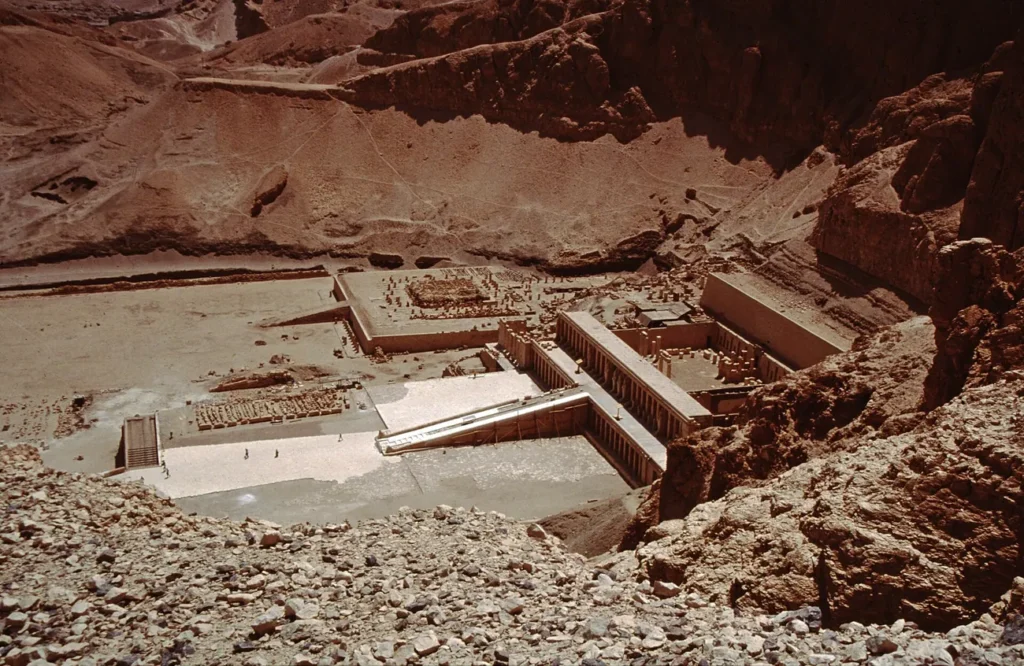
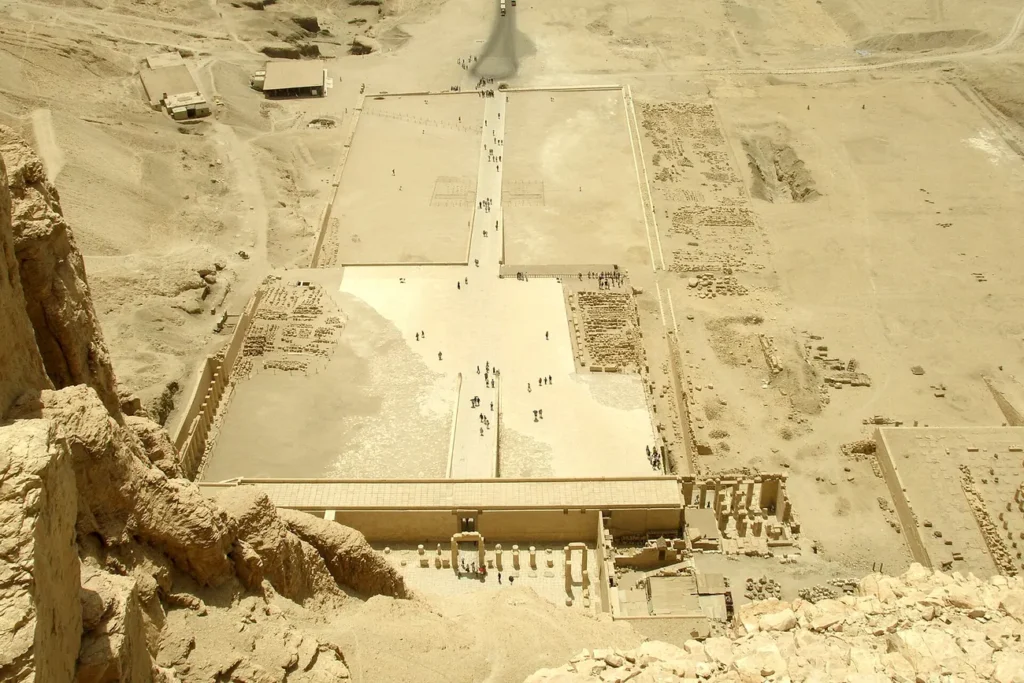
Hatshepsut's mortuary temple at Deir el-Bahari stands against the dramatic limestone cliffs on the west bank of the Nile near Luxor. Its terraces and colonnades use the landscape as an architectural setting, with procession routes, courts and ritual areas arranged in relation to surrounding rock. The current visitor experiences a monument transformed by excavation, conservation and modern access routes, so contemporary photographs should be explicitly dated and captioned. The larger Deir el-Bahari zone also includes the much older temple of Mentuhotep II and remains associated with Thutmose III. Confusing those structures or treating all visible stonework as Hatshepsut's original design obscures important chronological evidence. Studying the buildings together demonstrates how Egyptian rulers interacted with established sacred landscapes. An overview photograph can be exceptionally helpful, but only when the caption identifies which building is in front and acknowledges the complexity of the surrounding archaeological remains.
Sen(en)mut and the people who built a monumental programme
Senenmut is among the best-known officials associated with Hatshepsut, recognised in inscriptions and material evidence linked to royal administration and construction. Popular treatments sometimes turn him into a romantic protagonist because details of his life remain incomplete. Professional and social relationships, however, require sources, not speculation. His titles and monuments help reveal the organisation of royal projects, including how officials could gain visibility through patronage and work near the court. Large construction campaigns involved many skilled and unskilled labourers, quarrying and transport, ritual specialists, artists and administrators whose names often do not survive. A single famous architect or adviser did not physically build every terrace alone. This wider labour history is essential to an encyclopedia: it connects monumental form with resources, administration and craft while avoiding unsupported intimate biographies. Where proposed assignments of individual structures to Senenmut remain debated, those limits should be stated.
The terraces of Deir el-Bahri
Hatshepsut's mortuary temple at Deir el-Bahri, often called Djeser-Djeseru, lies on the west bank at Thebes. Its terraces and colonnades are designed in dialogue with the dramatic limestone setting, but the complex is not merely an architectural spectacle. Ritual chapels, offering spaces, royal imagery and scenes of political and economic achievement were part of the program. Famous reliefs reference an expedition to the land of Punt, illustrating the role of trade, prestige and carefully curated royal memory. These scenes deserve attention as a royal representation of an event, not an unrestricted documentary record of every merchant, route or product. The broader Theban landscape places the temple among other mortuary and sacred spaces and reveals how physical geography contributed to royal theology.
Hatshepsut and Thutmose III
The relationship between Hatshepsut's authority and Thutmose III's position is central to the reign. Their monuments, regnal dating and later historical accounts need to be distinguished from modern fictional stories about rivalry. After Hatshepsut's death, some images and names were altered or removed, but the motive and timing of the changes are not established simply by the existence of damaged reliefs. Royal memory in ancient Egypt was a political field in which legitimacy, succession and the presentation of predecessors mattered. Thutmose III's later military campaigns provide another context for assessing how the dynasty represented power. A careful timeline gives both their political careers and their shared institutional environment rather than turning every monument into evidence for a private feud.
What the surviving record cannot reveal
Temple texts make claims in the language of kingship and ritual. They are valuable primary sources, yet they rarely expose the entire debate among court factions, the experiences of labourers or the precise intentions of individual sculptors. Excavated objects and architectural sequences can test dates and practices while still leaving uncertainties. Visitors should compare documented photographs, museum object records and scholarly readings, including material from the Metropolitan Museum of Art's Hatshepsut collections. For the experience of Thebes today, use a separate travel guide; historical interpretation and current ticket logistics require different kinds of evidence.
The Punt expedition: real record and unresolved geography
Scenes at Deir el-Bahari famously depict an expedition to Punt with boats, people, goods and landscapes. They provide documentary evidence for a court's presentation of an overseas trading venture and the exotic materials and relationships it sought to celebrate. Yet a royal relief is a curated political account, not a modern shipping manifest. Researchers debate aspects of Punt's exact location and the logistics of the journey, drawing on texts, images, comparative archaeology and the geography of Red Sea routes. It is misleading to attach a single contemporary country's border to Punt with absolute certainty or to reconstruct each boat's movements from the relief alone. The expedition scenes also offer valuable visual evidence for how Egyptian artists represented foreigners and imported products within royal ideology. Readers should compare inscriptions with archaeological data rather than choose between the false extremes of 'pure fiction' and 'perfect eyewitness photograph'.
Obelisks at Karnak and royal devotion to Amun
Hatshepsut's building activity extended beyond Deir el-Bahari, including major projects associated with Karnak and the cult of Amun. Obelisks, inscriptions and sanctuary construction placed the monarch's name and offerings within highly visible sacred settings. The exact sequence of projects must be established from monuments and texts rather than a modern tourist trail that groups all ancient works together. Obelisks communicate dynastic legitimacy, dedication and enormous organisational capacity, requiring stone procurement, transport and specialised erection methods. They should not be described merely as decorative monuments. Their surviving inscriptions can be important primary evidence for royal claims, while the surrounding complex was modified by later rulers. A guide should distinguish what visitors can see in Karnak today from material displaced or recorded in older publications. Studying these projects alongside Deir el-Bahari gives a more rounded view of the reign.
Hatshepsut and Thutmose III: beyond a simplistic rivalry
Hatshepsut and Thutmose III appear in a complex historical relationship that has often been narrated as a melodrama of competing personalities. Thutmose III later ruled alone and became known for military campaigns, but the sequence of the joint political period must be reconstructed from contemporaneous monuments and later changes. The existence of Hatshepsut's royal imagery during Thutmose III's lifetime does not automatically prove that every court official took one of two bitterly opposed sides. Institutional continuity and changing roles may have coexisted with political tension. Some monuments appear to present them together, while subsequent treatment of her names and images raises different questions. A careful chronology separates the original creation of a relief from any later reworking. This prevents readings of the archaeological record that simply project modern royal-family dramas onto societies with very different forms of authority.
Erasure, destruction and the difficult issue of motives
Hatshepsut's name and images were altered, removed or overwritten in some contexts after her reign. The physical evidence is real, but it does not identify a single universally accepted personal motive for every act. Older accounts sometimes claimed that Thutmose III immediately sought revenge for a stolen throne. Chronological studies and patterns of alteration complicate that narrative, including the timing and selectivity of modifications. Destroyed royal images could relate to later strategies for recording legitimate succession as well as other political concerns. Careful interpretation distinguishes an excavated fragment showing deliberate damage from a modern story about what someone felt. Some objects survived intact, others were reused, and different monuments have different conservation histories. A rigorous article should explain these differences instead of treating 'erasure' as a dramatic one-sentence explanation for the reign. The material record deserves more than a revenge anecdote.
How scholars reconstruct her reign from incomplete evidence
Hatshepsut's historical record includes temple reliefs, statues, inscriptions, architectural remains and the testimony of later materials. Each class of evidence has biases. Royal inscriptions tend to emphasise legitimacy, ritual correctness and exceptional achievements. Museum collections sometimes preserve objects removed from their original context, while excavated fragments can be informative yet difficult to reconstruct. Dating depends on regnal-year expressions, relationships among monuments and broader Eighteenth Dynasty chronology. Absolute dates may differ slightly across reference works. A particularly valuable method is to compare independently documented objects that appear to belong to the same phase or political message. This allows scholars to refine claims without insisting on a complete psychological biography of a ruler who died more than three thousand years ago. Responsible interpretive writing can be vivid while making the uncertainty visible, and it should never invent quotes or intimate motivations.
Royal mortuary temples, ritual and visitor access today
A royal mortuary temple was not simply a commemorative tomb or a palace for everyday residence. Its ritual spaces served relationships between the deceased ruler, deities and ongoing offerings, and their layout incorporated religious and political meaning. Hatshepsut's temple is visited today within the Theban necropolis, but practical access belongs in a dedicated travel guide. Opening hours, ticket tariffs, photography policies and available chambers can change and must be checked with official Egyptian authorities. Visitors should recognise that excavation and conservation influence what they see, including reconstructed parts of terraces and statuary. Treating a modern photograph as an untouched ancient view would conceal this preservation history. The right connection between research and tourism is to explain which structures survived, how their dates were established and how to visit responsibly, without turning the historical article into a page of unverified commercial promises.
Site chronology and visiting essentials
| Topic | What the evidence establishes |
|---|---|
| Dynasty | Eighteenth Dynasty, New Kingdom |
| Political context | From senior royal woman to holder of full royal titles |
| Principal monument | Mortuary temple at Deir el-Bahari, western Thebes |
| Other building programme | Karnak, including obelisks and Amun-related projects |
| Punt | Recorded expedition scenes; location and interpretation remain debated |
| Historical caution | Later alteration of images is evidence, motives remain debated |
Frequently asked questions
Was Hatshepsut a ruler or merely a regent?
She came to hold full Egyptian royal titles, though the chronological development of that position requires careful study.
Does every statue of Hatshepsut look like a man?
No. Royal images use different conventions and texts to communicate office and identity.
Was Punt definitely in one modern country?
Its precise geographical identification is debated; evidence should be evaluated rather than assigned a certain border.
Why was her image damaged on some monuments?
Deliberate changes are documented, but the motives and chronology of alterations require interpretation.
References, museum evidence and photography credits
All cited providers and institutions should be consulted at their original sources. Photographs depict identified real sites or aircraft at a documented moment; images are not live footage, booking offers or proof of current facilities.
- The Metropolitan Museum of Art — Hatshepsut research
- Ministry of Tourism and Antiquities — New Kingdom
- The Metropolitan Museum of Art Hatshepsut historical overview
- Egyptian Ministry of Tourism and Antiquities — New Kingdom
- Met Museum catalogue of statues and sculpture of Hatshepsut
- Deir el-Bahari.jpg — Zezinho68, CC BY-SA 4.0.
- Thebes, Luxor, Egypt, Panoramic view of Deir el-Bahari, Temple of Hatshepsut.jpg — Vyacheslav Argenberg, CC BY 4.0.
Historical-source cross-check and further reading
Evidence and dating note (23 October 2026): Queen/king of Dynasty 18; Met uses c.1473–1458 BCE; UCL notes c.1479/1473–1458/57 BCE. Dates are scholarly estimates; royal gender iconography is not proof of impersonation.
Original institution or academic research record: https://www.metmuseum.org/art/collection/search/547761
Scholarly reading / comparative reference: Ian Shaw, ed., The Oxford History of Ancient Egypt (OUP, 2000), Eighteenth Dynasty.
Scope: a source comparison of the named historical point, not independent scholarly approval of every claim or every image in this article.