Take a look at the stone stela of King Raneb. At its top stands a falcon, with a royal name written below inside a rectangle patterned like a palace wall. It hardly resembles the oval cartouche that later became one of ancient Egypt’s most recognizable symbols. Yet for the country’s earliest kings, this architectural frame was a powerful way of announcing who ruled.
Egyptologists call it the serekh. The shape helped a royal name travel beyond the ruler’s physical presence, appearing on objects, stelae and sealings. It tells us something about the formation of kingship, but it isn’t a shortcut to every answer about when Egypt became a unified state.
A palace façade small enough to fit on a jar
The serekh is usually drawn as a rectangle, with a lower panel imitating the recessed façade of a royal building and an upper area for the king’s name. A falcon representing Horus commonly appears above it. The UCL Digital Egypt explanation describes those three parts: palace, name and god.
That arrangement made a political idea visible. The king’s name belonged within the symbolic palace, while Horus was associated with the royal figure above it. The emblem was not a plan of an actual named palace building and does not tell archaeologists where that king slept. It was a way of writing and presenting royal identity.
Some of the earliest examples look less regular than the textbook drawing. The falcon may be absent, and there is disagreement about how certain signs should be read. This variation matters because the institution developed over time. Calling every early royal symbol a perfectly formed serekh conceals some of the archaeology that makes its history interesting.
A wine jar whose king’s name may not be a king’s name
One of the most striking examples is a pottery vessel in the Metropolitan Museum, object 61.122. It is dated broadly to the Naqada III–Early Dynastic period, around 3300–2960 BCE. A very early serekh is marked on the jar, but the museum cautions that scholars disagree about what it represents.
It could preserve the name of an otherwise poorly known Predynastic ruler. Or it could function as a broader emblem of kingship without recording a specific royal name. The museum suggests that a vessel bearing such a sign might have been produced at a royal estate, used in a palace or intended for a royal tomb. None of those possible uses is an independently proven biography of the jar.
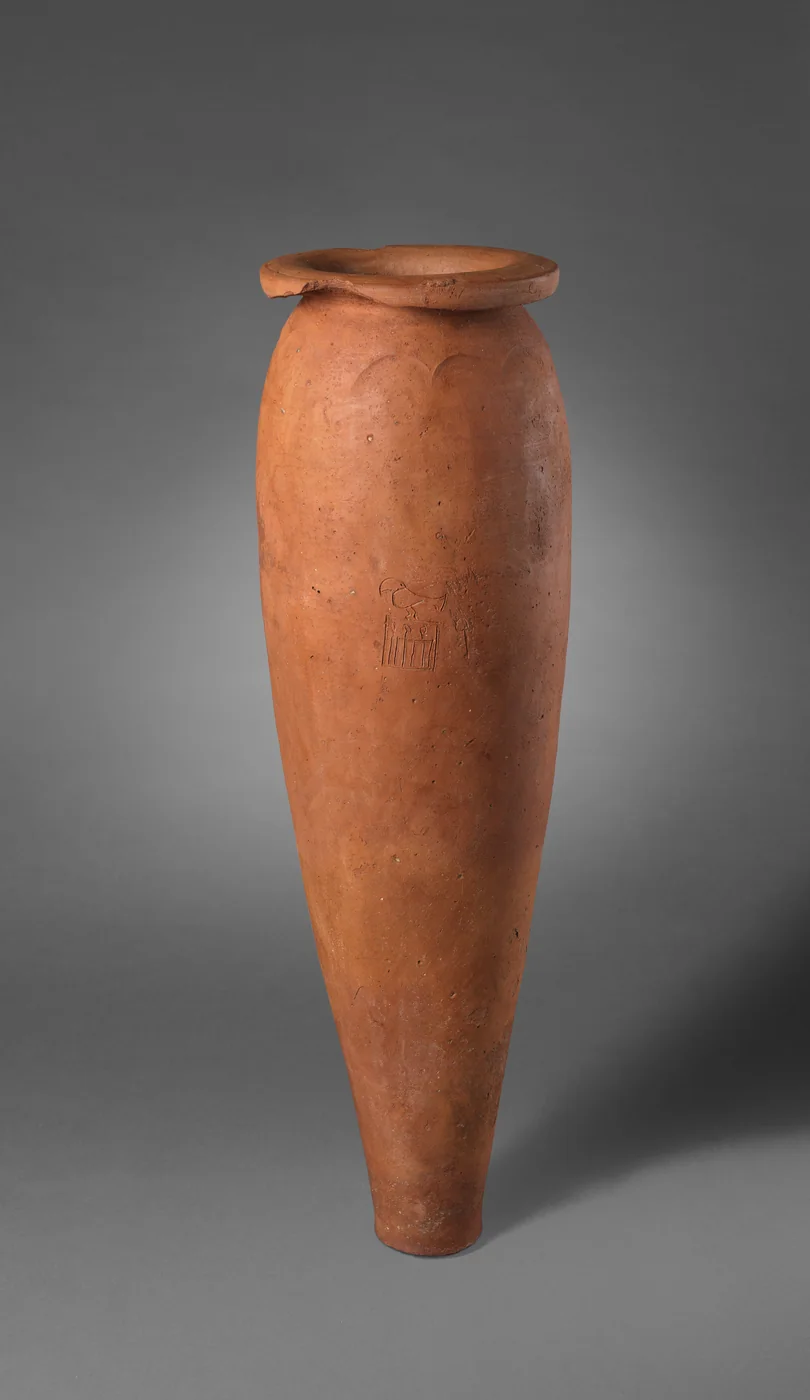
That is why it would be irresponsible to caption this vessel ‘Narmer’s jar’ simply because Narmer is a familiar name from discussions of early Egyptian kingship. The sign is important precisely because of its early and uncertain status. Archaeology allows a small object to raise a big question without insisting on an answer the evidence cannot yet supply.
Raneb’s granite stela shows the formula clearly
Move forward to the Second Dynasty, and the system becomes much easier to recognize. The Metropolitan Museum’s stela of King Raneb, object 60.144, dates to around 2880 BCE. It presents the name within a serekh, surmounted by the Horus falcon. The stela stands about one meter high and is carved from granite.
The material itself is significant. The Met describes Raneb’s monument as the earliest surviving example of relief carving in such hard granite. The stela is believed to have been found near Memphis rather than in the royal cemetery at Abydos, where many comparable stelae originated. That find history has encouraged suggestions about Raneb’s burial area, but the stela’s reported provenance does not settle the entire question of his tomb location.
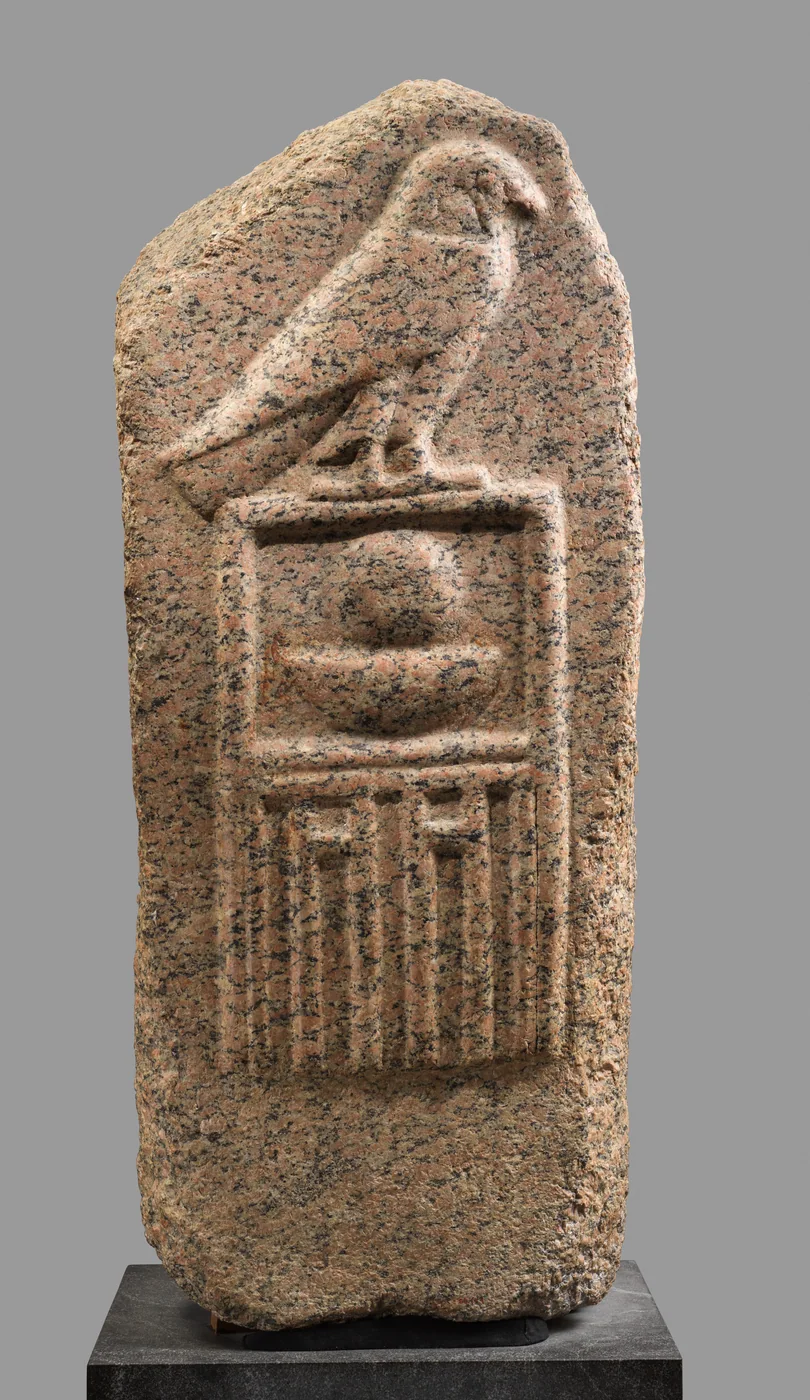
The contrast with the wine jar is revealing. One object preserves an ambiguous early version of the emblem; the other shows a clear named ruler and a recognizable architectural design. They shouldn’t be flattened into two identical examples of a symbol that never changed.
Why Horus appears above the palace
The falcon was associated with Horus, a deity closely connected to Egyptian kingship. In early royal ideology, the king’s status and the god’s image were brought together through the serekh. The bird’s placement above the palace name is not decorative in the modern sense; it expresses an idea about the legitimacy and divine framework of rule.
The symbolism was not fixed in every reign. UCL’s Horus-name guide points to King Peribsen, who placed the Seth animal above his serekh instead of the falcon, and Khasekhemwy, whose emblem included both Seth and Horus. Those variations show that early kings could adapt the visual formula while continuing to rely on the powerful language of royal identity.
The serekh also belongs to a larger development of kingly names. Later Egyptian kings used multiple royal titles, including the Two Ladies and the cartouche-enclosed birth and throne names. The UCL study of the Two Ladies name helps distinguish these traditions rather than treating them as interchangeable labels.
What a mark on an object can actually prove
A serekh on pottery or a sealing can associate an object with royal institutions, an estate or a context of authority. Its meaning depends on where the object was found and how it was made and used. It does not automatically prove that the king personally handled that container or that a complete central bureaucracy already controlled every village in Egypt.
| Object | What is secure | What remains uncertain |
|---|---|---|
| Wine jar, Met 61.122 | Very early serekh-like sign on pottery | Whether the inscription records a particular ruler |
| Raneb stela, Met 60.144 | Named Second Dynasty king, falcon and palace façade | Some details of the stela’s original find context and burial significance |
| Other royal sealings | Royal names and marks used on material goods | The exact role of each object without reliable archaeological context |
For a closer look at labels and objects used in early administration, our Abydos labels and sealings article follows tiny finds associated with First Dynasty rulers. That is a related but distinct question: how marks were put to work in managing goods, rather than what the royal emblem itself expressed.
A name that could stand for royal authority
The serekh is worth remembering because it made political power portable. A palace façade and a falcon could be impressed into clay, drawn on pottery or carved in stone. The ruler did not need to be physically present for a royal identity to appear in a place where people worked, stored goods or commemorated the dead.
The wine jar and the Raneb stela together show a tradition taking recognizable shape, with some of its earliest meanings still debated. That is more compelling than imagining the emblem arrived fully developed at the moment Egypt was first united. The surviving objects reveal a process, not a single founding ceremony.
Primary evidence: The Met’s records for wine jar 61.122 and Raneb stela 60.144, alongside UCL Digital Egypt’s Horus-name resource. The two documentary photographs above show these exact museum objects, not digital reconstructions.