Who was Senusret III? Senusret III was a major Twelfth Dynasty pharaoh whose reign is associated with consolidation of Egypt’s southern frontier in Nubia, the fortresses around the Second Cataract and a year-sixteen boundary stele at Semna. His reign is also linked to changes in administration, royal sculpture and funerary monuments at Dahshur and Abydos.
Unlike a legend-led royal biography, this study starts with object records, archaeological landscapes, the Semna inscription and administrative papyri. It distinguishes the king’s own political rhetoric from independent historical conclusions.
Why Senusret III matters beyond a list of kings
Senusret III, also written Senwosret III and known by the Greek-form name Sesostris III, ruled during Egypt’s Twelfth Dynasty in the Middle Kingdom. His reign offers an unusually clear meeting of monumental royal display, frontier policy and changes in administration. The most informative evidence is not a modern adventure story about one invincible warrior. It includes inscriptions at the southern border, royal sculpture, forts and documents recording the movement of people around Nubia. The University College London Digital Egypt chronology identifies him by the throne name Khakaure and places him within the Middle Kingdom. Scholars differ about the absolute regnal dates because ancient chronology is reconstructed from several types of evidence. Rather than use a single year without qualification, this dossier follows the archaeological relationships that can be established directly. The central question is what Senusret’s policies changed in the Egyptian state and how we know. His campaign inscriptions are royal statements; they must be distinguished from independent accounts of what happened on the frontier.
The Twelfth Dynasty and the changing Middle Kingdom state
The Twelfth Dynasty was a period of strong central institutions, large building projects and extensive contact between Egypt and Nubia. Senusret III inherited an organised monarchy rather than assembling the Egyptian state from nothing. UCL’s historical outline relates his reign to significant transformations in provincial elite burial practices and the greater prominence of cemeteries near the royal residence. This is material evidence for political and social change, although it cannot by itself prove that one decree instantly abolished every provincial power. Royal cults, treasury needs, building activity and military expeditions were connected through officials who administered work and movement. A biography that focuses exclusively on battlefield victories misses the institutional context that made long-distance campaigns possible. Egypt’s interaction with Nubia also predates Senusret III: earlier kings had already established a strategic presence beyond the First Cataract. His achievement is better understood as consolidation and intensification of that presence, not a first discovery of the south. The archaeological record connects him to a whole system of sites rather than one solitary temple.
The evidence for the Semna boundary
One of the most important sources for his frontier policy is a boundary stela from Semna, now catalogued by Berlin’s Egyptian Museum under inventory ÄM 1157. The museum identifies its setting at Semna and dates its inscription to regnal year sixteen. That date is part of the ancient stela’s own record, while the translation into an absolute BCE date is a modern reconstruction. The monument proclaims a southern boundary and demands its maintenance by succeeding rulers. Its text praises royal resolve and disparages Nubian opponents in language shaped by Egyptian political ideology. The inscription is therefore powerful evidence for how the monarchy wished to present sovereignty, not an unbiased report of Nubian society. The stele’s location at a heavily controlled stretch of Nile made its message intensely practical. Travelers, traders and soldiers entering that river corridor encountered a frontier enforced by architecture as well as words. This is why the exact archaeological findspot and museum inventory number are more illuminating than loose quotations detached from their object.
Semna, Uronarti and the landscape of forts
The Middle Kingdom fortress network near the Second Cataract linked several sites, including Semna, Kumma and Uronarti, to the river landscape. Their function was not merely theatrical. Forts could supervise boats, regulate exchanges, store supplies and monitor movements between communities along the Nile and desert approaches. The British Museum’s account of the Semna dispatches describes the strategic character of these installations and the importance of trade and surveillance. It also makes clear that Egyptian fortifications had a history before Senusret III. The king’s boundary policy belonged to this larger developing system. It would be misleading to imagine one uniform stone wall stretching uninterrupted across the desert. Instead, geography gave river passages, islands and narrow channels particular importance. Archaeologists study the positions and architecture of the installations to reconstruct the practical possibilities of control. Nubian settlements and political institutions existed beyond them; Egyptian texts do not supply a complete account of those societies. The frontier was a zone of interaction, coercion and economic exchange, not an empty line on a modern map.
The Semna dispatches: bureaucracy behind the frontier
The Semna dispatches are unusually revealing because they are administrative papyri rather than grand royal stone inscriptions. The British Museum, whose collection appears in its public research presentation, describes reports concerned with the movement of Nubian groups and parties tracking activity near the frontier. Such records offer a narrower but more immediate view of the work of fort personnel. An officer or scribe needed to record arrivals, departures and other events in a way that allowed supervisors to respond. The dispatches also remind us that the state needed writing, communication and logistics to make the frontier function. Their discovery context is complex: they were recovered with papyri in a Middle Kingdom tomb area under the Ramesseum at Thebes, not excavated neatly in a modern Semna office. That separation between where a text was written, used and found is crucial to its interpretation. A surviving report cannot represent every border incident. Yet these documents make the functioning of a Middle Kingdom bureaucracy much more tangible than a repeated claim that the pharaoh personally controlled everything.
Royal rhetoric versus the experience of Nubian communities
The Semna boundary inscription uses striking language to contrast an ideal Egyptian ruler with people beyond the frontier. Translating such rhetoric into a neutral historical description would reproduce the royal state’s assumptions as if they were facts. Royal inscriptions were written within a political system that celebrated power, obedience and military success. Nubian communities had their own history, economic networks and political structures, none of which can be reconstructed solely from Egyptian hostile characterisations. The archaeological history of Kerma and the wider Nile corridor must be considered independently. A careful reading can still learn a great deal from the Egyptian inscription: where a boundary was claimed, how successors were instructed to defend it and how military action was used to justify kingship. Those are statements about policy and ideology. They do not establish that everyone living south of Semna experienced the same political relationship or that the border was never crossed. Distinguishing royal voice from historical reconstruction is an essential part of the article’s evidence-led approach.
The year-sixteen stela as an actual museum object
Berlin’s institutional object record offers a rare opportunity to move beyond an anonymous photograph of hieroglyphs. It identifies the boundary stela as ÄM 1157 and describes its large carved stone surface, its royal names and the sequence of nineteen horizontal inscription lines beneath the upper imagery. The museum also documents its nineteenth-century expedition history. This provenance matters because many objects moved from archaeological sites to European collections under conditions that deserve historical scrutiny. The modern museum record is evidence for the object’s current location and documentation, while the inscription reflects an ancient royal message. They are distinct layers of history. A picture of the stela’s face may reveal the layout of signs but cannot answer every question about its find circumstances or later conservation. Readers should consult the museum catalogue alongside published translations rather than relying on an unsourced transcription. The surviving object is the strongest anchor for a discussion of Senusret III’s border proclamation; unrelated statues should never be captioned as photographs of that stone.
What the surviving statues tell us about kingship
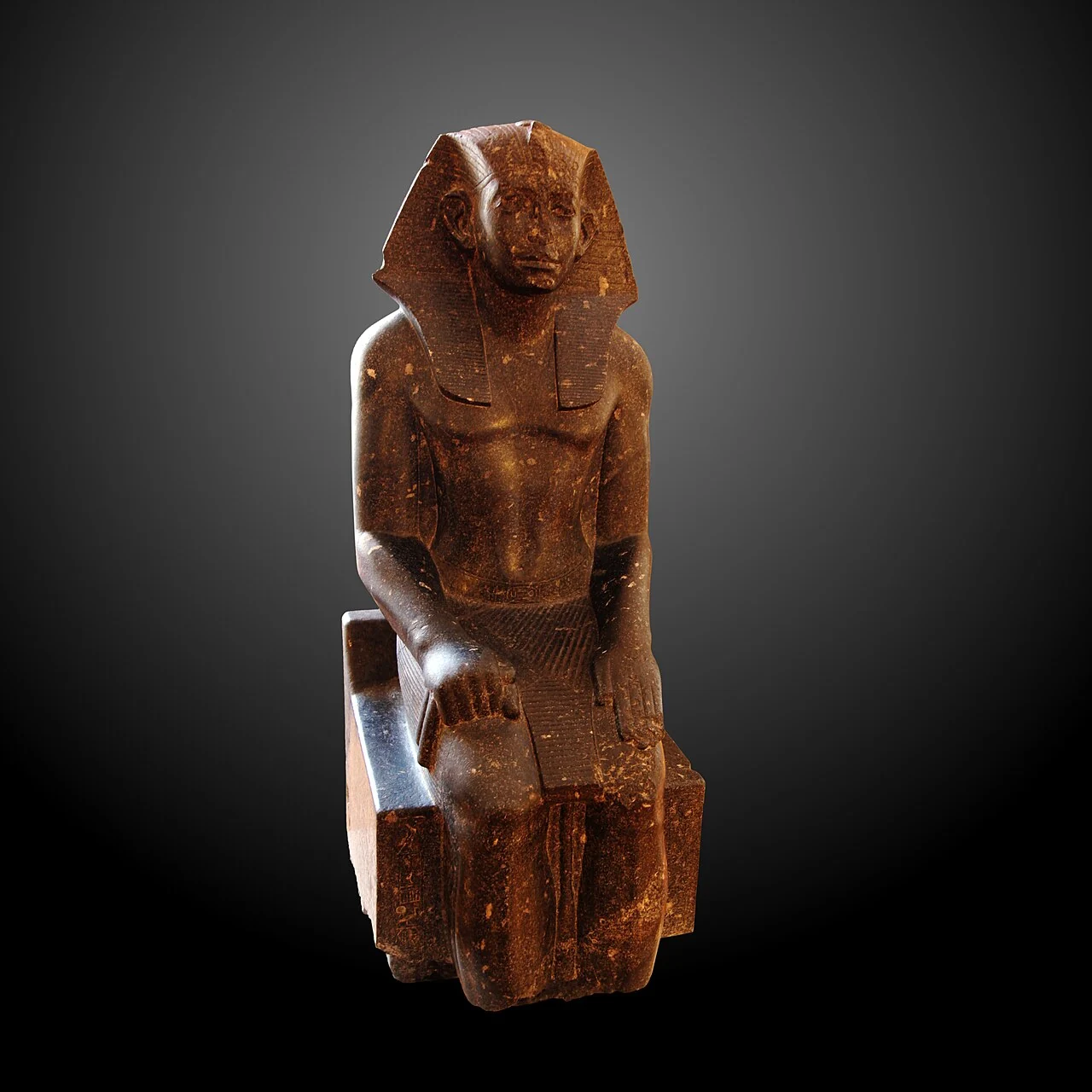
Senusret III’s sculpture stands out for its expressive royal portraits. Some known images present a mature face with strongly marked features, diverging from the eternally youthful ideal common in other royal works. It is tempting to read the portraits as photographic likenesses or as proof that the king was visibly exhausted by war. Neither inference is secure. Royal portraiture is a crafted political and artistic form, and facial conventions can communicate authority, age, reflection or royal identity without documenting the sitter’s medical condition. The paired documentary photographs in this article show actual museum sculptures attributed to Senusret III, with the object locations named separately. They are not AI reconstructions of the pharaoh as a living man. Close observation of the eyes, cheeks, headdress and material can lead to better questions about workshop choices and royal presentation. A photograph taken today establishes what a sculpture currently looks like; a responsible historical argument must still ask how and when that sculpture was made, displayed and later collected.
The pyramid at Dahshur and royal burial architecture
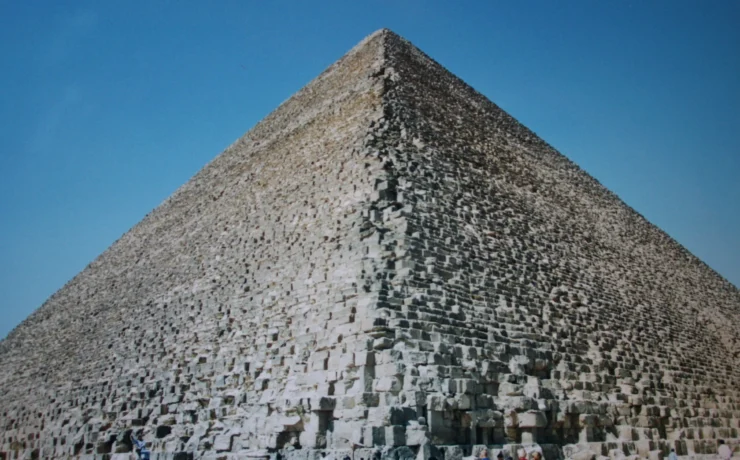
Senusret III was associated with a pyramid complex at Dahshur, where the material record offers a different view of kingship from the Nubian frontier. Burial architecture involved workers, supplies, planned spaces and a funerary system designed to place the ruler within a ritual landscape. UCL’s outline connects the king with the Dahshur pyramid and a second important royal cult and tomb landscape at Abydos. These places should not be collapsed into one unquestioned statement that a body was found in a particular chamber. Archaeological interpretation of tomb use, especially where remains are disturbed or incomplete, can be complicated. The comparison also reveals how a powerful king could act simultaneously in distant regions. On the southern frontier, military architecture and inscriptions projected power in the Nile corridor; near the royal centres, the pyramid complex expressed dynastic continuity and afterlife ritual. Both required substantial administrative resources. For the broader context, our Senusret II pyramid study examines a different Twelfth Dynasty royal monument and should not be mistaken for this king’s burial.
Abydos and the king’s southern commemorative landscape
Abydos was one of Egypt’s major sacred landscapes, associated with royal mortuary practice and with Osiris. Senusret III maintained an important presence there, and research on the late Middle Kingdom has examined the king’s underground tomb and mortuary structures. The presence of a royal tomb landscape at Abydos complicates a simplistic one-king-one-pyramid view of Middle Kingdom kingship. A monument may support commemoration, ritual activity or symbolic geography even when the question of actual burial remains debated. UCL notes both the Dahshur and Abydos settings in its chronology. A historical account should distinguish attested structures from claims about an undisputed final resting place. This also places the reign within broader transformations in religious practices and funerary display. Our early Abydos writing study concerns a much earlier archaeological period, providing a useful contrast between successive uses of the same broader region. The difference in date is essential; prehistoric labels cannot be presented as evidence about Senusret’s court.
The relationship between campaigning and administrative reform
Scholarly summaries often connect Senusret III with centralisation and changing provincial elite power. UCL observes the reduced prominence of large rock-cut tombs for provincial officials and the increased significance of cemeteries near the royal centre. Material culture can help trace these shifts, but a causal explanation remains a historical argument rather than a single inscription’s plain statement. Military expeditions in Nubia required planning, manpower, transport and records. The same kinds of institutions could affect taxation, building works and the balance between palace and provincial households. Yet chronological coincidence does not prove every administrative change was personally ordered by this monarch. The strongest interpretation compares multiple independent sets of evidence: inscriptions, monuments, burial patterns and documents. Senusret III becomes more interesting when seen as a ruler acting within developing institutions than when depicted as a lone reformer issuing magical commands. Local variations and the long duration of change matter, especially when comparing regions distant from the royal residence.
Can we assign an exact reign and campaign chronology?
Different historical reference works give somewhat different absolute dates for Senusret III’s reign. The disagreement does not imply that the king or his monuments are imaginary; it reflects the challenges of aligning ancient regnal years with later chronological systems. A securely labelled year on an inscription is not the same type of evidence as an estimated BCE date. This dossier therefore uses the relative Twelfth Dynasty sequence and clearly identifies regnal year sixteen for the Semna stela. A reader should be alert when popular histories provide a single month or day for an ancient campaign without showing a dated contemporary source. Ancient Egyptian calendars and inscriptions can preserve detailed dates, but not every event has that level of documentation. The Smithsonian-style practice of separating object label, interpretation and inferred date is valuable here. If new research changes an absolute chronology, the identity of the Semna object, its text and its place within the reign remain meaningful. Good encyclopedic writing protects that distinction rather than treating all dates as equally certain.
Senusret III and other kings of Egypt’s frontier
The temptation to compare Senusret III with later pharaohs as though they commanded the same empire should be resisted. Egypt’s political reach changed dramatically between the Middle Kingdom and the New Kingdom. The range of fortifications, military resources and relations with Nubian polities had different histories in different reigns. Our study of the Hyksos and Ahmose covers a later episode of conflict and reunification, not the Twelfth Dynasty. Likewise, the Hatshepsut expedition to Punt is concerned with a different time and relationship to distant regions. Placing the articles side by side helps illuminate change in how kings negotiated diplomacy, trade and force. It would be wrong to convert all ancient Egyptian southern expeditions into one continuous campaign. Different evidence types also survive: a border stele, a temple relief and an administrative papyrus cannot be read with identical assumptions.
Modern research, museum collections and ethical context
Museum exhibitions make Senusret III’s material history accessible but can also separate objects from their original landscapes. Royal statues encountered in London or Paris no longer stand in the setting for which they were created. The Semna stela in Berlin likewise has a documented modern collection history that should be examined alongside its ancient text. Museums can provide catalogued measurements, object numbers and photographs, while excavations and landscape studies explain where those objects originally stood. Good interpretation brings these records together without erasing the history of collecting. The two photographs selected here represent distinct surviving museum objects, not images created to simulate a battle or a procession. Their Commons licences concern the reproduction of the modern photographs; they do not erase the need to acknowledge the ancient object’s museum context. The article’s purpose is not to settle every contested heritage question but to identify what is documented and where a reader can investigate provenance further. That approach is more durable than an attractive but unsupported historical illustration.

Primary records and further reading
The core chronology and burial-context outline comes from UCL Digital Egypt’s Senusret III entry. The State Museums of Berlin inventory ÄM 1157 anchors the year-sixteen Semna boundary stela, its inscription and its documented object history. The British Museum’s Semna dispatches presentation explains the administrative papyri and the frontier network. A Metropolitan Museum scholarly exhibition checklist supplies additional context for the Semna stela and Twelfth Dynasty frontier policies. These are independent institutional records, not copies of a single travel article. Monument dates in this dossier are framed as archaeological estimates where necessary. Royal claims about enemies are reported as claims in their own ancient political setting. The images link to individual Commons file records with author and licence so a reader can distinguish visual evidence from reconstruction.