A mummy is not simply a dead body covered in linen. Ancient Egyptian preservation was a developing craft involving specialist workers, controlled drying, body treatment, ritual performance and burial equipment. What survives today ranges from bodies and wrappings to jars, natron bags and remarkably ordinary tools. Studying these objects allows us to separate what embalmers actually did from what later writers reported and what ancient Egyptians hoped would happen after death.
This guide focuses on the practical sequence, materials and archaeological evidence for human mummification in ancient Egypt. Procedures varied enormously between centuries and social groups. It does not assume that a preparation often described for an elite New Kingdom burial was universal, or that funerary religious ideas can be verified as physical events. Each illustrated object below is an identifiable museum artifact, not an AI depiction of an embalming workshop.
Mummification at a glance
1. What is mummification, and why did it matter?
Mummification means the preservation of a dead body by limiting decomposition. In a naturally dry burial, tissue can survive because surrounding conditions restrict moisture. Egyptian artificial mummification expanded beyond that accident of environment, using intentionally chosen substances, wrappings and treatments. The visible mummy was also part of a much larger funerary setting containing a coffin, inscriptions, objects and, in some burials, specially prepared organ packages.
Ancient Egyptians had complex and evolving ideas of identity and the afterlife. Preserving the body could support a person’s hoped-for transformation and recognition, but those beliefs varied by place and time. No archaeologist can infer the complete theology of a family simply by finding a wrapped body. The labor of embalmers is a physical question; the religious significance attributed to their work is a historical and textual question.
The earliest known preservation includes natural desert desiccation. Over subsequent millennia, specialist techniques developed and changed. A visitor viewing a Late Period mummy and a prehistoric naturally dried burial is not looking at two copies of the same technology. The Smithsonian’s discussion of Egyptian mummies and the Australian Museum’s overview both stress this variation.
2. The process: an evidence-based sequence, not a universal recipe
A frequently described elaborate method is associated with high-status burials, particularly in the New Kingdom. The sequence below is an educational reconstruction based on archaeological finds, scientific study and ancient written testimony, including Herodotus’s much later account. It must not be applied automatically to every ancient Egyptian or every dynasty.
| Stage | General aim | Principal evidence or caution |
|---|---|---|
| 1. Prepare and assess | Move the body to specialists and prepare materials | Embalmers’ caches and burial archaeology; precise routines varied |
| 2. Treat internal organs | Reduce sources of decomposition; sometimes remove viscera | CT scans, surgical traces, canopic equipment; not all bodies show identical treatment |
| 3. Dry with natron | Remove moisture from tissue | Surviving salt bags; later accounts describe a long drying stage |
| 4. Treat and support tissue | Apply oils, resins or other materials; sometimes pack cavities | Residue chemistry, wrappings and medical imaging |
| 5. Wrap and equip | Enclose the remains in linen and sometimes add amulets | Authentic bandages, textile archaeology, coffin assemblages |
| 6. Perform burial rites | Prepare for deposition with the associated funerary ceremony | Archaeological settings and religious texts, which are not identical to direct recordings |
Often quoted figures of forty days drying and seventy days overall come from accounts of elaborate embalming and ritual timing, rather than a measurement taken from every excavated mummy. The British Museum’s educational mummification guide outlines the distinction. Archaeologists evaluate whether any particular body’s treatment agrees with those later descriptions.
How to read the six stages: whose process are we describing?
The familiar six-stage diagram is a model, not a preserved ancient workshop instruction sheet covering every funeral. Practical preparations could overlap with ceremonies and textile work; the length of each stage was not necessarily identical in separate households or centuries. A particular mummy might show an incision in the flank, an emptied cranial cavity, padding beneath the skin or an unopened torso. Modern CT imaging can document some of those features, but a person’s absence of an incision does not prove that no preservation treatment occurred. Methods must be inferred from the specific body and associated materials rather than from an ideal illustration of the procedure.
There is also a sharp difference between the ancient evidence for an action and an author’s description of how it should have been performed. Herodotus visited Egypt in the fifth century BCE and later described multiple embalming options, including different levels of expense. His account helps explain what an external writer learned about certain practices in his own era, but it is not direct eyewitness testimony to the embalming of a royal New Kingdom mummy a thousand years earlier. The British Museum’s 2025 visitor resource organizes the evidence into removal of organs, drying and anointing, storing organs, wrappings and burial containers. Archaeological objects and preserved bodies must always test how far that teaching sequence applies.
3. Natron: the chemistry behind drying
Natron is a naturally occurring mixture of sodium salts, including sodium carbonate and bicarbonate, known from deposits in Egypt’s desert landscapes. Its practical role was to remove moisture. This was crucial because bacteria and other processes that break down tissues generally depend on water. Drying did not make preservation guaranteed; burial conditions, materials, temperature and later disturbance all shaped the outcome.
What makes this more than a textbook claim is that actual ancient embalming materials survive. A linen bag containing natron was found among material now associated with the embalming of Tutankhamun. The Met attributes the bag to the Eighteenth Dynasty and its accession number makes it independently identifiable. The salt in the bag is a physical find, not evidence invented from a modern illustration.

The archaeological presence of natron does not tell us the exact daily work schedule, nor does it establish that every person’s body spent the same number of days in the material. It does, however, connect a substance repeatedly mentioned in historical accounts with surviving royal funerary evidence. For students, this is an important distinction between direct object evidence and reconstruction of a whole procedure.
4. Internal organs and the limits of the textbook diagram
In many elaborate procedures, embalmers removed the lungs, liver, stomach and intestines, preserving them separately or placing them back after treatment. The heart was frequently retained because of its importance for personal identity and judgment in funerary belief. Brain treatment also varied; accounts of extraction through the nasal passage describe some methods, not an invariant practice across the whole of Egyptian history.
Modern CT studies show how much variation existed. Some bodies contain linen packing or packets, while others have very different internal preservation. Not all internal organs were removed in every case. The Smithsonian’s documented CT investigation provides an example of how the internal arrangement of a mummy can be examined without unwrapping the person for display.
The exact relationship of a preserved organ to the four protective divinities is best studied through real canopic vessels. In familiar New Kingdom iconography, Imseti protects the liver, Hapy the lungs, Duamutef the stomach and Qebehsenuef the intestines. Their heads are commonly represented as human, baboon, jackal and falcon respectively. These associations are real features of Egyptian funerary symbolism; they do not require believing the protective effect happened in the physical world.
| Protective figure | Typical head | Organ association | Critical note |
|---|---|---|---|
| Imseti | Human | Liver | Often paired with Isis in canopic protective texts |
| Hapy | Baboon | Lungs | Not to be confused with the similarly named Nile-related deity |
| Duamutef | Jackal | Stomach | Associations were expressed through ritual and vessel iconography |
| Qebehsenuef | Falcon | Intestines | Linked with protective goddesses in inscriptions |
These conventional associations can be checked against the Metropolitan Museum’s own canopic-jar interpretation and a British Museum catalogued canopic set.
5. Canopic jars: real containers and symbolic versions
Canopic jars are among the most instantly recognisable objects of Egyptian embalming. An individual example at The Met, accession 12.183.1a.1, .2, comes from the Late Period and has a human-headed lid. Its museum record identifies Imseti and explains that this container probably held the liver. The uncertainty word matters: an object can be confidently identified while a particular original use is stated more cautiously.
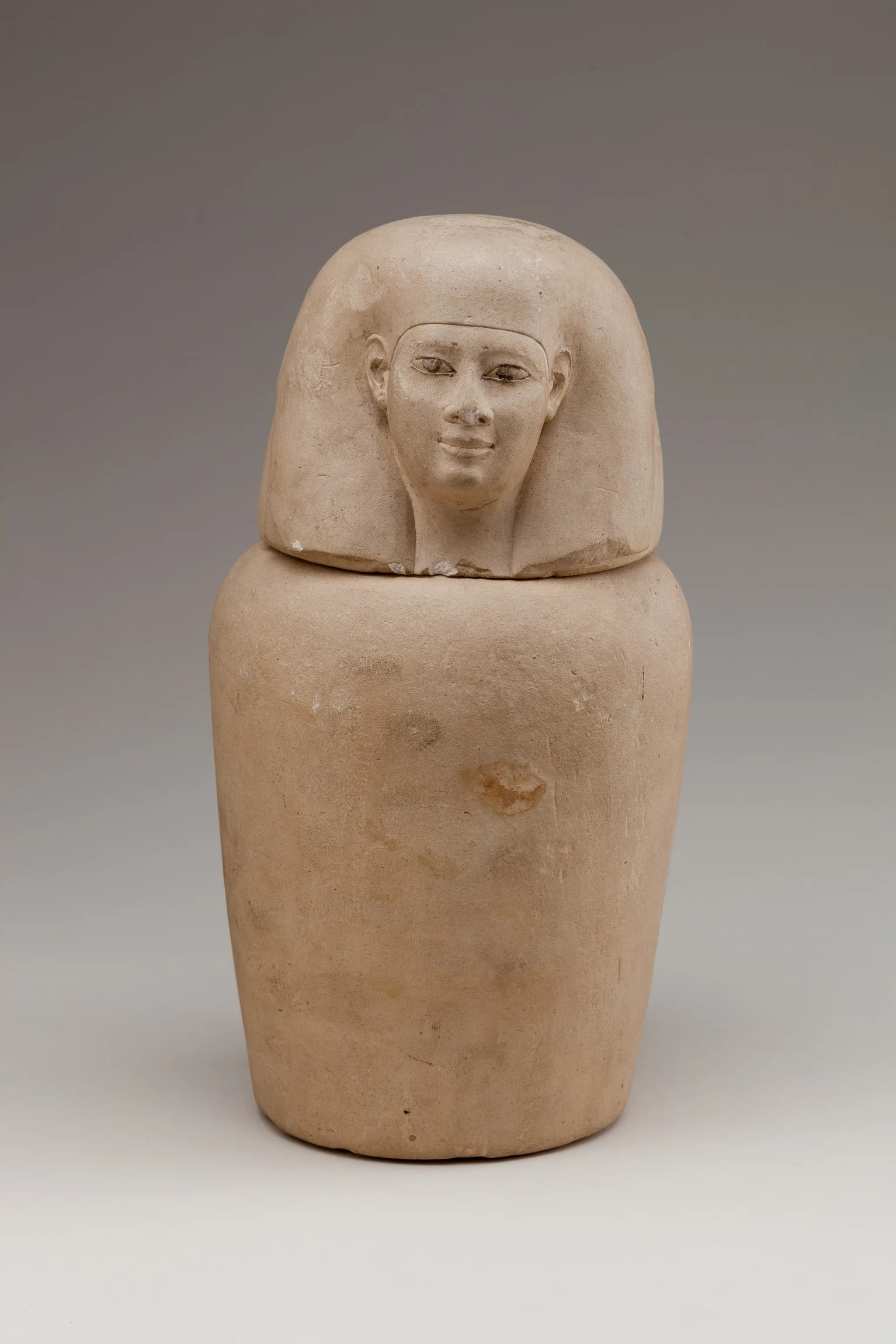
Other canopic objects present a surprise. The Met’s human-headed jar 28.3.56a, b, excavated from a Theban burial, has a removable lid but a cavity too small to contain an organ. It belongs to a period when organs could be preserved and returned to the mummy, while dummy jars retained symbolic functions. A jar’s appearance therefore does not prove that it once contained bodily tissue.
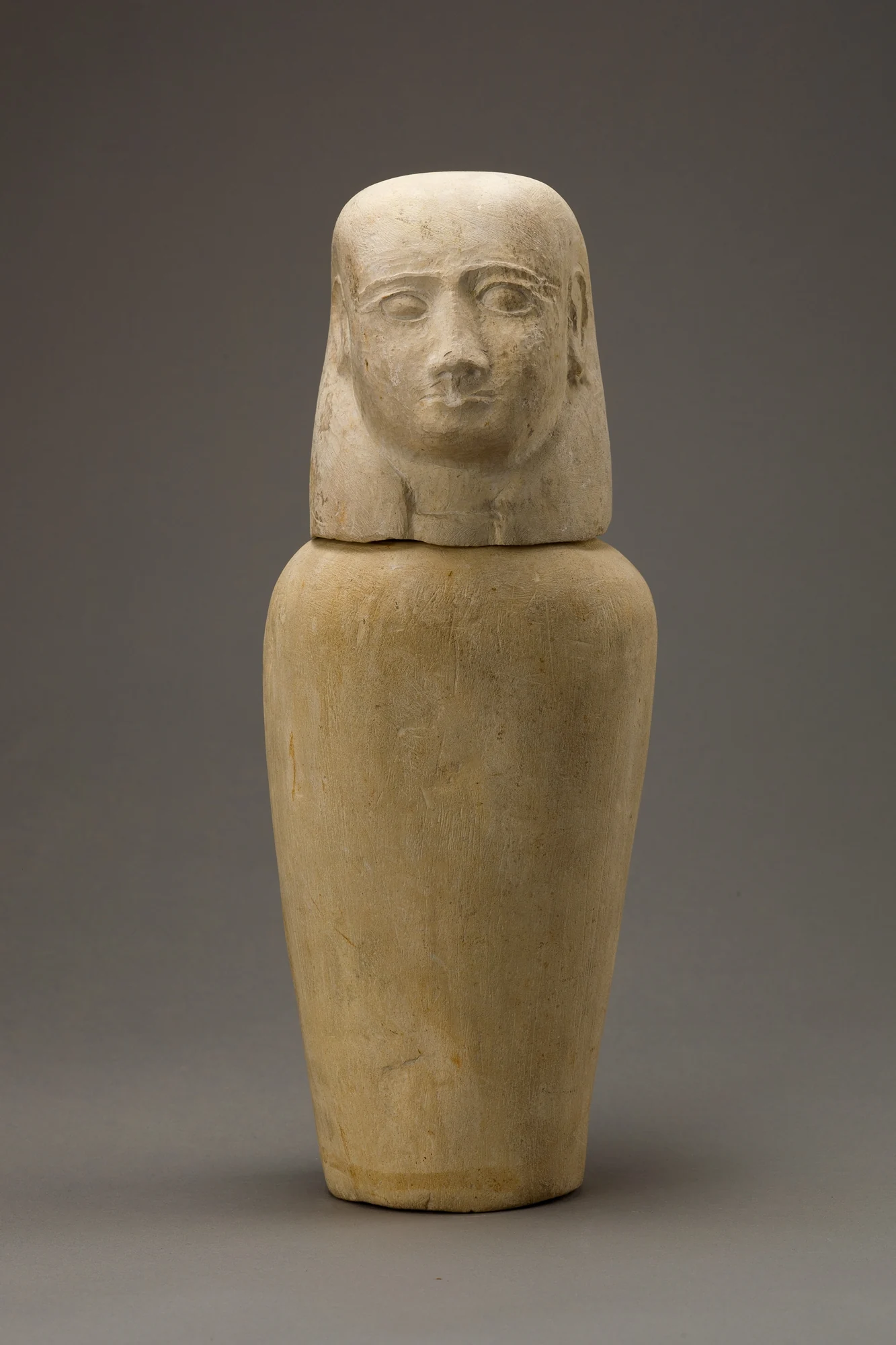
These artifacts counter a persistent misconception: that every Egyptian mummy came with exactly four functional jars filled with organs. Differences between periods, social groups and specific burials were substantial. When studying a photograph, ask whether the museum identifies a full set, a surviving single jar, a dummy container or an uncertain attribution.
6. What did embalmers use to treat the body?
Drying was not the end of body treatment. Embalmers could use oils, waxy substances, resinous mixtures and packing materials. The materials likely served multiple purposes, including helping bind wrappings, affecting texture or aroma and carrying ritual meaning. We cannot assume every substance had the same formula, source or purpose across more than a thousand years of practice.
One particularly unusual survival is a swab from a cache of embalming equipment in the Theban necropolis. The Met catalogues it as a palm stick with linen at one end, containing oily residue and natron. Such an object offers a closer look at practical work than the usual monumental gold-mask imagery. It suggests hands-on application of materials, while the precise motions or words of the worker cannot be recovered from the object alone.
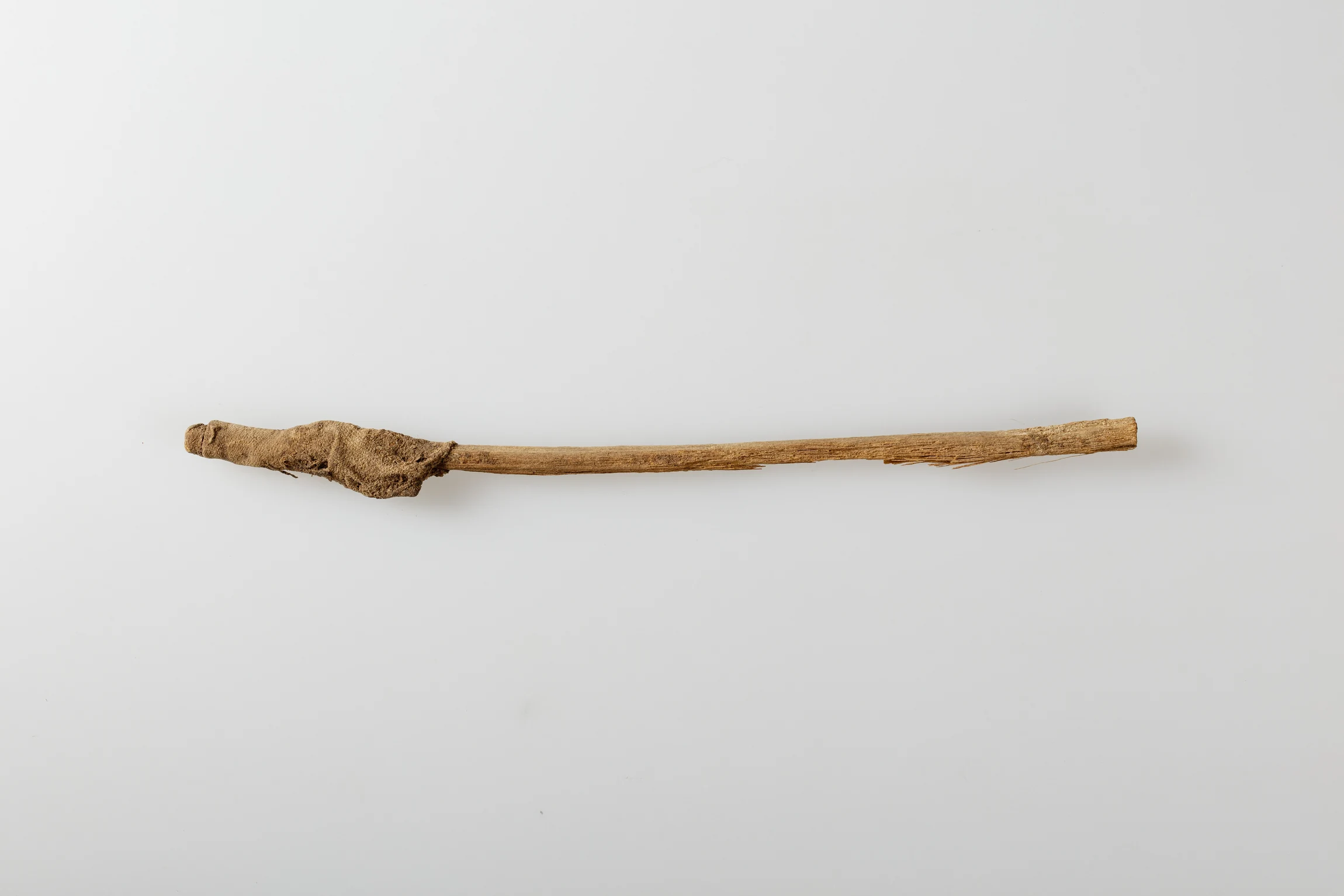
Chemical analysis has extended the evidence beyond what is visible to the eye. A British Museum research project on black ritual coatings used gas chromatography and mass spectrometry to identify mixtures including plant oils, animal fat, conifer and pistacia resins, beeswax and bitumen on some 22nd Dynasty funerary objects. Some ingredients were imported, indicating long-distance resource networks. But that specific analyzed coating was found on coffins and mummy cases: it must not be described automatically as the chemical composition of every embalming mixture used directly on human tissue.
The distinction between a laboratory-identified component, an archaeological inference and a religious interpretation helps keep research accountable. The fact that a residue is black does not automatically make it bitumen, or mean all black coatings were identical.
A Saqqara embalming workshop gives the chemistry a specific date
In 2023, Maxime Rageot and colleagues published a landmark biomolecular study of 31 pottery vessels from an embalming workshop dated to the 26th Dynasty, approximately 664–525 BCE, at Saqqara. Some pots bore ancient Egyptian labels describing their contents or intended use. Combining those inscriptions with gas chromatography and mass spectrometry made it possible to associate substances with treatments of the head and the preparation of linen. The study identified differing mixtures that could include Pistacia resin, beeswax, animal fats, oils or tars of juniper, cypress or cedar, and other plant products, sometimes including elemi. The researchers did not recover a single universal formula applicable to every Egyptian mummy.
This finding matters for the step-by-step process because labeled vessels tell us about specialized applications, not simply that embalmers used something fragrant. Several mixtures relate to the head or wrappings, making the surviving inscriptions as important as the identified molecules. The authors also discuss long-distance access to ingredients. An individual residue can identify a substance or group of substances; establishing precisely where it was collected requires additional botanical and trade evidence. Read the original 2023 Nature research article, and Salima Ikram’s accompanying assessment. This is evidence from one Late Period workshop, not permission to apply its recipes unchanged to the Old Kingdom.
7. Linen wrappings: textiles, reuse and skilled preparation
Linen bandages were made from flax textiles. Many preserved examples indicate reuse of household cloth, although some textiles appear to have been prepared expressly for the funeral. The direction of wrapping, number of layers, placement of padding and inclusion of amulets changed between cases. The visible outer bandage should never be assumed to represent every textile hidden below it.
An especially revealing example is the mummy bandage from Tutankhamun’s embalming cache, Met accession 09.184.797. The museum explains that this piece has two woven selvedges, a clue that it was made for a particular purpose rather than simply torn from an older bedsheet. Such textile features allow archaeologists to study specialized production without imagining an otherwise undocumented complete workshop.
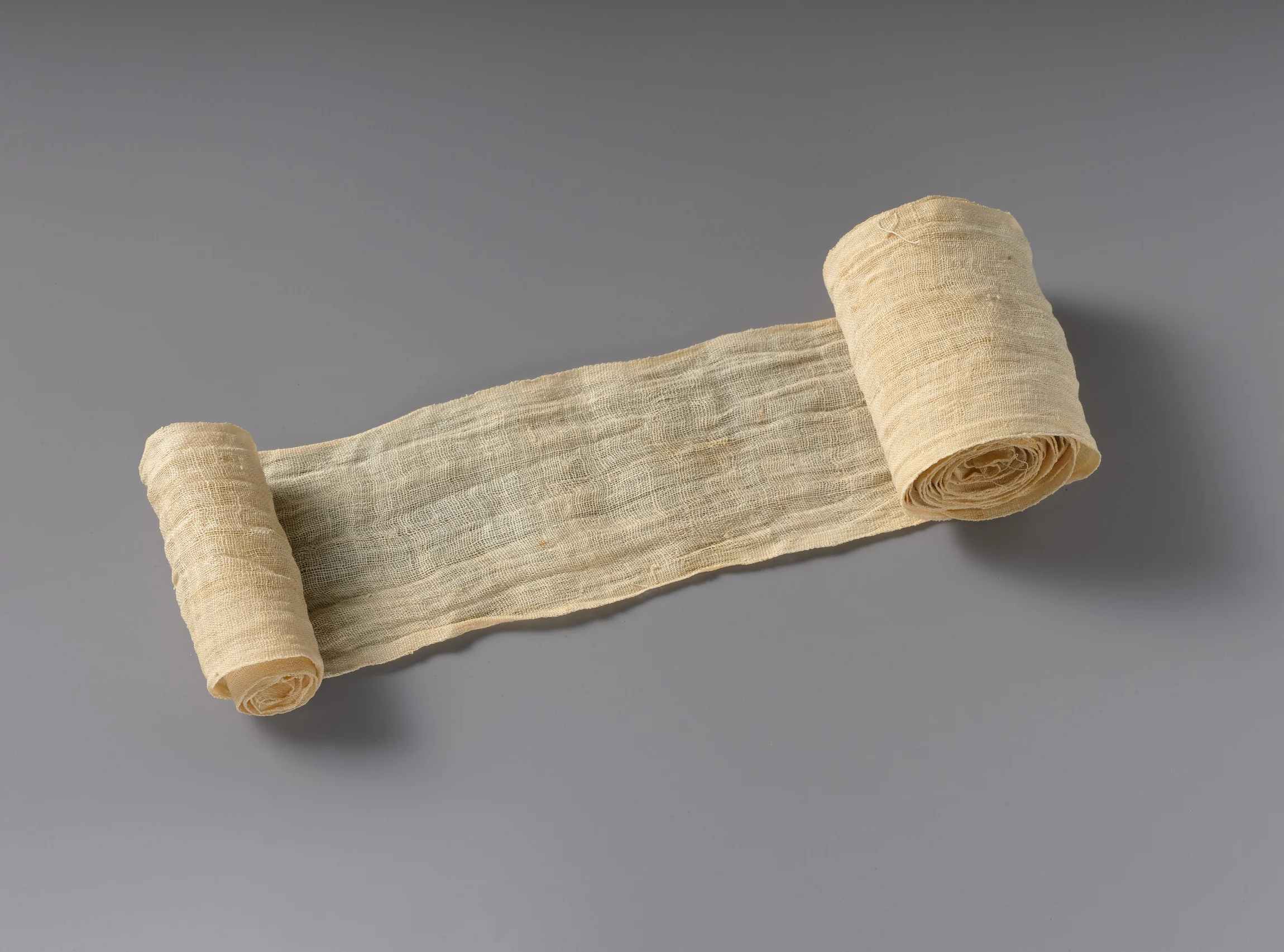
Wrappings are also vulnerable evidence. Unwrapping a mummy can damage the original arrangement, inscriptions and organic residues; it is not automatically necessary for research. Modern methods such as CT imaging and carefully targeted analysis offer alternative approaches. This does not mean imaging answers every question, but it changes the ethical balance between information gained and damage caused.
What happened after wrapping: the body, the coffin and the final ceremony
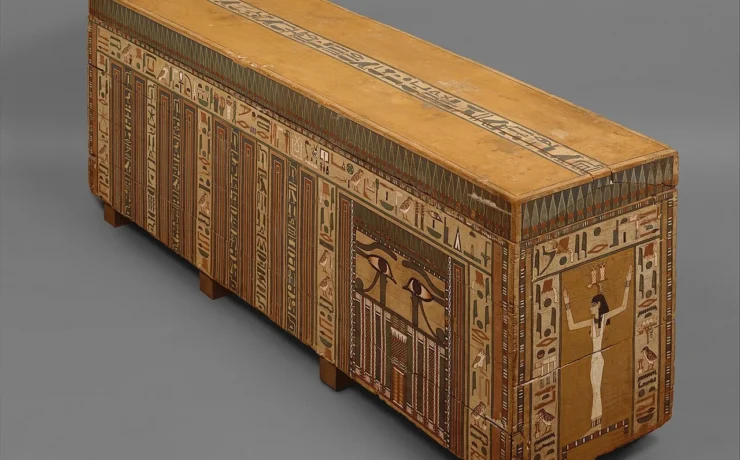
Wrapping a body did not complete a funeral. Material from tombs places the wrapped remains within further layers of protection and representation: sometimes a mask or cartonnage, one or more coffins, a burial chamber, protective figures, texts and offerings. Not every family could commission the same combination, and a coffin should not be treated as part of the chemical drying method. A mummy was a human individual within a wider burial landscape. The separate Kemet Vault history of Egyptian coffins examines changes in their shapes and images, while the Book of the Dead article addresses some of the texts. Keeping these subjects linked, rather than copying their full histories into this page, allows readers to follow a coherent route.
The so-called Opening of the Mouth rites and other funeral performances were concerned with the deceased’s ability to participate in the afterlife, according to ancient beliefs. Depictions and texts provide evidence of religious meaning but do not demonstrate that every surviving body underwent the same exact sequence of spoken words or gestures. In research, always identify whether a claim comes from the archaeological position of an object, a funerary scene or a later literary explanation. These contexts can inform one another, but they are not interchangeable.
8. Tutankhamun’s embalming cache: why excavation context matters
In 1907–08, excavators recovered a group of storage jars and related materials from a small pit in the Valley of the Kings, designated KV54. These were initially puzzling discoveries. Subsequent archaeological interpretation connected textiles, natron, seals and ritual leftovers to the burial preparations for Tutankhamun. The cache was not his intact royal tomb, KV62, which was found years later.
A large whitewashed storage jar in The Met collection, accession 09.184.1, shows the less glamorous reality of funeral preparation: ordinary containers could be used to hold materials. A modern article that only shows gilded coffins and masks would conceal the logistical and material side of embalming.
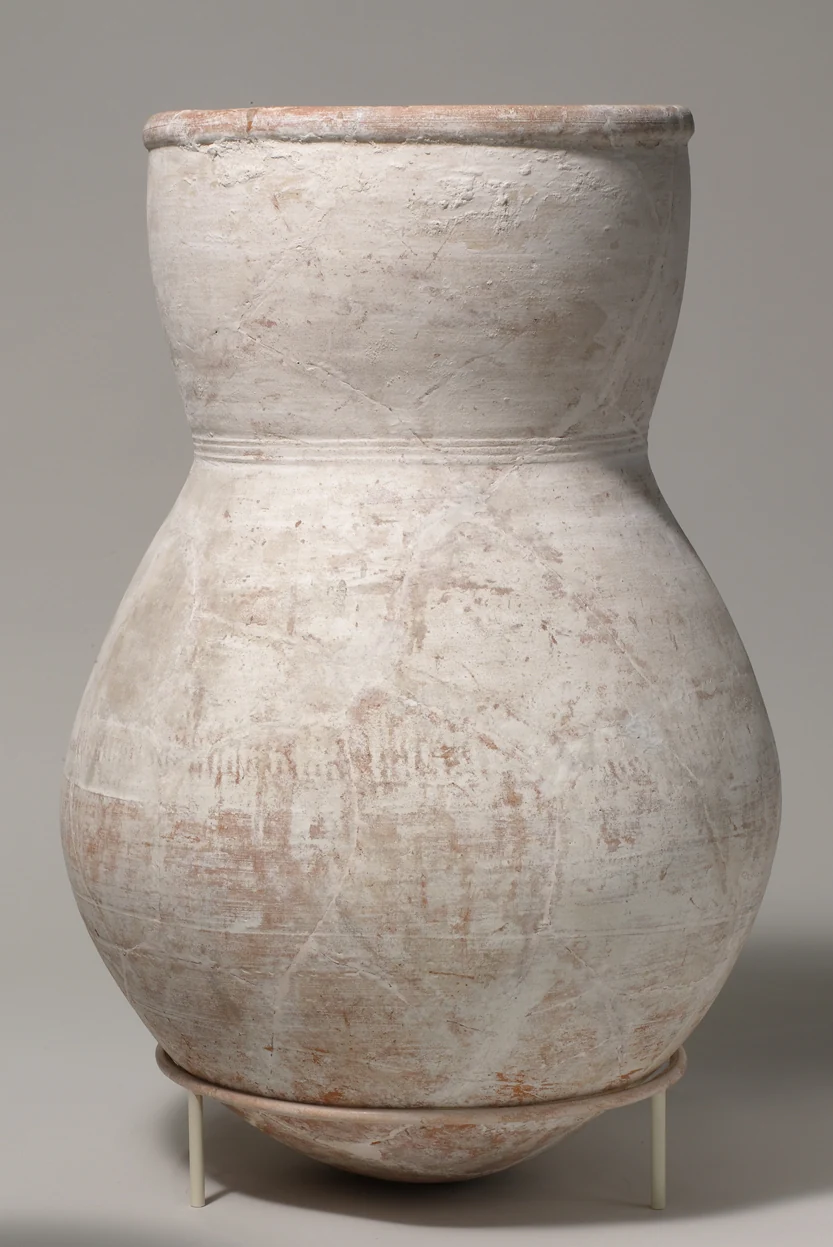
The Met’s detailed account of Tutankhamun’s Funeral illustrates why context is essential. Seals, location, linen inscriptions and associated objects together support the interpretation. A single natron bag photographed without its excavation history cannot establish the owner of the body for which it was intended. Responsible archaeology connects the object back to its recorded assemblage.
9. How did mummification differ across Egyptian history?
Different communities and individuals could receive very different funerary treatment. Early natural preservation under desert sand preceded specialized artificial treatments. Elite New Kingdom preparations are among the best studied and often the most elaborate. In later periods, internal organs might be returned to the body, canopic jars could be symbolic and the style of external presentation changed. Economic circumstances also affected how much preparation a family could commission.
| Historical context | General pattern | What not to assume |
|---|---|---|
| Predynastic and early burials | Some bodies naturally preserved in dry sand; diverse early treatment | Not a complete later-style seventy-day workshop procedure |
| Old and Middle Kingdoms | Development of artificial methods with varied burial treatment | No single neat technological timeline for every social group |
| New Kingdom elites | Well-documented specialist drying, wrapping, organs and funerary equipment | The royal procedure does not describe the experience of every family |
| Third Intermediate and Late Periods | Changed organ practices; symbolic jars and new wrapping conventions in some contexts | Presence of four jars does not prove four organ packages were inside |
| Ptolemaic and Roman periods | Continued mummification with evolving decorative, religious and regional traditions | A painted portrait or decorated mask is not a direct diagnosis of inner body treatment |
Dates and technological trends are approximate summaries, not categorical descriptions of every individual. The British Museum’s archaeological introduction and the Smithsonian overview provide useful comparison material.
Predynastic Egypt: laboratory evidence of embalming by about 3600 BCE
A discovery reported by researchers at the University of York in 2018 complicates the familiar idea that mummification began only when later dynastic embalmers learned to dry bodies with natron. An interdisciplinary team studied a naturally preserved male body in Turin, dated by radiocarbon analysis to around 3600 BCE, and examined chemical residues associated with its treatment and wrappings. Their results provided evidence for an intentionally applied preservative mixture long before the highly developed elite embalming procedures of the New Kingdom. The body was not merely a modern demonstration of what dry sand can do on its own.
That finding does not establish an uninterrupted, identical workshop tradition lasting thousands of years. Early burial communities may have used particular resins or aromatic substances together with environmental drying, while later specialists developed more elaborate organ treatment and funerary preparation. The archaeological comparison must respect these different evidence types. The University of York’s research explanation describes the radiocarbon, chemical and textile analyses. Kemet Vault’s separate study of the Gebelein naturally preserved individuals explores another predynastic context; those people must not be misidentified as the Turin specimen or portrayed as having undergone exactly the same treatment.
10. Ritual mummies that were not human bodies
The word “mummy” can refer to objects intentionally wrapped to represent regeneration even when they contain no human remains. A striking example is a falcon-headed coffin with a grain mummy and Osiris mask, catalogued by The Met as 58.106.1a–d. The museum explicitly states that it contains a symbolic grain-and-sand Osiris figure rather than a human body. Such objects were prepared in ritual contexts celebrating the god’s renewal.
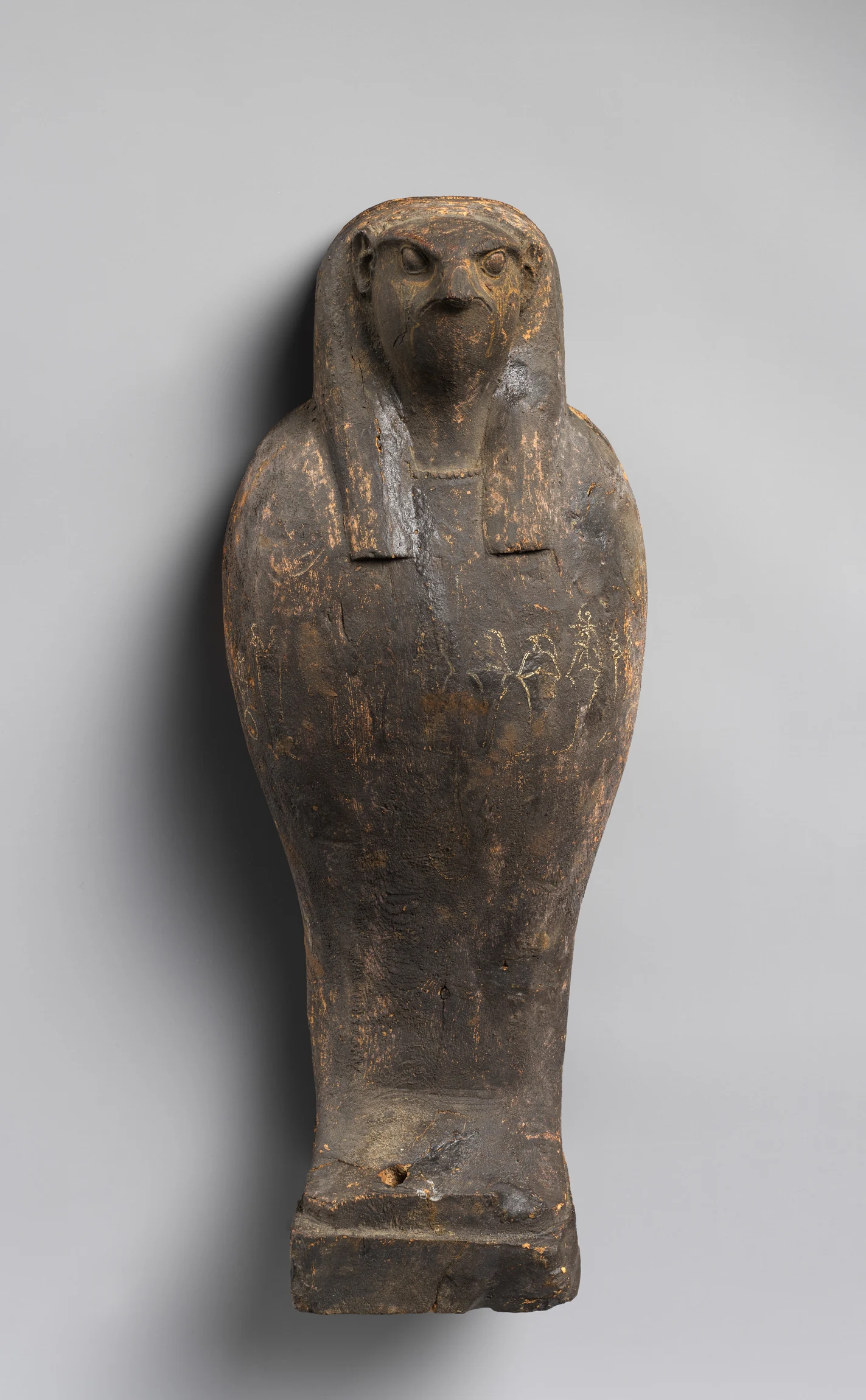
Its importance is interpretive. The resemblance between wrapping a symbolic Osiris figure and wrapping a body reflects shared ideas of transformation, but one object does not prove that every mummy was an Osiris figurine or that each person underwent the same ritual. The distinction also helps correct sensational images that label every human-shaped wrapped object an unidentified mummy.
11. Modern methods: CT scans, chemistry and careful conservation
Archaeologists and conservators now examine Egyptian mummies and their equipment using methods that were unavailable to early excavators. Noninvasive CT scans can reveal skeletal condition, tissue, packing and the placement of hidden objects. Such imaging may establish whether selected organs were removed, whether a cavity was packed, or whether the outer wrapping conceals repairs. It cannot independently reveal a person’s thoughts or recreate the words recited by a priest.
Microscopy and chemical analysis can identify fibers and ingredients from carefully selected samples. Stable isotope studies and other scientific methods may offer clues about diet or materials when enough contextual data survive. However, every method has limits: post-burial contamination, modern preservatives applied in museums, ambiguous historical provenance and damage caused by sampling can complicate conclusions.
The Smithsonian’s original CT scan demonstration is a useful visual companion. Its digital reconstruction shows why medical imaging can reveal the interior without turning a museum visitor into an observer of a destructive unwrapping session. View the demonstration alongside the institution’s account of its methodology.
Ethical study: a preserved person is not only a scientific specimen
CT images, DNA research and chemical testing can reveal important details about historical health, preservation and burial practice. Yet individual Egyptian mummies are human remains, and museum decisions about handling, sampling, visibility and description should involve informed curatorial and ethical judgment. A highly detailed scan may uncover characteristics of an individual, but it cannot automatically identify the person or reconstruct a social position from skeleton and wrapping alone. Possible disease diagnoses must be assessed according to preservation, imaging quality and the limits of differential diagnosis. Modern conservation products and old excavation conditions can also change what tests detect.
Responsible display distinguishes documented names from modern nicknames and makes clear when a specimen’s original identity or burial context is uncertain. It avoids sensational claims about the circumstances of death or dehumanizing photographs used only for spectacle. Non-invasive examination often preserves opportunities for future study, but even digital imagery can raise questions about how human remains are represented. The British Museum’s mummification teaching resources and the Australian Museum’s summary of imaging techniques offer contrasting ways to learn about the subject without treating unwrapping as entertainment. This article therefore prioritizes archaeological equipment, contextual facts and respectfully captioned objects.
12. What the evidence proves, and what remains interpretation
Good research asks exactly what kind of claim an object can support. A natron bag establishes the presence of that substance in an excavated assemblage; analysis and written sources support its role in dehydration. A small dummy canopic jar documents symbolic equipment; it does not contain four internal organs. A text invoking a protective god demonstrates ancient religious belief, not an independently verified supernatural action.
| Claim | Evidence standard | Confidence and limitation |
|---|---|---|
| Natron was available to embalmers | Recovered natron bags and historical testimony | Strong for documented contexts; not identical drying periods for all bodies |
| Organs were sometimes preserved separately | Canopic vessels, actual organs, CT and archaeological records | Strong for many burials, variable by dynasty and individual |
| Specific substances were applied to funerary equipment | Controlled chemical residue studies | Strong for analyzed samples; should not be generalized beyond them |
| Exactly seventy days were always required | Literary and traditional summaries | Not established as universal by surviving bodies |
| Funerary spells transformed the deceased | Egyptian ritual and religious texts | Evidence of a historical belief, not a laboratory finding |
For the religious and written traditions, read Kemet Vault’s separate Book of the Dead dossier with four verified papyri. For the god associated with funerary renewal, see the Osiris study. For the longer history of Egyptian funerary writing, compare the Pyramid Texts, Coffin Texts, Amduat and Book of Gates. These are complementary research paths, not duplications of this article’s practical and archaeological focus.
13. Common questions about ancient Egyptian mummification
Did all ancient Egyptians become mummies?
No. Body preparation differed dramatically by wealth, period, location and personal circumstances. Naturally preserved burials existed, and artificial preservation ranged from limited treatment to expensive specialist work. Famous royal mummies are an important but unrepresentative sample of Egyptian society.
Why was the brain sometimes removed?
Certain embalming methods removed brain tissue because the head, like the rest of the body, required treatment to limit decay. Techniques differed, and not every mummy was treated this way. Claims should be evaluated against imaging and individual preservation evidence, not treated as a universal procedure.
Were organs always stored in canopic jars?
No. Organ treatment changed across periods and individuals. Some jars held preserved organs; other jars were made only for their protective symbolic role. An object’s shape alone does not prove it once contained tissue, as confirmed by museum records of dummy jars.
Did mummification always take seventy days?
Seventy days is a well-known approximate figure from descriptions of elaborate embalming and mourning or funerary practice. It is not a verified duration for every preserved individual. Process variations, economic differences and the difference between drying and the broader funeral must be considered.
Can scientists identify exactly how a mummy was made?
Scientists can infer many physical procedures through imaging, residue analysis, textiles and excavation records. They cannot reconstruct every action, intention or prayer, and some findings remain uncertain because of damage or later handling. Good reports state both their evidence and their limits.
14. Museum records and scholarly sources
Every photographed object in this feature has a current institutional accession record and was independently checked for public-domain image access before Kemet Vault hosted its optimized WebP. Ancient remains and funerary objects are treated here with care; no modern speculative imagery is presented as excavation evidence.
- Rageot et al. (2023), Nature: biomolecular analysis of 31 Saqqara embalming-workshop vessels
- Salima Ikram (2023), Nature: historical interpretation and limits of embalming recipes
- University of York (2018): prehistoric c. 3600 BCE Turin mummy and chemical evidence
- British Museum (2025): step-by-step object-based mummification visitor resource
- The Met: Natron bag from Tutankhamun’s embalming cache, 1988.437.2
- The Met: Mummy bandage, 09.184.797
- The Met: Embalmer’s swab, 31.3.127
- The Met: Dummy canopic jar, 28.3.56a, b
- The Met: Canopic jar, 12.183.1a.1, .2
- The Met: Storage jar from KV54, 09.184.1
- The Met: Symbolic Osiris grain mummy, 58.106.1a–d
- The Met: Tutankhamun’s funeral and the KV54 assemblage
- British Museum: Molecular analysis of black funerary coatings
- Smithsonian: Egyptian mummies and preservation
- Australian Museum: Mummification techniques over time
Continue the evidence trail: Explore actual funerary papyri and the Book of the Dead, compare the Isis–Osiris myth with ancient source testimony, or visit Kemet Vault’s Digital Museum for catalogued objects. These are links to already-published resources, not to imaginary future pages.