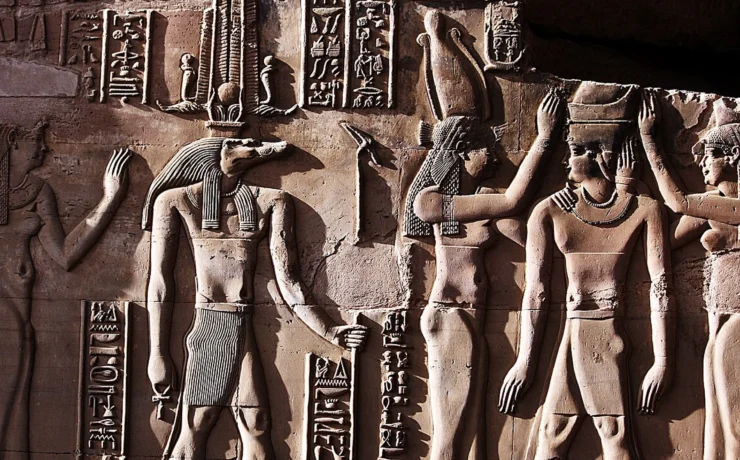
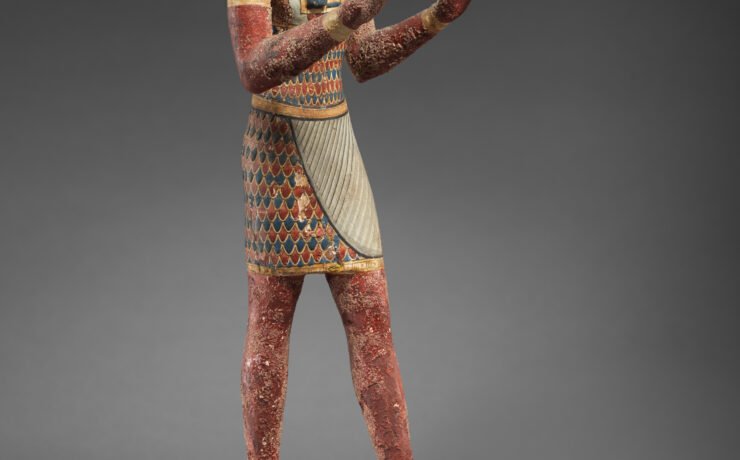
In ancient Egyptian religion, the story of Isis and Osiris was more than a tragedy about a murdered ruler. It explained why a legitimate king should inherit his father’s throne, why funerary rites could transform the dead, why a goddess’s protective speech mattered, and how divine order could survive disruption. Isis is not simply a grieving wife, and Osiris does not simply “come back to life” in the modern sense. Their story moves between worlds: the living throne belongs to Horus, while Osiris becomes a powerful ruler among the dead.
For the deities behind this developing narrative, compare Isis as a protector and source of effective sacred speech, Osiris in historical cult and funerary judgment, and Horus in kingship and temple iconography. Each subject follows its own dated objects rather than assuming every period told the myth identically.
The important historical warning is that no single surviving Egyptian book tells every episode in exactly the familiar modern order. The story below is a carefully labelled synthesis of Egyptian sources from different periods and a later, more continuous Greek-language account by Plutarch. Where a scene comes chiefly from a later retelling, we identify it rather than pretending that every detail appears in Old Kingdom inscriptions.
The myth at a glance
How to read this guide: start with the narrated myth, then explore what the inscriptions, papyri, statues, festivals and museum records actually prove. Evidence and interpretation are deliberately kept separate.
1. Before the tragedy: a divine family and the question of order
In a major Heliopolitan theological tradition, Osiris and Isis belong to a divine family descended from the sky goddess Nut and earth god Geb. Their siblings include Seth and Nephthys. These family relationships are not an ordinary human genealogy. They explain differences and interactions among powers that ancient Egyptian thinkers associated with kingship, death, magic and the organization of the cosmos.
Osiris is depicted as a ruler whose authority will become associated with the world of the dead. Isis is the goddess whose knowledge, protective action and magic help preserve the possibility of succession. Seth is the disruptive opponent, but Egyptian religious thought did not always reduce him to a simple, timeless devil. Seth could also have protective functions, especially in other religious contexts. Nephthys, often appearing with Isis in funerary material, helps protect and lament the dead.
The story gives each figure a role in a wider problem: what happens when rightful rule is broken by violence, and by what means can the world become ordered again? Its answer turns toward the actions of Isis, the survival of Horus and Osiris’s transformed authority.
2. The death of Osiris: what did Seth do?
Egyptian textual traditions identify Seth as the attacker or murderer of Osiris. Their precise details were not fixed in a single surviving original narrative. A particularly familiar scene describes a beautiful chest constructed to fit Osiris exactly. Seth invites guests to test it; when Osiris lies inside, conspirators seal it and cast it into the river. The chest eventually reaches Byblos. This developed sequence is especially associated with Plutarch’s later retelling, not with a continuous Old Kingdom eyewitness text.
Earlier Egyptian funerary sources contain references to the death, discovery and protection of Osiris, but usually in prayers, allusions and ritual speech rather than a complete adventure story. That difference matters. A modern storyteller can retell the chest episode, but a historical guide must explain when that particular version is attested and avoid moving it unchanged into much earlier centuries.
Scholar’s note: the famous coffin scene
The sealed chest, the journey to Byblos and the richly elaborated scattering of body parts are features of a late continuous account. Other Egyptian evidence attests key themes much earlier. “Popular version” and “earliest Egyptian attestation” are therefore not identical categories.

3. Isis searches: devotion, knowledge and protection
Isis’s search is not presented merely as private grief. Her determination to find and protect Osiris’s body gives the myth a ritual dimension. In Egyptian funerary thought, recognition of the dead, protection of the body, correctly performed rites and effective sacred speech all matter. Isis is joined in many traditions by Nephthys, and together the two goddesses become recurring figures in mourning and funerary protection.
The image of Isis traveling across the country in search of fragments belongs to the developing story of recovery and restoration. Different localities could claim roles in Osirian sacred geography. This helps explain why a myth could be simultaneously pan-Egyptian and deeply connected with particular shrines, festivals and cult places.
For historians, it is useful to distinguish a mythic action from a geographic itinerary. A temple’s claim that an episode occurred near it expresses cultic meaning, and does not automatically function as archaeological evidence of a historical journey.
4. Reassembly and renewed power: what does “resurrection” mean?
Once Osiris has been recovered, Isis and other divine helpers restore and protect him. This is closely connected with Egyptian ideas of bodily preservation, magical power and funerary transfiguration. When the myth speaks of Osiris’s renewed potency, it does not mean that he simply returns to ordinary daily life as ruler of a city. His destiny is to become ruler of the realm of the dead, while another king must eventually inherit the living throne.
The connection with mummification made this story especially important in Egyptian funerary belief. In ritual language, the deceased could be identified with Osiris, and funerary ceremonies drew on protective powers associated with Isis, Nephthys, Anubis and other deities. Egyptian religious practice developed across millennia; surviving texts and images do not prove that an identical ritual was carried out everywhere in the same way. For material evidence such as natron bags, canopic jars and linen, read our archaeological study of mummification.
The principal transformation in the myth is thus a change of condition and power. Death is not erased; it becomes the threshold through which Osiris acquires a new and enduring role. This distinction helps explain why the god can stand simultaneously for death, renewal and continued cosmic authority.

5. The conception and protection of Horus
Egyptian accounts connect Isis’s restoration of Osiris with the conception of Horus, who will ultimately succeed his father. Representations of Isis as a bird spreading her wings, or as a protective mother sheltering a vulnerable child, reflect the richness of her role. Ancient Egyptian texts do not restrict her to one simple iconographic form or a single function: she is a powerful healer, an effective speaker of magic and a defender of divine legitimacy.
In traditions concerning Horus’s childhood, Isis hides and protects him in the marshes of the Nile Delta. The image of a vulnerable child guarded by a goddess spoke directly to Egyptian concerns about sickness, dangerous animals and the fragility of early life. Healing texts and magical objects could invoke Isis and Horus, showing how mythic protection reached beyond monumental temples into practical religious life.
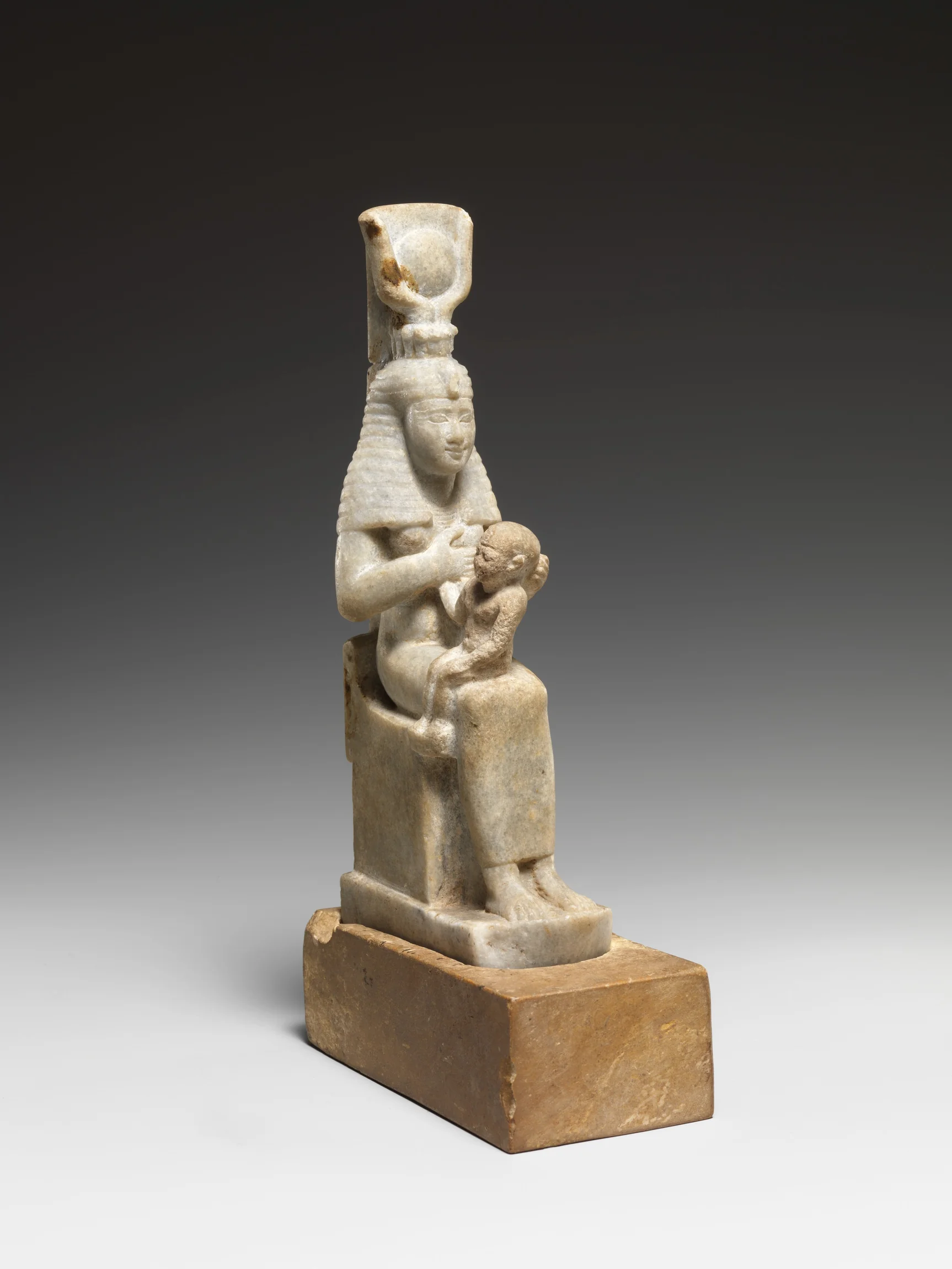
Where a later statue shows Isis nursing Horus, the sculpture captures the goddesses’s protective motherhood. It does not literally document a particular event in the story. Dating matters: many surviving examples belong to the Late or Ptolemaic Periods, long after the first Old Kingdom references to the deities.

6. Horus and Seth: a struggle over Egypt’s throne
When Horus grows, the question of rightful rule becomes unavoidable. His claim depends on being the heir of Osiris; Seth remains the powerful rival associated with the disruption of that inheritance. Egyptian sources describe their contest in different ways, including physical confrontation, divine arbitration and episodes of trickery. The gods are not merely fighting for personal revenge. Their dispute concerns the principle of succession and the restoration of ordered kingship.
The New Kingdom literary composition commonly called The Contendings of Horus and Seth, known from Papyrus Chester Beatty I, gives a particularly elaborate and sometimes surprising picture of the rivalry. Divine assemblies consider competing claims, and the events include comic and provocative episodes that a simple children’s retelling usually omits. Earlier religious traditions allude to the antagonism without necessarily giving the same narrative sequence.
The eventual confirmation of Horus allows the living kingship to be restored. Osiris’s realm remains the domain of the dead. This division between the two domains is one of the myth’s most consequential explanations for the relationship between the deceased king and his successor.
7. A story of two kinds of kingship
Horus: legitimate rule among the living
The living pharaoh could be linked symbolically to Horus. The divine son’s inheritance offered a model for legitimacy and continuity across royal succession. This was not a claim that a modern historian could simply verify through genealogy; it was part of the sacred language of kingship.
Osiris: enduring authority beyond death
Osiris embodied the transformed and powerful dead ruler. Funerary texts connected deceased kings, and later a wider range of the dead, with his regenerative destiny. The model joined political continuity to the hope of life beyond death.
The pairing helps explain why the story was so durable. Succession is a moment of danger in any monarchy: a ruler has died, and another must take his place. The myth gives the transition a cosmic structure. It asserts that death need not destroy rightful order and that the son can establish his father’s legacy without making the father cease to matter.
8. What do our earliest Egyptian sources actually say?
The Pyramid Texts, preserved in Old Kingdom royal pyramids beginning with Unas in the Fifth Dynasty, already refer to major features of the divine network, including Osiris, Isis and Horus. The texts were compositions for the king’s funerary transformation, not a single chronological biography of the gods. It is therefore misleading to say that the complete popular coffin-and-search narrative was “written in the pyramids.”
Later Coffin Texts developed and adapted many funerary traditions in different settings. The Book of the Dead, especially from the New Kingdom onward, preserved further ritual and explanatory passages. Some chapters illuminate Osiris’s succession, Isis’s protective power and the nature of the afterlife. Because funerary texts often reuse or reinterpret material, historians distinguish a composition’s surviving manuscript date from the earlier age of motifs it may contain.
University College London’s Digital Egypt publishes translations and explanatory pages for several compositions. For example, its discussion of Book of the Dead Chapter 17 connects Horus to his father’s throne, while Chapter 156 concerns the protective powers of Isis and the tyet-knot. These references are valuable for reconstructing the myth’s religious significance without forcing scattered Egyptian sources into a single literary plot.
9. Plutarch and the danger of a single definitive version
Plutarch’s On Isis and Osiris was written during Roman antiquity. His account is valuable because it presents a relatively continuous narrative, including the sealed chest and its journey, the search and the division of Osiris’s body. But he lived many centuries after the Old Kingdom and wrote in Greek for a different intellectual audience.
Some elements of his version resonate with older Egyptian religious evidence; others cannot simply be retroactively guaranteed as ancient in every detail. A passage can be influential and historically late at the same time. Modern reference works often summarize Plutarch because he is readable, which may hide the more fragmentary, evolving character of the native Egyptian evidence.
Essential distinction
Egyptian ritual allusion: attested across varied original Egyptian funerary and temple sources. Long narrative with chest and Byblos: especially familiar from Plutarch. Modern textbook plot: often combines different centuries into one convenient story. Kemet Vault identifies the layers instead of claiming that all versions were identical.
10. Why Isis mattered in healing and everyday life
Isis’s restoration of Osiris and protection of Horus made her an especially powerful figure in traditions of healing and magical defense. Egyptians could invoke divine identities and sacred narratives as part of ritual action. The myth supplied patterns: a vulnerable child is protected, a deadly threat is repelled, and life is preserved through knowledge and effective speech.
The tyet amulet, often linked with Isis, could symbolize protection and was included in funerary practice. The Eye of Horus, associated with injury, restoration and wholeness in various traditions, similarly moved between divine narratives and protective symbolism. These symbols were not generic logos disconnected from ritual meaning. Their names, materials and contexts vary, and not every object bearing a familiar shape had the same function.
The Met’s gold amulet of Isis and Horus, accession 23.10.66, shows how a small and portable object could bring religious imagery into a different scale from an enormous temple statue. Its later date should be explained rather than mistaken for the time when the myth originated.

11. Osiris, mummification and the hope of an afterlife
Osiris’s connection with the preserved body and transformed life made him central to funerary thought. His image often appears as a wrapped figure wearing an elaborate crown and holding royal insignia. These attributes communicate his identity as a ruler whose power persists in the realm of the dead. They do not require the object to illustrate a specific episode of bodily reassembly.
The deceased might seek justification, protection and a transformed existence in a world whose geography and divine guardians were described in funerary compositions. The familiar modern phrase “Egyptian judgment of the dead” simplifies varied religious traditions; the well-known weighing of the heart is most clearly associated with later funerary representations and should be dated and explained independently.
The myth’s funerary meaning changed across time and social groups. Old Kingdom royal rites, Middle Kingdom burial texts and Late Period objects should not be presented as interchangeable evidence for a single fixed religious system. Their continuity is real, but so are their differences.
12. The festival of Khoiak and the renewal of vegetation
The festival cycle associated with Khoiak shows how Osirian beliefs could be expressed through repeated ceremonial action. Rituals involving seed-filled forms of Osiris linked the deceased god’s regenerative destiny with the renewal of plants. They made renewal visible through natural growth rather than simply repeating a narrative aloud.
Egyptian religious calendars and local celebrations were complex, and what survives is uneven. University College London’s Digital Egypt provides an accessible account of the Khoiak festival and its connections with Osiris’s death, restoration and agricultural symbolism. A ritual involving germinating grain is evidence for religious meaning; it is not evidence that a supernatural resurrection took place as a historical event.
Abydos became an especially important center of Osirian commemoration. Its cult, festivals and monumental landscape linked private hopes for the afterlife with royal and temple religion. Students studying the myth should compare sacred narratives with what archaeology and inscriptions show about the actual institutions that maintained those traditions.
13. Can an ancient papyrus show us the real myth?
An ancient papyrus is a material document, not a transparent window into every aspect of belief. Scribes wrote particular compositions for specific ritual, funerary, administrative or literary purposes. The date of the surviving papyrus is the date of that physical copy, while parts of its language or religious motifs may be older. Students should always ask who used the text and in what context.
The Metropolitan Museum of Art preserves a papyrus inscribed with six Osiris Liturgies, accession 35.9.21a–o, from the early Ptolemaic Period. The museum explains that the texts serve the protection and glorification of Osiris and were associated with an individual named Imhotep, a priest of Horus. This is exceptional evidence for the ongoing ritual importance of Osiris. It is not the original written manuscript of the entire Isis and Osiris story.
The difference between a ritual liturgy, a funerary spell, a mythological allusion and a later prose narrative is essential to the discipline of Egyptology. All can be historically valuable without being equivalent sources.

14. Symbols of the Isis–Osiris cycle: a visual dictionary
The throne and the name of Isis
Isis’s Egyptian name is connected with the concept and hieroglyph of the throne. Representations of the goddess may use the throne-sign headdress or, especially in later periods, the horns-and-disk crown associated with Hathor. Her visual identity must be understood in the date and context of each object.
The crook, flail and crown of Osiris
Osiris often holds royal emblems and wears the distinctive atef crown. These attributes connect his funerary identity with enduring kingship. A wrapped body emphasizes his status among the transformed dead, not ordinary mortal movement.
The falcon and protective Eye of Horus
Horus can appear in several forms, including a falcon or falcon-headed figure. The restored eye is important in ritual and healing symbolism, but the details of particular myths and iconographic expressions vary.
Tyet, djed and the language of regeneration
The tyet-knot is associated with Isis and protection, while the djed pillar is frequently linked with stability and Osiris. Their importance lies in ancient religious contexts, not just their decorative geometry.
15. Where could you encounter Isis and Osiris in Egypt?
Abydos: the best starting point for studying major Osirian religious traditions and the memory of the god’s death and renewal. The region’s temples, inscriptions and cult landscape offer more direct historical evidence of devotion than a modern dramatized legend. Always distinguish the age of a standing structure from the age of the beliefs represented in it.
Philae: the island sanctuary of Isis, now on Agilkia Island after the monuments were relocated, is particularly valuable for understanding the goddess’s long religious life in later Egyptian history. This surviving architectural landscape reflects Late and Ptolemaic/Roman religious development, not a literal setting of every episode in the earliest myth.
Saqqara and museum collections: funerary objects, amulets, papyri and representations of deities reveal the myth’s connection with protective ritual and ordinary hopes for the dead. A museum’s securely cataloged object can be more informative than an attractive but mislabeled online photograph.
Use Kemet Vault’s Archaeological Atlas for geographical orientation and the Interactive Timeline for broad chronological context. Practical access, operating hours and current ticket arrangements should always be checked through official visitor channels.
16. Was Isis worshipped in the same way throughout Egyptian history?
No. Isis’s importance increased and developed substantially over time. The goddess appears already in Old Kingdom funerary sources; in the first millennium BCE, her protective motherhood and healing aspects are particularly visible in statuettes and amulets. During the Ptolemaic and Roman periods, forms of Isis worship spread around the Mediterranean, although their local rituals and meanings were not identical to those of much earlier Egypt.
The large number of later images of Isis nursing Horus should not be projected back unchanged onto the Fifth Dynasty. An object from 200 BCE is testimony to how a religious tradition was understood and represented then. Comparing early written allusions with later physical artifacts makes the historical changes visible rather than treating Egyptian culture as frozen for three thousand years.
This continuity across change is precisely what makes the Isis and Osiris myth so compelling for scholars: a connected family of ideas could be interpreted anew by many communities and generations.
17. Common misconceptions about the story
“There was one official Egyptian version.”
False. Surviving traditions developed across periods and local cults. The complete familiar modern plot often relies heavily on Plutarch’s later synthesis.
“Osiris returned to rule Egypt normally.”
Misleading. His restoration gives him a transformed destiny as ruler among the dead; Horus ultimately inherits the throne of the living.
“Every statue depicts an exact scene from the myth.”
False. Temple offerings, protective amulets and funerary objects communicate religious identity and concepts without necessarily illustrating a named story episode.
“Anubis, Seth and Nephthys mean exactly the same thing everywhere.”
False. Their roles varied across periods, locations and texts. A carefully dated inscription offers better evidence than a generic infographic.
18. A student’s method: comparing myth and archaeological evidence
First: label the kind of source
Is it a royal funerary inscription, a temple text, a papyrus with ritual formulae, an excavated statue or a later literary retelling? Note its date and original purpose.
Second: reconstruct only what the source says
Do not quote a detail from Plutarch as if it came from the Pyramid Texts. When you build a narrative from multiple periods, call it a synthesis.
Third: compare physical objects with texts
A statuette of Isis with Horus proves how that divine relationship was represented at a particular date. It does not independently prove that a specific legendary event occurred.
Fourth: cite accession numbers
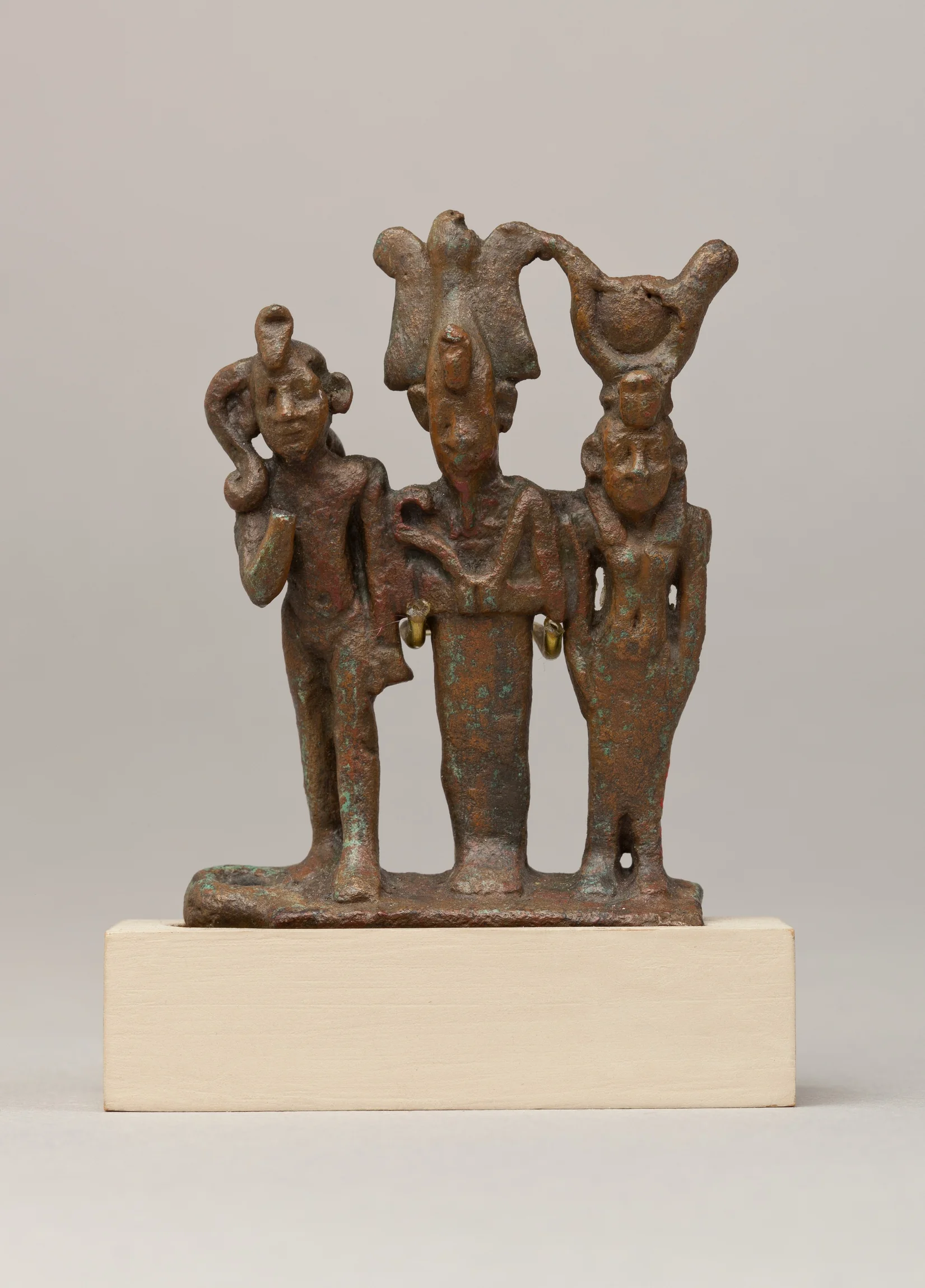
Write The Met 23.6.11 for the divine triad or 35.9.21a–o for the Osiris Liturgies papyrus. Museum catalog numbers help other readers inspect exactly the same evidence.
Finally: explain uncertainty
Separate direct archaeological observation, interpretation supported by several sources and speculation. A useful student essay makes the evidence visible instead of pretending that uncertainty is ignorance.
19. Questions often asked about Isis and Osiris
Is the myth of Isis and Osiris a real historical event?
It is a religious tradition preserved in ancient texts, rituals and art, not a verified human historical episode. The sources reveal real beliefs, institutions and artistic practices. Historians can date the surviving evidence without treating divine actions as excavated events.
Did Isis bring Osiris completely back to life?
The myth describes recovery and renewed divine potency, but Osiris becomes ruler of the dead rather than returning as an ordinary living king. Horus’s eventual accession completes the restoration of succession among the living.
How many pieces was Osiris’s body divided into?
The number and details differ among retellings and later local traditions. A single fixed count repeated without identifying its source is not a reliable way to present the entire ancient Egyptian tradition.
Who is the child of Isis and Osiris?
Horus is their son in the major Osirian succession tradition. Egyptian theology includes several forms and local expressions of Horus, and those distinctions matter when interpreting specific objects or texts.
Why is Isis often shown nursing Horus?
Such images emphasized divine motherhood, care, protection and royal legitimacy. They became particularly common in later Egyptian votive art, and museum records let us date individual surviving examples.
Which is the oldest source for the myth?
Old Kingdom Pyramid Texts preserve early allusions, while later Coffin Texts, Book of the Dead manuscripts, temple inscriptions and literary compositions expand and reinterpret the tradition. The earliest surviving allusions are not a complete storybook.
Where were Isis and Osiris worshipped?
Osiris was especially associated with Abydos, while Isis had important cult traditions at places such as Philae. The geography and prominence of worship changed over many centuries, so one location should not be treated as the sole origin of the myth.
Can I see authentic objects connected with the myth?
Yes. The Metropolitan Museum of Art and many other museums preserve Egyptian statuettes, amulets, reliefs and papyri connected with Isis, Osiris and Horus. Kemet Vault displays locally hosted copies of specifically licensed photographs with precise accession numbers.
20. Explore the myth across Kemet Vault
Continue with the Digital Museum to inspect genuine Egyptian objects and their catalog records. Use the Interactive Timeline to compare Old Kingdom funerary references with much later Ptolemaic artworks, or open the Archaeological Atlas to locate major monuments and historic centers.
The Gods & Mythology collection is the home for connected biographies of deities, mythological narratives and religious symbols. The same topics have several viewpoints: a visitor may want to understand a temple relief, while a student may need to distinguish the surviving Egyptian texts from a modern paraphrase.
Sources, object records and image rights
- UCL Digital Egypt — Gods and goddesses in ancient Egypt: creation and divine succession.
- UCL Digital Egypt — Festivals of Khoiak.
- UCL Digital Egypt — Book of the Dead Chapter 17.
- UCL Digital Egypt — Book of the Dead Chapter 156.
- Institute for the Study of Ancient Cultures, University of Chicago — Book of the Dead: Becoming God in Ancient Egypt.
- Global Egyptian Museum — Osiris and the differing Egyptian and Plutarch traditions.
- Global Egyptian Museum — Pyramid Texts.
- The Met 23.6.11 — Isis, Osiris and Horus triad.
- The Met 04.2.442 — Isis and Horus.
- The Met 04.2.575 — Osiris.
- The Met X.352.4 — Osiris.
- The Met 23.10.66 — Isis and Horus amulet.
- The Met 1979.180a,b — Isis with Horus.
- The Met 35.9.21a–o — Papyrus of six Osiris Liturgies.
Method and image notice: This is an original educational synthesis, not a verbatim translation of one ancient manuscript and not affiliated with The Met, UCL or the Egyptian authorities. Object dates and descriptions follow each named museum catalog entry. All seven artwork photos are The Met Open Access / Public Domain files, independently archived and served on Kemet Vault. The original source records remain cited for scientific accountability.