Horus is one of the most recognizable gods of ancient Egypt, but the familiar falcon image conceals an unusually varied religious history. This guide explains his connection with kingship, the myth of Isis and Osiris, the contested throne, the protective eye and the major temple at Edfu, using dated archaeological evidence rather than treating every representation as an undifferentiated symbol.
Horus’ role in kingship is visible in two different kinds of source: the first kings’ Horus names inside palace-shaped serekhs, preserved on royal objects, and the developing Isis–Osiris–Horus succession narrative. An early royal name emblem is not a complete retelling of the later religious tradition.
Horus quick reference
1. Who was Horus?
Horus was a major divine figure whose falcon symbolism, connection with the sky and association with Egyptian kingship developed across millennia. There is no single unchanging “Horus story” covering every locality. Different forms and local traditions could share the same name or related iconography while emphasizing different powers and relationships. The historical task is to identify which Horus a text or object describes.
The child Horus connected with Isis and Osiris, Horus the Elder in other mythological contexts, and the falcon-god worshiped at Edfu should be studied through their dated sources. They belong to an interconnected religious landscape, but not every title or action can be transferred indiscriminately among them.
2. The falcon and the sky
Horus is frequently represented as a falcon or as a human figure with a falcon head. Falcons communicate vision, height and royal power in Egyptian visual language. The bird image was so important that falcon imagery became deeply connected with the iconography of kingship. A tiny faience falcon amulet and an imposing sculpture can both embody the theme while fulfilling different practical roles.
Museum catalog records are indispensable because some falcon figures belong to specific cult sites, funerary assemblages or periods. Students must not assume that every bird statuette represents the same manifestation without examining crowns, inscriptions, provenance and comparative interpretation.
3. Horus as a model of living kingship
Egyptian rulers could present themselves in relation to Horus, a connection visible in titulary and royal iconography. It does not follow that each king was understood as the same deity in a simplistic, uniform way. Kingship was embedded in ritual, divine relationships and the political claim to maintain order.
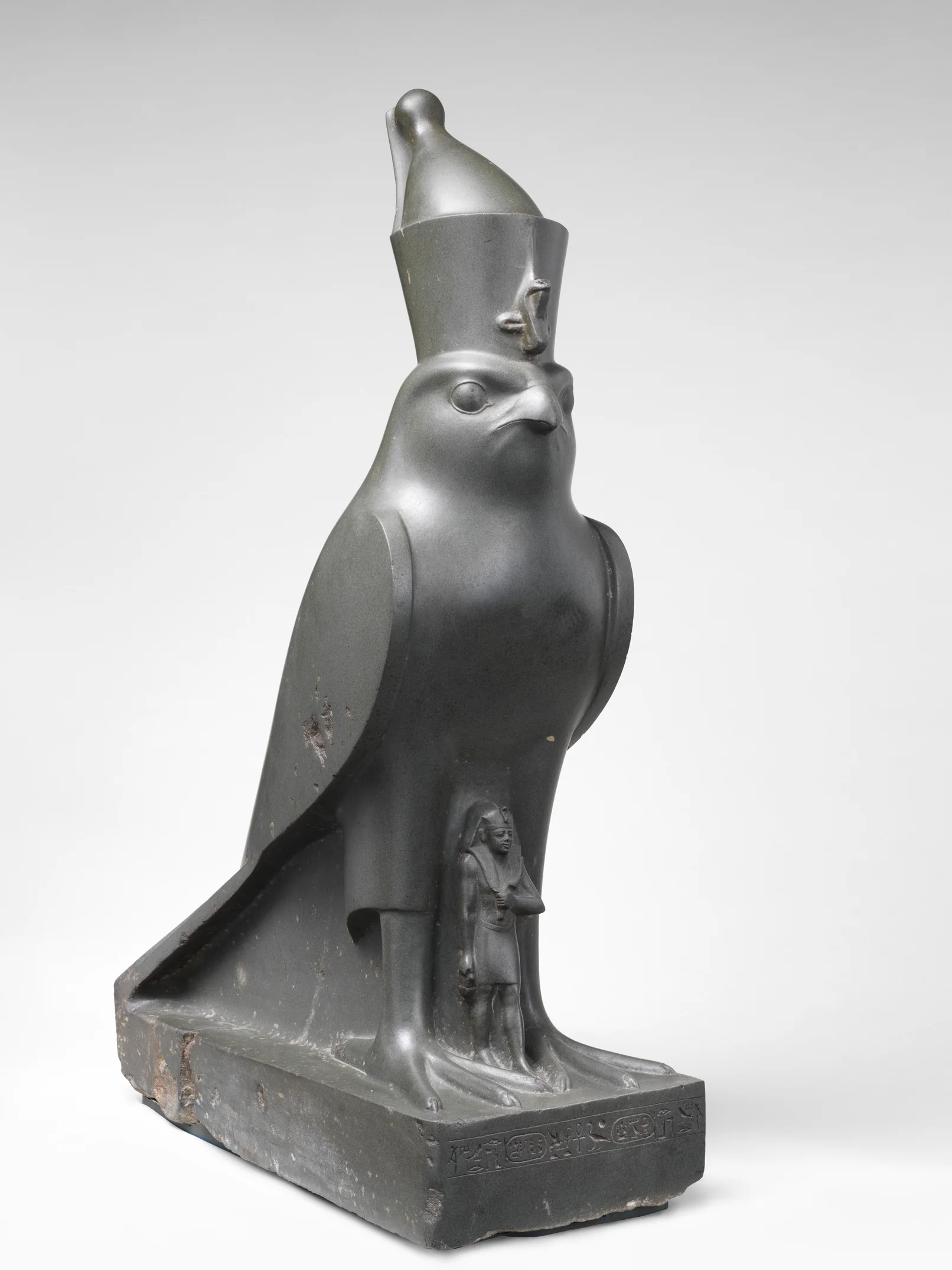
The Met’s statue of Nectanebo II under the protection of an immense falcon vividly expresses this relationship in a Late Period context. The object is not a portrait of the god acting in an earlier myth; it is a historically specific representation of royal identity and divine protection.
4. Horus the child and Isis
In important Osirian traditions, Horus is the son of Isis and Osiris. Following the death of Osiris, the vulnerable child is protected by his mother, who uses knowledge and effective sacred speech against threats. Later nursing figures of Isis and Horus connect divine care with the legitimacy of the heir.
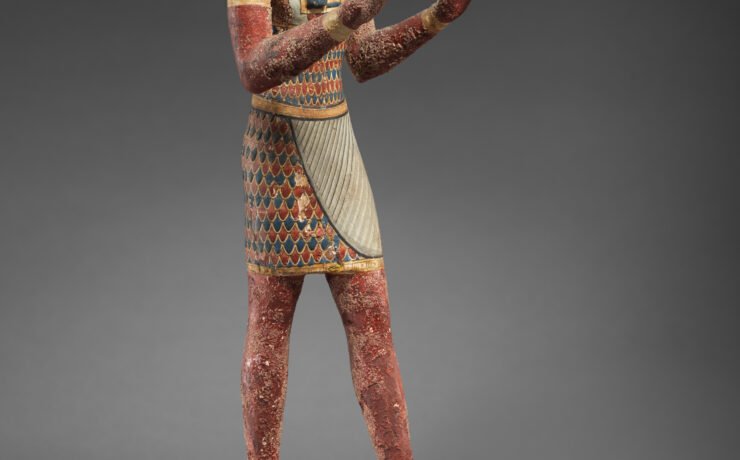
The historical evidence includes many later amulets and statues that show this relationship. A Late Period statuette reveals how people of that time represented the divine family; it should not be described as an artifact made at the beginning of the myth.
5. Horus versus Seth: a contest about succession
The conflict between Horus and Seth is not just a fantasy battle for readers looking for supernatural heroes. It is a religious drama about competing claims, injured power, arbitration and the eventual restoration of rightful kingship. The most developed surviving literary narratives belong to specific periods and can include humor, conflict and complex divine judgments.
The New Kingdom composition commonly called The Contendings of Horus and Seth should be distinguished from earlier Egyptian ritual references to their dispute. A modern one-page retelling often combines material from different traditions. A responsible guide shows those layers rather than claiming a single original text.
6. The Eye of Horus and wholeness
The wedjat, often called the Eye of Horus, became a potent image of healing, protection and restoration. It is associated with the mythical injury and restoration of the divine eye, but particular meanings depend on the source. Egyptian objects may feature eyes in settings connected with burial, personal protection or other rites.
The popular internet habit of assigning a universal modern fraction table or medical anatomy diagram to every Eye of Horus image is not a substitute for a dated, translated ancient source. Students should distinguish evidence for ancient Egyptian symbolism from modern creative interpretations.
7. Horus at Edfu
The Temple of Edfu is among the best-preserved Egyptian temple complexes and is dedicated to Horus. The Egyptian Ministry places its present Ptolemaic construction from the third to the first centuries BCE and describes the pylons, courts and sacred spaces. Falcon statues at the entrance make the relationship between religious imagery and monumental architecture unusually vivid.
The temple preserves late forms of ritual and mythological expression. It is not appropriate to present its visible walls as if they were built in the Old Kingdom, or to regard every scene as an illustration of an unchanging myth from the first dynasty.
8. Other forms of Horus
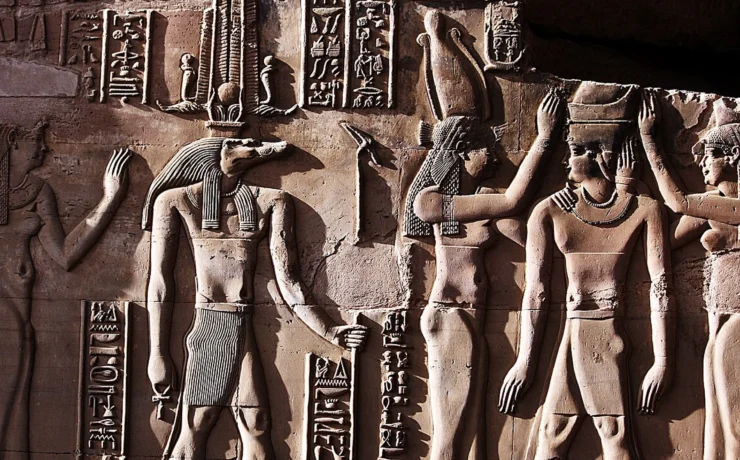
Horus the Elder and other named manifestations complicate simple genealogical charts. At Kom Ombo, the temple has paired cult axes and is associated with Sobek and Harwer, Horus the Elder, according to the Egyptian Ministry. The local pairing provides a different ritual setting from the Isis–Osiris succession cycle.
An article that merely declares Horus was always born to Isis and Osiris would erase important aspects of this theological variety. A scholarly explanation names the source tradition instead of treating different gods with related names as identical characters in a single fixed mythology.

9. Royal protection in the Nectanebo statue
The Met’s Late Period statue of Horus as a falcon protecting King Nectanebo II is especially revealing because the god’s massive form and the king’s smaller image communicate a political-religious relationship. The museum identifies meaningful elements in the king’s name and the cultic setting that may be relevant to understanding the sculpture.
The statue dates to the fourth century BCE, while the religious connection between kingship and falcons existed far earlier. Its date and historical setting are part of the explanation, not inconvenient details to be omitted for a timeless caption.
10. Falcon amulets and ordinary religious practice
Small falcon figures could circulate as amulets or votive objects. Their scale makes them relevant to religious experiences beyond enormous royal sculpture. A tiny object may have been worn, deposited or otherwise used for protection, but the original function cannot be reconstructed solely from how attractive it looks in a museum display.
The Met records a faience Horus falcon excavated at Lisht as well as a metal falcon figure from Abydos. Their different materials and findspots make comparison fruitful, provided students do not assume one uniform rite behind every falcon form.
11. Processions, standards and sacred barks
The museum catalog for a Horus falcon figure discusses several possible original functions, including attachment to a standard or a sacred bark. This makes it an excellent case study in uncertainty: archaeologists can identify the bird and crown with relative confidence while remaining cautious about how the object was used.
A responsible caption distinguishes an observed base and metal attachment from a hypothetical reconstruction of the entire object. The ability to say “could have” accurately is a strength of historical scholarship, not a weakness.

12. The double crown and the unity of Egypt
Horus figures sometimes wear the combined crown that symbolizes Upper and Lower Egypt. The double crown emphasizes the connection between the god and legitimate unified rule. Yet it is not proof that a particular bronze statuette was commissioned to celebrate a named military victory.
The meaning of a royal symbol grows clearer when examined with the object’s date, material, original setting and inscription. This is why multiple images in a guide should not be treated as interchangeable decoration.
13. Chronological changes in Horus worship
Horus symbolism can be traced across royal and religious contexts, but surviving visual evidence is uneven over long periods. A Late Period falcon image, a Ptolemaic temple relief and an earlier royal name all tell us something different. Students should resist the temptation to assemble their features into one supposed original Egyptian belief system.
Historical continuity often involves reinterpretation. Different communities could retain recognizable symbols while using them to express shifting priorities and local relationships.
14. Museum object reading workshop
Start with The Met 34.2.1, the statue protecting Nectanebo II. Describe the bird’s size, the king’s posture, the material and the museum’s interpretation. Then compare The Met O.C.380, a much smaller falcon figure from Abydos, and 26.7.994, a faience inlay. Ask what the same god’s iconography does in each context.
For every comparison, record accession number, date and provenance. Do not claim the small figure came from Edfu or that the sculpted king is Osiris. Linking a genuine object to a correct name is more important than attaching a dramatic but unsupported legend.

15. Questions for students
Is Horus a falcon or a man? He can be represented as a falcon or falcon-headed figure and in other forms. Was Horus always the son of Isis? That is central in certain traditions, but Horus has several theological manifestations. Was Seth simply evil? His roles varied across contexts. Is the Eye of Horus the same as a modern medical symbol? No. Did Edfu begin in the age of the pyramids? The surviving major temple is Ptolemaic. Do all falcon figurines come from one sanctuary? No.
undefined
16. Explore Horus across the encyclopedia
Horus connects royal titulary, the stories of Isis and Osiris, protective objects and late temple ritual. The strongest reading route begins with the deity’s documented forms, continues to the mythological succession narrative and then to a particular temple site. This builds understanding without repeating one generic paragraph across separate pages.
Use the Gods & Mythology collection for the linked deities and the Archaeological Atlas for Edfu and other relevant monumental settings.
Institutional references and related studies
Egyptian Ministry: Temple of Edfu; Egyptian Ministry: Kom Ombo and Horus the Elder; The Met: Nectanebo under Horus’s protection; The Met: Horus falcon figure. Companion pages: Isis, Osiris and the full Osirian succession myth.