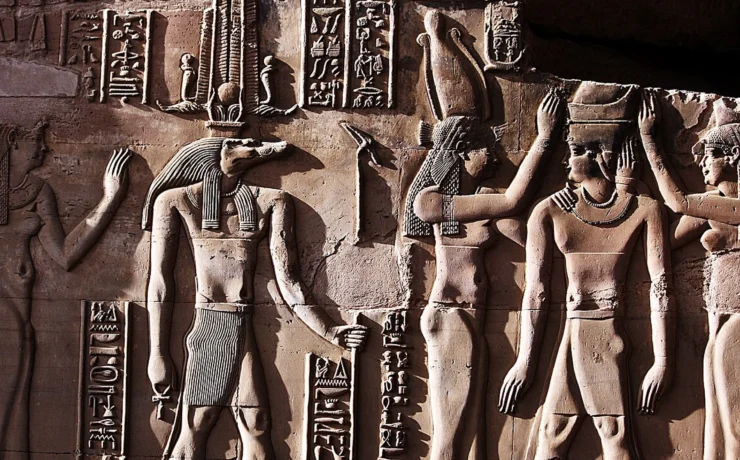
Anubis was not simply an Egyptian “god of death.” To ancient worshippers he was a guardian of burial grounds, a divine model for careful embalming, and a presence at the threshold between a prepared tomb and an uncertain existence beyond it. His long-eared black canid form guarded the places where the dead were most vulnerable. The familiar image of Anubis standing beside a balance belongs to one important strand of that history, not to every Egyptian period or every funeral.
This illustrated guide follows the evidence from Egyptian funerary texts and archaeological objects, distinguishing what surviving works actually show from the later stories and modern fantasy images that surround the god. It also introduces genuine museum objects with verifiable accession numbers. The opening creative illustration associated with this study is a modern artistic interpretation, not an excavated object, an ancient portrait or a reconstruction of an identifiable historical rite.
Who was Anubis in ancient Egyptian religion?
Anubis, commonly called Inpu or Anpu in modern renderings of his Egyptian name, belonged to the group of deities associated with the care and protection of the dead. He was linked to cemeteries, the preservation of bodies, ritual purity, and the safe passage of deceased people into a transformed condition. That combination matters. A funeral in Egypt was not merely the disposal of remains; it was an attempt to maintain identity, relationships, and religious order despite physical death. Anubis stood at precisely that difficult boundary.
It is tempting to divide Egyptian gods into single job titles, but surviving religious evidence resists the simplicity. Anubis can appear as protector, ritual authority, attendant, and guide, while Osiris may represent the transformed ruler of the dead. Their roles overlap without becoming identical. Likewise, the symbolic work of Anubis changed over the long history of Egypt, and a Roman-period representation should not automatically be read back into an Old Kingdom royal burial.
Early funerary compositions already invoke Anubis. Later coffins, statuettes, papyri and amulets show that his image remained recognizable across many centuries. Continuity, however, is not the same as an unaltered universal story. An object records a particular place, date and use, and claims about the god should be judged accordingly.
Why did Anubis have the head of a jackal?
Egyptian artists showed Anubis as a recumbent or standing dark canid, or as a human figure with a canid head. Modern labels often say “jackal-headed,” although the precise zoological classification of Egyptian divine canids is more complicated than one English animal name. The pointed muzzle and upright ears made the divine identity visible at a glance. Funerary landscapes probably helped establish the link: wild canids could be encountered near desert-edge cemeteries, the places where people sought to keep graves safe.
There is a striking reversal in the iconography. An animal that people might fear near exposed burial places becomes, in divine form, a guardian capable of resisting disturbance. Images of a canid resting alertly over a shrine communicate watchfulness, and human-bodied representations give the deity hands with which to perform or oversee ritual actions. Neither form should be read as an eyewitness report of an animal-headed creature walking through historical Egypt.
Black coloring also invites misunderstanding. In Egyptian visual language it can suggest the darkened body after mummification and, in broader contexts, the generative black silt of the Nile Valley. It is not simply a shorthand for wickedness. Anubis’s dark form was associated with protection and the hope of renewed existence, not with the modern horror-film assumption that darkness must mean evil.
Anubis and the preparation of the dead
Anubis is strongly connected with embalming. Mummification was a practical, technical and religious process, but its methods varied considerably over time, by locality and by the resources of the family. There was no one procedure applied to every Egyptian body for three thousand years. Embalmers worked with the body and its wrappings; religious language imagined divine protection around the work; and Anubis offered a model for the sacred importance of preserving what could be preserved.
In some rituals, human officiants represented divine participants. Museum and archaeological discussions of jackal masks, along with images of gods attending a funerary bier, help explain this performance dimension. Yet a scene of Anubis bending over a mummy should not be confused with a literal photograph of the embalming process. Religious images convey a relationship between ritual actions and the supernatural agency Egyptians believed those actions could invoke.
Protecting a body was only one part of the goal. The dead also needed recognition, access to offerings, ritual speech, and a secure place within a transformed world. That is why images of Anubis appear among other gods and sacred signs on coffins and burial equipment, often alongside appeals to Osiris. For the physical evidence behind natron, linen, organ treatment and changing embalming methods, compare Kemet Vault’s separate guide to funerary texts and the Book of the Dead; texts and mummies provide different kinds of evidence and should be examined together rather than conflated.
Guardian of the necropolis and the tomb
Egyptian tombs often stood where cultivated land yielded to desert. The cemetery was not simply an empty zone outside a city: it could include tomb chapels, processional approaches, offering places, workers and priestly specialists, and active remembrance of the deceased. Protection was therefore both practical and sacred. Anubis’s title often translated as “lord of the sacred land” or “lord of the hallowed ground” emphasizes a relationship to the necropolis, the protected cemetery landscape.
Some representations place the divine canid on a shrine-shaped support. The pose suggests vigilance over a bounded sacred space, and its frequent use in funerary imagery helps explain why a modern viewer associates the silhouette with a tomb entrance. But artists also represented other canid gods, notably Wepwawet, so identification should rely on inscriptions, provenance and a museum’s cautious catalog description, not just ears and muzzle.
There is no single “Anubis temple” that explains every phase of his cult. Devotion could be embedded in wider funerary establishments, local theological traditions and burial rituals. Ancient Egyptian religious practice was profoundly local, even where imagery and names circulated widely. To understand a depiction, identify the object and setting before attributing a specific ceremony or cult center.
Did Anubis judge the dead? The weighing of the heart
The best-known Anubis scene for many modern audiences is the weighing of the heart. In illustrated funerary manuscripts the deceased person’s heart may be balanced against the feather or image of Ma’at, the principle of rightness, order and truth. Anubis attends or adjusts the balance, while Thoth can record the outcome and Osiris receives the justified deceased. The fearsome devourer Ammit represents the loss of continued existence if the judgment fails. Different manuscripts and epochs vary in layout and theological detail.
These scenes are not straightforward judicial records of ordinary Egyptians. They show how Egyptian funerary religion imagined a successful passage to continuing life. The heart was associated with thought, conduct and identity, so its assessment was more than a magical test of physical weight. Spell 125 of the Book of the Dead includes declarations of innocence; the image makes an ideal outcome visible. Some texts include divine judges and further exchanges, rather than a single mechanical action on a scale.
Crucially, Anubis was not simply the final king of the underworld, and he was not the monster that devoured failed hearts. In the familiar composition he helps conduct or supervise a procedure connected to the authority of Osiris. For a careful distinction between manuscript tradition and later retelling, consult Kemet Vault’s study of Osiris and funerary renewal.
The University of Michigan’s Kelsey Museum account of Anubis in the judgment hall identifies the god’s role in attending the scales and draws attention to textual details often lost in modern summaries. The British Museum’s overview of Egyptian gods similarly emphasizes his protection of the dead rather than portraying him as an evil figure.
Two real Anubis objects: how museums identify the god
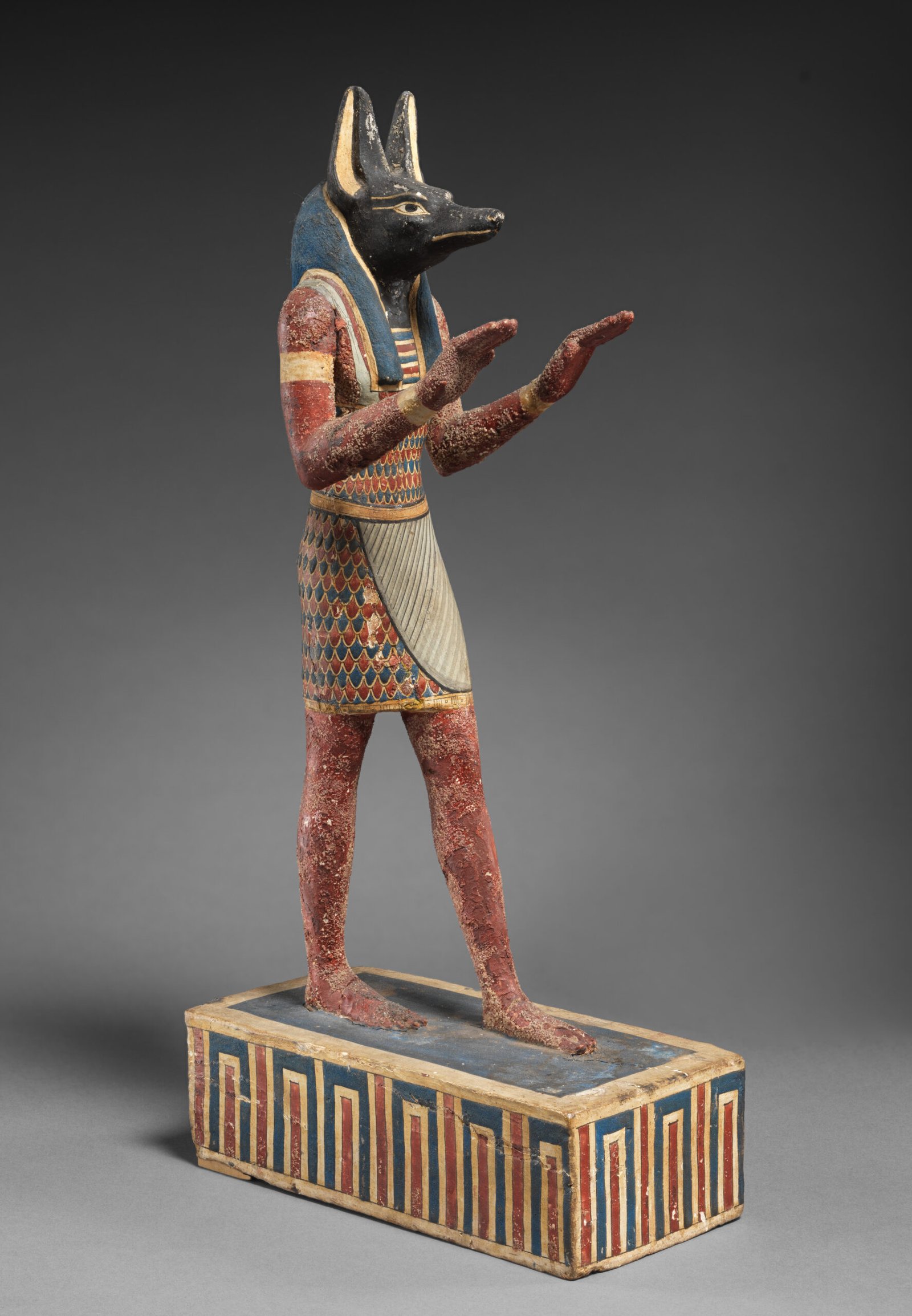
The strongest way to escape vague visual mythology is to look at actual surviving objects. The Metropolitan Museum of Art records a painted wooden canid-headed figure from the Ptolemaic Period, dated to 332–30 BCE, as probably Anubis (accession 38.5). That word “probably” is essential. The museum recognizes that more than one Egyptian deity could have a canine head and uses comparison, costume and iconography to offer a careful identification. The object’s painted feather-patterned clothing is a useful warning against assuming all divine costumes are straightforward depictions of ordinary linen garments.
A second Met object, accession 04.2.430, represents Anubis in metal. The museum dates it broadly to the Late Period–Ptolemaic Period, 664–30 BCE, and records the figure as 14 centimeters tall without its tangs. Its small scale is worth noticing. Anubis was not confined to monumental temple walls: small objects could also carry sacred identity and protective meaning. A careful catalog reading differentiates the museum’s description of the material and date from interpretations about the exact circumstances in which an object was used.
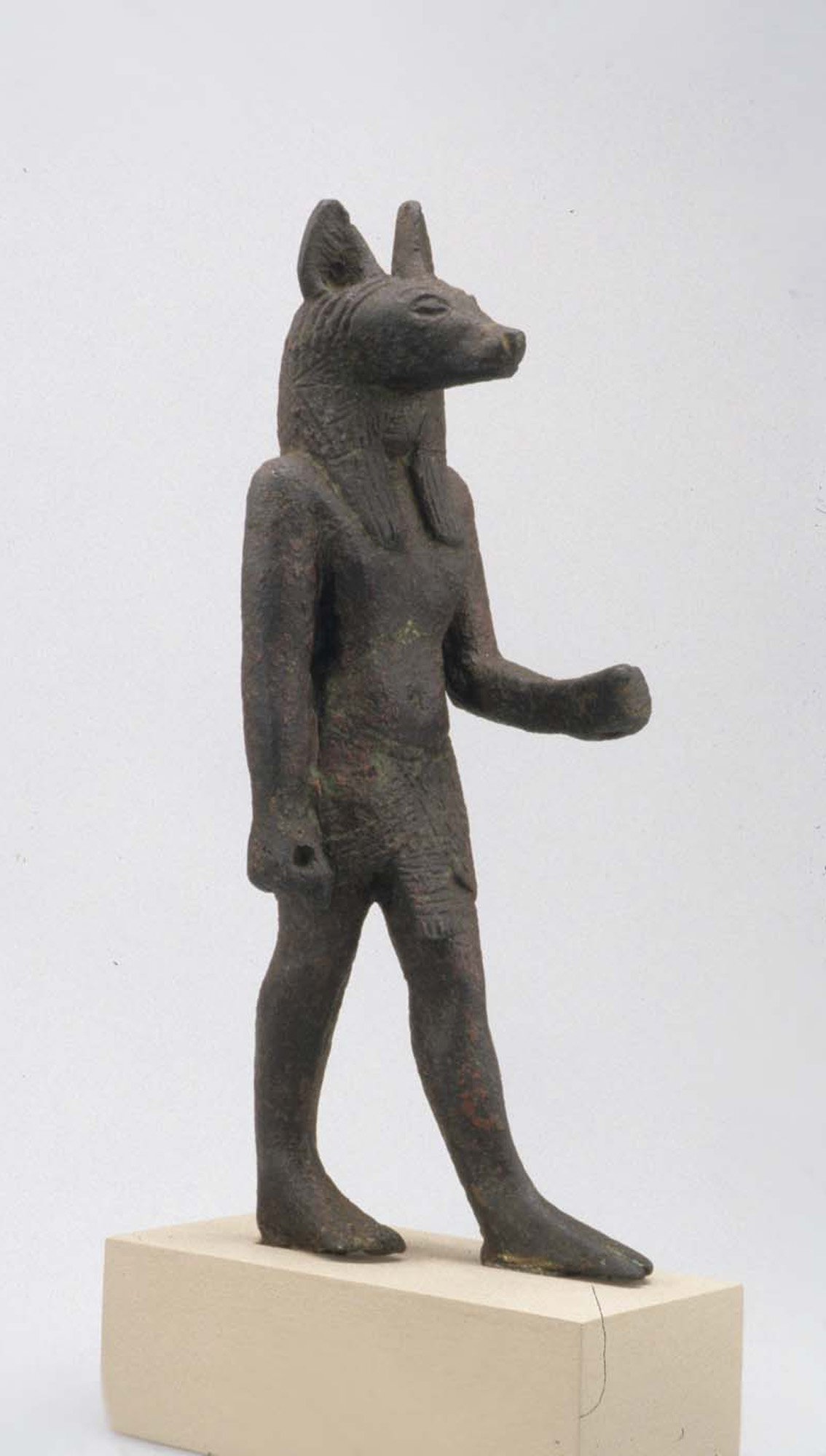
These are photographs of real ancient objects, not digital reconstructions. Both catalog pages explicitly mark their photographs Public Domain. Their visual style is also historically useful: the brightly decorated wooden figure and the small dark metal figure belong to different object types, and neither can stand in for every image of Anubis across Egyptian history. Treat each dated object as evidence of a particular artistic and religious practice.
What did Anubis’s symbols and titles mean?
Iconography often gives Anubis a dark canine head, long ears, a close-fitting kilt or elaborate divine costume, and sometimes a staff. But the significance of an attribute depends on context. A staff in the hand of a deity cannot, by itself, establish a unique title or narrative episode. A reclining canid on a shrine may point to protection of sacred ground; a figure attending a mummy may connect to funerary treatment; and a figure at the scales suggests post-mortem judgment.
Egyptian titles for Anubis were not casual nicknames. Translations such as “he who is upon his mountain,” “he who is in the place of embalming,” and “lord of the sacred land” reflect relationships between the deity, burial landscapes and ritual care. Exact spellings and explanations vary by textual context. The modern habit of using every title as if it were an individual character in a fixed fantasy universe makes these religious nuances disappear.
Students should distinguish an attested written epithet from a modern descriptive label. If a website calls Anubis “the grim reaper of Egypt,” that is an analogy, not a literal translation from an Egyptian inscription. A useful study method is to find the museum accession number, consult the associated inscription if published, and then ask which parts of a description are directly observed and which are interpretive.
Anubis, Osiris and the changing stories of divine family
Later traditions often connect Anubis with Osiris and Nephthys, while other ancient accounts give him different parentage. The variation matters because Egyptian religion did not possess one universally edited mythology. Local cults, changing historical periods and different genres of texts could offer contrasting genealogies. Retellings that confidently present one family chart as the only Egyptian answer are selecting a tradition, even when they do not admit it.
Anubis’s relationship with Osiris is particularly important. In some accounts Anubis helps protect or prepare Osiris after his death, a model that resonates with the funerary preservation of humans. But Osiris is generally the ruler who represents renewed existence among the dead, whereas Anubis is especially prominent in protection, preparation and passage. The stories work together without making the gods interchangeable.
For the narrative complexity around Isis, Osiris, Horus, Seth and Nephthys, see the Kemet Vault analysis of the Isis and Osiris myth. It separates earlier Egyptian allusions from the expanded story known through later sources, including the Greek writer Plutarch. That distinction is essential: a late literary narrative can be historically important without being evidence that every detail was told in the same form in the Old Kingdom.
How was Anubis represented across Egyptian history?
The image of Anubis reached across centuries and object types. Royal funerary literature, decorated coffins, amulets, tomb scenes and later devotional statuary provide different windows into his presence. The dates of surviving witnesses are not identical to the origin dates of the religious ideas they reflect. A Ptolemaic statuette can demonstrate how the deity was visualized in that period; it cannot tell us the exact date on which a symbol first appeared.
Material also alters interpretation. A faience amulet likely had a different relationship to the body than a painted coffin lid. A statuette placed in a burial differs from a temple relief intended for display in a larger ritual space. Even when two objects show the same head and pose, their social function need not be the same. The same caution applies to images collected without secure archaeological context, where claims about original use should be restricted.
During the Greco-Roman periods, interactions among Egyptian and Mediterranean religious languages sometimes associated Anubis with Hermes in the figure modern scholarship calls Hermanubis. This is evidence of religious adaptation, not proof that the gods were always the same or that a single myth displaced all older practices. Chronology remains the best protection against misleading claims.
Was Anubis feared or revered?
Modern entertainment often turns Anubis into an enemy, a destroyer or a commander of supernatural armies. The historical religious evidence presents a more protective figure. His roles involved safeguarding the dead, attending rituals, guarding sacred spaces and helping the deceased negotiate dangerous transitions. Those duties were serious because death was serious, but seriousness is not equivalent to malevolence.
Ancient funerary texts do describe danger, divine powers and necessary ritual knowledge. Egyptians did not necessarily imagine the beyond as uncomplicated comfort. Yet Anubis appears as part of the protective system that could allow a person to meet those dangers, not as an uncomplicated force seeking human suffering. Funeral imagery often shows gods cooperating to secure renewal, with Anubis performing one set of tasks within a much larger theological network.
The question should also be framed carefully: we cannot survey the private emotions of all ancient Egyptians. Evidence survives unevenly. An inscribed coffin or sanctuary offering records a religious practice and expectation, not a psychological questionnaire. “Feared or revered?” is therefore better answered by specific images and texts than by a single adjective applied to an entire civilization.
Anubis or Wepwawet? How to identify an Egyptian jackal god
A reclining jackal on a funerary object is not automatically Anubis. The Metropolitan Museum of Art describes an uninscribed Third Intermediate Period jackal figure that may represent either Anubis or Wepwawet, the deity known as the Opener of the Ways. An inscription or secure archaeological context can identify the god more confidently than an isolated silhouette. This distinction prevents a familiar Egyptian symbol from being mistaken for a proven identification.
By contrast, the Met specifically catalogues its Anubis amulet (04.2.151) as a funerary representation of the embalming god. His responsibilities included preserving and protecting the dead and attending the weighing of the heart. For that judgment scene in a specific ancient manuscript, examine the Papyrus of Ani and its British Museum frames. For the physical preparation of bodies, consult the separate mummification archaeology guide.
How to recognize the real Anubis in a museum
Begin with the caption, not the dramatic silhouette. Look for a precise accession number and the object’s archaeological or collection history. Read the period and approximate date, then the medium and dimensions. If the label says “possibly” or “probably Anubis,” retain that uncertainty in your own notes. Museum catalogs sometimes update attributions when new comparisons are found; this is ordinary scholarly practice rather than a flaw.
Next ask what kind of source you are seeing. A painted wooden statue documents a representation. A funerary papyrus can transmit narrative or ritual language. A coffin scene may illustrate a desired transformation rather than an event a living observer claims to have watched. A modern generated illustration offers atmosphere, but cannot establish costume, building layout, chronology, or religious rite by itself.
Finally, compare at least two independent institutions or publications. The Met record for the painted canid-headed figure, the Met record for the metal Anubis statuette, and the University of Michigan’s exhibit allow the visual and textual dimensions to be studied together. For further exploration of genuine objects, visit the Kemet Vault Digital Museum, where catalog identifiers and object photography are kept separate from modern artwork.
Frequently asked questions about Anubis
Is Anubis the Egyptian god of death?
He is more accurately described as a god of embalming, cemeteries and protection of the dead. Egyptian funerary beliefs assigned overlapping but distinct roles to Anubis, Osiris, Thoth and other divine figures.
Why is Anubis black?
His dark appearance fits funerary symbolism and can relate to preservation and renewal. It should not be interpreted as automatic evidence that the deity was considered evil.
Did Anubis weigh the heart himself?
Many Book of the Dead scenes portray Anubis supervising or attending the balance. Thoth may record the result, with judgment connected to Osiris and Ma’at. Details vary across manuscripts.
Was Anubis always the son of Osiris?
No single genealogy represents every tradition. Later accounts often connect him to Osiris and Nephthys, while other accounts describe different divine relationships. Dates and textual genres matter.
Are the images in this guide genuine artifacts?
The two museum photographs show distinct cataloged objects from The Metropolitan Museum of Art and are marked Public Domain on their official records. Any cinematic illustration accompanying the guide is a modern interpretive artwork, not an archaeological photograph.
Sources, object rights and editorial method
This original educational synthesis uses The Metropolitan Museum of Art object 38.5 and object 04.2.430 for material evidence, the University of Michigan’s Kelsey Museum exhibition for the textual interpretation of funerary judgment, and the British Museum’s deity reference for a concise institutional overview. The museum object pages explicitly mark both photographs Public Domain; their images are credited here even though the Open Access license does not require permission.
Images of real objects are documentary; any separately labeled visual dramatization is creative. Statements about gods and the afterlife describe ancient beliefs preserved in texts and art, not independently verified supernatural events. Object dating is approximate, interpretive disputes are marked, and genealogy and iconography are never presented as perfectly uniform across Egyptian history. Kemet Vault is an independent educational publication and is not affiliated with the museums cited.