What is Spell 30B on an ancient Egyptian heart scarab? Spell 30B is a funerary composition that asks the deceased person’s heart not to oppose or condemn its owner during judgment in the afterlife. It is preserved both within the wider Book of the Dead tradition and on the undersides of some large scarab-shaped amulets. Egyptians regarded the heart as closely connected with memory, moral character and identity, while the beetle also evoked renewal. These objects are real, individually catalogued artifacts rather than modern symbols invented for tourist souvenirs.
This article studies the actual inscription, how a heart scarab was used, the judgment of Osiris and two documented museum objects. It is a focused guide to material amulets and Spell 30B, not another introduction to the whole Book of the Dead or to the Papyrus of Ani. The museum photographs below portray original artifacts and retain their distinct accession histories.
A named spell, not one uniform Egyptian prayer
Ancient Egyptian funerary writings survived on papyri, coffins, bandages, stone and amulets. Egyptologists use numbered chapters to compare compositions appearing in those different materials, and Spell 30B is among the best known. Yet no surviving object demonstrates that every individual copied precisely the same text at the same date. An inscribed amulet can abbreviate, reorder or customise a formula for its owner. The Metropolitan Museum’s detailed heart scarab record explains the connection between this spell and the prospect of the heart speaking against the dead person. Reading an individual amulet requires attention to the owner, the surviving signs, damage and edition. The label 30B is an editorial convenience, not a statement that all Egyptian funerals used a fixed textbook with an identical page thirty. Other Book of the Dead spells addressed dangers, speech, nourishment and transformation. Spell 30B forms one part of this much broader ritual repertoire.
Why the heart mattered to Egyptian ideas of personal identity
Egyptians often treated the heart as the centre of memory, thought and ethical responsibility, not simply as a pump. In ritual representations of posthumous judgment, a person’s heart might be weighed against a symbol of maat, the ordered moral world often represented by a feather. That weighing is a belief recorded in texts and images; it is not an archaeological test of whether an individual was virtuous. The Egyptians feared that the heart, familiar with the person’s actions, could offer damaging testimony. A specially inscribed object sought to prevent such opposition. The Met’s uninscribed heart scarab record explains this anxiety within the Hall of Two Truths narrative and describes the threat of Ammut. The moral setting helps explain the spell’s unusual form: the deceased addresses a part of the self as though it were a powerful witness. Historians should not reduce the entire Egyptian afterlife to this one courtroom scene.
What the scarab beetle added to the heart symbol
Scarab beetles, associated with solar renewal and coming into being, provided an effective shape for a protective funerary amulet. Egyptians could connect the insect’s behaviour and appearance with the daily renewal of the sun. A large funerary scarab differed from the much smaller seal scarabs used in everyday administration, although the broad insect motif was recognisable in both. A heart scarab might have incised legs, wing cases, a central division and a flattened inscribed underside. Some examples instead combine the heart shape with a beetle, while others add a human head. These variations mean that a generic modern photograph of a beetle cannot identify a particular artifact. The Global Egyptian Museum’s glossary explicitly corrects the popular claim that the amulet was intended to replace a heart supposedly removed during embalming. The heart was normally important enough to remain within the body, and the amulet had a protective ritual role.
The words were meant to affect judgment
Spell 30B commonly speaks directly to the heart. It aims to prevent that heart from standing against its owner as an adverse witness before divine judgment. This is not a modern legal defence, nor a record that Egyptians performed one physical weighing for every burial. The language belongs to a theological vision of moral examination and restoration after death. The individual name might be added to the inscription, making the amulet personal. Inscribed lines are often small and compressed, so popular translations need to be matched to the specific object and scholarly edition before being quoted. This article paraphrases the purpose rather than presenting an invented continuous translation. It matters that some amulets include the spell and others are blank. A material shape and a written formula may operate together but should be catalogued independently. The British Museum’s heart scarab EA79453 specifically describes a human-headed scarab with nine lines of Spell 30B.
How Egyptians wore or placed the amulet in burial
Large heart scarabs were commonly associated with mummy wrappings or placement near the deceased’s chest. They might have suspension holes or be attached using cord, gold wire or a setting. Their specific archaeological position depends on the individual burial and whether that context survived disturbance. A museum record sometimes has little information about the original findspot, so the presence of a drilled hole cannot alone prove how it was worn in life or death. Scarab-shaped amulets could serve several functions, but a heart scarab inscribed with Spell 30B has a clear association with posthumous hopes for favourable judgment. The Met’s Heart Scarab of Manhata, 26.8.144 records a green stone and gold-wire setting from a documented royal women’s tomb. Such provenance is more informative than an anonymous object acquired on the market. Compare the physical history of mummification for distinctions between preservation procedures and religious accessories.
Bak-en-Djehuti’s scarab: an original ten-line inscription
An actual grey-green greywacke scarab in the Walters Art Museum, accession 42.380, preserves Spell 30B on its flat underside. It was made in the late New Kingdom to Third Intermediate Period and was later associated with a priest of Amun named Bak-en-Djehuti. The Walters catalogue and Commons provenance describe ten separate lines of hieroglyphic inscription and note that the personalized signs on the body may have been added in a different working stage. This is a useful reminder that objects could be inscribed or adapted for individuals and that an inscription’s hand may vary within one artifact. The first documentary photograph below depicts the underside rather than an unrelated beetle. The owner identification, period and technique all belong to the catalogued object, not to every heart scarab ever made. A modern viewer may recognise horizontal dividers, but accurate reading needs a close epigraphic edition rather than guessing words from compressed images.
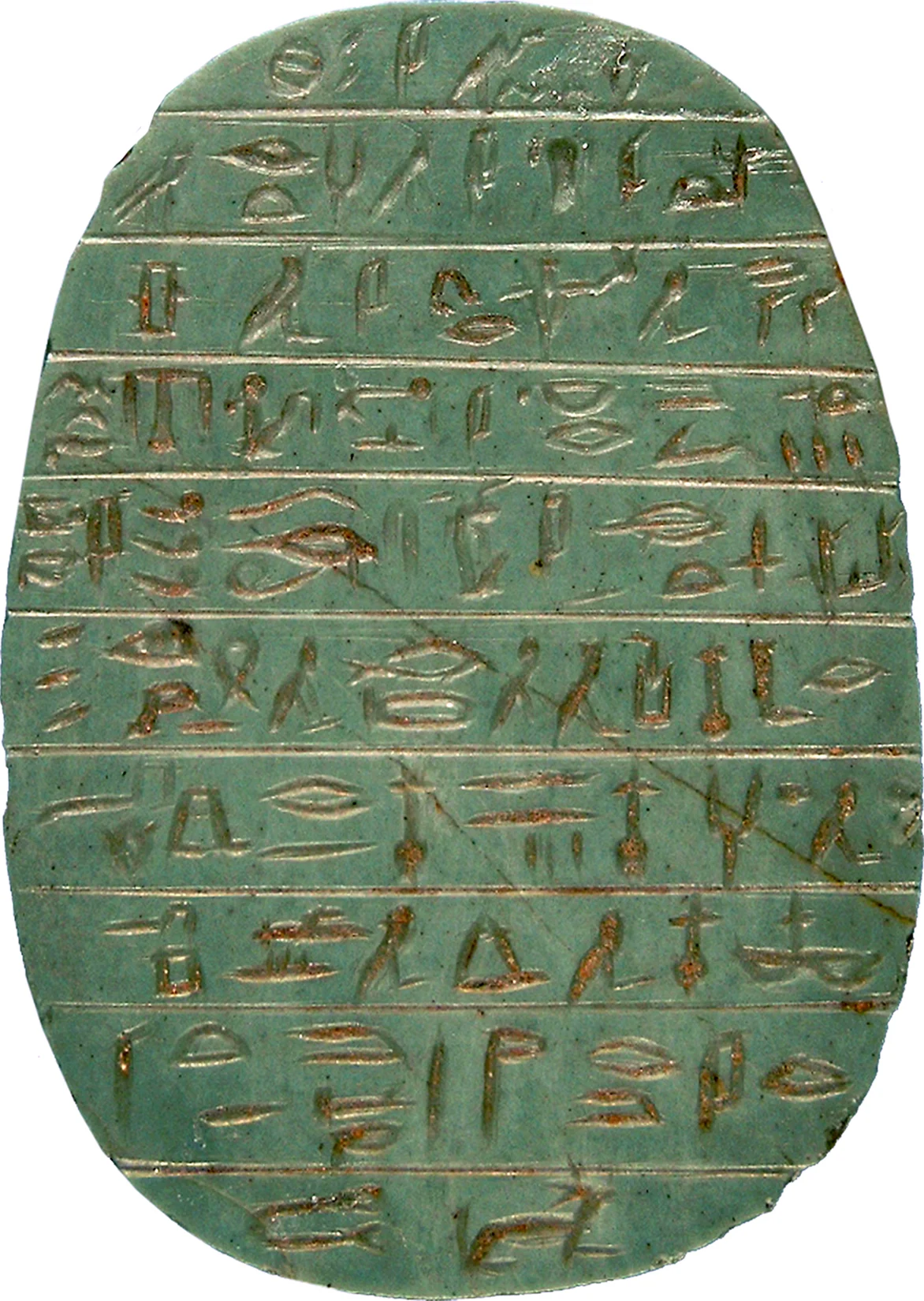
Walters 42.380: what the photograph can prove
In the original photographic record, the back of the scarab and its underside were documented separately, allowing researchers to distinguish carved anatomical features from the hieroglyphic text that addresses the heart. The underside contains multiple rows of signs inside a framing border. The cataloguing history records purchase by Henry Walters in 1911 and the transfer of the collection to the Walters Art Museum. These modern dates do not establish the ancient object’s exact burial year. The photo has a verifiable Creative Commons licence but does not show the original excavation site, which was not documented in the same way as a controlled modern archaeological find. It would be improper to assume that this exact scarab came from the tomb of the deceased named in some other inscription. Photographic rights and ancient provenance are separate questions. Readers can inspect the museum’s object record and the individual Commons file used here. Both the material and inscription are central to interpreting Spell 30B.
A second real object: the human-headed scarab
The Metropolitan Museum’s object 30.8.1080 is a striking human-headed heart scarab made of basalt, bronze and traces of gold leaf, dated broadly to the New Kingdom. Its unconventional head shows that the scarab form was not entirely uniform. The Met explains the intention of heart scarabs in relation to judgment and preserves the artifact’s measured dimensions. The second museum photograph in this article shows this separately catalogued original, not a different angle of Walters 42.380 and not a modern fantasy sculpture. Object identity matters: the Walters scarab preserves a named ten-line text, while the Met piece illustrates a different material and variant form. A photograph alone cannot prove that an unusual head was carved to represent its original owner. The official Met catalogue supplies the secure context and distinguishes observation from explanatory hypothesis. Using two real objects shows both continuity in funerary intention and variation in shape and technique.

Spell 30A and Spell 30B are related, not identical
Heart scarabs are frequently discussed in relation to Chapter 30B, but another version, 30A, also exists. An especially well-documented example is the heart scarab of Hatnefer, a New Kingdom woman whose burial equipment was recovered by the Met’s archaeological expedition. The Met’s Hatnefer record explicitly identifies its text as a version of 30A rather than 30B. The cataloguing information also records a change to the named owner, showing why epigraphic details matter. A public article should never label every inscribed scarab ’30B’ without checking the museum record. The two spell versions share the broader concern that the heart might challenge the deceased, but their textual forms and surviving attestations require specialist comparison. This distinction is especially useful to students researching actual amulets rather than relying on the familiar pictures of a giant scarab in gift shops. A physically comparable object does not always carry the same inscription.
Green, black, faience and stone: material was not standard
Ancient instructions and later ritual texts may specify preferred substances, including green stone and precious settings. Actual surviving objects show variation in stone type, pigment, surface treatment and construction. Some heart scarabs were made of greywacke, schist, basalt, serpentine or faience, and some incorporated gold. A particular material should be cited from its museum record, not inferred by the apparent colour on a web photo. Museum lighting, restoration and burial effects can alter the visible hue. The Los Angeles County Museum of Art’s heart scarab uses serpentine and provides an independently catalogued example with its own collecting history. Materials were selected by makers and owners in distinct circumstances, so one cannot claim that every large scarab cost the same or was reserved for a single social class. Understanding manufacture means distinguishing the soft-glazed material of faience from naturally formed stone and from metal or gilding used as a setting.
Was a heart scarab standard for every Egyptian burial?
No. Scarab amulets and inscriptions are represented unevenly by time, burial practice, wealth and archaeological preservation. The prevalence of an object type in major museum collections does not prove that everyone in ancient Egypt owned it. Some burials may have used other protective objects or no identifiable heart scarab at all. The Met’s uninscribed heart scarab illustrates another important qualification: size and shape can identify an object as a funerary heart scarab even without text on its underside. It is therefore possible to study the protective intention without falsely claiming every one bears an extant 30B inscription. The shape, perforations and wrapping context add evidence. Burial assemblages are selective, and modern collecting also affects which objects survive in public view. Historians have to distinguish an ideal ritual prescription from actual practice documented in archaeological and museum collections.
Judgment scenes and the papyri are complementary evidence
Pictures of the weighing of the heart appear in some Book of the Dead manuscripts, including the famous Papyrus of Ani. An inscribed heart scarab serves a related function, but is a different kind of object. The papyrus may depict deities, a scale and the creature Ammut in an arranged scene, whereas the stone amulet contains words or protective material near the body. One must not use a papyrus illustration to claim that a particular small scarab was present in Ani’s burial. The Papyrus of Ani’s manuscript guide follows its known British Museum frames, while Spell 110 concerns the separate landscape of renewal after judgment. These linked studies serve different search questions: the present article asks about an inscribed protective amulet, not every scene of the Book of the Dead. Cross-reading objects and texts helps students understand Egyptian religious hopes without treating all artifacts as interchangeable illustrations.
An object-first checklist for reading inscribed scarabs
Start with the museum accession number and photograph source, then the material, approximate date, dimensions and recorded findspot. Look for the way the insect body is shaped and whether the flattened base actually bears lines of writing. A photographic impression, a modern transcription and the stone itself are distinct forms of evidence. Check whether a scholar identifies Spell 30A or 30B, whether the text is complete and whether a name was added later. Compare a specific object with another documented example to identify variation. Do not infer from the motif that every scarab was a funerary charm, and do not claim that a commercial replica is an ancient excavation find. For the Walters 42.380 scarab, the named priest and its museum history are relevant; for the Met 30.8.1080 object, the human head and composite materials matter. This method makes an apparently small artifact useful for studying craft, identity, beliefs and the reliability of historical explanations.
Frequently asked research questions
What does Book of the Dead Spell 30B do?
It asks the deceased’s heart not to speak against its owner before divine judgment. This ancient religious intention is documented on inscriptions and papyri, not evidence that a modern protective charm can influence actual events.
Was a heart scarab a replacement for a removed heart?
No. The ancient Egyptians normally valued retaining the heart during mummification. The heart scarab was a ritual protector linked to memory, judgment and rebirth, not a physical substitute for a surgically removed organ.
What is the difference between Spell 30A and 30B?
Both are heart-directed funerary compositions, but they are distinct textual versions. The Met’s heart scarab of Hatnefer preserves 30A; other catalogued scarabs, including Walters 42.380, contain 30B.
Primary objects and research references
Walters Art Museum accession 42.380; Met Museum human-headed heart scarab 30.8.1080; Met Museum Hatnefer 30A comparison; British Museum EA79453; Met Museum uninscribed scarab; Global Egyptian Museum specialist glossary. Ancient textual intentions and actual burial practice are distinct. The two photographs are independently catalogued original amulets with free commercial reuse rights; captions preserve their accession numbers. Research reviewed 31 October 2026.