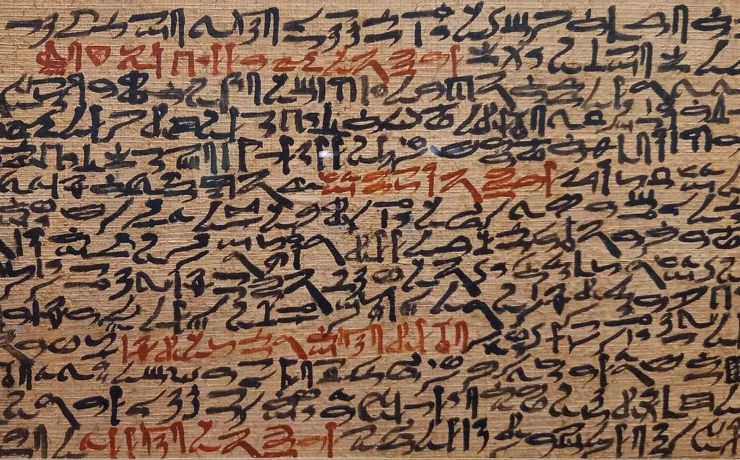
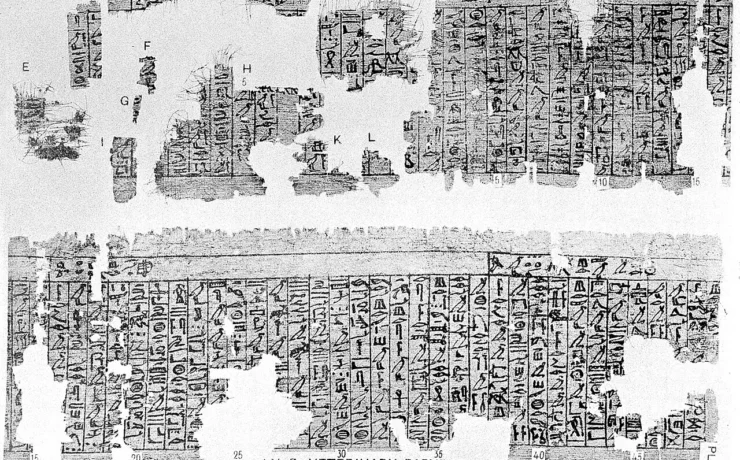
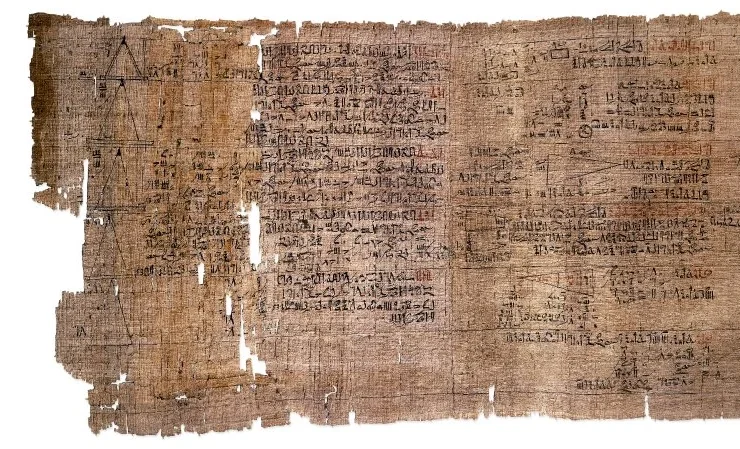
What is Spell 110 in the Egyptian Book of the Dead? It is the composition traditionally associated with the Field of Reeds and Field of Offerings, a hoped-for realm of waterways, grain and renewal after death. In the British Museum’s description of the Papyrus of Ani, its illustration includes boats, offerings, reaping and ploughing. The spell represents ancient belief, not a real geographical location.
One of the most striking images in ancient Egyptian funerary manuscripts is not a monster, a court or a dangerous gate. It is a landscape of canals and cultivated fields where the deceased can move by boat, harvest grain, encounter gods and receive nourishment. This is the realm commonly called the Field of Reeds or Field of Offerings, associated with Spell 110 of the Book of the Dead. It formed part of a hoped-for continued existence after death, and it is especially vivid in the Papyrus of Ani.
The scene is often described online as an “Egyptian heaven.” That phrase can introduce the topic, but it hides the key evidence. The fields are described in texts and painted on surviving papyri. Their canals, harvests and divine encounters were religious images, not a map of a physically discovered region. This guide reads the landscape as ancient literature and visual evidence, compares its themes with life beside the Nile, and explains what a consulted historical Arabic edition adds to the comparison.
Spell 110 at a glance
Textual tradition: the ancient Egyptian Book of the Dead, usually called the Book of Coming Forth by Day in translation. Modern spell number: 110. Focus: a blessed agricultural region, food and drink, divine access, movement and the ability to continue existing. Important visual source: the Papyrus of Ani, a Nineteenth Dynasty funerary manuscript at the British Museum.
The uploaded Arabic work introduces chapter 110 on PDF page 109. Its account includes the Field of Peace or Offerings, access to water and food, and the hope of enjoying life-like capacities in the domain beyond death. UCL Digital Egypt identifies chapter 110 as the composition of the Fields of Hetep; the chapter numbers themselves were assigned in modern editions. Accordingly, “Spell 110” names a scholarly reference, not a numbered chapter written by Ani at the head of his original painting.
What was the Field of Reeds?
For Egyptians whose lives depended on farmland, the greatest imagined blessing could include many of the things that gave earthly life meaning: irrigated land, reliable grain, protection from hunger, usable waterways and participation in divine order. The Field of Reeds appears in a ritual setting where the deceased seeks enduring life and security. It is not merely a picturesque background painted to fill the scroll.
The English expressions “Field of Reeds,” “Field of Rushes,” “Field of Offerings” and “Field of Hotep” are often used near each other. They are not always interchangeable translations of exactly one ancient place-name. Individual texts and illustrations can refer to distinct but related fields, waterways and offering landscapes. A translator’s preference must be traced to a specific composition instead of being treated as a universal map legend.
The realm is also not a synonym for every Egyptian idea of the world beyond death. Solar journeys, the kingdom of Osiris, ritual thresholds and the fate of the heart occur in other compositions and sometimes overlap. Egyptian afterlife literature developed over long periods, and its images need not fit together as a single modern fantasy universe with one authoritative geography.
What does the Papyrus of Ani actually show?
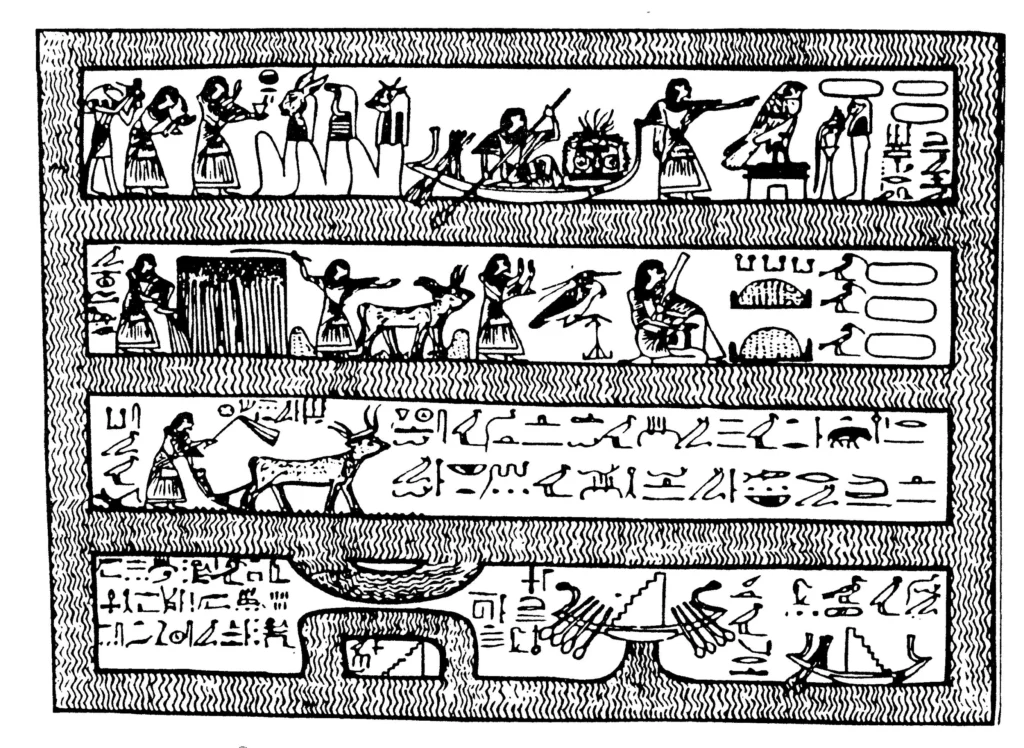
In the commonly reproduced vignette, Ani appears in several related scenes within a marshlike arrangement of fields and water. Figures worship divine beings, travel by boat and work the land. The painted spaces are divided into rectangular or channel-like zones. These are organised sacred images, not a perspective view of a town that can be located today.
A reproduction of this part of Ani’s papyrus is catalogued on Wikimedia Commons under “Bookofthedead-fieldofreeds.jpg”. The British Museum’s own record is more important for original-object identification, while historical nineteenth-century facsimiles remain useful for understanding how early scholars printed the scene. Each reproduction must be labelled honestly so that a modern engraving is not passed off as a color photograph taken directly from the ancient manuscript.
The location of the scene within a funerary manuscript matters. It is not an illustration from an agricultural account book or a Nile survey. Ani is shown accomplishing the activities that the ritual text asks to make available after death. The desired outcome is not just a beautiful landscape; it is successful participation in a protected world.
How to read the water, islands and canals
Water is both familiar and symbolic. Egyptian agriculture required control of river inundation, canals and land boundaries. In a funerary painting, water also structures access, separates locations and allows boat travel. The fields in Spell 110 are therefore legible to an Egyptian viewer without being a literal copy of a known section of the Nile Valley.
When looking at the image, begin with the borders and channels. Identify which spaces contain figures, which are filled by water and which hold crops or equipment. Then trace the positions of boats and offering actions. The same owner may appear more than once. That repetition is a normal visual method for representing different ritual activities, not evidence of several identical people living in one place.
The scene’s schematic shape is an artistic choice. Egyptian compositions often arrange scenes to show what is important rather than how an aerial photograph would look. A canal drawn straight or a rectangular field bordered by blue is a sign within the ritual language of the papyrus. Reconstructing exact lengths, compass bearings or a GPS itinerary from these motifs would exceed the evidence.
Why does the dead person work in an ideal paradise?
The presence of farming surprises readers who assume that the best possible afterlife must mean never working again. But cultivated land could signal prosperity, access to food, stable order and the continuation of useful human activity. In a society shaped by agriculture, the ability to harvest could itself represent abundance rather than punishment.
It is also possible to distinguish idealised productive activity from the question of who performed obligatory labour. Other burial traditions include small servant figures commonly called shabtis, which could answer a call to work on behalf of a deceased person. A shabti and a Field of Reeds image are different kinds of objects and evidence. Their relationship belongs to a wider discussion of labour after death, not an assumption that every Spell 110 picture shows shabtis.
The strongest reading keeps the ancient context in view: labor, status, food security and ritual effectiveness were interconnected. The deceased sought the right to participate in a perfected setting. That can be both alien to a modern reader and immediately recognisable to anyone who has depended on land and harvests.
Grain, reaping and ploughing: a closer look
Farm work in the imagery is not an accidental survival from a daily-life painting. Grain can be harvested, separated, stored and eventually offered or consumed. The recurrent sequence of agricultural actions gives material form to the promise of nourishment. In certain pictures, the deceased carries tools or stands beside crops; other images show a boat moving toward divine recipients.
The British Museum’s educational material on reading funerary papyri discusses a different manuscript, the Book of the Dead of Nakht, whose version of Spell 110 shows the owner pulling flax, reaping and ploughing. That is useful comparative evidence, but Nakht must not be silently relabelled as Ani. Likewise, a composition involving grain cannot automatically be used to reconstruct the exact crops and yields of any historical farm.
For students, the productive comparison is between the real material culture of irrigation and the idealised image. Real Egyptian farmers faced changes in flood height, taxes, labour obligations and uneven harvests. The sacred fields offer continued access to prosperity rather than a detailed report of those conditions.
Boats and movement through the blessed fields
Boats are a practical necessity in a river world and a major symbolic form in Egyptian religion. In the Field of Reeds imagery, vessels and waterways establish movement between places of offering and divine encounter. Boat scenes need to be read according to the specific characters and names present; not every Egyptian sacred boat is the solar barque of Ra.
The British Museum’s account of Spell 110 in Nakht’s papyrus identifies travel across the Lake of Offerings and a vessel connected with Wennefer, a name of Osiris. Related scene types can illuminate Ani’s composition while preserving differences between owners. The first task is always to identify which original papyrus is being discussed.
Movement matters because one of the threats addressed by funerary spells is confinement. Continuing life involves access to spaces, food, air, water and gods. The power to go and come is part of the promise, and a navigable landscape visualises that agency far more clearly than an abstract statement of immortality.
Gods in the Field of Reeds: what their presence signifies
Divine figures appear as the recipients of worship and as participants in a blessed setting. The deceased may approach, offer to or stand near gods of the underworld. Their identities are not always recoverable from appearance alone because Egyptian deities could share crowns, animal forms or attributes. The nearby names and phrases in the manuscript are essential.
Osiris is particularly relevant because the hoped-for continuation of life could be expressed through his authority among the dead. Yet the agricultural field is not simply a picture of Osiris’s biography, and every waterway should not be made into the river of one modern mythic retelling. The image belongs to a network of religious relationships rather than to one familiar narrative.
The presence of divine witnesses also changes how we understand abundance. Food and land are not portrayed as fully independent material rewards. Their availability depends on rightful access, sacred order and successful performance of the knowledge and declarations contained elsewhere in the funerary tradition.
Field of Reeds versus Hall of Judgment
The Hall of Judgment and the Field of Reeds are often blended into one sequence in modern summaries: the person passes a heart test, then enters a perfect farming paradise. This is a helpful simplification only if it is immediately qualified. Ancient manuscripts do not all assemble the same texts in one unchanging order, and imagery does not always follow modern story logic.
The judgment picture focuses on the heart, Maat, Anubis, Thoth, divine witnesses and admission to Osiris. Spell 110 focuses on movement, cultivated land, offerings and survival. Both are aspects of hoped-for afterlife success, but they answer different questions: How might a person be justified before gods? What could continuing existence involve?
Kemet Vault’s illustrated Papyrus of Ani guide examines the actual owner, the weighing scene and the museum frame references. This page is deliberately narrower: it treats one specific sacred landscape and the symbolism of Spell 110 rather than repeating the entire judgment story.
Is the Field of Reeds the same as the Duat?
The term Duat describes a realm involved in Egyptian conceptions of the beyond, but reducing every described space to one geographical zone can conceal distinctions. The Field of Reeds is often discussed within wider underworld beliefs. The precise relationship among spaces changes with corpus, period and the terminology used by each editor.
A modern map may draw the fields as one province of the underworld and place various gates or lakes around it. Such graphics can help students organise concepts if labelled as interpretive reconstructions. They should not be presented as maps recovered from a real cave system or a single ancient master chart.
The uploaded Arabic text is particularly instructive here. Its wording for chapter 110 evokes the hoped-for peace, provisions and activities of the deceased, while other chapters focus on tests, divine names or transformations. A faithful analysis does not force these distinct textual aims into one linear novel.
Why Spell 110 is more useful than a generic “Egyptian heaven” article
The modern word “heaven” carries theological assumptions from many later traditions. It can suggest a uniform disembodied realm, a moral reward without activity or an everlasting escape from nature. The Egyptian farming fields instead place bodies, movement, work, food and sacred water at the centre of an ideal existence.
The strongest explanatory question is therefore not whether the ancient Egyptians believed in “heaven” in exactly our sense. It is what a decorated funerary papyrus hoped to secure for its owner and why an agricultural landscape was effective imagery for that hope. This approach is both historically more accurate and better suited to comparing real archaeological sources.
A later scholar can legitimately make cautious comparisons between ancient traditions. However, direct claims that the Field of Reeds “became” a particular later paradise or supplied a verbatim blueprint for another religion need chronological and textual evidence far stronger than similarity in common motifs.
Spell 110 and the changing Book of the Dead tradition
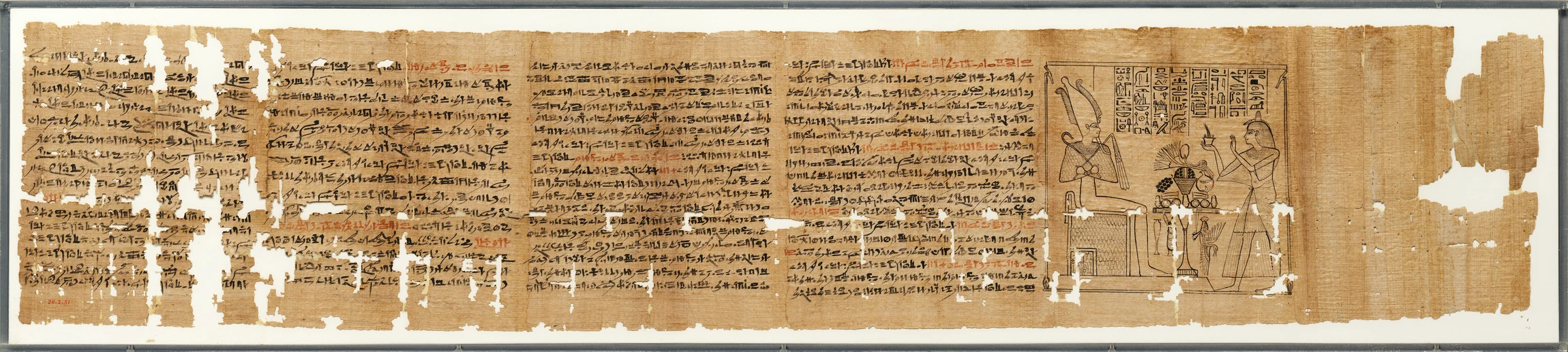
The Book of the Dead is a modern label for a corpus of roughly two hundred compositions identified through modern numbering. UCL Digital Egypt explains that Richard Lepsius and later scholars developed the chapter system through editions of different manuscripts, and that the ancient order was not fixed across all surviving versions.
This matters for Spell 110. It is useful to cite a number for navigating scholarship, but a student must also ask who owned the papyrus, when it was written and where an illustration appears. A modern handbook may move a famous Field of Reeds plate into a discussion of one topic, while the historical scroll situates it among particular prayers and images.
The Papyrus of Ani is a prominent New Kingdom witness, not a universal master manuscript. Comparisons with papyri belonging to Nakht or other individuals illuminate choices and continuities without making those owners interchangeable. A scene’s visual resemblance is an invitation to research, not permission to erase its provenance.
The Arabic Book of the Dead edition: what its chapter 110 contributes
In the scanned Arabic source supplied for this project, chapter 110 begins on PDF page 109 with a small illustration of Ani and his wife near an offering scene, followed by a passage concerning the fields and the desire for food, drink and effective movement. The treatment continues through page 116. This provides a useful Arabic-language route into the ideas of agricultural abundance and well-being in a supernatural setting.
The edition is a modern translation and commentary associated with the scholarship of E. A. Wallis Budge. Its printed page numbers and explanatory headings are not original ancient inscriptions. Reading it alongside the British Museum catalogue and UCL material helps distinguish what the text describes, what the translator inferred and what later Egyptology has revised.
The book also contains a manuscript-specific index on PDF pages 171–175 and a broader spell index on pages 176–188. For any article claiming that a passage is part of Ani, the former must control the identification. Neither index alone establishes the precise reading of every damaged hieroglyphic line.
Visual guide: what to identify in a Field of Reeds image
Owner: read the person’s name and museum record before making a claim about which papyrus is shown. Water: separate waterways from agricultural rectangles. Actions: identify boating, harvesting, ploughing or offering. Gods: determine whether figures are labelled and which divine activity is represented. Registers: distinguish multiple scenes in one composition from a single continuous camera-like moment.
Source type: is the picture a colour photograph of the original artifact, a nineteenth-century facsimile, a modern line drawing or an imaginative reconstruction? Every one can be useful for a different purpose, but none should be mislabeled. If only the reproduction is available, say so.
A good exercise is to compare the arrangement of water and cultivated land with an ordinary Nile agricultural scene. Identify both the shared visual vocabulary and the specifically religious material, especially divine figures, offerings and the presence of the named deceased. The difference is what makes the funerary picture historical evidence for belief rather than a farm survey.
An evidence table: what can we say with confidence?
A source-led account should distinguish the observed artifact from our interpretation. This short table separates those categories and prevents a familiar mythological image from being repeated as archaeological fact.
| Question | Supported answer | Source / limitation |
|---|---|---|
| Did Egyptians illustrate ideal fields after death? | Yes, funerary papyri preserve such scenes. | Spell 110 imagery and museum descriptions. |
| Did the deceased work the land in these images? | Several surviving versions show agricultural activities. | A depicted religious ideal, not a work diary. |
| Were these pictures based on a physical map? | No material evidence demonstrates a real supernatural location. | Interpret as religious and symbolic geography. |
| Is every Spell 110 papyrus identical? | No. Owners, texts, layout and images can vary. | Compare records for each named manuscript. |
| Is Spell 110 the same as the weighing of the heart? | No. They are distinct compositions and images. | Spell 110 versus Spell 125. |
Mistakes to avoid when researching the Field of Reeds
One error is to turn the phrase “Field of Reeds” into a promise of a particular undiscovered location in Egypt. There is no accepted physical site for the supernatural fields. Another is to treat copied artwork as a contemporary excavation photograph. The image of farmland may come through a nineteenth-century print, and the provenance of that print must be stated.
A second recurring mistake is to make the Book of the Dead into a single canonical work, with Ani as its author. Ani was the owner of one manuscript. A modern editor could collect and arrange material differently, but that does not create an ancient authored book in the modern sense.
Finally, beware summaries that derive a moral ranking of all ancient Egyptians from one scene. Funerary manuscripts often reflect elite resources and choices. They show desired outcomes, not a survey measuring what every farmer, priest and craftsperson actually believed.
Questions readers ask
What does Spell 110 show in the Papyrus of Ani? Ani appears among canals and cultivated fields, making offerings, travelling by boat and taking part in agricultural activities such as reaping and ploughing. The British Museum’s object interpretation describes the scene. Another original Spell 110 manuscript, the Greenfield Papyrus, confirms that the composition appears in distinct owners’ papyri.
What is the Field of Reeds in ancient Egyptian religion? It is a blessed landscape described and depicted in funerary texts, associated with ongoing nourishment, water, cultivation and divine access after death.
Which Book of the Dead spell describes it? The famous illustrated composition is numbered Spell 110 in modern editions. Spell numbering was assigned by Egyptologists and is not an ancient chapter system.
Was the Field of Reeds a place on the River Nile? The imagery draws upon river agriculture, but it represents a supernatural landscape. There is no archaeological evidence for a physical Field of Reeds that can be visited.
Why did the deceased farm there? Cultivation signified provisions, productivity and continued meaningful existence. The ideal was expressed through familiar forms of Egyptian agricultural life.
Is the Field of Reeds identical in every papyrus? No. The details and arrangement of scenes vary among manuscripts, and research should identify each owner and artifact before comparing them.
Sources and image credits
Source edition for this study: Kitab al-Mawta al-Firawni, the uploaded Arabic translation based on material from the Papyrus of Ani, especially PDF pp.109–116 for chapter 110 and pp.171–175 for the manuscript-specific spell inventory. Its Arabic wording is treated as a historical translation, not a modern definitive transcription of the hieroglyphs.
Independent controls: UCL Digital Egypt, Book of the Dead chapters in numerical order (identifies chapter 110 and full-height field illustrations); British Museum, Reading a Papyrus education notes (comparative description of Nakht’s chapter 110); British Museum object description through Google Arts & Culture for Ani’s fields vignette.
Featured image: a historical 1895 representation associated with Ani’s fields, recorded as Duat.jpg on Wikimedia Commons and marked as public domain. It is a reproduction from a historic publication, not a modern photograph of the original papyrus and not a newly generated illustration. For the manuscript-wide context, see The Papyrus of Ani: Illustrated Guide. For the distinct genre-wide context, see Ancient Egyptian Afterlife Books and The Egyptian Book of the Dead.