What are the main types of ancient Egyptian coffins? Burial containers included rectangular wooden coffins, human-shaped anthropoid forms and feather-patterned rishi examples. Their use changed across periods, places and social circumstances rather than following one universal sequence. This article compares the forms and chronology, leaving a detailed explanation of painted protective motifs and inscriptions to a companion source guide.
Ancient Egyptian coffins evolved far beyond the familiar golden human face. From early wooden boxes to Middle Kingdom Coffin Texts, feathered rishi designs and elaborately painted anthropoid containers, burial furniture expressed changing hopes for the afterlife, family resources and specialist craftsmanship. This museum-based study uses actual photographed Metropolitan Museum objects and archaeological references to show what changed, and what cannot be inferred from one beautiful object.
Before golden masks: the coffin as an archaeological object
It is easy to imagine an ancient Egyptian coffin as a gold-colored human face. That expectation comes from a narrow group of famous royal objects, especially those associated with the New Kingdom. Over more than three millennia, however, Egyptians used burials ranging from simple arrangements in sand and wood to decorated rectangular boxes, human-shaped coffins, stone sarcophagi and several nested protective containers. These forms changed with funerary theology, workshop techniques, cost and social setting. Not every corpse had a coffin, and not every coffin was painted. Some were repaired or reused, while others were commissioned as elaborate statements of wealth. In museum galleries, the coffin deserves to be read as a material document: timber species, painted eyes, wood joints, ownership names and the placement of images can all tell us about the person and the people who prepared the burial. A coffin is not simply an attractive shell placed around a mummy. Its outside and inside surfaces could help create a protected home for the dead, convey prayers and connect the deceased to gods. The meaning of those choices shifted with the period and the household’s resources.
Early graves and Old Kingdom rectangular containers
The earliest Egyptian burial practices were highly varied. A body in a pit lined with matting or other organic materials is not the same thing as a coffin manufactured from timber. The expense of cutting, joining and transporting wood made even a simple rectangular box a meaningful investment. In Old Kingdom elite funerary contexts, rectangular coffins developed alongside stone burial chambers and architectural arrangements intended to support offerings. The American Research Center in Egypt explains that coffin decoration began relatively simply and could include formulaic inscriptions, pairs of wedjat eyes and false-door motifs. Such symbols were not mere ornaments: the eyes were associated with the deceased’s connection to the outside and protective powers, while false-door imagery could help structure access to offerings. The development was not uniform across Egypt. Different cemeteries and social classes preserve different stages, and historians should not identify a box coffin as “Old Kingdom” solely by its silhouette. Material, stratigraphy, inscriptions, workshop style and archaeological context are needed to establish date.
The wedjat eyes: looking out from a sealed box
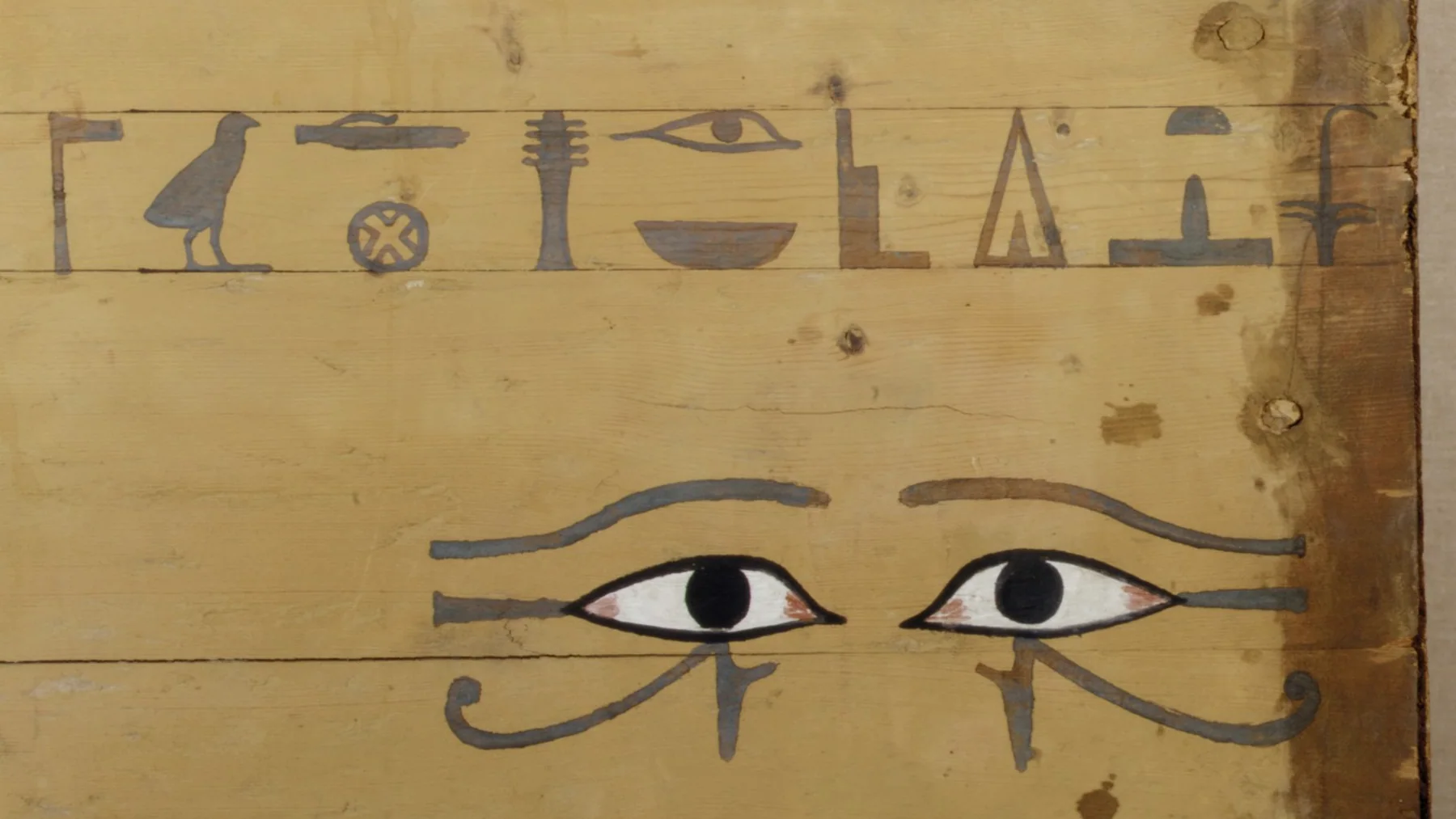
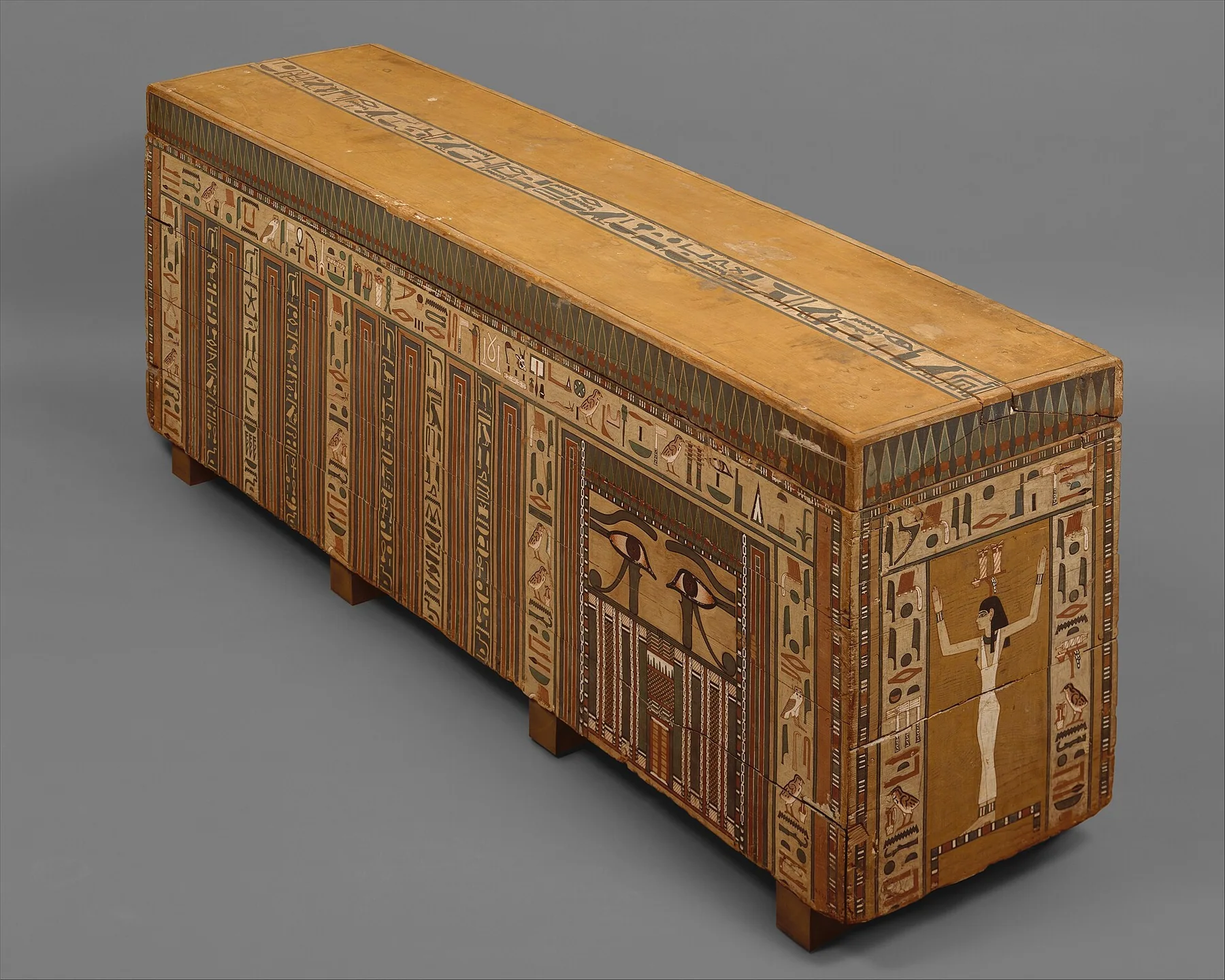
One distinctive feature on Middle Kingdom coffins is a pair of stylized wedjat eyes, often painted on the side or head end of a rectangular box. These images were meaningful in the religious symbolism of bodily integrity and protection. Their location could correspond to the deceased’s orientation and imagined ability to see beyond the container. Yet not every coffin bears them, and their absence does not prove the owner held a different religion. The Met’s wooden coffin of Wah provides a real photographed example. Wah lived in the early Twelfth Dynasty, and his tomb was excavated in the Theban area. The image documented below specifically shows part of the coffin with painted eyes, rather than a fabricated diagram of the object. Studying a genuine museum entry anchors larger interpretation to one person, date and object. It also reminds us that ancient artisans worked within conventions but did not mass-produce every coffin in identical detail. The positioning, finish and combination with other decoration changed across phases and workshops.
Coffin Texts and the transformation of funerary writing
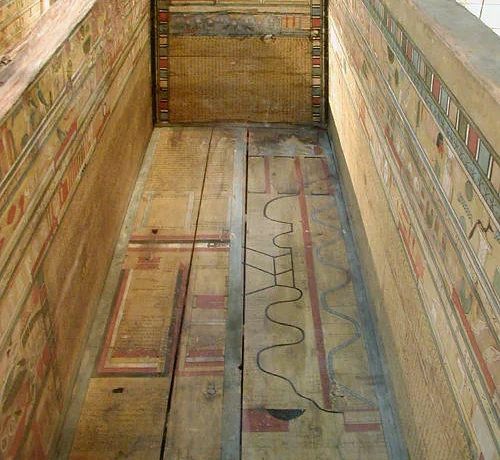
The Middle Kingdom is especially associated with the Coffin Texts, a diverse body of funerary spells inscribed most famously on coffin interiors. Some drew on earlier royal Pyramid Text traditions, while others expanded and reorganized access to religious knowledge. The inscriptions do not constitute a single universally fixed book, and not every box coffin carried the same collection. Their value was performative as well as literary: words, names and representations could help transform and protect the dead within an imagined afterlife. The study of Coffin Texts requires attention to the exact object, because a spell’s wording can vary by manuscript and archaeological origin. What a modern translation calls “spell 1” or “spell 75” comes from scholarly numbering and classification, not from a single ancient edition printed everywhere. The increasing inclusion of private elite names and texts has sometimes been described as a democratization of the afterlife. That broad phrase is debated because commissioning inscribed coffins still demanded wealth, status and access to specialists. The surviving record tells us most about people whose families could pay for funerary material.
Middle Kingdom palace façades and decorated surfaces
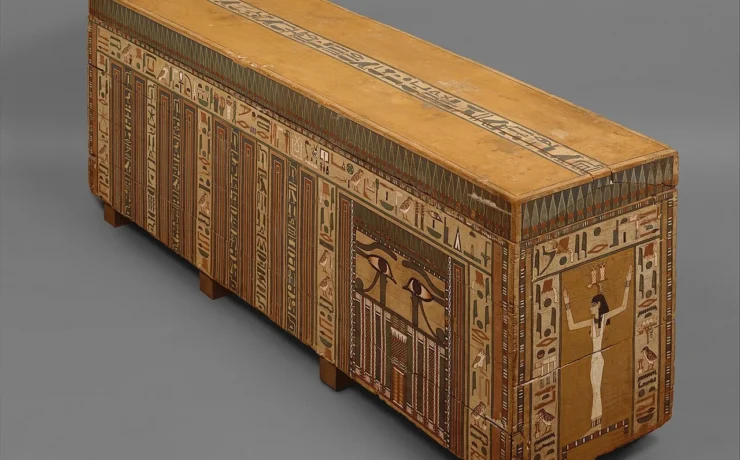
Coffin design changed during the Middle Kingdom in ways that archaeologists can trace through painted architecture. UCL’s Digital Egypt notes that during the Twelfth Dynasty some coffin exteriors were increasingly covered with a palace-façade pattern, which derives from much older architectural motifs. The painted box could make a conceptual house or monumental space around the dead. As the visual emphasis shifted, earlier interior decorations did not simply remain unchanged. At times, inscriptions spread to new surfaces or became more formulaic. The Met’s Thirteenth Dynasty coffin of Khnumnakht, also recorded as Nakhtkhnum in Commons metadata, offers a genuine example of a rectangular painted wood coffin. It is important not to confuse the man with every other similarly named Egyptian individual. Object accession numbers help separate identities. In museum study, painted palace façades and false-door symbols are better understood by looking closely at the wood and surviving pigment than by assigning a single symbolic sentence to the whole decoration. A pattern could be protective, prestigious and related to architectural memory at the same time.
The rise of anthropoid coffins: when the container became a person
During the later Middle Kingdom, human-shaped or anthropoid coffins appeared and grew in importance. UCL documents that in the Twelfth Dynasty these forms could be nested inside outer rectangular cases. The familiar human-shaped coffin was thus often only one component of a burial arrangement rather than the whole system. An anthropoid form presented the deceased in a transformed condition, increasingly associated with Osiris and the hope of restoration after death. The human face on a coffin should not automatically be interpreted as a portrait with modern forensic accuracy. Masks and idealized features operate through ritual conventions. The owner could be identified more securely by inscriptions than by the shape of the nose or eyes. Coffin-making also involved real engineering problems: creating a hollow wooden form, joining halves, stabilizing a lid and aligning painting with curved surfaces. Variation in wood quality, size and labor cost affected what different households could commission. The emergence of anthropoid coffins therefore reflects theology and material craftsmanship together.
Rishi coffins: feathers and protective imagery
In the Second Intermediate Period and around the beginning of the New Kingdom, some human-shaped coffins carried distinctive feather decoration across the torso. The term rishi, taken from Arabic for feathered, is used by Egyptologists to describe this style. It did not designate one royal dynasty or a universal national burial law. Feather imagery may evoke enveloping or protective divine wings, though the visual program varies among examples. UCL notes that these anthropoid forms were not always combined with outer box coffins in the same way as earlier sets. A museum should identify the actual date of the feathered object rather than present every rishi coffin as identical to a later New Kingdom royal burial. Researchers compare feather orientation, pigments, materials and contexts when establishing workshop traditions. If coffin layers survive without the original mummy, the object still offers evidence of funerary technology but less direct information about bodily preparation. Rishi coffins illustrate how religious ideas can be expressed through changing formal conventions, not only through written passages.
New Kingdom nesting and the temptation to generalize Tutankhamun
By the New Kingdom, wealthy and royal funerary assemblages could include nested anthropoid coffins and a surrounding stone sarcophagus. Tutankhamun’s burial is the famous example, with three nested human-shaped coffins inside a rectangular stone container. It is a spectacular case, not the standard burial package of every inhabitant. In less wealthy contexts, materials and burial furniture were much simpler. The New Kingdom also saw increasingly rich combinations of protective deities, bands of inscriptions and surfaces colored to evoke divine transformation. Tomb walls and papyri could contain additional funerary compositions, whose selections differed between owners. In some periods an image or passage that later appeared prominently on a coffin had earlier been placed elsewhere in the tomb. Religious meaning moved with the medium. Detailed archaeological publications of individual burials are necessary to describe actual layers; images of golden funerary equipment may otherwise suggest that outer, middle and inner coffins were universally made of solid gold. Kemet Vault’s documented Tutankhamun mask study explores one royal object without turning it into a template for every Egyptian death.
The Third Intermediate Period: the coffin became a painted theological world
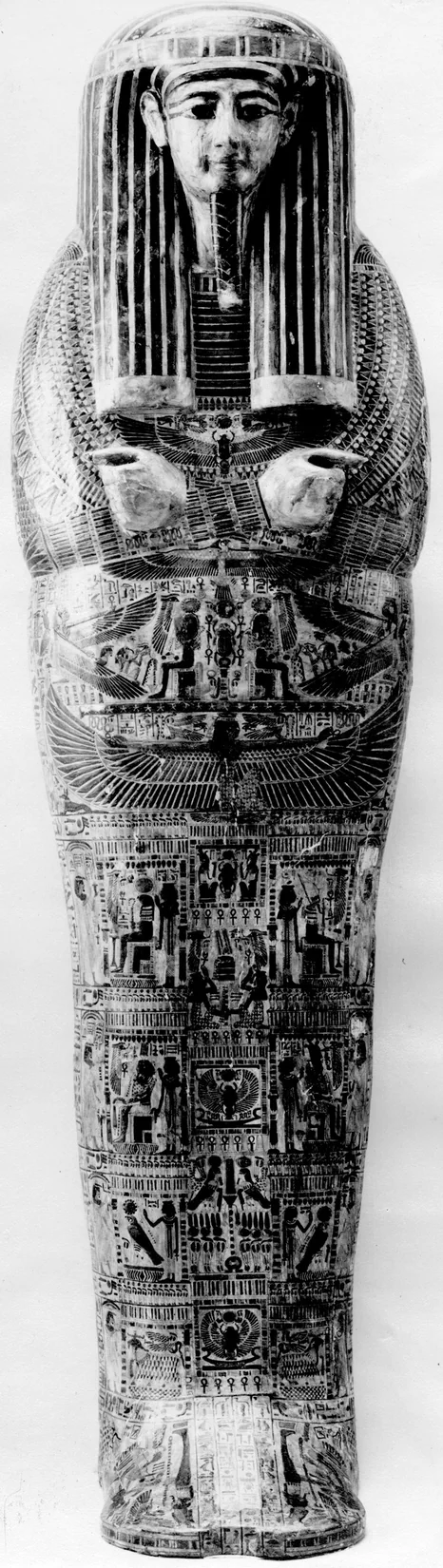
By the Third Intermediate Period, some coffins carried dense religious imagery that might previously have been displayed across tomb walls, chapels or funerary papyri. Human-shaped surfaces were densely organized around protective figures, mythological scenes, names and sacred emblems. A coffin could become a complex visual map for the deceased’s passage, but reading such a program requires precision. An image of Nut, Osiris or a solar deity does not by itself prove the existence of a fixed official design. Regional and chronological workshops varied. The Met’s real wooden inner coffin of Menkheperre, dated to Dynasty 21, is particularly instructive because the museum notes that it was reused or usurped from an owner named Ahmose. This reveals how ancient objects could change owners and inscriptions. Reuse complicates any attempt to infer the original intended recipient from the latest visible name alone. It also shows that access to funerary materials was shaped by availability and politics as well as personal belief. The physical object is a better guide than a generalized online collage of ornate coffins.
Late Period, stone sarcophagi and long-term diversity
Later Egyptian funerary traditions continued to develop during the Late Period and under subsequent rulers. Stone sarcophagi, decorated coffins and cartonnage cases reflect changing resources, religious imagery and workshop practices. A sarcophagus is usually understood more narrowly as a stone burial container, though museum catalogues sometimes use the term in broader ways. The distinction matters when comparing weight, production and reuse. A stone sarcophagus demanded quarrying and transportation that differed profoundly from making a painted wooden box. Cartonnage often involved textile or papyrus layers shaped with plaster, producing a different structure again. No single line of development simply replaced every earlier form: rectangular and anthropoid ideas could coexist, and older motifs were adapted. The afterlife texts and protective emblems changed depending on date, regional traditions and the identities of patrons. If a visitor sees a painted face, wings and rows of gods, the correct first questions are when and where the object was made, whose name appears and what accession record documents it. Those questions protect against treating objects from distant centuries as the same thing.
How museums identify a real coffin
An accurate coffin catalogue typically provides accession number, period, material, dimensions, provenance and a history of acquisition or excavation. These are not bureaucratic details to skip on the way to a beautiful photograph. They allow scholars to check whether a box from the Twelfth Dynasty really belongs to the Middle Kingdom, whether a coffin was reused, and whether a painted name has been read correctly. Museum photos can also show a feature absent from familiar frontal views, such as an eye panel on the side or inscriptions under the lid. Conservators analyze paint, adhesives and wood while deciding how to stabilize fragile surfaces. A responsible website makes the difference between original, restored and reconstructed elements visible. The three real Metropolitan Museum photographs included in this article depict different objects from different periods; they are labeled independently. For related funerary practices read Kemet Vault’s mummification process and Egyptian afterlife books and their manuscript evidence. Neither ritual text nor embalming can be fully inferred from coffin shape alone.
Timeline and comparison table
| Historical period | Important coffin characteristics |
|---|---|
| Old Kingdom | Rectangular containers; offering phrases, eyes and false-door devices emerged in elite contexts |
| Middle Kingdom | Decorated boxes; Coffin Texts; palace façade patterns; early anthropoid coffins |
| Second Intermediate Period | Some feather-decorated rishi anthropoid coffins |
| New Kingdom | Rich nested burial arrangements among elites, especially royal burials |
| Third Intermediate Period | Dense protective scenes and texts on anthropoid containers |
| Late and later periods | Diverse wooden, cartonnage and stone forms; continuing reuse of protective motifs |
Sources, object numbers and permissions
ARCE Development of the Egyptian Coffin; UCL Digital Egypt, Late Middle Kingdom coffins; Metropolitan Museum Coffin of Wah 20.3.202; Global Egyptian Museum coffin glossary. The three museum photographs are separately identified accessioned objects provided through the Met’s CC0 Open Access initiative. Descriptions are limited to documented object identities, dates and evidence. Review: October 2026.
Frequently asked questions
When did anthropoid coffins appear in Egypt?
Examples appeared by the Middle Kingdom, while rectangular boxes continued to be used. Regional and chronological patterns were varied.
Were all Egyptian coffins made of gold?
No. Most known examples used wood, stone or other materials, and many graves lacked an elaborate coffin entirely.
Why did coffins show eyes?
Wedjat eye imagery could help symbolize protection and the deceased’s ability to see or engage with offerings beyond the coffin.