What is the ancient Egyptian Book of Two Ways? It is a group of Middle Kingdom funerary compositions preserved on a limited number of coffins from Dayr al-Barsha (Deir el-Bersha) in Middle Egypt. Some versions show winding paths and watercourses, traditionally interpreted as routes through a dangerous supernatural landscape. The original material belongs to the larger Coffin Texts tradition, not to a bound book with a known ancient title. Its modern nickname comes from scholars’ interpretation of the two pathways, and its contents are more complex than a literal travel map.
This study examines the actual coffins, the ritual function of the text, the evidence from Gua’s coffin in the British Museum and the earlier fragments belonging to a woman named Ankh, recovered by KU Leuven archaeologists. It is distinct from Kemet Vault’s comparative survey of afterlife literature and the specific Pyramid Texts of Unas. Original artifacts, excavation reports and scholarly uncertainty lead the account.
Dayr al-Barsha: the Middle Egyptian necropolis behind the texts
Dayr al-Barsha was an important burial area in Middle Egypt during the Middle Kingdom, connected to provincial elites and governors. The Book of Two Ways is recorded on a small group of coffins from the necropolis, not from every tomb across the Nile Valley. This concentrated geographic distribution matters. Text selection and decorative programmes were influenced by local funerary practice, workshop traditions, access to specialist scribes and the social setting of the deceased. The KU Leuven excavation announcement explicitly states that the book is attested only on coffins from this region, a qualification often missing from broad internet summaries. A tomb found at Dayr al-Barsha cannot be assumed to have the same decorations as another burial on the same hillside. Nor is the site a modern underground theme park with mapped passages. The compositions represent an Egyptian supernatural world associated with movement after death, but their origin lies in actual decorated wooden burial equipment.
What counts as a ‘book’ in a Middle Kingdom coffin?
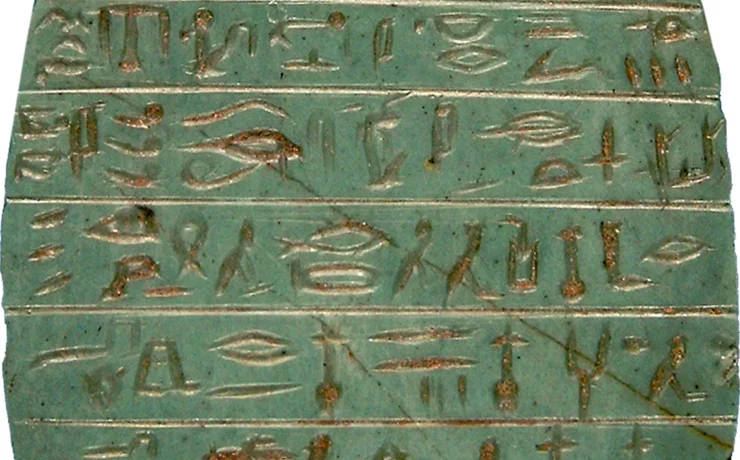
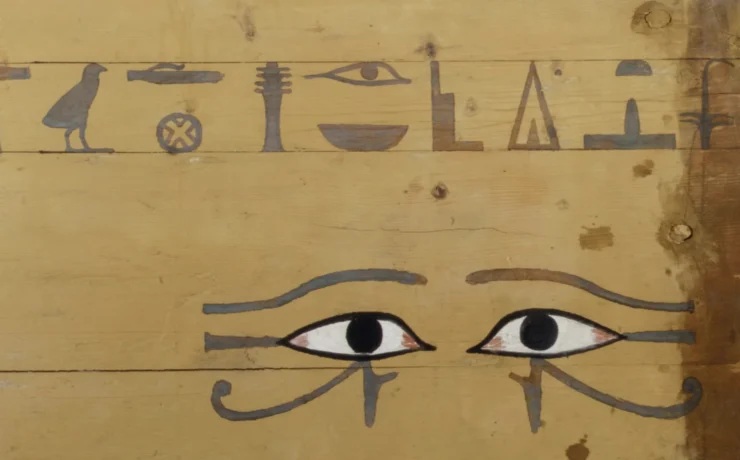
The English label Book of Two Ways sounds like the name of a bound volume, but the relevant texts were written directly onto coffin boards. Egyptian funerary literature was transmitted through many physical media, and a group of related passages might be selected, arranged and amended for a particular burial. The Coffin Texts name itself is a modern editorial category. The Global Egyptian Museum’s Coffin Texts overview describes how spells appeared on coffin sides and bottoms, as well as other funerary surfaces. For the Book of Two Ways, important versions use a map-like graphic arrangement alongside text; both parts have to be interpreted together. The surviving layout differs from a continuous paper road map. The expression ‘book’ can be useful if it means a literary or ritual composition, but not if it implies pages stitched together, numbered chapters printed for all buyers, or a single definitive manuscript. Different surviving coffins are different witnesses to a developing tradition.
Coffin floors and the arrangement of winding routes
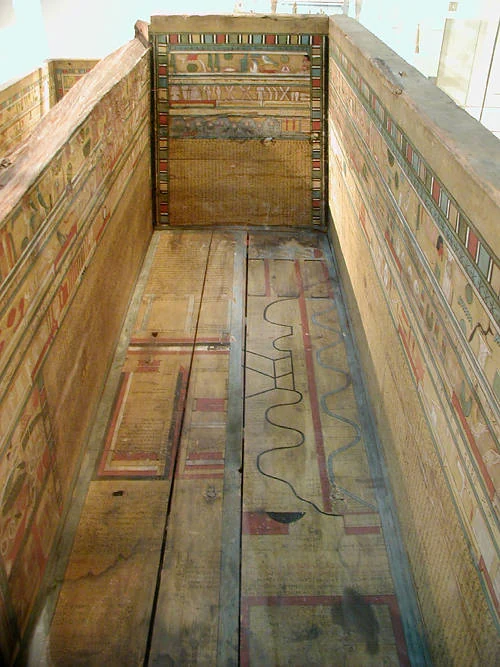
One striking version presents two routes, which scholars have interpreted as paths by land and water. The lines, signs, barriers and inscriptions form a spatial arrangement that resembles a map. The bottom of a coffin was a significant place for such imagery because it lay beneath the deceased, directly linking the represented journey with the burial space. The graphic design could suggest passages, boundaries and dangerous regions in the world of the gods. Yet it is impossible to reduce every text to a modern instruction like ‘turn left at the second gate’. Ritual words and complex imagery do not necessarily describe a continuous itinerary. Harco Willems and the Dayr al-Barsha researchers have warned that the label ‘underworld map’ overstates the role of the mapped portion. The actual composition also contains demons, gates, boats and highly obscure words. A well-grounded visitor guide therefore starts with the coffin’s photographed surface, not a simplified reconstruction resembling a tourist map of imaginary caves.
Gua’s coffin and the original Book of Two Ways image
The British Museum owns the Middle Kingdom outer coffin of Gua from Deir el-Bersha, registration 1899,0708.168, accession EA30839. The coffin is among the best documented objects associated with the Book of Two Ways. The museum’s institutional commentary explains that the inner surfaces contain maps of routes to the afterlife, along with columns of Coffin Texts, offerings and objects needed by the dead. The pictured original coffin fragment should not be confused with the surviving coffin of a different person simply because both are painted with sacred words. The first original documentary photograph below records part of Gua’s coffin floor and its winding netherworld design. The file is licensed for unrestricted reuse by the photographer via Wikimedia Commons, but its resolution is limited. Its value is therefore documentary identification rather than a promise of fine-grained epigraphic detail. Readers wanting exact words need a scholarly edition rather than guessing from the small image.
Ankh’s newly documented coffin and what the research actually found
A second important discovery was made in 2012, when the KU Leuven Dayr al-Barsha team reopened a shaft that George Reisner had first encountered in 1915. The archaeological record contained badly decayed coffin wood belonging to a woman named Ankh, related to a provincial governor called Ahanakht. Conservators reconstructed enough of the coffin bottom to identify parts of the Book of Two Ways. The project dates the source to the early Middle Kingdom, around 2040 BCE, and describes it as the earliest version published to date. The scholar Harco Willems discussed its passages in the Journal of Egyptian Archaeology, including portions of Coffin Text spells 1128 and 1130. Ankh’s fragments are not the same artifact as Gua’s coffin in London. Their importance lies in showing that this religious tradition existed early within the Middle Kingdom and had an editorial history across different coffins. The university’s project account is especially careful about what those fragments do and do not preserve.
Why the ‘oldest map of Hell’ headline is historically wrong
Popular stories about Ankh’s coffin called it the world’s oldest illustrated book or the oldest map of Hell. The excavation team explicitly rejected these claims. The preserved fragment does not contain the famous map itself, and the text is not a continuous tour guide through one modern notion of hell. The project explained that only one section of the wider Book of Two Ways can properly be called map-like, and even that section serves a religious purpose. A photograph of Gua’s more extensive coffin does not prove that Ankh’s broken floor panel preserved the same full illustration. This distinction is central to source criticism. A dramatic headline can be repeated thousands of times, but the excavation report remains the stronger evidence for the artifact’s content and condition. The KU Leuven official release gives the more modest, more important conclusion: an exceptionally early attestation of a funerary composition known from other Middle Kingdom coffin floors.
Rostau, Osiris and supernatural destinations
The landscape represented in some versions has been associated with Rostau, a realm connected with Osiris and the beyond. Texts and images evoke dangerous thresholds, divinities, movement and transformation after death. These are Egyptian religious ideas, not records of archaeological tunnels that can be located by a modern GPS survey. The context of Osiris is important because the dead person hoped for renewed and secure existence among divine powers. Yet the compositions are not necessarily arranged as a single narrative of punishment followed by reward. Some passages may preserve ritual themes less easily translated into modern prose. An interpretation that assigns each curved line one exact place on earth would require evidence the coffin cannot provide. Compare the Osiris research article for the longer development of the god’s cult, while keeping this study focused on how a particular Middle Kingdom corpus was painted, placed and transmitted on coffin boards.
Roads, waterways, barriers and ritual movement
Why did ancient people depict paths at all? One interpretation is that the deceased required knowledge of possible routes and obstacles in the supernatural world. Maps can be ways of expressing relationships between places, movements and powers even when they are not intended for physical travel. In the Book of Two Ways, the winding lines and adjoining text invite this kind of reading, but the original compositions contain more than diagrammatic navigation. The use of both water and land symbolism may reflect broader Egyptian cosmological concerns and a landscape where waterways were familiar features of daily life. Scholars should nevertheless resist assigning every squiggle the literal Nile’s course. The dangerous beings and gateways belong to a mythological setting, while the wooden coffin was a physical artifact made and decorated by craftspeople. This distinction separates religious intention from geography. It also encourages readers to ask how an elaborate design under the body affected the ritual experience of those responsible for preparing the burial.
How Coffin Text numbers relate to actual wooden boards
Egyptologists identify many Middle Kingdom compositions with Coffin Text spell numbers. These numbers allow variants from different artifacts to be compared, but they did not appear as a universal printed table of contents when a coffin was decorated. The Ankh fragment has been connected with spells conventionally numbered 1128 and 1130. Those identifications come from epigraphic reconstruction of decayed material, not from a photograph in which every sign is legible to the casual visitor. Later editions and new discoveries can change how fragment relationships are understood. A properly documented article should cite the particular board, burial, edition and passage rather than say that an object ‘contains all Coffin Texts’. The Global Egyptian Museum estimates a very large corpus, from which individual owners received selections. Gua’s decoration is therefore one witness among several, and the discovery of Ankh’s earlier fragments adds to textual history rather than replacing older museum objects. Words and their physical placement both matter when reconstructing the development of the genre.
A comparison object: the coffin of Nakhtkhnum
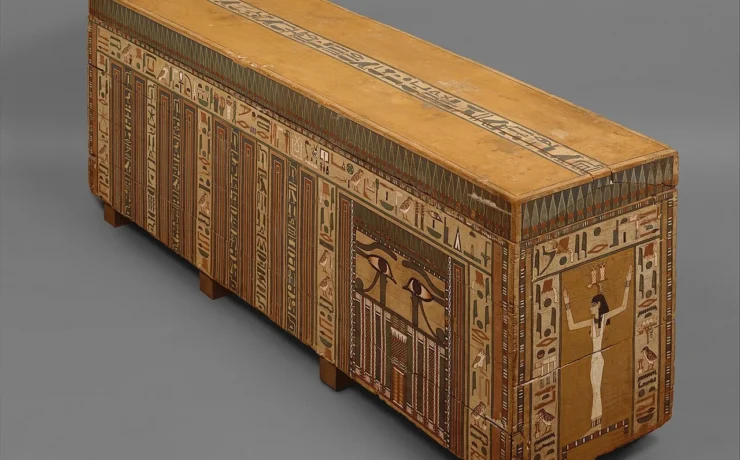
The second archival photograph in this article depicts a different Middle Kingdom coffin: Nakhtkhnum, now in the Metropolitan Museum of Art, accession 15.2.2a, b. It is dated to Dynasty 13, later than the early Middle Kingdom burials central to the first examples of the Book of Two Ways, and it does not belong to Gua or Ankh. The image demonstrates how rectangular wooden coffins could carry protective painting, inscriptions and elaborate panel arrangements. Its clear, high-resolution public-domain photography makes a valuable comparison with the Gua image’s smaller, older documentary view. Yet the comparison must be framed accurately: Nakhtkhnum’s coffin is not presented here as another surviving original map of the Book of Two Ways. The Met’s collection record gives the object’s material, date, provenance and accession. Distinguishing comparative artifact from direct source is fundamental if the page is to educate rather than decorate.

The craftsmen, scribes and the social setting of burial
Decorated coffins required the work of people able to prepare timber, join panels, apply pigment and produce complex funerary writing. Such equipment also depended on resources and the choices of elite families. The existence of increasingly extensive Coffin Texts on non-royal coffins has often been described as a broader distribution of funerary privileges. That observation does not mean every ordinary Egyptian could afford a painted map. Some burials leave few written traces; others preserve elaborate objects. The material record is shaped by wealth, access to skilled labour, geography, robbing, excavation and modern collecting. A coffin decorated with complex writing is evidence for a specific investment in the deceased, not a demographic statement about all of Egypt. The study of Egyptian coffin types gives the broader chronology of wooden boxes and anthropoid forms. This article instead asks how a particular religious arrangement on coffin floors worked within Middle Kingdom burials.
The relationship to the Pyramid Texts and later Book of the Dead
The Coffin Texts tradition follows and reshapes earlier royal religious utterances, some of which survive on the walls of Old Kingdom pyramids. The Book of Two Ways is a special composition within this Middle Kingdom landscape. Later works such as the Book of the Dead and the Amduat have their own chronology, media and internal structures. A shared concern with movement or protection after death does not mean that the Book of Two Ways was a chapter copied unchanged into every later papyrus. The Unas study examines stone wall inscriptions in a royal pyramid, and the Book of the Dead research guide examines later individual manuscripts. Together they show how Egyptian rituals were copied and recombined rather than superseded by neat editions. Students should first locate an individual text’s material support and owner, then ask how its phrases relate to earlier or later compositions.
How to recognize a responsible ‘map of the afterlife’ interpretation
Begin with the photographed coffin’s museum accession and place of discovery. Identify which portions show paths, writing, gates or offerings, and note which are damaged. For Gua, the British Museum EA30839 is a named original example. For Ankh, the KU Leuven report documents a fragmentary early source where the famous map section does not survive. A modern diagram simplifying the two routes may be useful for teaching, but it is not an original Middle Kingdom photograph. Avoid reading every line as an actual road or claiming that researchers have physically mapped the world of the dead. Check the dates, especially whether the statement concerns the first inscription of a composition, a particular copied coffin or a modern excavation year. The second image of Nakhtkhnum demonstrates comparative practice without pretending to be a Book of Two Ways source. Rigorous labels let a reader understand what is preserved and where scholarly reconstruction begins.
Questions about the Book of Two Ways
Is the Book of Two Ways the world’s oldest illustrated book?
No. KU Leuven’s excavation team specifically rejected claims that its 2012 find establishes the oldest illustrated book or an oldest map of Hell. The early coffin fragment does not preserve the famous map section.
Was the Book of Two Ways found on papyrus?
The best-known original witnesses discussed here were inscribed and painted on wooden coffins from Dayr al-Barsha. The modern term ‘book’ describes the composition, not a universally bound papyrus volume.
Who was Gua?
Gua was a Middle Kingdom individual whose coffin, now in the British Museum, contains an important depiction associated with the Book of Two Ways. The photographed object must be distinguished from Ankh’s early fragmentary coffin recovered in 2012.
Sources, images and disputed interpretations
KU Leuven Dayr al-Barsha, Ankh’s coffin and disputed oldest-book headlines; KU Leuven original excavation press release; Harco Willems, scholarly study of Coffin Text spells 1128 and 1130; British Museum’s Gua coffin description; Global Egyptian Museum Coffin Texts overview; Met’s Nakhtkhnum coffin as a differently provenanced comparison. Photographs reproduce actual objects with clear licensing; the comparative coffin is not labelled as a second Book of Two Ways. Reviewed 31 October 2026.