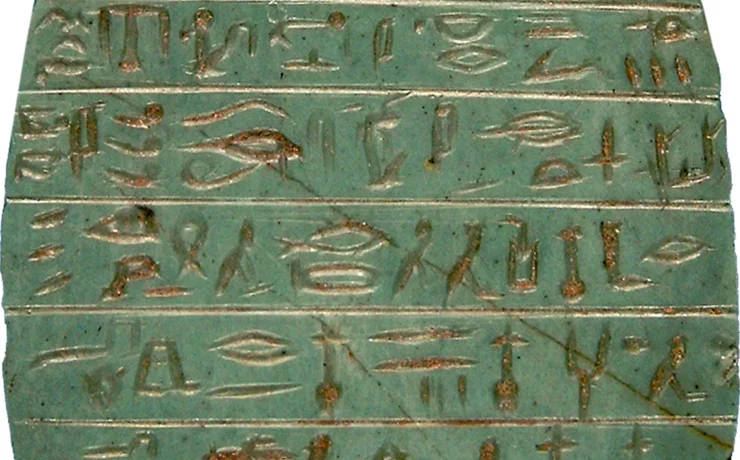
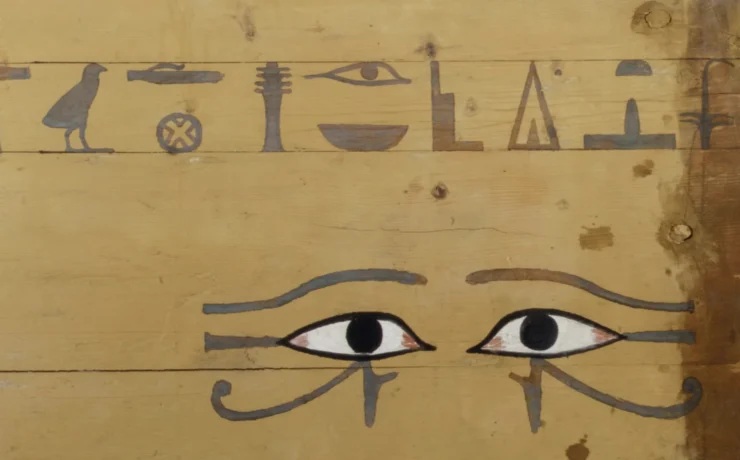
What do the symbols on ancient Egyptian coffins mean? Painted wedjat eyes, divine figures, offering lists and funerary inscriptions could express hopes for protection, sight, nourishment and renewed existence. Their meanings and arrangements changed across periods. This article studies the imagery and text on actual museum coffins rather than retelling the full chronology of rectangular, anthropoid and rishi coffin types.
Ancient Egyptian coffins changed with the societies and religious communities that made them. The transition from early burial boxes to intricately painted faces reveals craftsmanship, funerary beliefs and access to resources. Here we compare real museum objects rather than imaginary reconstructions.
Coffins before the famous golden masks
Ancient Egyptian coffins were much more than expensive containers for bodies. Across nearly three thousand years, their forms, texts and imagery changed with ideas about protection, personal identity and the afterlife. The gilded royal coffins of the New Kingdom are spectacular, but the history starts with much simpler receptacles and burials that predate the great dynastic monuments. The University of Sydney’s museum account traces the evolution from early boxes or containers to full-length wooden coffins and eventually anthropoid types. Those broad trends are historically useful, though individual cemeteries show considerable variety. Not everyone could commission elaborately painted nested containers, and materials varied with local resources. A coffin found in a well-furnished tomb speaks for a person whose family had access to labor and resources; it is not a universal object owned by every Egyptian. This guide compares museum records rather than treating all pieces in a gallery as members of one imaginary burial set.
Reed, wood and clay: early containers
Some early Egyptian dead were buried in ways that relied strongly on the dry desert environment for preservation. Bodies could be placed directly in graves, wrapped, laid on mats or enclosed in simple containers, depending on period and community. Early coffins made from reeds, wood or clay are attested in various contexts. Their small size could correspond to contracted burial positions rather than the fully extended body associated with many later coffins. A change of posture is not proof that Egyptian beliefs switched on overnight. Burial customs differed geographically and over time. The transition to the Old Kingdom saw the more common use of elongated coffins for the fully extended dead, especially among those with resources for such equipment. Wood was a valued material, and the construction of a sound container required skilled carpentry. The act of enclosing the body already joined practical care with symbolic separation from ordinary life. The coffin could protect remains while also marking a person as belonging to a community that valued continuing existence after death.
Rectangular coffins and the emergence of painted sacred space
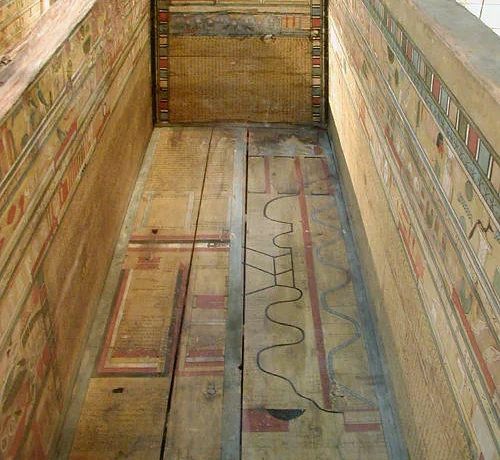
In the Old and Middle Kingdoms, rectangular coffins could become richly decorated surfaces. Their long sides offered space for offering formulas, names, protective inscriptions and bands of pattern. Some included painted false-door imagery, facades and eyes. The famous pair of eyes associated with some Middle Kingdom wooden coffins can be understood in relation to the deceased’s ability to look outward, rather than as the eyes of a living occupant peering physically through solid wood. An actual Middle Kingdom example at the Metropolitan Museum belongs to a named individual and a specific documented collection. Examining the wood, paint and panel arrangement teaches more than merely memorizing which dynasty came first. The location of texts and images could convey ideas of access, rebirth and protection. Such designs also interacted with funerary spells. The relationship between painted coffin imagery and written ritual evolved; it should not be assumed that every coffin carried the same text. The materials record families selecting from a repertoire of religious possibilities, not simply following one centrally issued burial template.
A real Dynasty 13 coffin: Nakhtkhnum
The Metropolitan Museum holds the coffin of Nakhtkhnum, a rectangular Middle Kingdom object dated to Dynasty 13, around 1802–1640 BCE. Its visible decoration can be studied in a real collection photograph. The careful geometric arrangement reminds us that highly expressive Egyptian funerary design did not depend on human-shaped coffins. Rectangular surfaces remained important even while anthropoid forms were developing. The date is a curatorial estimate based on broader evidence, not a modern certificate stating the year of manufacture. Without securely recorded inscriptions of all the owner’s lifetime events, a museum catalogue should not be turned into an invented biography. The object still supports questions about woodworking, paint, inscriptions and the social aspiration to protection beyond death. A collector’s display photo has its own history after excavation. Its present location in New York should not be mistaken for the ancient place of manufacture, and any secure findspot must be taken from the museum’s record rather than inferred from stylistic similarities. Comparing materials and construction across objects helps distinguish chronologies that can overlap, rather than pretending a rectangular type simply vanished when newer forms appeared.

How anthropoid coffins changed the representation of the dead
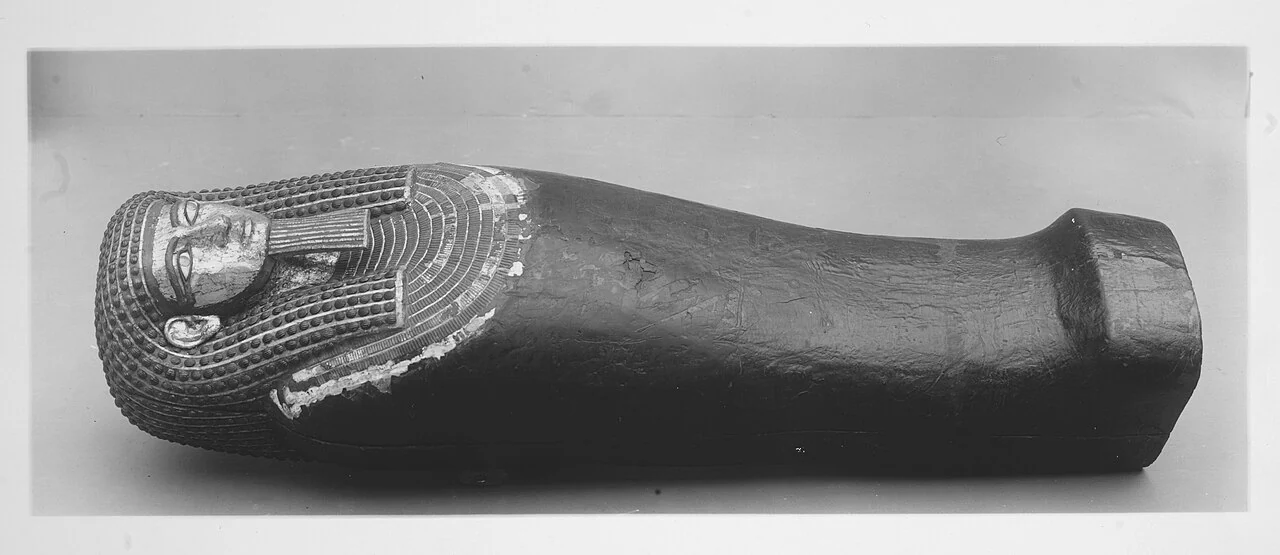
An anthropoid, or human-shaped, coffin transforms the container into an image of the person or a transfigured funerary identity. The Metropolitan Museum’s inner coffin of Hapiankhtifi, dated to the Middle Kingdom, is especially instructive because it was discovered nested within larger rectangular containers. Its gilded facial elements, colored collar and modeled beard were designed to communicate a sacred rather than merely everyday likeness. The museum explains that the anthropoid coffin emerged in the Middle Kingdom as a development of the funerary mask. This gives a concrete history for the format: new types could be placed within older types and combined for additional ritual protection. The shape also allowed artists to turn the body itself into a religious image. We should not treat every coffin face as a photographic portrait of the deceased’s actual appearance. Facial styling, divine elements and ideals of transfiguration could matter more than physiological realism. The surviving object is a material example of those practices, not a universal statement about the body or gender of every coffin owner.
Coffin Texts and protection written across wood
The Coffin Texts of the Middle Kingdom expanded the range of mortuary writing available in certain non-royal contexts. Spells could be inscribed on the interiors of coffins as part of an environment imagined to protect and enable the deceased in the afterlife. Yet the term “Coffin Texts” is a modern scholarly label for a corpus distributed across many objects and versions, not a single universally purchased book. A coffin without extensive visible writing might still belong to a rich religious tradition. The organization of texts could differ, and spells might be selected to meet patron expectations or local customs. Some beliefs and formulae developed from earlier royal mortuary traditions; later, other ideas were transmitted into New Kingdom funerary papyri. This complex transmission is explored in Kemet Vault’s guide to funerary text traditions. The presence of a formula on wood is evidence that a ritual ideal was represented, not proof that every family interpreted its meaning in precisely the same way. Religion is visible through artifacts, but material remains and belief should be distinguished.
Nested coffins, shells of identity and added protection
Egyptian burial containers could be nested, with one coffin placed inside another. The practice is famous from royal burials but was not exclusive to them. Hapiankhtifi’s Middle Kingdom burial provides a museum-documented example of an anthropoid inner coffin placed within two rectangular examples. Nesting required additional resources and craftsmanship; it also created layers of protection and ceremonial meaning. The physical surfaces offered places for different decorations and texts. Many modern exhibits show an inner coffin outside its original outer setting, which can distort a visitor’s sense of how the assembled burial appeared. Curators sometimes reunite related items digitally or explain their original relationships in catalogues. For students, identifying which lid, box, mask and inner component belong together is important. A photograph of a particularly lavish coffin does not establish that an unrelated lid in another museum was once part of the same set. Provenance and accession details matter. Nor does the number of coffins directly give a simple index of love, belief or social importance. Families possessed unequal access to materials and artisans, and burial practices responded to varied traditions.
New Kingdom color, gods and increasingly public funerary imagery
During the New Kingdom, anthropoid coffins and funerary masks could be extensively decorated with painted divine figures, protective symbols and inscriptions. A coffin face might be gilded, and a broad collar could show brilliant color. Yet surviving examples are diverse; some are relatively modest, others spectacular. An Egyptian coffin should not be called “Tutankhamun style” merely because it has a human face. The art of royal burials occupies a different economic and ritual scale from that of most officials or families. Icons of Osiris, Isis, Nephthys, the Four Sons of Horus and other protective beings appear in changing combinations. Their selection and placement were related to funerary traditions rather than the preference of a modern decorator. Painted text and symbolic dress could present the deceased as able to participate in divine renewal. For a complementary explanation of practical bodily preservation, see Kemet Vault’s mummification process study. Coffin history concerns one dimension of the burial package, not the entire procedure.
Later polychrome coffins and the expanding visual record
In the Third Intermediate Period, decorative programs became especially elaborate on many coffins. Curators and Egyptologists study the resulting imagery alongside changing burial customs. Some subjects formerly familiar from tomb walls or papyri were now concentrated on outer and inner wooden surfaces. The Global Egyptian Museum explains how scenes of judgement, divine protection, solar regeneration and the deceased’s relationship with gods could appear directly on coffins. Dating particular objects still requires care: color alone cannot securely establish a century. Art styles overlap, and changes in museum restoration can affect how brilliant a surface appears. A brightly painted coffin whose provenance is uncertain should not be assigned to a famous tomb merely because the imagery looks similar. The fact that objects traveled through dealers and older collections also means excavation details may be lost. Responsible educational writing acknowledges missing provenance instead of inventing it. Such uncertainty is an invitation to compare materials, inscriptions, workshop practices and documented burials, not an excuse to present every attractive object as interchangeable.
How museums study ancient coffins today
Modern museums use conservation assessments, radiography, scanning, pigment analysis, wood identification and textual study to understand coffins and the bodies associated with them. Some institutions display coffins without disturbing the mummy inside, while others document past interventions and conservation. The British Museum’s mummy-gallery material highlights CT scans, coffin display and comparison among objects from different periods. Scans reveal construction or hidden contents that cannot be seen through a glass case, but they do not reconstruct personality, voice or motives. Scientific technologies complement rather than replace historical interpretation. Museums also have responsibilities concerning human remains, repatriation debates, display and respect for descendants and communities. It is important not to treat a deceased ancient person merely as spectacular technology content. A good encyclopedia distinguishes a modern scan of an ancient object from an image made in antiquity, and a reconstructed digital color scheme from surviving pigments. Originality comes from clear source identification and interpretation, not from inventing an impossible precision about individual lives.

The evolution in one timeline
The broad sequence can be summarized without creating rigid boxes. Earlier periods saw simple containers and contracted burials, with variability by community. The Old Kingdom used full-length rectangular coffins in important contexts. Middle Kingdom rectangular coffins could be richly painted and inscribed with funerary spells; anthropoid forms appeared and could be nested within rectangular containers. New Kingdom burial traditions developed human-shaped coffins and elaborate divine imagery with considerable differences between royal and non-royal contexts. Later periods often deployed very dense painted schemes, gilding and further adaptations. The chronological overlaps are real. Not every old form disappeared when a new one was invented. Moreover, changes in embalming techniques, social wealth and the availability of craftsmen all affected choices. The University of Sydney’s historical overview and the Met’s dated objects are helpful precisely because they supply examples rather than claiming one universally observed timeline. To understand the larger spiritual setting, compare the Book of the Dead article, while remembering that many coffin traditions predate that corpus in its New Kingdom forms.
Questions answered and documentary sources
Was every coffin shaped like a mummy? No: rectangular boxes remained important and different styles coexisted. Were all coffins made of stone? No: many were made of wood, reed, clay or composite materials, while stone sarcophagi formed a separate part of some burials. Did all Egyptians receive gilded coffins? No: such materials required access to significant resources. What does the human face mean? Often divine identity or a ritualized representation, not necessarily a portrait. Could a coffin contain another coffin? Yes, nested examples are well documented. For evidence, consult The Met’s coffin of Hapiankhtifi, the University of Sydney museum introduction, the Global Egyptian Museum glossary, and British Museum teaching notes. All three images are photographs of actual Met collection objects, attributed and linked to Commons files. Period and museum identification are not inferred solely from appearance. Source review: 25 October 2026.