Tutankhamun's golden funerary mask is more than the best-known face of ancient Egypt. It is a carefully constructed royal image, a composite work of gold, lapis lazuli, obsidian and colored glass, and a material instrument of rebirth inscribed with a protective Book of the Dead spell. Starting with Christiane Desroches Noblecourt's Tutankhamun: His Life and Death, this study checks physical details against Egypt's museum catalogues, the spell's documentation against Egyptological research, and the date of the mask's unveiling against Howard Carter's fourth-season records. Two original licensed high-resolution museum photographs show the genuine mask, not a generated portrait.
Editorial standard: This original essay starts with Christiane Desroches Noblecourt’s Tutankhamun: His Life and Death (user-supplied Arabic translation, 340 scanned pages). It separates the original book narrative from updated evidence in Oxford’s Howard Carter archive, Egyptian museum catalogues and ancient objects. Modern licensed photographs document authentic artefacts, not reconstructed scenes. The reader-submitted YouTube documentary is linked as supplementary viewing only: its audio transcript has not been independently verified and no claim below is attributed to unseen narration.
The most photographed face in archaeology was designed for the dead
Tutankhamun's golden mask is often discussed as if it were a portrait bust made to preserve a young ruler's appearance. It certainly presents royal features, but it was not conceived as a museum artwork for admiring crowds. It rested over the head and shoulders of a mummified king inside the innermost coffin, offering an enduring divine form and protective power. The Egyptian Museum catalogue and the Grand Egyptian Museum's own object description both place the mask within funerary religion, not simply ancient luxury.
Christiane Desroches Noblecourt's Tutankhamun: His Life and Death helps us ask what the king's objects tell us about personal identity and the transition from life to death. The most useful modern question is therefore not merely 'How much is the mask worth?' but 'What work was its material and iconography meant to perform?' The answer brings together goldsmithing, colored mineral inlay, royal insignia, Osirian symbolism and an actual protective inscription on the back. Each is a clue preserved in the original object.
JE 60672: an identifiable museum object
The funerary mask has the historical inventory number JE 60672. The Global Egyptian Museum's catalogue documents its height as 54 centimeters and its width as 39.3 centimeters, while the Grand Egyptian Museum identifies it as collection object GEM 8. These record numbers help students distinguish a genuine, individually documented artifact from the countless replicas offered in gift shops and the digital images with invented materials and colors.
Museum descriptions have changed as collections moved and new exhibitions opened. An old photograph may show the mask at the Egyptian Museum in Cairo, while more recent records place it in the Grand Egyptian Museum. The date and location of the photograph must be separated from the date and origin of the original object, which belongs to the late Eighteenth Dynasty and comes from KV62 in the Valley of the Kings. We cannot assign a contemporary photography date to a three-thousand-year-old artifact or claim a display photograph proves what the mask looked like under burial linen in 1323 BCE.
The gold was not merely a sign of spending power
Gold was prized for more than its brilliance. Egyptian funerary thought associated the divine body with gold and the hair of gods with lapis lazuli, connections explained in the Grand Egyptian Museum's account of the mask. The golden surface therefore suggested durability, solar brilliance and transformation into an enduring sacred state. The visual effect worked with the words inscribed on the mask, not separately from them.
Calling the face 'solid gold' needs contextual care: the object incorporates a substantial gold structure, but also stone and glass inlays for eyes, brows and collar. Different layers and decorative elements should not be flattened into one material. Nor should the weight of an object be treated as an automatic measure of its purpose. The gold mattered because of technology, status and theology at the same time. An illustrated encyclopedia can make those functions understandable while leaving unsupported stories about occult properties or hidden treasure chambers out of the discussion.
Eyes, brows and colored material choices
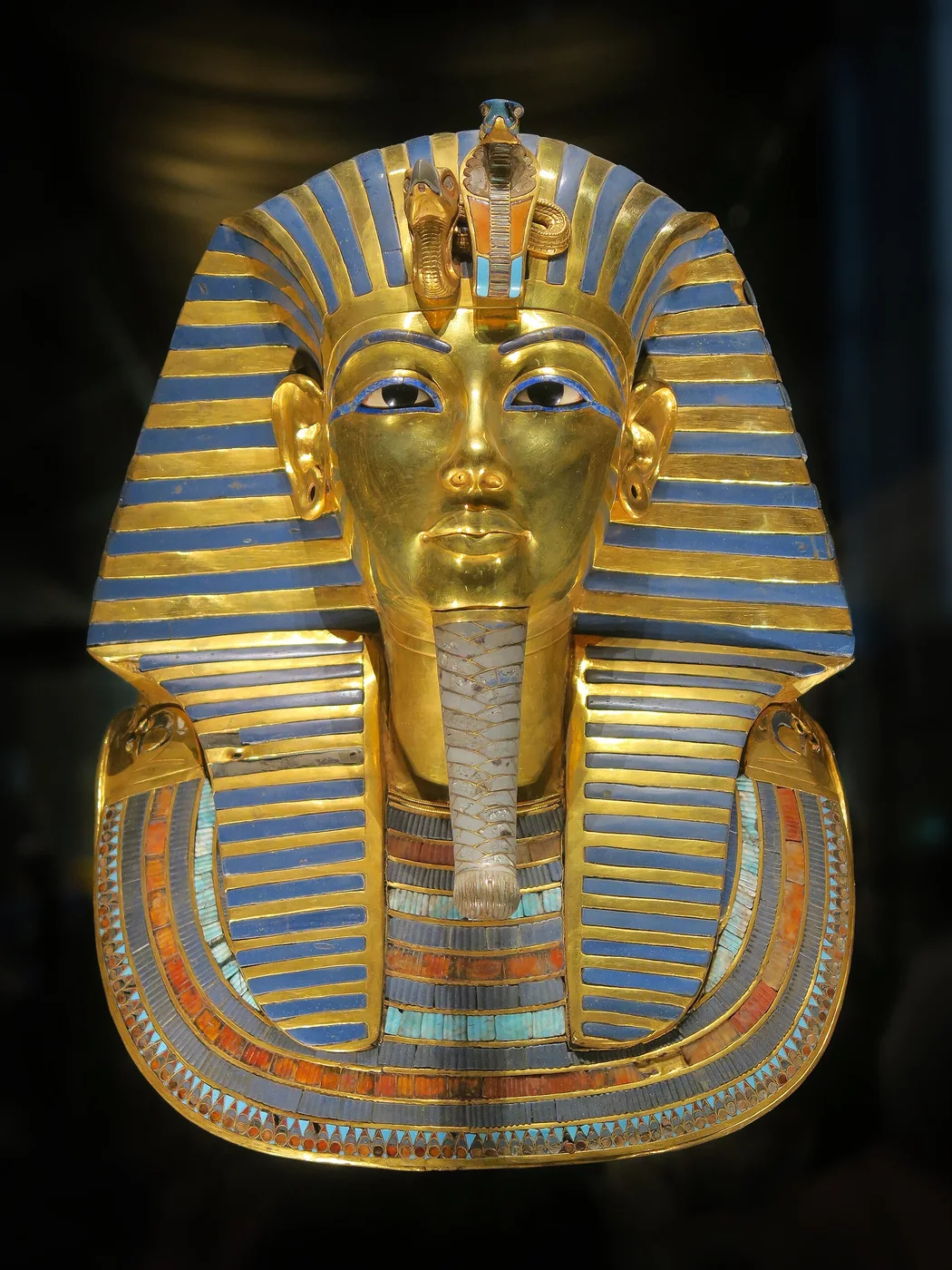
The Global Egyptian Museum catalogues obsidian and quartz for the eyes and lapis lazuli for the eyebrows and eyelids, with colored stone and glass used in other details. Such materials produce carefully controlled contrasts: a bright face, sharply defined eyes and lines of intense blue. The ancient makers selected real substances with differing textures, colors and methods of working. The result is a composite object, not a single piece poured into a featureless gold mold.
Photographs can exaggerate particular colors because lighting, reflective highlights and editing change what a viewer sees. That is why both documentary images in this article are kept identifiable and accompanied by original file links and licenses. They show the actual mask in modern museum settings, rather than an imaginary scene of its manufacture. The choice of inlay is independently checkable against a museum catalogue. If scientific analysis revises the name of a mineral, responsible writing would update the claim rather than defending a familiar but inaccurate label.
The nemes headdress made the face royal
Above the face is the striped royal nemes headdress, a form seen in other Egyptian representations of kings. Its presence marks the deceased as a king, not simply an unnamed individual receiving funerary treatment. The forehead bears the cobra uraeus and vulture, emblems of protection and royal legitimacy. The broad collar extends across the shoulders, ending in falcon imagery and bands of colored material.
These are elements of a carefully composed royal body. A modern description that focuses only on the calm smile would miss the political-religious symbols that made the object recognizable within Egyptian visual conventions. A painted or sculpted royal image was not required to look like a candid photograph. It communicated a status that could outlast the ruler's physical body. Comparison with official portraits is useful, but it cannot establish that every surface feature reproduces Tutankhamun's unique facial anatomy exactly. The mask is simultaneously individual, dynastic and divine.
Osiris and Re are both present in one face
The Grand Egyptian Museum emphasizes the mask's association with Osiris, lord of the dead, and Re, the sun god whose divine body was imagined as gold. Those themes were not mutually exclusive: Egyptian funerary religion could link the dead king with Osiris while envisioning renewal through the sun's daily journey. The materials and gold surface express this complex language visually, while the inscription gives it verbal force.
The result differs from a modern idea of a gold death mask as a final portrait of a person at the instant of death. Tutankhamun's mask is an idealized instrument of rebirth. The living boy's age, family relationships and reign are historical questions that require other texts, mummies and royal monuments. This object answers a narrower but profound question: how did funerary equipment prepare a royal body for continued existence? Reading it through Egyptian religious evidence avoids the simplistic claim that the makers merely wanted to impress people who would never normally see the object sealed within the tomb.
The inscription on the back is central, not decoration
A protective inscription runs on the back and shoulders of the mask. It corresponds to a formula related to Book of the Dead Spell 151, which identifies parts of the deceased's head with divine powers. The Global Egyptian Museum and the University of Chicago's scholarly catalogue both connect the mask to that spell, and UCL's collection of Book of the Dead chapters confirms the textual tradition. The specific words form part of a religious technology intended to protect the body.
A photograph of the front does not show this inscription, which makes it easy for popular writing to overlook. Its presence means the mask was more than visual iconography. It was a written ritual object meant to function even while enclosed beneath coffins and shrines. The modern spell number is an Egyptological classification, not a label carved on every ancient manuscript. Ancient versions and contexts varied. Our separate study of the Papyrus of Ani explores a different manuscript within the larger Book of the Dead tradition; the royal mask is another material support for funerary texts.
Why the face may resemble a god more than a teenager
A person looking at the face often asks whether Tutankhamun was really so beautiful or whether the artist captured his exact features. The Grand Egyptian Museum observes a resemblance to royal coffins, statues and reliefs, yet it simultaneously emphasizes divine transformation. Those are two different kinds of resemblance. An artistic convention can make a king identifiable while presenting him in the perfected form suited to burial.
The gold mask does not supply a trustworthy independent photograph of the young king's living face. Physical anthropology, CT examination and archaeological objects may offer other information, but they also involve limitations and uncertainties. No image-generation program can fill those gaps with a newly created portrait and turn it into proof of his appearance. It is better to show the mask itself and explain how its creators balanced individuality with idealized rulership. This is one reason the object remains so fascinating: it tells us as much about Egyptian hopes for immortality as about the ruler whose name it bears.
28 October 1925: a date separate from the tomb discovery
The museum world learned of the mask through the long excavation of KV62. Howard Carter's team found the tomb entrance in November 1922, but its burial equipment required years of examination. The Griffith Institute's fourth-season records place the lifting of the innermost gold coffin lid and revelation of the mummy with mask on 28 October 1925. The mask was not among the first objects Carter saw through the antechamber blocking three years earlier.
The sequence can be checked in surviving excavation notes and the Oxford Tutankhamun Spatial Archive. It matters because archaeology is a documented process rather than a single cinematic unveiling. The coffins were embedded within shrines, affected by resin and wrapped materials, and the mummy could not be examined casually. The mask became visible during a technical operation combining careful separation, recording and conservation. When a documentary rearranges famous images for dramatic effect, the diary is the corrective source for which day an operation actually occurred.
28 October to November: the object had a physical context
Carter's fourth season began work on the coffins in October 1925. The archive notes that the inner coffin was found to be made of gold and was stuck to the middle coffin by thick ritual resins. When the lid was lifted, the masked mummy lay among bands and amulets. Later November work sought to examine the body and remove ornaments. The details show why an object catalogue must include where something was found, not merely its material or modern display.
A popular photograph of the mask on a pedestal cannot explain its original placement on the mummified head. The object began its burial life in contact with linen, resin and other protective equipment. Those relationships are archaeologically significant. They explain why modern museum photography and burial-context photography are not interchangeable. The article links to archival records of the fourth season without reproducing restricted historical images as if they were free stock photographs. Our in-site illustrations are modern licensed photographs of the genuine object, with source pages available to readers.
Two real photographs, but not two ancient eyewitnesses
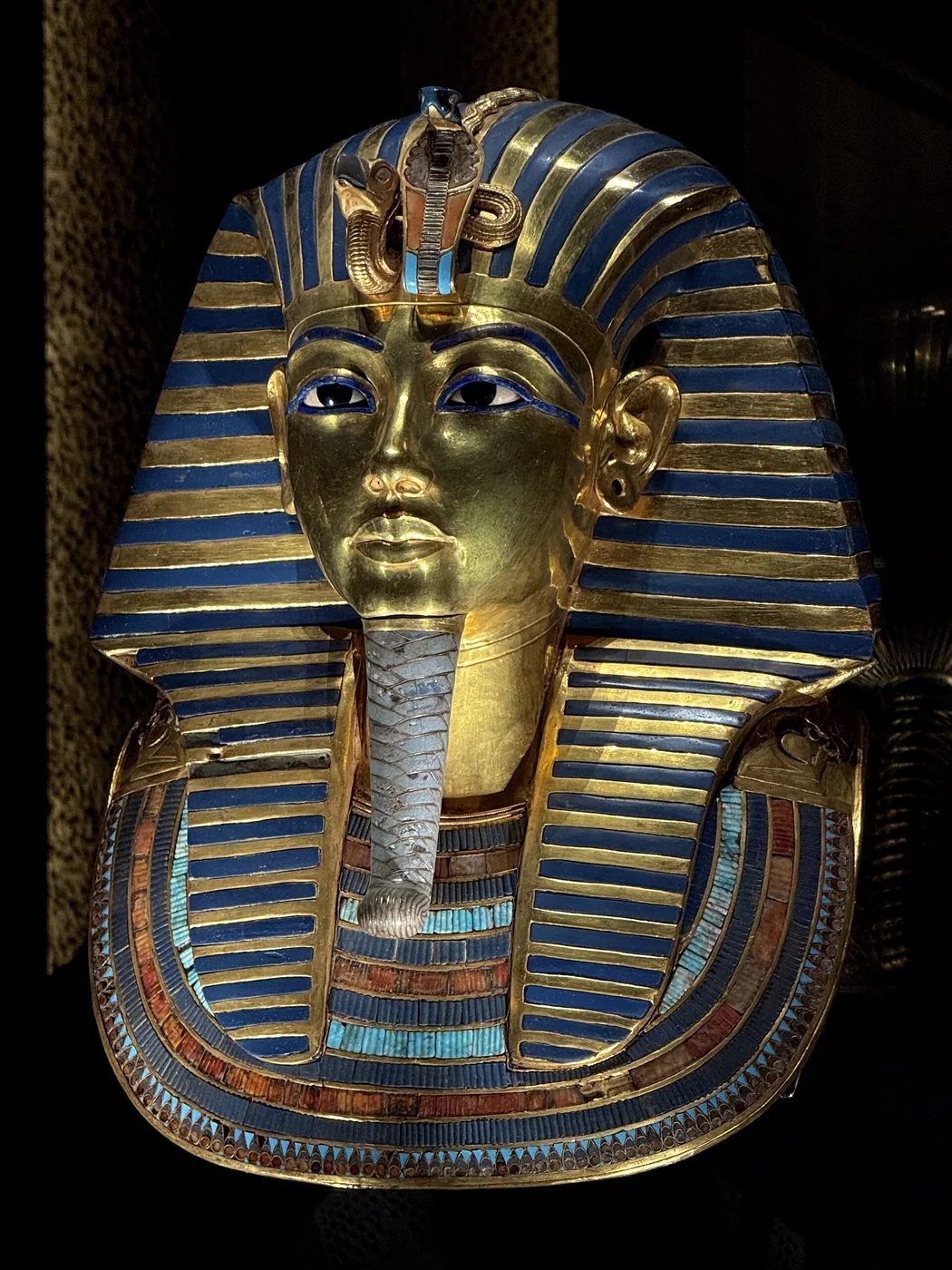
The article illustrates the actual golden mask with a licensed high-resolution photograph made in a museum in 2026 and a second original museum photograph from 2025. Those are independently authored contemporary images of the same ancient object. They are not photographs from the 1925 unwrapping, and they are not AI-generated attempts to invent the king's appearance in life.
The second view adds value when read as a separate documentary record rather than a duplicate decorative splash: lighting and camera position can reveal or conceal different portions of the headdress, collar and facial inlay. Both photographs are attributed by name and made available under the conditions specified by their photographers. The caption also notes any image optimization used for web display. The material and original historical context come from museum catalogues. This is how a visually ambitious Egyptology site can use spectacular images without selling fiction as archaeological fact.
The mask's mystery is its documented complexity
The object deserves attention not because of a vague curse or claims of impossible technology but because art, theology and craft converge in an extraordinarily preserved royal burial. Its inventory identity can be verified, its materials and iconography can be studied and its modern excavation sequence can be reconstructed from surviving handwritten records. The back inscription links it with a wider body of Egyptian funerary writing, while the paired golden face and royal headdress express transformation and kingship.
Desroches Noblecourt's book gives the historical setting in which a young king's death became visible through objects placed in a small tomb. The Grand Egyptian Museum, the Global Egyptian Museum, UCL, the Oriental Institute and Oxford supply checks unavailable to a single older narrative. That combination is what Kemet Vault should offer: not a reproduction of a book paragraph or an exaggerated YouTube headline, but an original, source-led interpretation that lets readers move from the dazzling surface to what the ancient makers intended the mask to do.
Evidence at a glance
| Evidence | What can be concluded |
|---|---|
| JE 60672 / GEM 8 | The exact ancient funerary mask with identifiable museum inventory records. |
| Gold and mineral inlay | Mask combines precious metal with lapis lazuli, obsidian, quartz and colored substances. |
| Nemes, cobra and vulture | Symbols of royal identity and protection, not neutral decorative patterns. |
| Book of the Dead Spell 151 | Protective funerary formula identifying parts of the deceased with divine powers. |
| 28 October 1925 | First documented unveiling of the mummy with its mask within the innermost coffin, three years after the tomb's discovery. |
| Two licensed photographs | Actual museum images of the genuine mask in 2025–2026, not images from the original burial or 1925 excavation. |
Frequently asked questions
When was Tutankhamun's mask found?
The tomb entrance was located in November 1922; the masked mummy was revealed during coffin work on 28 October 1925.
What is written on the back of the mask?
A protective funerary formula associated with Book of the Dead Spell 151, identifying parts of the head with divine beings and powers.
Is the mask entirely made of gold?
It has substantial gold construction but includes carefully applied mineral and glass inlays for the eyes, eyebrows and other decorative elements.
Where can I see verified photographs of the actual mask?
The article includes independently licensed museum photographs and links to official catalogues at GEM and the Global Egyptian Museum.
Sources and image provenance
This article uses the historical source listed in the bibliography as a research starting point, specifically PDF pages Christiane Desroches Noblecourt, Tutankhamun: His Life and Death, the uploaded Arabic illustrated 340-page edition: historical narrative beginning PDF pp. 7–57, burial equipment illustrations within the later tomb and object chapters (especially approximately PDF pp. 180–320). Exact JE 60672 materials, inscription and October 1925 date cross-checked to museum catalogues and Oxford records.. Its historical rhetoric and older interpretations are not treated as conclusive archaeological evidence. The external museum and research records below are linked for independent checking.
- Grand Egyptian Museum: The Golden Burial Mask of Tutankhamun, GEM 8
- Global Egyptian Museum: Gold Mask of Tutankhamun, JE 60672, material and protective spell catalogue
- Oxford Griffith Institute: fourth season, coffin opening and 28 October 1925 unveiling
- Oxford Griffith Institute: detailed original fourth-season archaeological journal
- University of Chicago ISAC: Book of the Dead scholarship, spell 151 and Tutankhamun mask
- UCL Digital Egypt: Book of the Dead numbered spells including 151
- Original high-resolution mask photo, ArchiH 2026, Commons licence
- Original mask photo, Dawid Wdowczyk 2025, Commons licence
- Reader's suggested YouTube documentary; source-specific transcript not independently accessible
- Photograph: Original 6 April 2026 photograph of Tutankhamun's genuine funerary mask, photographed by ArchiH, CC BY-SA 4.0. This is the museum object, not an invented appearance of the living king., ArchiH, genuine 6 April 2026 photographic record of Tutankhamun's mask, CC BY-SA 4.0
- Photograph: Authentic museum view of the original Tutankhamun mask photographed by Dawid Wdowczyk on 12 December 2025, CC BY 4.0. It is a modern photograph of a New Kingdom artifact, not a photograph of the burial chamber in 1925., Dawid Wdowczyk, original 12 December 2025 photograph of the genuine golden mask, CC BY 4.0
Watch the reader-supplied documentary
Treasures of Tutankhamun (Arabic-language documentary, YouTube) is recommended as supplementary viewing. This article is not represented as a transcript: the video narration and captions were not accessible for independent quotation or verification. The factual conclusions above are grounded in the cited book and archaeological or museum sources.