Alexandria's Ptolemaic story is often told as a contest between the world's greatest library and the ambitions of Cleopatra VII. That leaves out the political and social complexity of a city that served as royal capital, port, scholarly centre and meeting place of different cultural traditions. Archaeology, surviving texts and later accounts illuminate different parts of its history, sometimes with major gaps.
Alexander's foundation and the Ptolemaic monarchy
Alexander entered Egypt in 332 BCE and Alexandria was founded in the wider context of his conquests. The political dynasty named after Ptolemy I took shape after Alexander's death, with 305 BCE often used for the formal start of Ptolemaic kingship. It is therefore historically imprecise to collapse all events from 332 into one fully formed royal institution. The Ptolemies ruled from Alexandria while engaging established Egyptian temples, administration and religious traditions. Greek was important in court and administration, but Egyptian languages and communities remained central to life across the Nile Valley. A story confined to Greek philosophers or a single last queen misses much of the population and economy that sustained the state.
The Library and the limits of surviving evidence
The ancient Library of Alexandria and associated scholarly institutions became enduring symbols of learning. However, the surviving ancient evidence does not justify confident claims about an exact number of books or a single definitive fire that destroyed everything in one night. Texts were copied on papyrus rolls, circulated among scholars and maintained through institutions shaped by royal patronage. Much of the intellectual culture can be explored through authors, scientific traditions and the history of manuscripts, but the physical configuration of the original library is debated. The Bibliotheca Alexandrina today is a modern cultural institution, not a reconstructed functioning copy of the ancient library with all its original collections. A responsible account distinguishes these related yet different histories.
Alexandria's foundation and what archaeology can actually show
Alexander of Macedon founded Alexandria on the Egyptian Mediterranean coast in 331 BCE, but the surviving modern street plan is not a complete preserved plan of the original city. Much of the ancient urban landscape was built over, disturbed, submerged or transformed by later structures. Literary accounts, historical topography, excavation results and underwater archaeology contribute different pieces to the reconstruction. A modern photograph of a seafront street cannot by itself identify a Ptolemaic royal precinct. Researchers must distinguish plausible ancient street grids from the exact footprints of lost buildings. The original shoreline changed through harbor development and geological processes, so map overlays should indicate uncertainty. The most productive way to study early Alexandria is to combine archaeological context with sources that preserve the city's role in the emerging Ptolemaic kingdom, and to state clearly where the evidence is too incomplete to justify a precise location. A good museum article is therefore not a fantasy drawing of the ancient skyline, but a documented investigation of particular places, objects and dates.
From Macedonian conquest to a dynasty lasting until 30 BCE
Alexander entered Egypt in 332 BCE, whereas the Ptolemaic dynasty is conventionally dated from Ptolemy I's assumption of kingship in 305 BCE. Keeping those dates distinct prevents a common error: presenting Alexander as the first Ptolemaic king or treating the founding of Alexandria as the political start of the later dynasty. Ptolemy I had been one of Alexander's generals and consolidated control amid the struggles among the successors. The monarchy continued until the defeat of Cleopatra VII and the Roman takeover in 30 BCE. The kingdom encompassed far more than the city, so objects made in other Egyptian regions can illuminate Ptolemaic state ideology without being falsely labelled as excavated in Alexandria. A periodized historical account must also respect the political and cultural changes within the dynasty. Egyptian temple building, Greek-language court culture, financial administration and Mediterranean diplomacy did not develop at exactly the same pace. Reliable chronology makes the capital's history more intelligible, not merely longer.
Ptolemaic kingship expressed through Greek and Egyptian visual languages
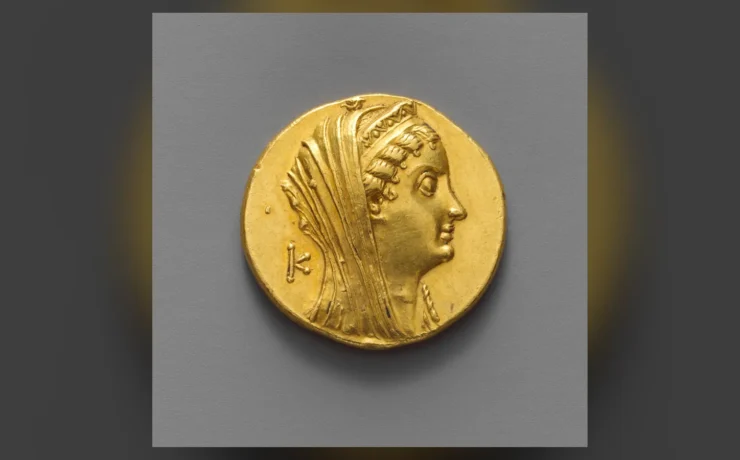
The kings of the Ptolemaic dynasty operated within both Mediterranean royal traditions and the older Egyptian framework of kingship. Coins, portraits, titles, decrees and temple reliefs can reflect different audiences and settings. A ruler's name in an Egyptian temple offering scene is not proof that he personally carried out every depicted ritual; the representation formed part of a sanctioned visual programme. Conversely, a Greek coin portrait does not demonstrate that Egyptian cultic institutions had disappeared. Objects can support specific conclusions when their issuer, findspot, inscription and date are documented. This is why a coin's accession number is useful and why an artifact photographed in London should not be labelled an artifact discovered in Alexandria unless the museum record supports that origin. Art history sees continuity and interaction rather than two permanently separate cultural worlds. The Met's survey of Egypt in the Ptolemaic Period is an accessible starting point for this discussion; a researcher should still refer to individual object records for precise claims about particular works.
The great Library: famous institution, limited physical certainty
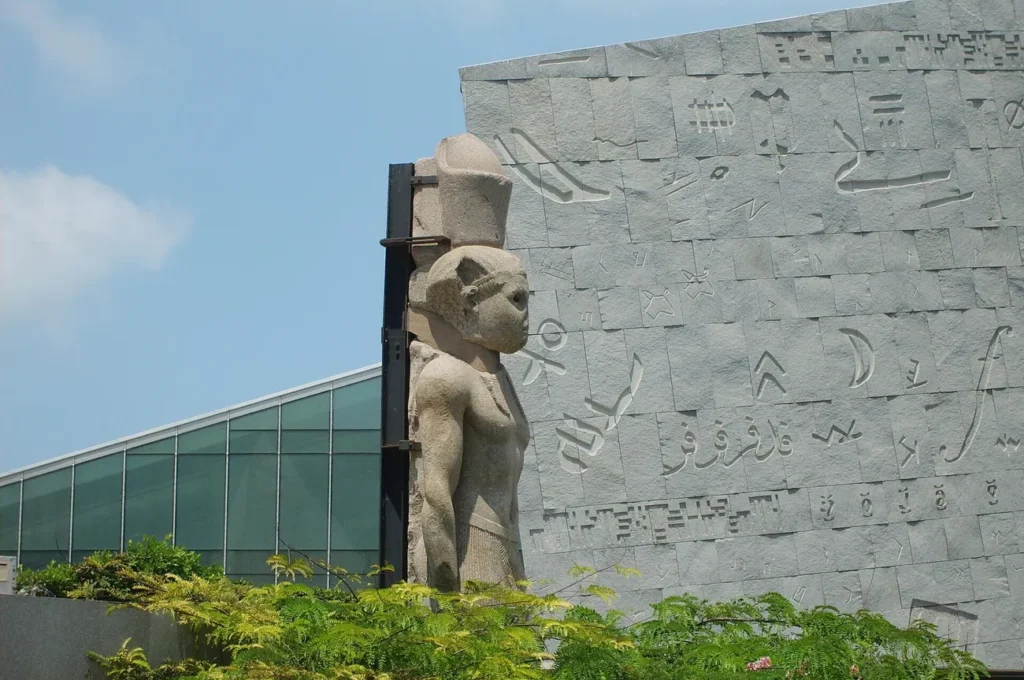
The Library of Alexandria has become a symbol of the ancient world, but modern articles often go far beyond what surviving evidence establishes. Literary testimony supports the Ptolemaic court's investment in scholarly collecting and the associated Mouseion, yet the precise physical structure of the original library has not been conclusively identified in the modern city. Claims giving a fixed floor plan, exact shelf count or confidently marked foundation footprint exceed the evidence in many popular accounts. Accounts about its destruction also refer to different events and periods, and should not be compressed into the assertion that one famous fire destroyed all ancient learning at once. A serious encyclopedia distinguishes ancient references from later literary traditions and archaeological hypotheses. The modern Bibliotheca Alexandrina is a separate contemporary cultural institution, not the same architectural building restored to its original dimensions. Photographs of its façade can accurately document modern commemoration but cannot serve as documentary images of the Ptolemaic library.
What the modern Bibliotheca Alexandrina photograph actually represents
One of the genuine photographs in this guide shows the modern Bibliotheca Alexandrina in Alexandria, with a public statue representing Ptolemy II Philadelphus. The photograph itself dates from 2008 and depicts a modern built environment. It is not an image taken during the Ptolemaic period and does not show the lost Great Library. The modern reference to Ptolemy II is historically meaningful because the Ptolemaic court and Alexandria's scholarly reputation are closely associated in ancient sources, but such public commemoration should not be mistaken for a secure archaeological identification of the ancient library's location. Editorial labels must identify the modern institution and state that the picture illustrates how the city remembers its scholarly heritage today. Scholars studying the ancient library need archaeological and textual evidence, not just contemporary city photography. Distinguishing commemoration from material antiquity makes the article more transparent to both tourists and reviewers who expect historical accuracy.
The Mouseion, court scholarship and claims about learning
The Mouseion is associated with the scholarly activities supported by Ptolemaic royal patronage. Ancient testimony allows historians to investigate learned communities, textual transmission and the prestige attached to royal collecting. Yet the evidence is insufficient to reconstruct the daily timetable, enrollment or complete staff list of a modern-style university. Calling it 'the world's first research institute' may work as a loose modern analogy, but the phrase imposes today's institutional categories on a very different royal setting. Scholars working with literary, mathematical, astronomical and medical texts lived in varied intellectual traditions; a single list of famous names should not imply that all worked together at one moment. The history is best told through dated authors and texts where evidence permits. Knowledge circulation stretched beyond a single building, and survival of works depends on copying across generations. A carefully worded narrative can celebrate the city's intellectual importance without inventing lost rooms or claiming that every classical scientific discovery occurred inside one celebrated library.
Royal ideology in an Egyptian and Mediterranean kingdom
Ptolemaic rulers used Greek dynastic titles and court forms while appearing in Egyptian temple decoration according to long-established religious conventions. Coins, inscriptions and temples allow historians to trace how political authority was presented to different audiences. A temple image should not be mistaken for a casual portrait of the king visiting a particular town. The sanctuary at Philae offers a compelling example of Egyptian religious traditions continuing under Hellenistic and Roman patronage. Political alliances, taxation and disputes also influenced the monarchy's survival. Social history must examine the relationship among rulers, military settlers, local officials, priests, merchants and farmers rather than using religious art as proof of complete cultural uniformity.
Trade, geography and urban change
Alexandria's harbours gave the city an important position within Mediterranean commerce, while the Nile connected the port to an agricultural hinterland. Maritime trade supported the royal economy, yet the everyday experiences of sailors, labourers and producers are less comprehensively documented than palace politics. Excavated urban remains, underwater archaeology and later accounts of shorelines contribute to research, but modern streets cannot be assumed to replicate the ancient grid in every detail. Some celebrated structures survive mainly in texts, reused building materials or contested archaeological interpretations. These limitations do not diminish Alexandria's importance; they guide how much certainty an educational site should claim.
Cleopatra VII and the end of the dynasty
Cleopatra VII became an important political actor in conflicts involving Rome and the last Ptolemaic rulers. Following the defeat of Antony and Cleopatra's forces and the Roman takeover of Egypt in 30 BCE, the independent Ptolemaic monarchy ended. Egypt's cultural life did not abruptly reset in that year: institutions, settlements and religious practices continued and changed under Roman government. Ancient biographies and later cinematic representations can blur the chronology, so every dramatic episode should be checked against surviving sources. To understand today's Alexandria as a visitor, follow a separate practical guide; a historical essay should not pretend to provide current ticket and transport information.
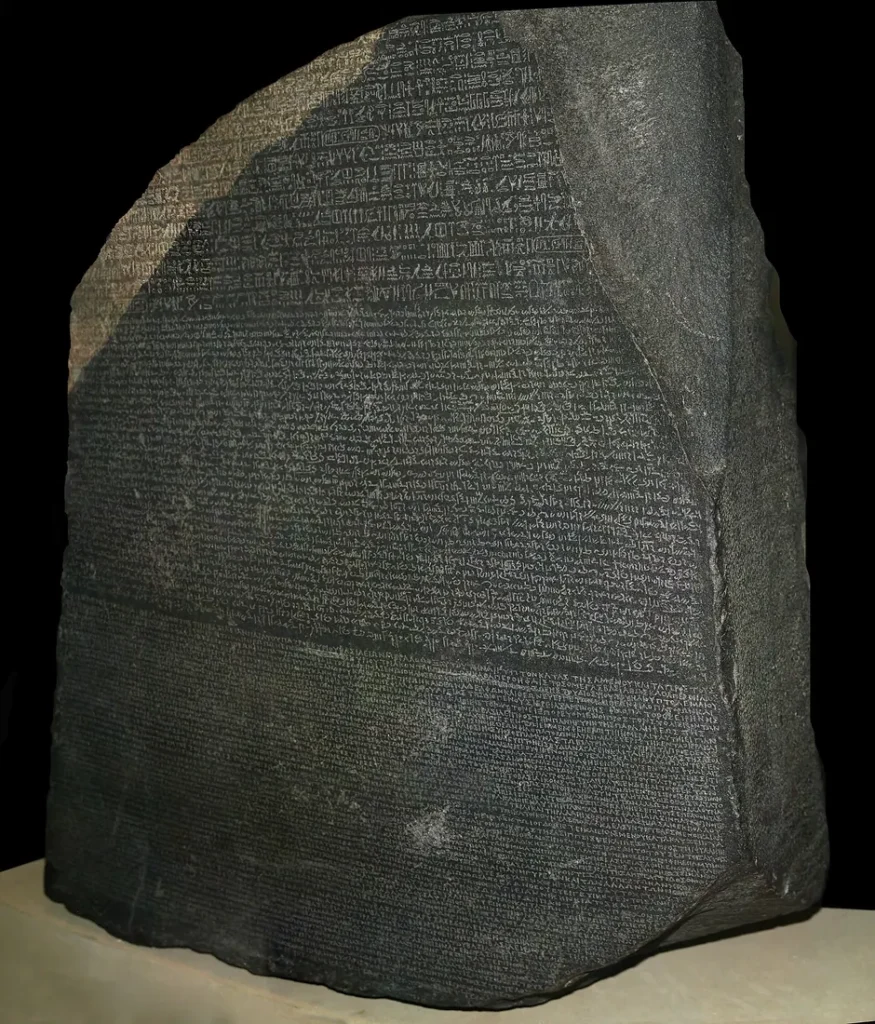
The Rosetta Stone: real Ptolemaic decree, not an Alexandrian excavation
The second historical photograph documents the original Rosetta Stone preserved at the British Museum. The inscribed decree was issued in 196 BCE during the reign of Ptolemy V and is known through hieroglyphic, Demotic and Greek versions. It is a real surviving Ptolemaic-era primary source demonstrating the relationship among royal authority, Egyptian priests and several writing systems. It was found at Rashid (Rosetta), not on the site of the Great Library of Alexandria. That distinction is indispensable: a photograph of this inscribed stone is perfectly relevant to the kingdom's multilingual administration, but is not evidence for the appearance or contents of Alexandria's library. Researchers should use the British Museum's object record for the inscription's modern provenance and legal collection history, and specialist editions for translation and historical interpretation. The museum photograph represents a real ancient object; its present London location and the modern discovery of the stone should not be confused with the date of the ancient decree.
A city of harbors and Mediterranean connections
Alexandria developed as a major Mediterranean port linking maritime networks to Egypt's Nile economy. Trade and movement are documented by archaeological discoveries, texts, ceramics, shipwreck and harbor research, but exact cargo quantities and routes change by period. It would be inaccurate to plot every sea voyage using a straight line between a modern port and a reconstructed Ptolemaic dock. The Heptastadion and the eastern harbor feature prominently in reconstructions of the ancient urban landscape, yet their interpretation requires specialist archaeological and geographical evidence. Scholars debate aspects of coastline and harbor topography, and current seawalls are not photographs of the ancient shoreline. Describing Alexandria as 'cosmopolitan' can be useful, but it should not erase political hierarchy, conflict and the different experiences of Egyptian, Greek, Jewish and other communities. Social and economic history needs evidence for particular groups and contexts, not an idealized portrait of universal tolerance or uniformly prosperous commerce.
The Serapeum and the problem of buildings from different periods
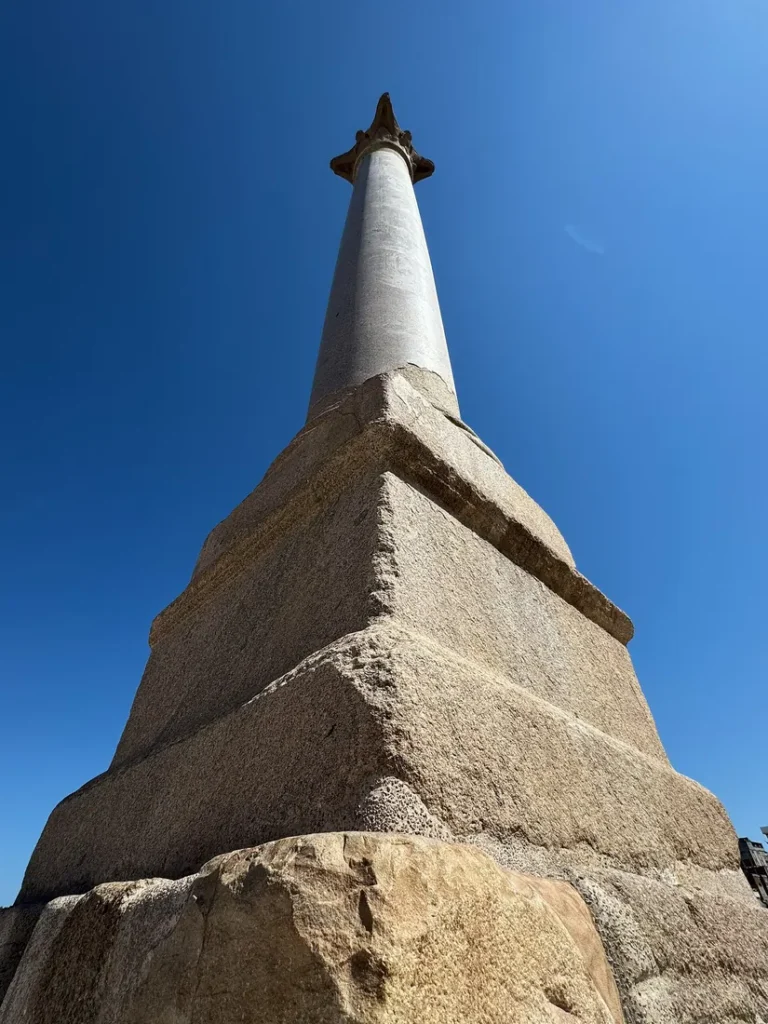
The third real photograph shows Pompey's Pillar at Alexandria in the area associated with the Serapeum. The standing column dates from the Roman period, much later than the foundation of the Ptolemaic dynasty. The site is useful as a teaching example precisely because the religious landscape underwent change and received later monuments. Some accounts describe a daughter library connected with the Serapeum, but one cannot simply identify the current column as part of the Great Library or assert that the Roman pillar itself was built under Ptolemy II. A photo caption that calls it 'the ruins of the Library of Alexandria' would be actively misleading. An accurate description identifies its Roman date and names the broader Serapeum context, while keeping debates over scholarly collections separate from visible masonry. This distinction prevents tourism photographs from being used to manufacture evidence for buildings whose archaeological identification remains uncertain.
Religious life beyond the royal palaces
Ptolemaic Egypt included established Egyptian sanctuaries, forms of Greek cult, royal dynastic honors and changing religious identities. Serapis, Isis and other deities entered different networks of practice and representation. The state could invest in monumental temples while Greek-language literature flourished at court; neither sphere completely replaces the other. Local inscriptions and votive practices are often more informative than broad claims that the entire population worshipped a newly created hybrid pantheon. The degree of royal sponsorship, the identities of temple personnel and the expectations of visitors changed across time and place. Philae, for instance, provides actual Ptolemaic and Roman temple reliefs elsewhere in Egypt and cannot be treated as a photographed temple located in Alexandria. Our linked archaeological Philae dossier examines its real carved evidence; the present study focuses on Alexandria as capital and on the larger religious history that shaped the kingdom. Distinguishing sites avoids misleading readers through irrelevant photography.
Cleopatra VII and the end of Ptolemaic sovereignty
Cleopatra VII is often reduced to a romantic figure or presented in modern cinema as though the visual details were historically secure. The surviving record supports a more politically meaningful account of a ruler involved in dynastic conflict, diplomacy and struggles over Egypt's position in Mediterranean power. Coins, texts and later Roman sources provide material for analysis but carry different interpretative limits. In 30 BCE Egypt came under Roman control following the defeat of the last Ptolemaic monarchy. This is a political transition, not a claim that Egyptian language, temple life or urban populations abruptly vanished. Chronological divisions in a history atlas should reflect such continuity. Describing Cleopatra's court without reliable primary references easily becomes speculative fiction, especially when used to fill gaps in the archaeological reconstruction of Alexandria's palaces. Readers should distinguish what is known through contemporary material from stories repeated many centuries after the events.
How to research Alexandria without inventing its lost monuments
A practical research plan starts with a dated primary source, a securely identified object or a specialist site report. Establish whether the evidence concerns Alexandria itself, the wider Ptolemaic kingdom or a later Roman reuse of the city. Verify the object's findspot, language, publication history and present museum repository before inserting an image into an article. Note uncertainty around disputed urban locations and avoid assigning exact building coordinates on the basis of famous names alone. When comparing the ancient Great Library with today's Bibliotheca Alexandrina, label one as an ancient institution known mainly from testimony and the other as a contemporary cultural project. For the Rosetta Stone, use its original inscription and museum record while acknowledging that the artifact was not unearthed in Alexandria. For Pompey's Pillar, distinguish the late Roman standing column from the older Serapeum context. The result is a historically credible guide that equips students and visitors to distinguish evidence, hypothesis and modern remembrance.
Evidence comparison and key distinctions
| Topic | What the evidence establishes |
|---|---|
| 332–331 BCE | Alexander's Egyptian conquest and foundation of Alexandria; earlier than the Ptolemaic dynasty proper. |
| 305 BCE | Ptolemy I assumes royal title, conventional start of the Ptolemaic dynasty. |
| Ptolemaic royal scholarship | The Mouseion and ancient Library associated with court patronage, but original building location and plan are not securely identified. |
| 196 BCE | Rosetta Stone decree under Ptolemy V, an Egyptian primary source found at Rashid, not the Library. |
| Serapeum area | Site with earlier cult history and later Roman monuments; standing Pompey's Pillar is not Ptolemaic. |
| 30 BCE | Roman takeover following the end of the Ptolemaic monarchy. |
| Bibliotheca Alexandrina today | A modern institution commemorating the city's historical learning, not the same physical building as the ancient library. |
| Photographic evidence | Show real museum objects and correctly dated monuments; never pass modern memorials off as surviving Ptolemaic library ruins. |
Frequently asked questions
Can visitors see the actual ancient Library of Alexandria building?
No securely identified surviving building can be shown as the original Great Library. The modern Bibliotheca Alexandrina is a different contemporary institution.
Is Pompey's Pillar a Ptolemaic monument?
The standing pillar is Roman-period, although its site has an older religious and archaeological history.
Was the Rosetta Stone found in the Great Library?
No. It is a Ptolemaic decree originally found at Rashid and now in the British Museum. It illustrates multilingual royal government.
Did Alexandria become Roman in 30 BCE?
Yes. That is the conventional end of Ptolemaic sovereignty, but local cultural and religious life continued and changed over time.
Economic geography: the two harbors and their trade
The Great Harbor and Eunostos: a city shaped by two sea entrances
Alexandria's two Mediterranean harbors emerged through a deliberate relationship between coastline and infrastructure. The island of Pharos was connected to the mainland by the Heptastadion, forming an eastern Great Harbor and a western harbor known as Eunostos. This physical arrangement helps explain why the city was chosen and developed as a capital. The Egyptian Ministry of Tourism and Antiquities identifies the dual harbor plan and the planned street system, while Bibliotheca Alexandrina's own historical material describes how the causeway gradually changed through the accumulation of sediments. These descriptions are not interchangeable with a precise modern hydrographic survey of the early Ptolemaic shoreline. The coast, channels and harbor entrances underwent change across centuries. A contemporary waterfront photograph therefore depicts the present city, not an untouched Ptolemaic quay. Studying the harbor requires period-specific reconstruction and acknowledgment of the buildings or structures now submerged.
Why the royal eastern basin is an archaeological problem
The Eastern Harbor is associated with the Ptolemaic royal quarter. Underwater work has revealed architectural remains, statues and other evidence that a political and maritime landscape existed near the waterfront. The Ministry of Tourism and Antiquities describes submerged remains across the harbor and the location of the old royal precinct. Yet identification of a harbor district does not establish that every stone came from one palace or that a famous individual used a particular landing stage. Erosion, earthquakes, subsidence, rebuilding and redeposition complicate interpretation. The Centre d'Études Alexandrines has documented thousands of architectural and sculptural blocks in studies associated with the Pharos lighthouse. Some reconstructions are scholarly visualizations from fragments rather than photographs of an intact ancient structure. Readers should distinguish the genuine excavated block, its recorded underwater position and any proposed reconstruction, since these are three different levels of evidence.
Moving produce from Nile districts to the Mediterranean
Royal income from agricultural estates and taxes could support a large capital only if commodities, personnel and information moved across Egypt. Water routes through the Nile and Delta were fundamental, but the details of any shipment depended on season, channel conditions, availability of vessels, authorities and distribution arrangements. Lotfy Yehia's historical study frames Alexandria's economic position in terms of location and exchange, while more recent treatments of the Ptolemaic economy stress local variations in land management and state revenue. The capital's ports should therefore be understood as nodes within a larger network, not as proof that the whole Egyptian countryside operated as one centralized warehouse. An account of grain shipments might involve inland collectors, merchants, carriers and port storage, but numerical totals for a given decade require source documents. A modern heritage article can explain the system's dependence on geography without inventing a daily tonnage or a specific route for each cargo.
Oil, wine, pitch and the need to read commercial claims carefully
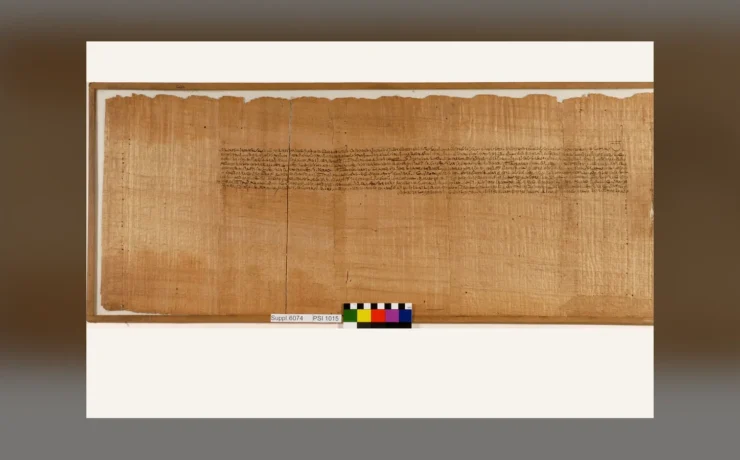
Yehia's economic discussion highlights marine trade, including the significance of pitch or tar and other supplies connected to ships. His interpretation draws on older historical scholarship, and individual product origins or quantities should be checked rather than repeated as universal facts. Import records and archaeology can corroborate the broader circulation of wine, oil and containers around the eastern Mediterranean, but they cannot automatically demonstrate the exact annual cargo passing through one Alexandrian quay. The related Zenon papyrus P.Cair.Zen. 59012 provides a documented example of imports at Pelusium in 259 BCE, which was a different eastern gateway. It should not be relabeled an Alexandrian customs record for the sake of a convenient city narrative. Differentiating these locations is useful: Alexandria had powerful royal harbor infrastructure, while Pelusium reveals the significance of additional Delta routes. The kingdom's commerce was a network, not a single harbor.
From documentary evidence to a responsible harbor history
Alexandria's lost and submerged structures pose a challenge to any digital encyclopedia. A map of the eastern and western basins may be helpful, but it should mark its chronological scope and identify modern shoreline changes. The Centre d'Études Alexandrines documents archaeological methods and the limitations of reconstructing the Pharos and harbor features from underwater remains. Official Egyptian archaeological descriptions give visitors a way to identify sites that actually survive or have been recorded. Economic papyri, coins and commodity lists supply another set of questions about how people used these spaces. No single class of evidence reconstructs every dock or shipment. The resulting picture is best understood as a layered history: a planned capital, royal maritime infrastructure, inland exchange, merchant networks and centuries of environmental transformation. For a more narrowly documented example of import administration, the separate Pelusium study examines a specific 259 BCE source without duplicating this city's wider archaeological history.
Further evidence on ancient harbors and trade
The economic harbor analysis extends Lotfy Yehia, Studies in Egyptian History: Ptolemaic Era, source PDF pages 306–310, and checks geographical and archaeological descriptions against the institutions below.
References, museum evidence and photography credits
All cited providers and institutions should be consulted at their original sources. The 3 genuine photographs document a modern Alexandrian monument, an ancient Ptolemaic decree found elsewhere, and an actual Roman column. Their explicit distinctions prevent inventing pictures of the lost Library.
- Egyptian Ministry of Tourism and Antiquities — Ptolemaic Period
- UNESCO — Nubian monuments and Philae
- Bibliotheca Alexandrina — Modern institution
- The Metropolitan Museum of Art — Egypt in the Ptolemaic Period
- Egyptian Ministry of Tourism and Antiquities — Ptolemaic period
- The British Museum — The Rosetta Stone
- Bibliotheca Alexandrina — Official modern institution
- UNESCO — Underwater Cultural Heritage and Alexandrian coastline context
- The Metropolitan Museum of Art — Ptolemaic coins in the Hellenistic kingdoms
- Wikimedia Commons — actual modern Bibliotheca photograph, not the Great Library
- Wikimedia Commons — actual Rosetta Stone museum photograph
- View of Bibliotheca Alexandrina.jpg — Ahmed Sherif, CC BY-SA 4.0.
- Rosetta Stone.JPG — Hans Hillewaert, CC BY-SA 4.0.
- Pompey's Pillar, Alexandria i.jpg — Bilal Detailz, CC BY-SA 4.0.
Historical-source cross-check and further reading
Evidence and dating note (23 October 2026): Alexander took Egypt 332 BCE; Ptolemy I's dynasty begins 305 BCE and ended with the Roman takeover 30 BCE; Rosetta decree issued 196 BCE near Memphis and stone found at Rashid, not the Library.
Original institution or academic research record: https://www.metmuseum.org/de/essays/egypt-in-the-ptolemaic-period
Scholarly reading / comparative reference: British Museum Rosetta Stone EA24; Ian Shaw, Oxford History of Ancient Egypt.
Scope: a source comparison of the named historical point, not independent scholarly approval of every claim or every image in this article.