An Egyptian customs document dated to 259 BCE offers a rare glimpse of trade through Pelusium, on the eastern edge of the Nile Delta. Rather than imagining an ancient marketplace, this study begins with P.Cair.Zen. 59012, a published papyrus associated with the Zenon archive, and compares its references to imports with the archaeological record of amphorae and Ptolemaic trade. Two genuine Greek papyrus photographs provide period documentary context, clearly identified as different manuscripts, not falsely labeled images of the Pelusium register. The result is an evidence-led microhistory of goods, records and changing coastal routes.
An invoice at Egypt's eastern doorway
Pelusium stood near Egypt's northeastern approaches, where routes between the Nile Delta and the Levant converged. One particularly valuable documentary clue is a Zenon archive papyrus, P.Cair.Zen. 59012, dated to 259 BCE. It records imported goods and has been discussed as evidence for customs at Pelusium. This is not a modern customs declaration, nor does a single text expose an entire national tariff schedule. It is a specific surviving document connected with people and shipments. Archaeology magazine's field report on Pelusium uses the papyrus alongside local excavation findings to reconsider the port's role in Mediterranean trade. Lotfy Yehia's economic history of Ptolemaic Alexandria provides a broader context in which imported products could travel between maritime gateways and Egyptian consumers. The unusual opportunity here is to explain a gateway through a near-contemporary record rather than reconstruct a fictional bustling harbor from a generic royal biography.
What P.Cair.Zen. 59012 actually is
The designation P.Cair.Zen. identifies a papyrus published from the archive associated with Zenon, a third-century BCE administrator connected to the finance minister Apollonios. The number 59012 is a scholarly reference, not an ancient Egyptian invoice number. Researchers use it to locate the specific published document among thousands of surviving pieces. Archaeology's account dates the text to late spring 259 BCE and identifies Pelusium as the setting of imported commodities. Readings of individual words and categories should be checked against an edition of the Greek rather than inferred from a modern summary. The archive's preservation is extraordinarily valuable, but it is not neutral: it reflects the affairs that generated records around particular elite administrative networks. A transaction in its pages cannot tell us what every ordinary merchant imported. It can, however, show which goods officials considered worth recording and how a port appears inside the machinery of Ptolemaic economic administration.
A gateway linking the Mediterranean and Nile
Pelusium lay in an ecologically changeable Delta landscape where branches of the Nile, marshes and coastal waters influenced movement. Ancient settlements and water routes shifted, so the coastline familiar from a modern map cannot be projected uncritically onto the third century BCE. Its location mattered for travelers and goods entering Egypt from the east. Trade depended on harbors, navigable approaches, inland transfer and official oversight. Pelusium also carried strategic military importance, yet its role as a border fortress should not swallow its commercial history. Archaeological investigation identified pottery and other materials that can help explain connections with Mediterranean regions. Still, a finding in a trench is not automatically the container described in a named papyrus. The value of combining the evidence is comparative: written record and excavated object can support a broader pattern of exchange even when they cannot be matched to the same shipment.
The categories of imported goods
The published discussion of P.Cair.Zen. 59012 describes imports such as wine, oil and honey. These are recognizable commodities, but their significance is not captured by a simple shopping list. Wine could vary by origin, container, quality and intended market; oil might be used in food, lighting or specialized work; honey was a valuable food product in multiple contexts. Without the full Greek text, exact quantities and the identities of everyone involved should not be asserted from a secondary summary. The record is important because it ties particular goods to a named point of entry and period. One does not need to invent cargo ships, merchants' names or a universal duty rate to make the document interesting. The strongest description separates attested categories from reasonable but unproven questions about their consumers and destinations.
Customs duty versus other state charges
A border entry provides a useful setting to investigate customs, but Ptolemaic financial administration used many forms of payment. An import duty is conceptually distinct from a sales tax, a lease charge, a license fee or a levy assessed on agricultural production. Researchers therefore need to identify what a papyrus actually records before calling every monetary entry a customs tariff. The presence of a list of goods might show reporting requirements without preserving every payment calculation. A published translation may summarize details that matter to legal interpretation. Modern accounts should avoid giving a neat percentage for all imported wine or honey in 259 BCE unless that rate is supported by the specific document and correctly translated. The route from tax theory to historical evidence passes through scribal terminology, calculation methods and the administrative purpose of a text. The papyrus makes the subject researchable; it does not make it effortless.
Zenon and Apollonios: why the archive survives
Zenon worked within a network associated with Apollonios, a senior financial official in Ptolemy II's administration. Many documents from this network concern accounts, travel, agricultural management, correspondence and transactions. The archive offers unusual access to administration because mundane paperwork survived in an Egyptian environment favorable to papyrus preservation. Its subjects were not chosen to entertain posterity. Some letters describe practical problems or financial decisions with consequences for individuals working for or interacting with the network. This makes the archive an antidote to narratives centered only on royal campaigns. It also creates selection bias: an elite administrative correspondent is more likely to appear than someone whose commercial activity never passed through such records. The historian's responsibility is to use the surviving text at its appropriate scale, not to convert an official's paper trail into a representative diary of every person traveling across the eastern Delta.
A genuine photographed Zenon tax letter
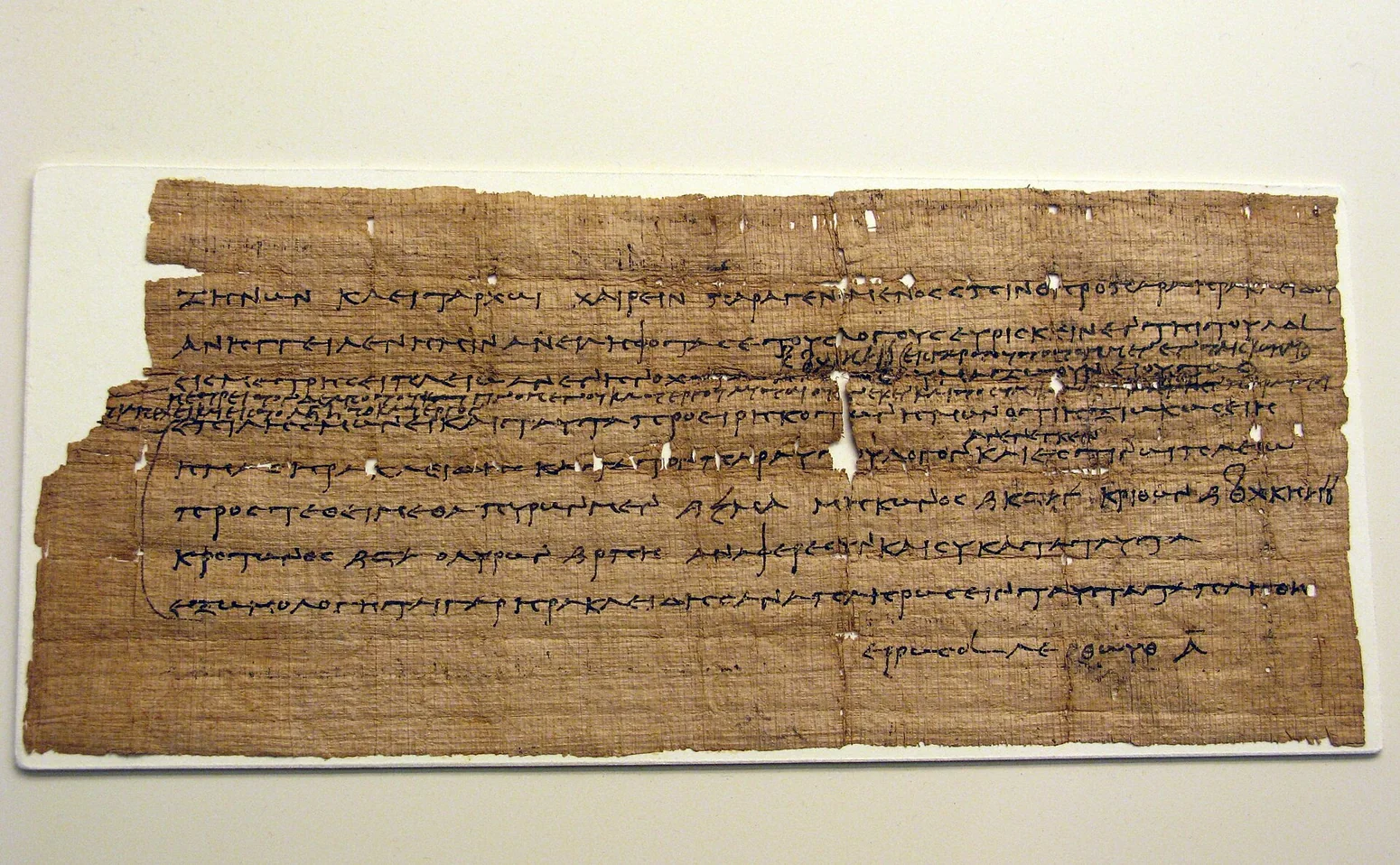
The National Archaeological Museum in Athens holds a third-century BCE Greek papyrus fragment identified as part of the Zenon archive, photographed by Tilemahos Efthimiadis under a Creative Commons Attribution 2.0 license. Its museum description concerns a letter dealing with the arrangement of suspended tax obligations. It is not P.Cair.Zen. 59012 and did not itself document the Pelusium imported goods listed above. The distinction needs to be conspicuous in a caption. Why use the photograph at all? It gives readers a real example of the type of Greek cursive administrative writing produced in this period, without pretending that an unrelated image is a facsimile of the headline evidence. The original Pelusium text is referred to by its publication number and source study. Honest editorial photography helps visitors understand what papyrological evidence looks like while respecting the identity of every surviving manuscript.
A second papyrus on honey and aromatics
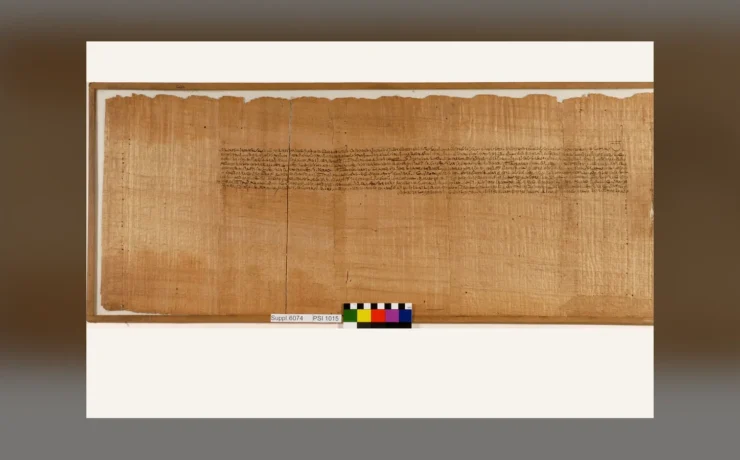
A different third-century BCE Greek papyrus, University of Michigan P.Mich.inv. 3243, includes a list of aromatics and honey and mentions nard among other substances. This provides independent evidence that administrators and scribes could record categories of imported or valued commodities in considerable detail. It is not a customs register from Pelusium, and its honey entry should not be presented as the same item in P.Cair.Zen. 59012. The photographic facsimile is an authentic archival object, not a generated parchment illustration. Its contents help expand the student's understanding of commodity vocabulary in Ptolemaic documentary culture. But there is a further interpretive limit: naming an aromatic product does not automatically establish where it originated, how frequently it passed through Pelusium or how its retail price was calculated in Egypt. These questions need trade, botanical, linguistic and fiscal studies conducted in conversation.
How amphora fragments contribute evidence
Pottery from Pelusium provides a different class of evidence. Excavations have identified amphora fragments with origins linked to places such as Rhodes, Kos and Knidos, alongside material associated with the Levant and other regions. Ceramic typology can sometimes suggest manufacturing centers or chronological ranges, particularly when handles and stamps survive. It does not identify the merchant who carried every container or its complete commercial itinerary. Archaeology's Pelusium field report discusses these amphora assemblages in connection with the papyrus evidence. The crucial chronological safeguard is that not every fragment comes from the exact same year or shipment as P.Cair.Zen. 59012. A published excavation can offer patterns across depositional contexts, while a dated papyrus anchors one transaction or account. It is tempting to attach every pot to the known document, but that would exceed the evidence. Their combined value lies in supporting a wider regional network of exchange.
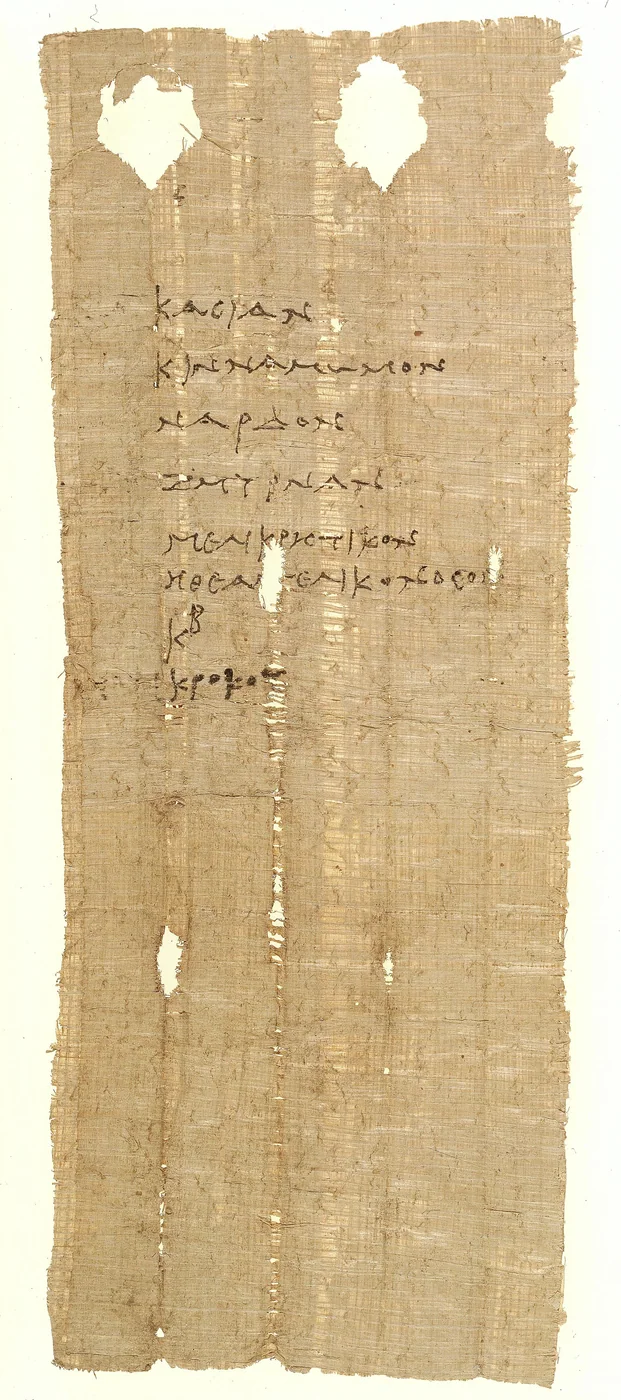
The sea route was more complicated than one straight line
A product arriving at Pelusium might have moved across multiple vessels, ports and commercial relationships before reaching Egypt. An amphora style can suggest where a vessel was made without proving where the contents were produced. Containers were sometimes reused; even a stamped handle is not a full itinerary. The eastern Mediterranean included Greek islands, coastal Levantine settlements and other markets linked by changing political conditions. Royal wars also affected access to ports, though one should not force every commercial arrival into an explanation based on a particular battle. A careful commercial history asks which evidence identifies the original seller, transshipment port, harbor of clearance and destination within Egypt. Frequently the answers are incomplete. That incompleteness makes the surviving Pelusium record valuable because it offers a rare, dateable connection between geographical passage and administrative writing.
Alexandria was not the only commercial story
The fame of Ptolemaic Alexandria often encourages a narrative in which all meaningful maritime trade passed through the capital. The Pelusium evidence helps correct that perspective. Different Delta gateways could serve distinct routes, while goods might be routed inland or redistributed through a more complex network than an Alexandria-only map suggests. Lotfy Yehia's earlier economic discussion places Alexandria at the center of major commercial developments; that larger theme remains important. It should, however, be joined to the documentary and archaeological evidence of eastern approaches rather than treated as the final word on all Egyptian imports. Pelusium's role should not be exaggerated in the other direction, as if one import list proves it rivaled Alexandria in total tonnage. No such complete comparative figures are available from the sources used here. The appropriate claim is that the network had multiple nodes with different functions.
Why rates and revenues are harder to recover
Students understandably want to know exactly what percentage officials collected on each imported commodity. The documentary record rarely provides a complete modern-style tariff table for all periods, places and goods. Ptolemaic taxes and revenue arrangements changed, and surviving documents have to be situated within a specific legal environment. An imported wine entry may identify a quantity, duty or charge, but interpretation depends on the precise Greek vocabulary and the state of the papyrus. When an older survey gives an attractive round figure, the responsible approach is to trace it back to an edition and calculation. It would be especially risky to treat a rate reconstructed from a separate Ptolemaic text as the definitive rate at Pelusium in 259 BCE. This article therefore does not publish unverified percentages. It explains the accounting questions and directs readers to the relevant primary-document reference.
Excavation context: an object is not the invoice
Material remains and manuscripts are both ancient sources, but they survive through very different processes. A papyrus may have been retained in an administrative archive far from the place it describes. A pottery fragment may have reached an archaeological layer through disposal, rebuilding or later disturbance. Unless the excavation's context and dating are secure, these objects cannot simply be lined up as if the papyrus were a shipping label glued to an amphora. The Pelusium research is strongest when read as an argument supported by converging patterns rather than a perfect reconstruction. Its pottery shows Mediterranean connections, and its written records attest to commercial recording at the eastern doorway. The historian must state which claims belong to a documented individual entry and which are broader interpretations about regional trade. This is the difference between reconstructing plausible ancient life and presenting speculation as an excavated fact.
What a student can verify independently
The paper trail begins with the publication identifier P.Cair.Zen. 59012, then a scholarly edition or reliable translation of its Greek text. The Archaeology magazine Pelusium report helps connect the written source with archaeological research, but it should not replace the underlying papyrological evidence where exact quantities or wording matter. A separate visit to the University of Michigan digital papyrus collection establishes the identity of P.Mich.inv. 3243, while the National Archaeological Museum in Athens can be identified as the holder of the photographed Zenon tax letter. These are three different objects or documents; their relationship is contextual, not identity. Keeping accession numbers and captions separate allows a reader to check each step. When new translations or excavation studies appear, the article can be updated without changing the fundamental rule that an object must be credited and described for what it actually is.
A microhistory that changes how we see the border
Pelusium in 259 BCE was not merely a spot on a military map. The surviving documentary trace points to imported goods moving through an eastern Egyptian gateway within a sophisticated administrative environment. Archaeological amphora evidence adds material context while introducing its own uncertainties about dating, provenance and reuse. The central lesson is not that an unknown merchant paid a precisely known tax on one romantic journey. It is that paperwork, pottery and geography can reveal a commercial system when treated with discipline. By using the Zenon document's identity and separating other genuine Greek papyri as contextual illustrations, the article gives students a method for reading ancient trade evidence. The richest history often emerges from documents that were never written to become history at all. A recorded commodity list, rather than a royal victory inscription, can change our sense of what was happening on Egypt's borders.
Evidence at a glance
| Evidence | What can be concluded |
|---|---|
| P.Cair.Zen. 59012 | The key dated import document associated with Pelusium and 259 BCE. |
| Greek Zenon letter in Athens | An authentic third-century BCE tax-related papyrus, not the 59012 Pelusium document. |
| P.Mich.inv. 3243 | An independent early third-century papyrus naming aromatics and honey. |
| Pelusium amphora fragments | Excavation evidence of links with Mediterranean manufacturing regions, not demonstrably identical to the invoice's cargo. |
| Numerical limitation | No universal tariff percentage or total customs revenue is asserted without directly verified ancient figures. |
Frequently asked questions
What is P.Cair.Zen. 59012?
A published papyrus associated with the Zenon archive, discussed in connection with goods entering Egypt at Pelusium in 259 BCE.
What goods are recorded?
Modern discussions identify imports including wine, oil and honey. Exact quantities and tax calculations need checking against the Greek edition.
Are the two photos of that document?
No. Both show genuine third-century BCE Greek documentary papyri: one related to the Zenon archive and tax obligations, the other to aromatics and honey.
Can amphora fragments prove the specific shipment?
Not by themselves. Excavated pottery reveals trade patterns, but not every sherd shares the precise date or provenance of the papyrus entry.
Sources and image provenance
This article uses the historical source listed in the bibliography as a research starting point, specifically PDF pages Lotfy Yehia, Studies in Egyptian History: Ptolemaic Era, economic Alexandria section PDF pages ~306–330; exact Pelusium claims checked independently. Its historical rhetoric and older interpretations are not treated as conclusive archaeological evidence. The external museum and research records below are linked for independent checking.
- Archaeology Magazine, Pelusium: Egypt's Gateway to the East
- University of Michigan P.Mich.inv. 3243 recto, APIS digital collection
- Wikimedia photo and accession context of an original Zenon archive Greek letter
- Wikimedia photographed original Michigan Ptolemaic papyrus with honey and aromatics
- Attalus online Ptolemaic and Zenon documentary translations
- Metropolitan Museum of Art, Egypt in the Ptolemaic period
- Photograph: Authentic Zenon Archive Greek papyrus letter about tax arrears, photographed in Athens by Tilemahos Efthimiadis (CC BY 2.0). It is NOT P.Cair.Zen. 59012., Tilemahos Efthimiadis, photographed at the National Archaeological Museum Athens, CC BY 2.0
- Photograph: Genuine Greek papyrus P.Mich.inv. 3243 listing aromatics and honey, early to mid-3rd century BCE; a separate document, NOT the Pelusium customs entry., University of Michigan Library digital papyrus collection; ancient anonymous author, Public domain