Why are Wadi Natrun’s monasteries important? The desert region historically called Scetis became a major centre of Egyptian Christian monastic life in late antiquity. Four major active foundations survive, while archaeological remains document other earlier communities. Manuscripts, church murals, architecture and continuing religious life connect the area with Egypt’s Byzantine, medieval and modern history.
This dossier separates the histories of St Bishoy, Dayr al-Suryan and the abandoned Monastery of John the Little, using the Egyptian Ministry and Yale’s archaeological research. Two dated original photographs identify real monastic locations without presenting today’s walls as untouched fourth-century buildings.
Why Wadi Natrun is central to Egyptian monastic history
Wadi Natrun, the desert basin historically associated with Scetis, played a major role in the development of Christian monastic communities in Egypt. Far from being an empty location chosen only for picturesque isolation, it combined desert conditions, travel routes, seasonal resources and sites where people could pursue particular forms of communal or solitary religious life. Yale University’s Monastic Archaeology Project describes Scetis as a prominent late antique centre and documents the material remains of churches, cells and settlements across the region.
This history extends from late antiquity through medieval Egypt and into living monasteries today. It belongs to the full story of Egyptian society, not only to a specialised discussion of theology. Written manuscripts, architecture, trade and archaeology help reconstruct communities that changed over centuries. The present article is about the regional monastic landscape and its surviving institutions, not a duplicate of Kemet Vault’s linguistic study of the Coptic language.
Scetis and the fourth-century desert tradition
The Egyptian monastic tradition associated with Scetis developed in late antiquity. Names such as Macarius of Egypt, Bishoy and John the Little appear in later devotional and historical records of the region. Traditions connect their ascetic practices with forms of prayer, manual labour, solitude and spiritual guidance. Yet historians distinguish an individual saint’s reported lifetime from the date when a large surviving stone complex took its present form.
The difference matters because many current monastic buildings were rebuilt, expanded or decorated long after early hermits arrived. An enclosure photographed in 2008 can stand at a site linked to earlier religious history without every wall dating from the fourth century. Yale’s archaeological work at the abandoned Monastery of John the Little provides especially useful material evidence, complementing narrative sources written for other purposes.
Four surviving active monastic foundations
Historical and heritage sources identify four principal surviving monastic complexes in Wadi Natrun: the Monastery of St Macarius, the Monastery of St Bishoy, the Monastery of the Syrians, and the Paromeos or Baramus Monastery. The Ministry of Tourism and Antiquities describes the Monastery of the Syrians as one of four surviving establishments. A broader historical inventory also records abandoned communities whose archaeology remains important.
These are not four buildings with identical histories. Each foundation has its own churches, spatial organisation, religious community and record of renovations. Treating them as interchangeable tourist attractions would miss their differences. The surviving complexes continue to be places of religious life, and public access can vary by site or occasion. A visitor should check the exact monastery before making travel arrangements rather than assuming that one general Wadi Natrun ticket covers every church or library.
The Monastery of St Bishoy
The Monastery of St Bishoy is an important working monastic foundation associated with the desert father’s historical and devotional legacy. Its visible enclosure, churches and courtyards reflect centuries of use, repair and development rather than one original construction phase preserved intact. The first documentary photograph in this article shows the actual monastery in June 2001, according to its original Wikimedia Commons file record.
The image is valuable for demonstrating the physical setting of a living foundation, but cannot prove an unbroken architectural plan from the fourth century. Modern paint, repairs and attached facilities may change over time. Visitors interested in its religious role should respect worshippers and restricted areas. The monastery’s cultural significance is both material and communal, and a photograph of an empty courtyard captures only one aspect of the institution.

Dayr al-Suryan: a monastery known for manuscripts
The Monastery of the Syrians, or Dayr al-Suryan, is particularly important to historians of books and interaction among Christian communities. The Egyptian Ministry says its foundations belong to the earlier monastic tradition and records the settlement of Syriac monks in the region. Academic research explores several stages of the institution’s development and stresses cross-cultural exchanges between Coptic and Syriac-speaking Christians.
The Ministry identifies the main church of the Virgin Mary and its extensive wall decorations as major heritage features. It also describes rare manuscripts that were historically associated with the library. The presence of Syriac material should not lead to the assertion that every resident or document was Syriac rather than Egyptian. Communities, languages and artistic traditions interacted in the monastery across many centuries. This makes the site a compelling subject for Egypt’s religious and intellectual history rather than a simple entry in a list of places to photograph.
The Church of the Virgin Mary and its paintings
Architectural studies of Dayr al-Suryan describe a church whose decoration developed through successive periods. The Egyptian Ministry notes the discovery and study of wall paintings beneath later plaster layers, with scholarly examination in the 1990s revealing complex historical phases. Cambridge University Press scholarship similarly situates the church within wider Coptic and Syriac artistic interaction in the medieval world.
This layered decoration is important because a church can contain evidence from more than one century. A surviving painting should be dated through material, iconography and documented conservation, not assigned automatically to the age of a monastery’s founding saint. Studying the layers helps reveal changes in ritual needs and artistic taste. A photograph of a restored surface documents its condition on a particular date; the painting’s original creation requires separate evidence.
Books moved from the desert to world collections
Manuscripts associated with Wadi Natrun monasteries have travelled into collections outside Egypt. The Ministry notes Syriac works once housed at Dayr al-Suryan whose later collection histories connect them with institutions abroad. Scholars examine their copying dates, language, bindings, contents and provenance to reconstruct how the library functioned. A book in a modern European library cannot be assumed to have been written there; likewise, a manuscript linked to a monastery may have arrived through exchange.
Kemet Vault’s Coptic Museum history provides related context on preservation of Egyptian Christian objects. Some manuscript catalogues describe a possible Wadi Natrun origin rather than an excavated findspot. Good scholarly interpretation retains those qualifiers. A fascinating script or painted border is only one part of the evidence; the historical movement of the book can be equally significant.
The Monastery of John the Little and lost communities
The surviving four active foundations do not represent every monastery that once existed at Scetis. Yale’s Monastic Archaeology Project studies the remains of the Monastery of John the Little, a community connected with a fourth-century monastic figure and later medieval use. The archaeological site eventually became abandoned, unlike the major working monasteries that remain visible today.
Excavated remains of cells, churches and built areas can clarify aspects of ordinary monastic living that devotional texts leave vague. Yale documents inscriptions and wall paintings which help establish later forms of reverence for monastic saints. These are direct material sources, not simply reconstructions from legend. The disappearance of a particular community also reminds us that monastic history is not an uninterrupted story of universal growth: foundations could decline, be rebuilt or cease to operate altogether.
What archaeology adds to stories about desert fathers
Lives of saints and monastic sayings preserve religious traditions that remain meaningful to communities, but their aims differ from modern archaeological field reports. A hagiographic episode may present moral teaching, miraculous events or a model of conduct. Excavated pottery, architecture and written inscriptions can instead establish dates, circulation routes or building functions. Historians learn most when these different source types are read together without forcing them to make identical claims.
Yale’s project is particularly valuable because it documents how religious institutions occupied physical space and how their community structures changed over time. A monastery is not only an isolated prayer cell; it may require storage, water management, communal worship and connections with travellers or donors. Those everyday arrangements create an archaeological record through which the larger history of the region can be investigated.
The Syrians and a wider Christian intellectual network
Dayr al-Suryan’s history provides a useful example of cultural exchange. The monastery became associated with Syriac-speaking monks whose books and traditions interacted with Egyptian monastic life. Cambridge scholarship studies architecture, paintings and texts as evidence of contacts between Coptic and Syriac Christianity across centuries. Such interaction did not erase local Egyptian identity or create a community with a single immutable language.
Egyptian monasteries could participate in networks reaching beyond the Nile Valley, through pilgrimage, the copying of texts and the movement of religious specialists. Contact with other regions is not proof that all artistic forms were imported in one direction. The history is better understood as a layered exchange in which materials, people and ideas were continually adapted. A regional Egyptian history should include these connections just as it includes Mediterranean and Ottoman trade.
What the two original photographs actually show
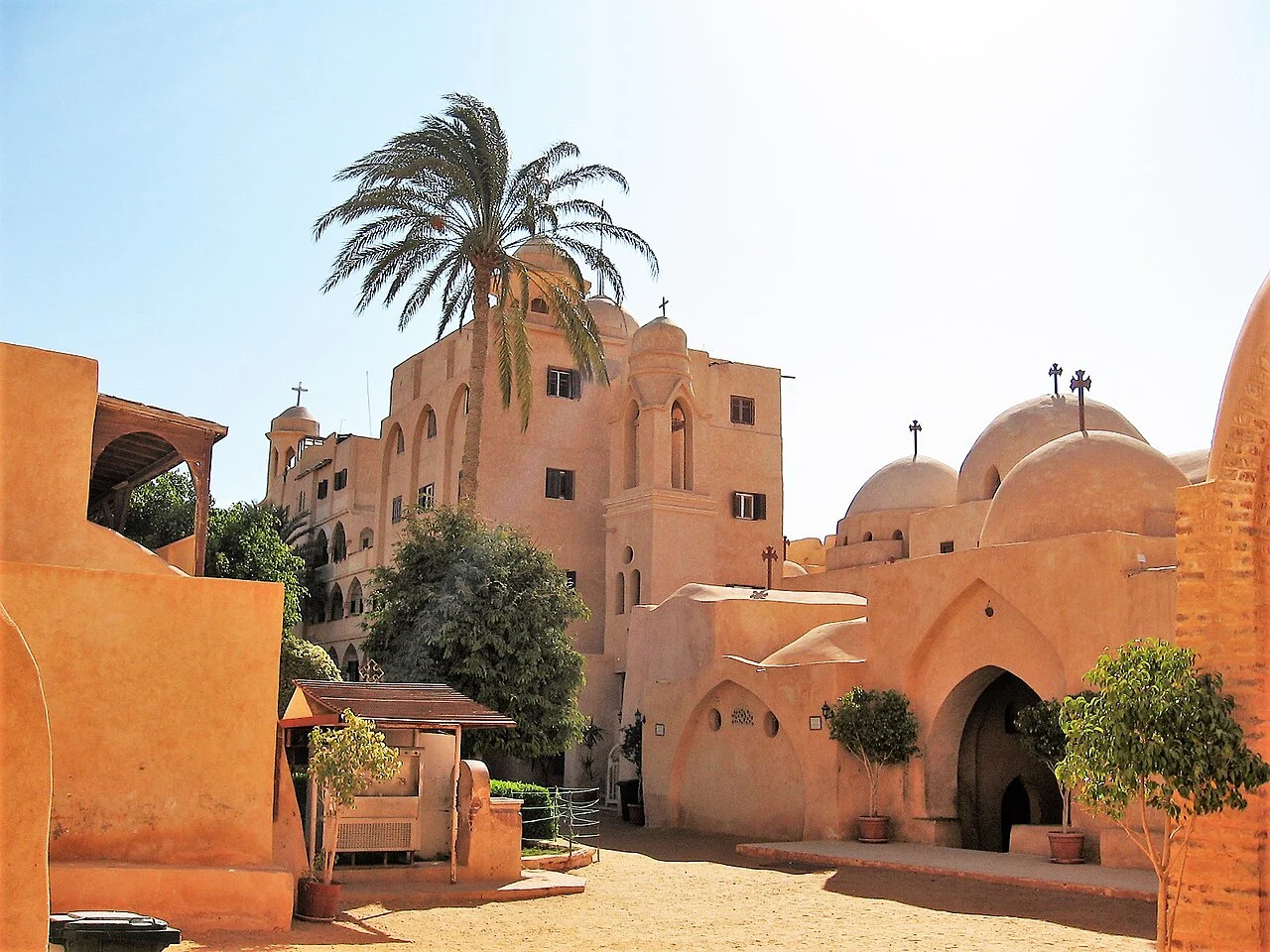
The first image is a documentary view of the Monastery of St Bishoy in June 2001, credited to The Eloquent Peasant and shared under Creative Commons Attribution-ShareAlike 4.0. The second is an independent photograph of Dayr al-Suryan made by Lumen roma in January 2008, distributed under Creative Commons Attribution 3.0. Both identify a real physical monastery, not an imagined fourth-century reconstruction.
Their different dates and subjects provide evidence of two surviving foundations. Neither photograph records the seventh-century wall-painting campaign or the medieval movement of manuscripts directly, so the captions do not pretend otherwise. Converting the photos to locally hosted WebP for an educational website should preserve the author and licence record. A clear documentary image can contribute to a heritage article without claiming to prove the age of every stone it contains.
Can travellers visit these monasteries?
Wadi Natrun is a religious landscape with functioning monastic communities. Visiting arrangements may differ by establishment, time and religious calendar. The presence of a building on a public heritage website does not guarantee access to every interior, manuscript room or monastic cell. Some areas are reserved for community use, conservation or worship. Visitors should seek the present rules of the particular monastery before arranging a journey.
Respectful clothing and quiet behaviour are appropriate, and photographing worshippers, manuscripts or restricted areas may require permission. A visitor should also consider that the desert location affects travel planning, daylight and transport arrangements. This article deliberately avoids invented fixed admission prices and opening times. The best cultural visit combines correct historical information with respect for a living institution rather than treating a monastery as an abandoned archaeological attraction.
Wadi Natrun across Egypt’s historical periods
The importance of Wadi Natrun is not restricted to a narrow Late Roman chapter. Its monastic history stretches through Byzantine and medieval Islamic Egypt, with surviving religious communities continuing into the present. Architecture, manuscripts, archaeology and devotional writings form different layers of evidence. The desert’s economic and geographic setting also matters, though the name Wadi Natrun should not be confused with the entire history of natron use in Egyptian embalming.
To explore related parts of Egypt’s history, connect this study with Saint Catherine’s Monastery in Sinai, a distinct site with its own manuscript tradition, and the Greek, Roman and Byzantine Egypt period gateway. Such links show how different communities and regions developed across time without turning each into a duplicate of the same pilgrimage guide.
Institutional archaeological and monastery history sources
The named surviving institutions and artistic history were verified against the Egyptian Ministry’s Monastery of the Syrians record. The historical and archaeological interpretation of Scetis and John the Little follows Yale University’s Monastic Archaeology Project and its monastery site study. Cross-cultural history is documented in Cambridge’s study of Dayr al-Suryan’s Church of the Virgin. Photographs document different surviving sites and years, not unverified original early medieval interiors.