How old is Saint Catherine’s Monastery in Sinai? The fortified Christian monastery on Sinai was built in the sixth century, traditionally dated to the reign of Byzantine emperor Justinian I, about 548–565 CE. It remains an active religious site with an unusually important collection of historical manuscripts and icons.
The monastery of Saint Catherine stands in a dramatic mountain landscape whose religious meaning reaches across Christian, Jewish and Muslim traditions. Its Byzantine walls, church, manuscript library and continuing monastic life are subjects of documented historical research. They also attract dramatic claims about secret books and lost scriptures. Rather than repeating mysteries without evidence, this article looks at the surviving complex, UNESCO’s heritage description and the limitations of assigning ancient dates to manuscripts or architectural details. A standing monastery used over many centuries is not a sixth-century time capsule.
For a distinct Egyptian church painting tradition, see the Red Monastery’s documented Byzantine painted sanctuary in Sohag. Travel itineraries belong to the separate a separate practical overview of travel in Egypt.
A mountain monastery in South Sinai
Saint Catherine’s Monastery stands in the mountainous interior of South Sinai, in a landscape revered in multiple Abrahamic religious traditions. Its setting is central to its importance: architecture, pilgrimage and the cultural memory of the surrounding mountains developed together. UNESCO identifies the monastery and its associated sacred landscapes as a World Heritage property, while Egypt’s Ministry of Tourism and Antiquities provides an official description of the surviving complex.
Religious traditions associate the area with Moses and the giving of the law. A historical article should accurately describe those traditions without treating a scriptural event as an independently excavated fact. The mountain names used by different communities can overlap, and a modern tourist map may employ several variants. The monumental complex itself can be dated through architecture and documentation more securely than claims about every ancient occurrence associated with the wider sacred landscape.
The sixth-century building campaign of Justinian
Egypt’s official monuments authority dates the Byzantine monastery to the reign of Emperor Justinian I, approximately 548–565 CE. Earlier ascetic communities had lived in the Sinai region, and the emperor’s building project provided an enduring fortified home for monastic worship. This date anchors the original architectural patronage, although a monastery actively used for many centuries inevitably accumulated repairs, new structures and adaptations.
The sixth-century foundation should not be confused with the date of all the treasures inside the library or museum spaces. Medieval manuscripts and icons may be much later than the walls, and objects could have traveled to the monastery from different places. Architectural identity and collection provenance are related questions but not the same question. Distinguishing them is especially important when a website advertises every book inside the monastery as a ‘secret book written in the time of Moses’.
A working monastery, not an abandoned archaeological ruin
UNESCO describes Saint Catherine’s as an exceptional continuously functioning Christian monastery. That ongoing use makes the site different from a deserted Roman temple or a museum collection displayed in an urban building. Religious services, monastic accommodation, maintenance and decisions over visitor access occur within a living institution rather than an archaeological space open without restriction.
Researchers must account for this continuity without suggesting that every practice has remained identical since the sixth century. Liturgical customs, languages and institutional relationships changed over time. The survival of the community helped protect books, icons and architecture, but it also means the record contains later interventions. Respecting the site as a place of worship is therefore both a practical visitor requirement and a historically sound way to understand its preservation.
The Church of the Transfiguration and sacred architecture
At the heart of the complex stands the Church of the Transfiguration, identified by the Egyptian Ministry as a principal surviving structure. Byzantine church architecture here reflects both the imperial foundation and the exceptional mountain setting. The church contains historical decorative and liturgical elements, although dating every surface or furnishing requires object-level research rather than an assumption that it belongs to one original building campaign.
Studying a church building means examining spatial organization, iconographic programs, changes in furnishings and the history of conservation. A modern photograph of walls cannot independently confirm the identity of every saint in a mosaic, nor can it show the exact appearance of the nave during Justinian’s lifetime. Institutional descriptions and published architectural scholarship are necessary controls for such claims. Similar caution applies when comparing the site to Egyptian Coptic monuments such as the Red Monastery in Sohag.
The manuscript library and its exceptional significance
The monastery’s library is internationally important for early Christian and other historical manuscripts. Egypt’s Ministry describes an exceptionally large collection, giving a figure of around six thousand manuscripts in its current site description. Different catalogues may count volumes, leaves, fragments or documents differently, which means totals should be attached to their source and date rather than repeated as a timeless fixed number.
Manuscripts are evidence for scribal work, reading, language and long-distance exchange, not merely collectible antiquities. A single book may carry notes from multiple readers, layers of rewriting or evidence of repair. Scholars study handwriting, materials, textual transmission and historical context to understand how a manuscript was produced and later used. The library’s significance lies in these rich layers of evidence, not in claims that every text overturns accepted historical scholarship.
Codex Sinaiticus and the limits of easy claims
Codex Sinaiticus is one of the best-known biblical manuscripts historically connected to the monastery, but its modern history includes dispersal and holdings outside Sinai. It is inaccurate to assume the complete codex is currently sitting on one shelf available to all visitors. Digital projects and institutional catalogues allow readers to distinguish sections and locations, though access to specific original leaves can be restricted.
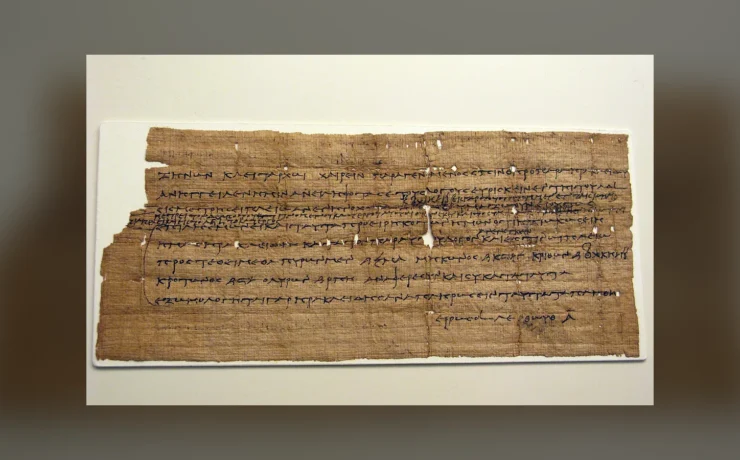
The manuscript’s text is important for the study of early Christianity and biblical transmission, yet textual scholarship requires comparison with other witnesses. A dramatic online claim that ‘the monks hid the only original Bible’ ignores how manuscripts survive and how editions are established. The key lesson is to identify the named codex, its dating and its current holdings before making assertions. The manuscript shown in this article is a different, later Greek work and is explicitly labeled as such.
Icons, mosaics and Byzantine religious art
UNESCO highlights the monastery’s outstanding collections of early Christian icons. These objects offer evidence for artistic traditions, worship, patronage and the circulation of imagery across the eastern Mediterranean. Their techniques, dates and iconography vary, and a collection that survived in a special historical setting should not be reduced to a single style or century.
Icons are both physical artworks and religious objects in living traditions. A historian can study pigment, panels, inscriptions and conservation without treating theological belief as an archaeologically established event. Conversely, respecting their religious role need not prevent rigorous historical interpretation. Authentic object photographs and catalogue records are essential, especially because modern reproductions, digitally aged illustrations and wrongly attributed panels circulate widely online.
What palimpsests reveal about manuscript reuse
A palimpsest is a manuscript surface that has been reused after an earlier text was erased or covered. Sinai manuscripts have played an important role in modern research using advanced photography to identify underlying writing. The existence of such layers does not mean every reused page conceals a suppressed doctrine or that multispectral imaging can always restore a perfectly legible lost text.
The historical value is more specific. Reuse reveals the value of writing material, changes in language, decisions by scribes and the transmission of literature. Imaging can detect traces inaccessible to the unaided eye, but interpretation still requires experts who understand scripts and textual contexts. Treating an unusual photograph as automatic decipherment is as misleading as assuming a damaged inscription on stone translates itself.

Greek, Syriac, Arabic and the diversity of written traditions
The Sinai manuscript heritage reflects contacts among communities using different languages and scripts. Greek Christian texts are prominent, while Syriac, Arabic and other languages are also relevant to the region’s documentary history. The presence of multiple languages is evidence for a complex intellectual and religious environment rather than a proof that every text was produced in the monastery itself.
Language identification requires more than matching unfamiliar letterforms to a chart. A codex may be copied in one script, annotated in another and catalogued using a modern title. Scholars establish provenance through comparative palaeography, ownership notes, materials and archival history. Educational content should therefore point readers toward institutional manuscript catalogues rather than invent English translations from a single image.
The Fatimid-era mosque within a Christian complex
Egypt’s Ministry identifies a mosque within the monastery complex associated with the Fatimid era. This feature highlights the long history of Sinai under successive political rulers and the layered relationships among religious communities. A structure within an older monastery does not make the entire complex Fatimid, nor does the Christian foundation automatically date every later addition to Justinian’s reign.
The architectural coexistence is historically interesting precisely because it raises questions about patronage, access and changes of control across centuries. A responsible account follows surviving fabric and documentary evidence without building a timeless parable in which all interactions were always identical. The monastery can be studied as part of Egyptian Byzantine and medieval history simultaneously, while keeping each building element attached to its particular chronological context.
How the UNESCO World Heritage designation works
UNESCO inscribed the Saint Catherine Area in 2002 for its cultural significance. Its property description discusses Byzantine architecture, the extraordinary manuscripts and icons, and the sacred mountain landscape. The designation recognizes a broader area rather than one small locked room or a fixed exhibition route. The cultural values include the relationships among buildings, mountain sites and continuing religious traditions.
A World Heritage inscription does not guarantee that all parts of the monastery are open to tourists or that current access procedures remain unchanged forever. Conservation needs and religious schedules can lead to restrictions. Equally, UNESCO recognition is not proof that every popular story about the site is an excavated historical event. The authoritative record establishes defined heritage values, while individual legend claims require their own source review.
What original photographs can and cannot prove
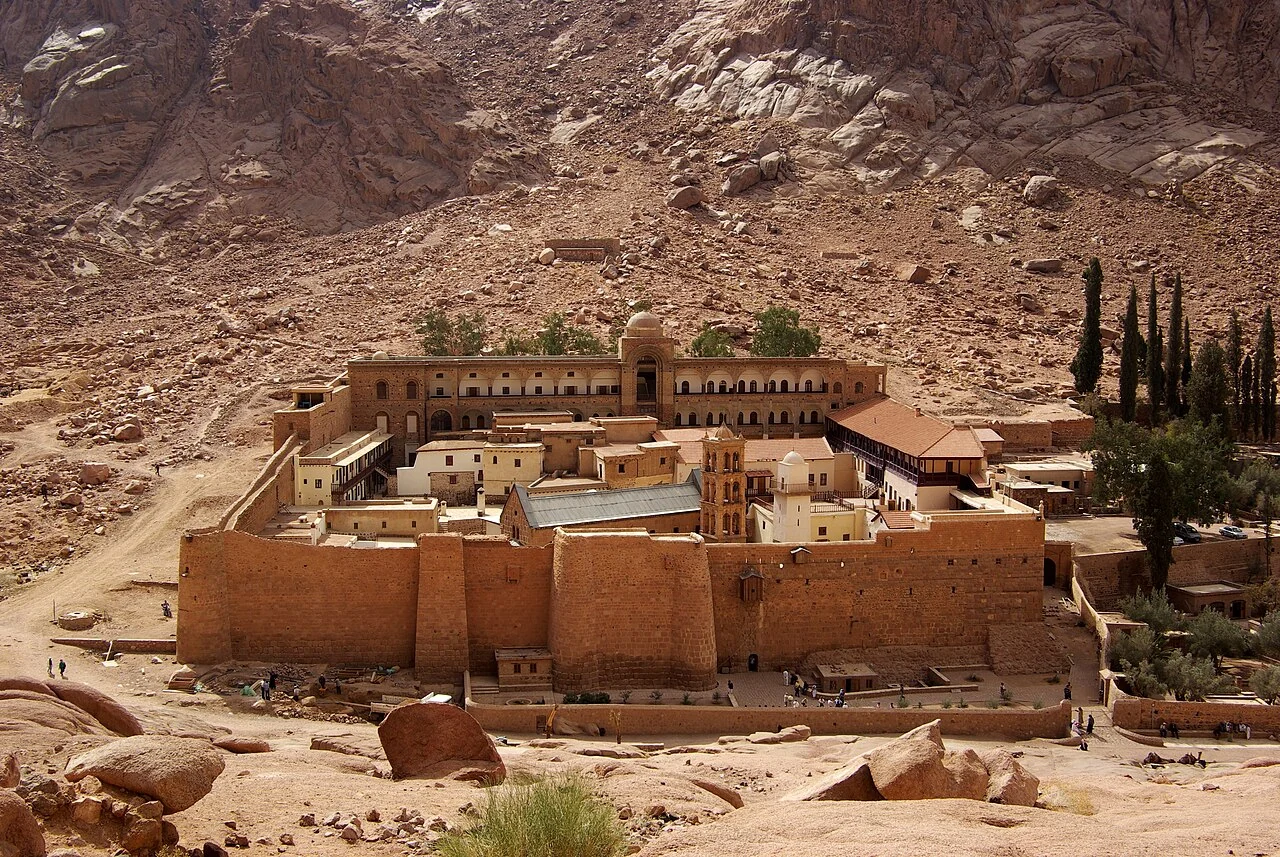
The first photograph is a real modern view of Saint Catherine’s Monastery and its mountain setting, useful for identifying the complex as a physical place. The second image reproduces a medieval Greek manuscript connected to the collection. These are different kinds of evidence: one documents surviving architecture and landscape, while the other documents scribal and textual culture.
Neither image proves that a named miracle occurred, that all manuscripts remain on site or that the modern restoration state matches the year in which a particular text was written. Their source records and licenses are noted separately. Photographic provenance matters especially for a place where there are many images of unrelated monasteries, fictional underground libraries and digitally generated ‘lost gospel’ pages circulating without proper captions.
Planning a respectful cultural visit
Anyone considering a trip should verify access arrangements through official Egyptian channels and the monastery itself close to the date. The Ministry publishes visitor information, but restrictions may change with services, conservation, weather and local conditions. A historical page should not promise entry to a manuscript archive, private monastic cells or a particular chapel simply because such spaces are mentioned in research literature.
Respectful conduct includes following photography restrictions, avoiding intrusion during worship and treating the surrounding mountain landscape as protected heritage rather than a location for unregulated collecting. A visitor may be able to see parts of the complex without seeing the original manuscript library. That is not a failure of the visit: its historical meaning extends to architecture, place and living religious practice.
Why the monastery’s layered history matters
Saint Catherine’s Monastery brings together a sixth-century Byzantine foundation, continuously evolving religious life, manuscripts copied in different periods and an internationally significant mountain setting. Its strongest historical claims rest on architecture, dated texts, published catalogues and institutional descriptions, not on dramatic lists of books supposedly hidden from the world.
An evidence-led reader can appreciate the site without insisting that every object or tradition dates to Justinian. Comparing its Byzantine artistic heritage with the Red Monastery’s Egyptian painted sanctuary offers one useful contrast, while the UNESCO site statement gives the broader cultural context. The monastery’s continued life makes conservation a shared responsibility, and its documentary treasures deserve source-specific identification rather than mythmaking.
What the sources actually document
| Evidence | Secure fact | Limit |
|---|---|---|
| 548–565 CE | Justinian-era fortified monastic foundation | Not the date of every manuscript or icon |
| UNESCO inscription 2002 | Recognized cultural landscape and monastic heritage | Not a guarantee of universal visitor access |
| Manuscript library | Exceptional collection of historical texts | Totals vary by catalogue and recording method |
| Fourteenth-century Greek manuscript photo | Real medieval textual object associated with Sinai | Not Codex Sinaiticus or a sixth-century page |
| Monastery buildings | Surviving architectural fabric and continuing religious life | Later changes require separate dates |
Primary institutional records and bibliography
The UNESCO property description and Egyptian government’s site record are authoritative for heritage significance and founding chronology. Religious traditions are described as beliefs; specific manuscripts are identified by their actual collection history. Sources reviewed 4 November 2026.