The Red Monastery of Sohag preserves an exceptionally rich painted sanctuary of Late Antique and Coptic Egypt. Its architectural color schemes, saint portraits and complex restoration history make it a major historical source, not merely an attractive destination. This study asks how the monastery was built, repainted, damaged, restored and experienced by worshippers, and why its art belongs to Egypt’s own history as well as to wider Byzantine-era culture.
The church is also a living religious site. Its earliest monastic traditions and the surviving late-fifth-to-sixth-century paintings must be dated separately. Every photograph in the article records real architectural fabric with its documented photographer, license and modern exposure context, and no reconstruction is described as a photograph of the original building.
Why the Red Monastery is a major chapter of Egyptian history
The Red Monastery near Sohag preserves some of the most extraordinary monumental Christian painting in Egypt. Its richly ornamented sanctuary contradicts the idea that monumental art vanished from the Nile after the pharaohs or that Late Antique Egypt merely copied distant capitals. Within a living Coptic Orthodox setting, painted architectural bands, sacred figures and carefully framed niches form an integrated visual environment. Most of the surviving sanctuary dates to a late fifth- or early sixth-century architectural and decorative world. A succession of painting campaigns, damage and restorations makes the historical picture more complicated than a single foundation date. In the early twenty-first century, conservators cleaned soot and stabilized surfaces that had long obscured the art. Their work changed what scholars could see without turning a modern photograph into evidence of how a church looked in the year 500. Kemet Vault examines the monument through documented architecture, conservation science, regional monastic history and original licensed photography. Its significance lies in the Egyptian people who worshipped, commissioned, built and repeatedly adapted it over centuries, not in a claim that it was an isolated European-style building transplanted into Egypt.
Deir al-Ahmar: location, naming and the Sohag landscape
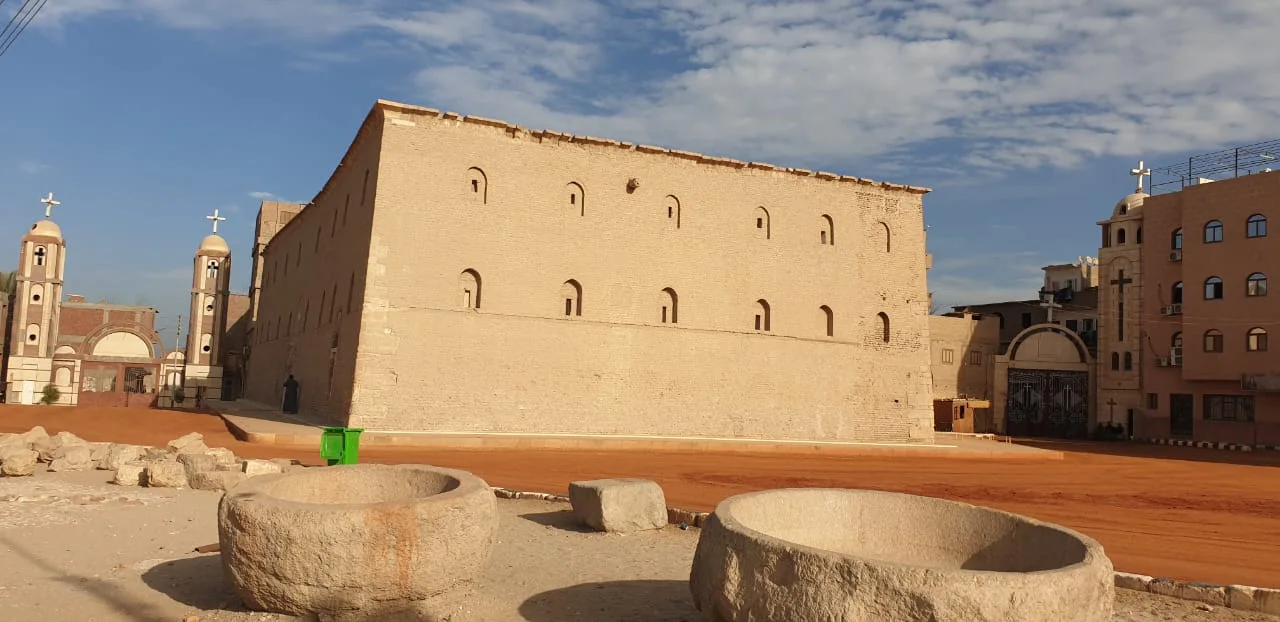
The Red Monastery, also called Deir al-Ahmar, lies west of Sohag in Upper Egypt. The Egyptian Ministry of Tourism and Antiquities places it roughly twenty-one kilometres west of Sohag and explains its traditional name through the red bricks employed in construction. White limestone and pink and dark granite columns also appear in its fabric, demonstrating that the architectural palette is more diverse than the name suggests. The surrounding region includes villages, cultivated land, desert margins and other ancient sites. Changes in land use mean that a photograph taken in 2024 cannot recreate the landscape inhabited by monks fifteen centuries earlier. The much-discussed White Monastery, associated with Saint Shenoute, lies nearby but is a separate complex with its own building history and archaeological program. The pairing is historically fruitful precisely because neither site’s evidence should be attributed casually to the other. A figure in a niche at the Red Monastery cannot be used as a generic photograph of the White Monastery. Place matters for interpreting the church’s materials, agricultural support, access and position within Egyptian monastic communities. It was never a weightless artwork removed from social and environmental realities.
Fourth-century traditions and the later date of the painted church
Several historical layers are frequently collapsed into one statement that the Red Monastery was founded in the fourth century. The Egyptian Ministry associates its early monastic foundation tradition with a figure called Bishoy or Pshoi. The surviving church and the monumental decoration examined by conservation specialists are generally attributed to the late fifth and sixth centuries, sometimes summarized as construction around 500 CE. The apparent difference is not necessarily a contradiction: a community’s remembered beginnings and the construction of a preserved sanctuary are separate chronological claims. Archaeologists establish building phases through masonry, plaster, blocked openings and comparisons with documented forms. Art historians analyze different painting layers, motifs and inscriptions. These sources give a more informative chronology than assigning every surviving wall to a famous saint’s lifetime. The church’s long life included episodes of destruction, renewal and functional change, while portions of the original basilica were modified. A careful account acknowledges that relatively short official summaries and lengthy specialist publications highlight different evidence. No one should describe a repaired column, freshly cleaned image and original brick wall as if they were all made in the same year.
The sanctuary’s three lobes and their architectural logic
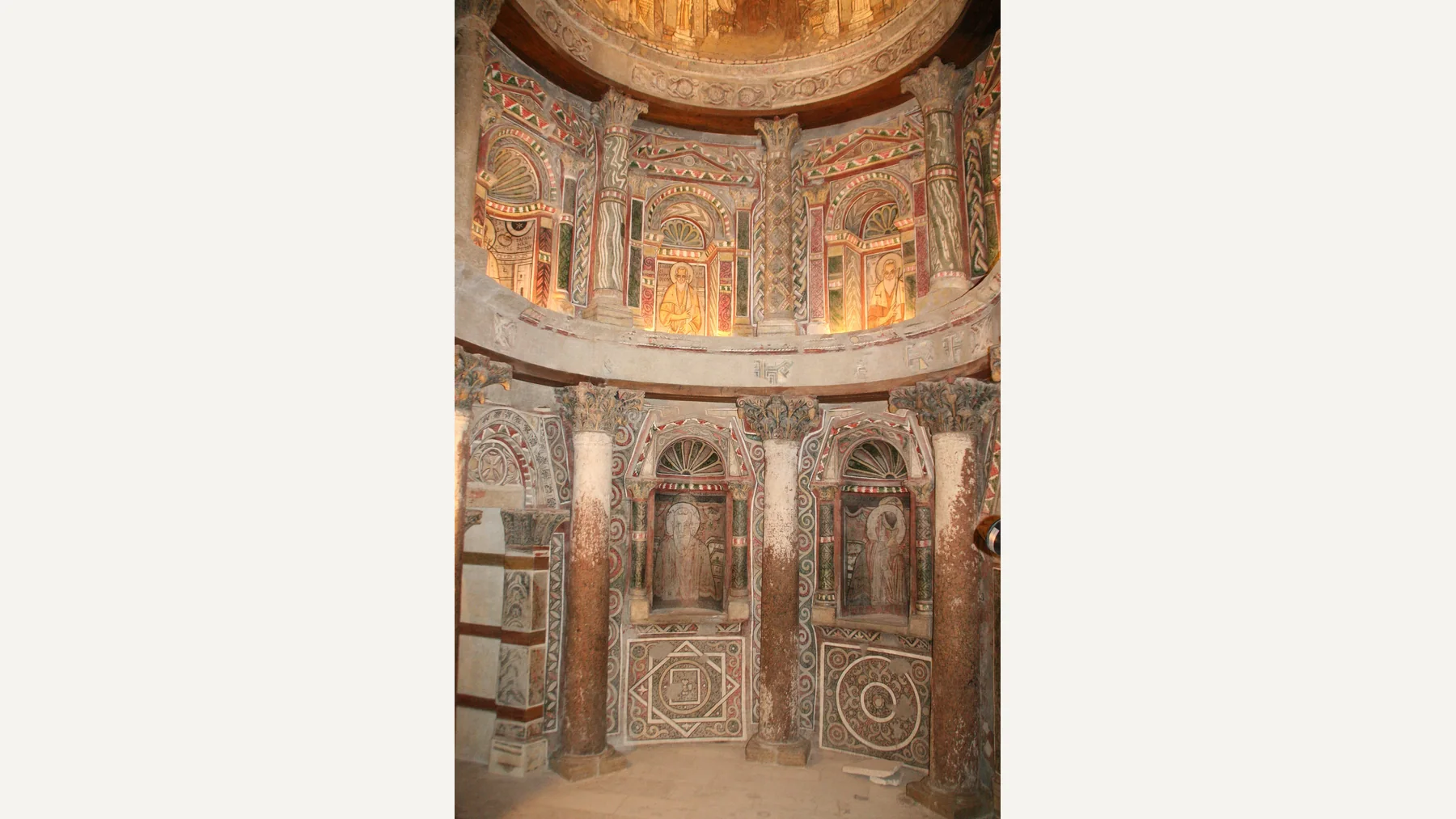
A distinctive feature of the Red Monastery is its sanctuary, organized around three apsidal lobes in what is often called a tri-conch plan. The resulting surfaces offered multiple curved niches, columns and arches that invited highly structured imagery. A visitor cannot understand the visual sequence from a single frontal image because decoration wraps around corners and changes with height. Figures were embedded in architectural settings where frames, colors and repeated patterns mattered as much as individual portraits. The stone elements and the painted surfaces must therefore be studied together. Some niches once carried more complete figures than survive now; others were modified or repainted in later campaigns. The room’s physical structure affected light, movement and the way worshippers encountered images. Compared with a rectangular exhibition wall, the sanctuary is a layered three-dimensional environment. Scholars have connected aspects of its design with wider Late Antique Mediterranean art but do not need to imply that all work was directed from Constantinople. Egyptian builders and painters created a locally functioning religious space using techniques and visual conventions circulating through many parts of the eastern Roman world.
Jewelled style: architecture painted into precious form
Art historians often call the colorful painted scheme of the Red Monastery a “jeweled style.” The term describes elaborate ornamental surfaces with striking color, patterned bands and visual effects recalling precious materials. It is a modern analytical label, not the name of an ancient school or workshop preserved in a dedicatory inscription. In the Red Monastery, ornament and figural painting coexist across columns, arches and niches. The decorated architectural framework could transform ordinary plastered surfaces into an impression of richness while preserving recognizable religious images. Met and ARCE scholarship relate these patterns to a broad Late Antique visual world. But resemblance to famous churches elsewhere is not sufficient evidence that a particular painter emigrated from one named city. Pigments, plaster layers and traces of overpainting require laboratory and field examination rather than interpretation from the brightest online photo. Different photographs record the sanctuary at different conservation stages, which also alters perceived contrast. The decorated surfaces demonstrate that Egyptian monastic visual culture was capable of lavish, technically demanding art, even within religious traditions that valued ascetic discipline. The artistic and social evidence needs to be read together rather than reduced to a stereotype.
Multiple painting campaigns and the question of dates
Published conservation research indicates several overlapping painting programs in the Red Monastery, particularly in the fifth and sixth centuries. Some short accounts describe three important phases, while a major scholarly volume edited by Elizabeth S. Bolman describes four successive paintings. The counts depend in part on how scholars group layers and fragmentary evidence. Instead of treating one summary as infallible, readers should recognize the interpretive structure behind such numbers. A painted saint might have been added after an earlier pattern, and a damaged section can preserve pigment from more than one campaign. Technical analysis of mortar, pigment, plaster and surface condition contributes to sequencing, although not every layer has an independently dated written inscription. A visitor should not assume that every figure was designed at the moment the church walls first rose. Restoration photographs can make more recently conserved sections appear more coherent than worn areas whose paint has almost disappeared. That visual unevenness is not proof of unequal ancient workmanship. A source-led history states approximate artistic horizons and presents the sanctuary as a changing sacred interior rather than one untouched image from a precisely recorded inaugural day.
Shenoute, Pcol and Pshoi in the painted niches
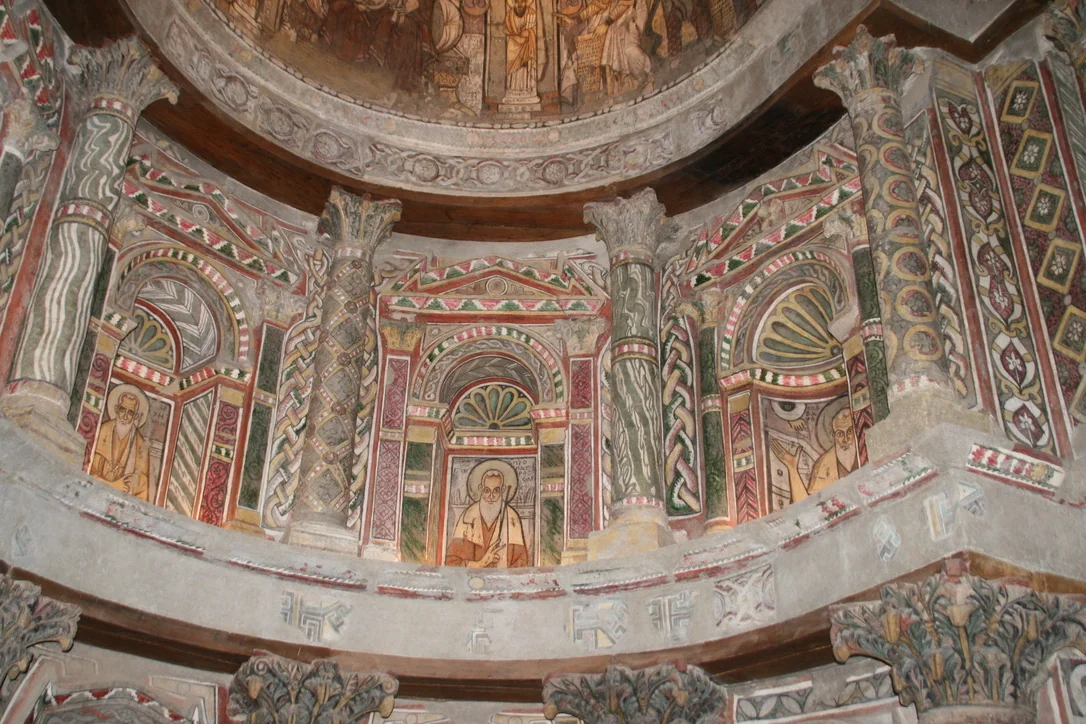
The sanctuary’s devotional portraits include figures linked with Egypt’s monastic traditions. The Commons record for a 2012 photograph of the north apse identifies a sequence of niches as Shenoute, Pcol and Pshoi, with another figure outside the crop. This source-linked label is useful but should still be distinguished from independent reading of every damaged inscription. Interpreting saints’ portraits combines surviving captions, stylistic comparisons, placement and monastic texts. Shenoute is best known through the nearby White Monastery and extensive Coptic literature connected with his community. The paintings at the Red Monastery attest to a broader regional devotional network, not a claim that all figures belonged to the same monastery or lived in the same decade. Nor does a portrait prove that a particular sermon was delivered before it. The art’s religious purpose involved recognition and memory within worship, yet its full original audience is not recoverable in detail. The figures demonstrate the usefulness of archaeology alongside written traditions: architecture can show what communities chose to make visible even when the everyday names of artisans and local worshippers are lost. Careful figure identification is preferable to assigning a dramatic story to every halo.
What an authentic photograph of the murals can show
The north-apse photographs in this article are genuine records of the Red Monastery interior taken in 2012 by the same identified Commons contributor, but they show different compositions. One offers the broader architectural setting and another isolates a group of portrait niches. This distinction matters because cropping a figure can sever it from the position that gave it meaning. A photo documents surviving pigment, structure, damage and conservation state at the time of exposure. It does not automatically date a plaster layer, identify every saint or reproduce ancient lighting. This is why the captions state photographer, license, place and date, while historical dates come from Ministry, ARCE and academic studies. A particularly attractive conservation image published by a museum may not be freely reusable merely because it is online. The editorial decision to use separate licensed originals with clear source links protects the research and the photographer’s work. The sanctuary is best understood through visual and documentary evidence in partnership. A person viewing two adjacent niches should ask not simply how colorful they look but how they relate to columns, earlier paint and the history of the worshipping community.
Red versus White Monastery: shared region and distinct histories
The nearby White Monastery is closely associated with Saint Shenoute and became the subject of extensive research by the Yale Monastic Archaeology Project South. Yale documents its own archaeological concession, survey, mapping, architectural research and wall-painting conservation. Those works illuminate the larger monastic setting of the Sohag region but cannot be substituted directly for excavation findings at the Red Monastery. The latter is especially known for its brilliantly painted sanctuary and ARCE-backed conservation campaigns. Distinguishing the sites is fundamental when drawing conclusions about early Egyptian monastic organization. A literary text related to Shenoute does not automatically name the patron who paid for a specific Red Monastery painting. Equally, a column in the Red Monastery is not visual proof of architecture uncovered at the White Monastery. Comparative research is nonetheless powerful because it can help reveal how communities shared devotional practices, artisanship and regional networks. A wider Kemet Vault study of Ptolemaic Alexandria supplies an earlier chapter in the Mediterranean history of Egypt, while this monastery belongs to the later Christian landscape of Upper Egypt.
Brickmakers, stoneworkers and the people who made the church
Monumental painting required more than religious ideas. The building depended on brick production, quarrying, transport, carpentry, plaster preparation and skilled painters. The preservation of stone columns alongside colored architectural bands shows collaboration among different crafts. Although the exact workforce is not known in full, its existence is a necessary material inference from the scale and complexity of the work. It would be wrong to invent a named master painter or announce that all specialists were sent by an emperor. Style comparisons do not equal surviving payroll records. Monastic communities also relied on food, land and regional networks to sustain residents and visitors, though evidence for a specific economic activity at another Upper Egyptian monastery should not be relocated here without local corroboration. The question of who financed the sanctuary is likewise distinct from who applied its pigments. Church patrons could seek spiritual commemoration, social standing and community benefit, but their personal motives require documentary caution. Exploring this history enriches the art rather than reducing it. A decorated niche becomes evidence of people preparing walls and sustaining a complex for repeated use, not merely an isolated icon floating free of the society that made it.
How soot and later intervention concealed a painted world
For a long time, portions of the Red Monastery paintings were hidden under soot, dust, old coatings and repairs. ARCE reports that these conditions kept the sanctuary’s visual richness from scholars and visitors. Cleaning old pigment is a scientific undertaking because the boundary between harmful deposit and fragile original surface can be difficult to establish. Conservators test methods before applying them at scale; uncontrolled abrasion or chemical treatment can remove ancient pigment irreversibly. Some later coatings and restorations are themselves historical layers that should be documented before intervention. The aim is not to replace every missing colored patch with newly painted decoration. It is to stabilize the surviving artwork, remove damaging material where justified, and make the evidence understandable. Academic publications on the 2006 and 2007 campaigns describe how the recovered ornament expanded the known corpus of Late Antique art. A modern photograph taken after cleaning can therefore reveal evidence that earlier visitors could scarcely see. It should also prompt questions about what was removed, what remained and which details researchers chose not to reconstruct. The history of conservation is part of the monument’s history, not a cosmetic afterthought.
ARCE conservation and the stability of the structure
The American Research Center in Egypt, with support from USAID and cooperation with Egyptian institutions and the local monastery, participated in substantial conservation beginning in the early 2000s. Its separate architectural conservation project under Nicholas Warner ran from 2015 to 2018. The work went far beyond beautiful photographs of newly vivid paint. Floors and surfaces had to be stabilized, previous problematic interventions reassessed, and the physical relationship between walls and the ruined basilica considered. The historical building had been damaged and rebuilt across centuries, complicating any attempt to treat it as a closed, stable architectural specimen. Protecting fragile paint without addressing movement in walls, moisture or inappropriate floor materials would not solve the conservation problem. Specialist research therefore integrated architectural documentation with treatment of decoration. The project exemplifies why international cooperation should not be presented as a foreign team rescuing an empty place. Local expertise, Egyptian heritage authorities and the monastic community have continuing interests in its care and interpretation. Published project descriptions provide better evidence of technical decisions and timelines than a travel blogger’s account of a dramatic overnight reveal.
The relation between monastic asceticism and visual splendour
The sanctuary poses a fascinating historical question: why would a community committed to religious discipline invest in visually rich decoration? A simplistic answer assumes that ascetic life excluded art, but Late Antique monastic practice was diverse. Painted saints, ornamental patterns and spatial arrangements could help articulate devotional relationships within worship. The same artistic investment might also reflect patrons and communities who saw the building as a public statement of faith. That does not prove monks universally approved every form of imagery, nor that the painting program settled religious debates across Egypt. Different communities and authors could express varying approaches. The Red Monastery nevertheless shows that disciplined monastic religious life and complex visual craftsmanship were not mutually exclusive. The images were not merely luxuries hung in a private room; they were integrated with the architecture of a functioning sanctuary. Their placement helped give sacred space a distinctive visual identity. To understand the seeming tension, historians analyze patronage, religious practices and the vocabulary of Late Antique art rather than projecting a modern opposition between simplicity and beauty onto the fifth or sixth centuries. The physical evidence allows a richer historical interpretation than stereotypes about either “Byzantine decadence” or “primitive Coptic art.”
Fire, destruction and rebuilding: which claims are securely known?
Official site histories mention fires and episodes of conflict during the Red Monastery’s long existence. Such statements point toward complicated building history, but the exact date and cause of every episode are not always recoverable from a short monument summary. Archaeology distinguishes a damaged surface, a rebuilt wall or a change in floor level from a later narrative naming the event that caused it. If a room was repaired, the reason might include fire, structural failure, altered use or ordinary maintenance. Without securely dated layers, inscriptions or other linked evidence, one cannot assign all modifications to one attack. ARCE researchers reported that the original church, built around 500 CE, underwent substantial later changes. This makes the preserved building a historical palimpsest rather than an unaltered masterpiece. It also makes long-term survival remarkable. The paintings were not simply preserved by chance; periods of use, partial loss, conservation and architectural change all affected what visitors see. An honest account does not conceal damage and modern rebuilding to protect an attractive story of uninterrupted perfection. It treats those layers as important evidence of what happened after the first artistic campaigns.
A living Coptic Orthodox sacred site, not a sealed tomb
The Red Monastery remains associated with active Coptic Orthodox worship and a local religious community. That changes how historical interpretation and photography should be approached. An archaeological tomb closed for preservation and a working sanctuary can both contain ancient art, but their visitors encounter different obligations. Researchers work within heritage and community arrangements; tourists should respect rules governing access, services and photography. The site is not a stage for invented fifth-century costumes or unrestricted filming. Its contemporary spiritual function is not in conflict with its archaeological importance, although practical conservation decisions require negotiation. Labels such as “Byzantine” and “Coptic” also have different scopes. Byzantine often designates the late eastern Roman political and artistic world, while Coptic refers to Egyptian Christian cultural and linguistic traditions. One can describe a sixth-century Egyptian Christian painting as part of a Byzantine-era context without declaring that its maker was a Greek or that its users were culturally foreign. The specificity of the monastery’s local history is essential. Visitors and students gain more when the site is treated as an Egyptian institution with continuing religious life rather than an exotic decorative ruin.
What does this monastery change in Egypt’s larger narrative?
Many accounts divide Egyptian history into the pharaonic and Islamic eras with only a brief mention of Roman or Byzantine centuries between them. The Red Monastery shows how misleading that division can be. Egypt’s Christian communities maintained institutions, languages, sacred art and connections to agriculture and towns, contributing to the cultural history of the Nile Valley. The painted sanctuary is not an imported art object isolated from the landscape; it grew from an Egyptian monastic network that participated in a wider Mediterranean world. Equally, the Arab conquest of Egypt in the seventh century did not mean that all monastic communities vanished immediately. The monastery’s later repairs and continuity help demonstrate the need to examine local chronologies. Kemet Vault’s study of early Islamic Fustat</a provides a complementary account of an emerging city in the following era, rather than a claim of instantaneous replacement. A complete encyclopedia benefits from following objects and people across conventional period boundaries. The Red Monastery's architecture, paintings and conservation records make that long continuity tangible, inviting readers to see Egypt's Late Antique centuries as an essential part of the country's own story.
How to read a restored mural and its photographic source
A museum-quality account must tell visitors what evidence is in front of them. The broad north-apse view shows genuine ancient decoration in a modern photograph taken after substantial conservation. The portrait detail belongs to the same sanctuary but emphasizes figures rather than the overall architectural design. The exterior photo from 2024 documents the site and modern setting, which includes later changes. These images are different from professional copyrighted conservation photographs published on institutional sites. Their Wikimedia source pages specify the authors and reuse licenses, and captions must preserve those conditions when the files are resized as WebP. A bright photographic image is not proof that every pigment is untouched, every saint is securely identified or every column is original to the first building phase. Research on dating and surface treatment belongs to site publications and conservation reports. The task of a careful editor is to place photos and evidence together while retaining each source’s actual limits. Doing so makes the Red Monastery useful to students, visitors and curators long after a fashionable reconstruction has become outdated.
Chronology and architectural evidence
| Historical layer | Supported observation | Caution |
|---|---|---|
| Fourth century | Early monastic foundation tradition | Not date of every surviving wall |
| Late fifth to sixth century | Church construction and several painting campaigns | Phases are differentiated through research |
| Later centuries | Building modifications and damage | Not every cause can be dated precisely |
| 2000s | Paint cleaning, repair, conservation | Cleaned colors are not newly invented paintings |
| 2015–2018 | ARCE architectural conservation phase | Different from original construction date |
Scholarly and official reference shelf
https://egymonuments.gov.eg/en/monuments/the-red-monastery; https://arce.org/project/red-monastery-architectural-conservation/; https://arce.org/conserving-coptic-heritage-historic-egyptian-american-partnership/; https://www.metmuseum.org/exhibitions/listings/2012/byzantium-and-islam/blog/where-in-the-world/posts/sohag-and-bawit; https://academic.oup.com/cairo-scholarship-online/book/28513/chapter-abstract/230190787; https://smarthistory.org/red-monastery-sohag/; https://egyptology.yale.edu/expeditions/current-expeditions/yale-monastic-archaeology-project-south-ymap-south. Original photo copyright and authorship statements are embedded immediately below each image. Chronological conclusions reflect field research and conservation findings. Reviewed 25 October 2026.
Frequently asked questions about the Red Monastery
Where is the Red Monastery?
It lies west of Sohag in Upper Egypt, near but distinct from the White Monastery of Saint Shenoute.
Was the surviving church built in the fourth century?
The monastic community has an early foundation tradition, but the main surviving painted church is generally assigned to the late fifth or early sixth century with multiple later decoration campaigns.
Are the newly vivid murals modern repaints?
Conservation removed obscuring material and stabilized authentic historical paint, though the fabric includes later repairs and changes.
Is the monastery still in religious use?
Yes. Historical research and visits must respect its continuing Coptic Orthodox community and site rules.