At the heart of downtown Cairo, the traffic flows around Talaat Harb Square while people cross between banks, bookshops, cafés and narrow side streets. Look up from the pavement and you’ll see another city above the shop signs: balconies, elaborate cornices and European-influenced façades built for a different era of Cairo’s urban life.
The city didn’t suddenly become modern when those buildings appeared. But during the nineteenth century, its rulers extended Cairo westward with new streets, public buildings and bridges. Downtown became a place where architecture, transport and changing ideas of public life met. Much of that story is still visible, provided we look beyond the most photogenic façades.
How Ismail’s new Cairo grew beside the old city
Modern Cairo’s nineteenth-century transformation had roots in the reign of Muhammad Ali, who took power in 1805 and pursued sweeping administrative and infrastructure reforms. A generation later, Khedive Ismail backed an ambitious expansion of the city. Egypt’s Ministry of Tourism and Antiquities links Ismail’s plans to his visit to the Paris Exposition in 1867 and the involvement of Ali Pasha Mubarak in urban development.
New squares, broad roads, gardens and public institutions formed a district west of the older city. This was not simply a European town placed on empty ground. It developed beside existing neighborhoods, while housing, social access and public services remained uneven. The fashion for calling Cairo the ‘Paris of the East’ captures the planners’ aspirations, but it risks making Egyptian agency disappear from the story.
The contrast is useful when exploring on foot. Historic Islamic Cairo preserves streets and monuments shaped by much earlier dynasties. Downtown, with its late nineteenth- and early twentieth-century building stock, answers different questions. The UNESCO Historic Cairo World Heritage designation is not a label that automatically covers every building with an ornate façade in central Cairo.
Read the buildings around Talaat Harb Square
Many downtown buildings combine elements borrowed from several architectural traditions. A balcony with French-looking metalwork does not necessarily mean a French architect designed the entire block. Different owners and generations changed facades, ground floors and internal uses. The city’s architecture reflects collaborations among Egyptian and foreign builders as well as the tastes of landlords, businesses and residents.
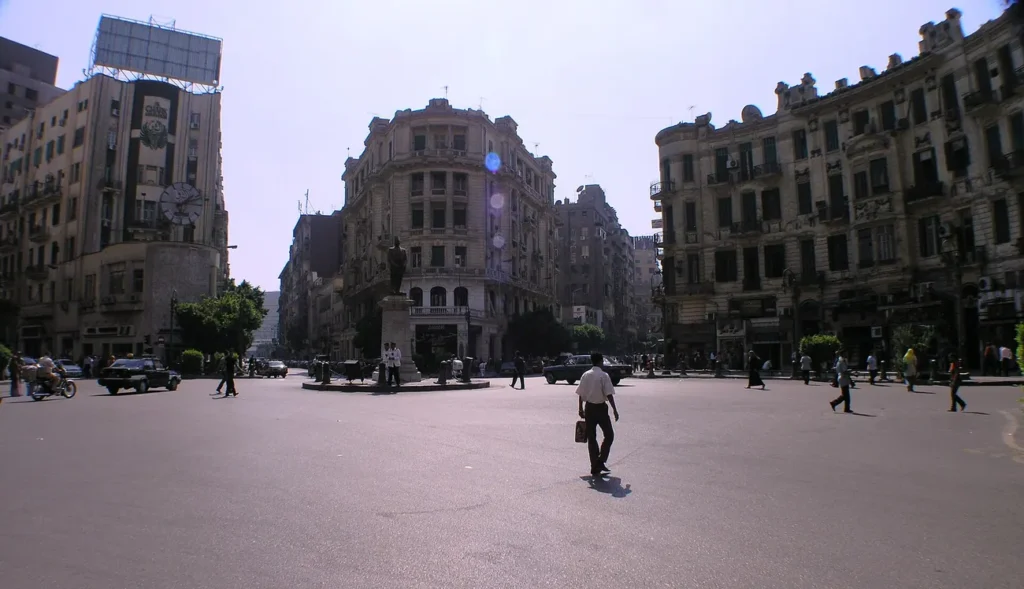
The published Cairo Urban Initiatives Platform record for the Immeubles Khédiviaux identifies a group of early twentieth-century buildings on Emad el-Din Street designed by Antonio Lasciac. It describes their shared courtyards and distinctive domed corners. That level of documentation is worth seeking out for any building you want to name: an address, an architect, and a particular historical phase, rather than a generic label such as ‘colonial European building’.
A good urban walk may involve nothing more than comparing several nearby buildings. Notice where upper-floor residences remain above new shops, how entrances and courtyards organize space, and which signs of repair or decay reveal later chapters of use. Today’s street life is part of the architecture’s history, not visual clutter to edit out of the photograph.
The Nile and bridges changed how people moved
Cairo’s bridges are more than scenic lines across the river. They connect districts, support commuting and shape the way the Nile can be approached or crossed. A visitor looking at the river from a bridge sees a modern infrastructure system as well as a famous landscape. The nineteenth-century city-building program described by Egypt’s monument authority explicitly included bridge building alongside squares and gardens.
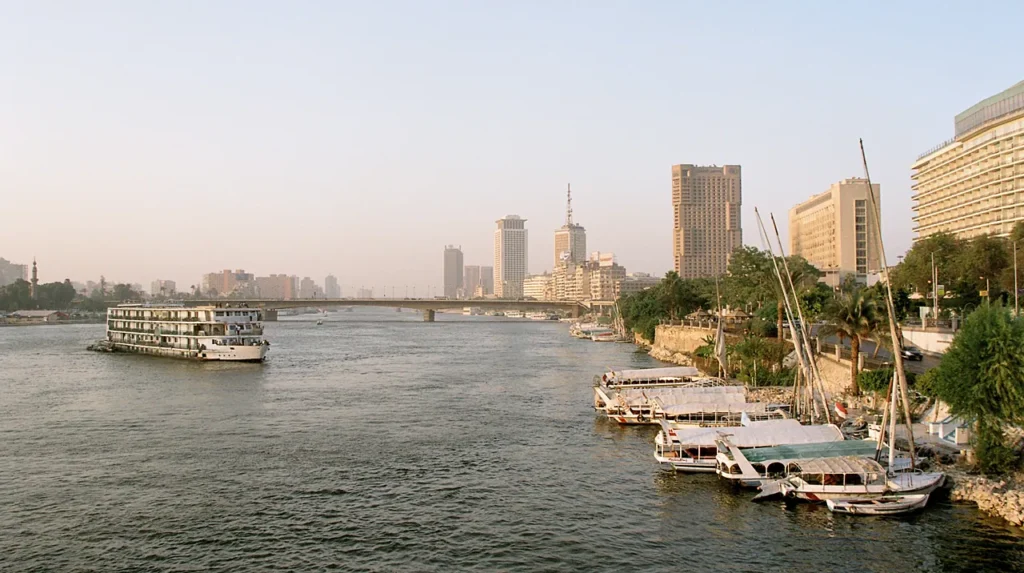
The riverfront can appear serene from above, but its streets are heavily used spaces, shared by residents, visitors, vehicles and riverside businesses. Photographs taken a decade or two ago may be valuable records of the city as it was then; they should not be passed off as proof of how a crossing or promenade works today. When discussing a specific Nile walkway, access, traffic and construction need contemporary checking.
That difference between urban history and current travel advice is easy to overlook. An accurate city article can explain why a bridge matters without promising that a particular sidewalk, ferry or service remains open on the date a reader arrives.
Books, cafés and the city beyond its façades
Downtown Cairo became a setting for institutions, commercial life, publishing and political discussion. Shops and cafés gave people places to meet; theaters and cinemas changed the ways culture was experienced in public. These uses are as important as decorative stonework, although their history cannot be established from building photographs alone.
The development of public libraries belongs to the same long transformation. Egypt’s national library, Dar al-Kutub, grew out of nineteenth-century initiatives that reflected new cultural and educational ambitions. Our Dar al-Kutub historical guide follows the institution through its buildings and collections. Looking at both the library and a downtown commercial street helps reveal a city where formal institutions and everyday social spaces developed side by side.
It is worth resisting a romantic claim that every old café or cinema has remained unchanged since the age of the monarchy. Businesses move, reopen, change names or disappear. Their specific histories need photographs, directories, oral testimony and dated records, not nostalgia alone.

Why saving downtown is complicated
Historic urban buildings were designed for uses, materials and services very different from those of a crowded modern metropolis. Maintenance is expensive, interior requirements change, and shopfront alterations can gradually obscure older architectural details. A recent academic study of Khedivial Cairo’s revitalization describes the difficulty of restoring buildings while working with existing owners, stakeholders and contemporary urban needs.
Preservation cannot mean treating downtown as an empty stage set. Residents need usable housing, businesses need viable premises and the public needs access. Nor should every building be repaired with a superficial façade treatment that leaves structural and social problems untouched. Conservation succeeds when historic value and present-day life are considered together, even if that makes the work slower and more complicated than a promotional before-and-after image suggests.
How to explore modern Cairo without pretending it has one story
A useful starting point is the area around Talaat Harb Square and its surrounding streets. Look up at the façades, compare building styles and read the dates and names where they are documented. From there, follow the relationship between downtown and the Nile, keeping in mind that bridges, parks and public access points may have changed since an older photograph or travel guide was published.
For a different architectural layer, our Al-Muizz Street walking route explores the much older city and its surviving Islamic monuments. The contrast is the point. Cairo has repeatedly changed without becoming a single new city each time.
The strongest documentary starting points for this article are the Ministry’s Khedivial Cairo history, the UNESCO Historic Cairo dossier and the Cairo Urban Initiatives building record. Together they show how a street, a building and a protected historic district can answer very different questions about one living city.