\n
A local confrontation near Menouf on 13 August 1798 rarely features in English accounts of Napoleon's Egyptian expedition. Egyptian historians describe armed resistance at two neighboring villages, Ghamrin and Teta, followed by an attack by reinforced French units. Some retellings report severe casualties and punitive burning, but key details depend on an alleged officer's letter that requires original archival verification. This original encyclopedia investigation distinguishes the dated narrative in Muhammad Moro's book and the earlier account attributed to Abd al-Rahman al-Rafii from evidence that remains unconfirmed. Its historical maps are authentic source images, not fabricated photographs of an eighteenth-century battle.
Two villages that rarely appear in English histories
A reader searching for Egypt's resistance to Napoleon's expedition will usually encounter Alexandria, the Battle of the Pyramids or the Cairo uprisings. Yet an Arabic historical account describes a violent confrontation on 13 August 1798 at two villages north of Menouf in the Nile Delta, named Ghamrin and Teta. Dr Muhammad Moro includes the episode in his modern history of Egypt, drawing in part on the earlier historian Abd al-Rahman al-Rafii. Later Egyptian commentary repeats the same names, date and an alleged French officer's description. This makes the event a meaningful subject for research, but also a warning against counting repeated versions of one source as independent eyewitness confirmation. An original history must show which details are reported, who reported them and what cannot yet be checked directly. The villages deserve attention not because an exciting legend can be embellished, but because local conflict reveals a side of the expedition often lost in narratives centered on generals and capitals.
The French expedition had barely begun
French forces arrived in Egypt in the summer of 1798, and major political and military upheaval followed. Napoleon's campaign combined military ambitions, demands for supplies and attempts to establish administration in a country governed through Ottoman and Mamluk structures. The Bibliothèque nationale de France describes the expedition as a project with imperial and commercial motives as well as a scientific component. Such framing matters: research on local resistance should not portray the campaign as a peaceful archaeological tour interrupted by unreasonable villagers. Nor should it assume that every person in the Delta fought for identical motives. Villages faced demands for food, animals, taxes and cooperation while also responding to military occupation and rumors of war. The records are uneven because French officers generated substantial correspondence, while many Egyptians left fewer surviving personal documents. A story about two villages must be situated within that unequal documentary landscape.
The reported date: 13 August 1798
Moro's book states that General Fougières departed Cairo on the evening of 5 August, passed through Menouf and moved toward Gharbia on 13 August. After approximately an hour's travel north of Menouf, his column reportedly encountered resistance at Ghamrin and Teta. The date and sequence appear also in narratives drawing on al-Rafii's history of Egypt's national movement. These attestations establish that a recognizably similar account circulated in Egyptian historiography. They do not, by themselves, confirm every hour or direction in the itinerary from an independently checked French operations journal. Spelling further complicates searches: Arabic sources transcribe French names in several ways, while the village name sometimes appears as Tata, Teta or Tana in modern renderings. Rather than select a spelling and erase its variants, this article records the uncertainty. A truly precise itinerary would require locating the original dated dispatch and a period map with reliable toponyms.
Why village geography changes the story
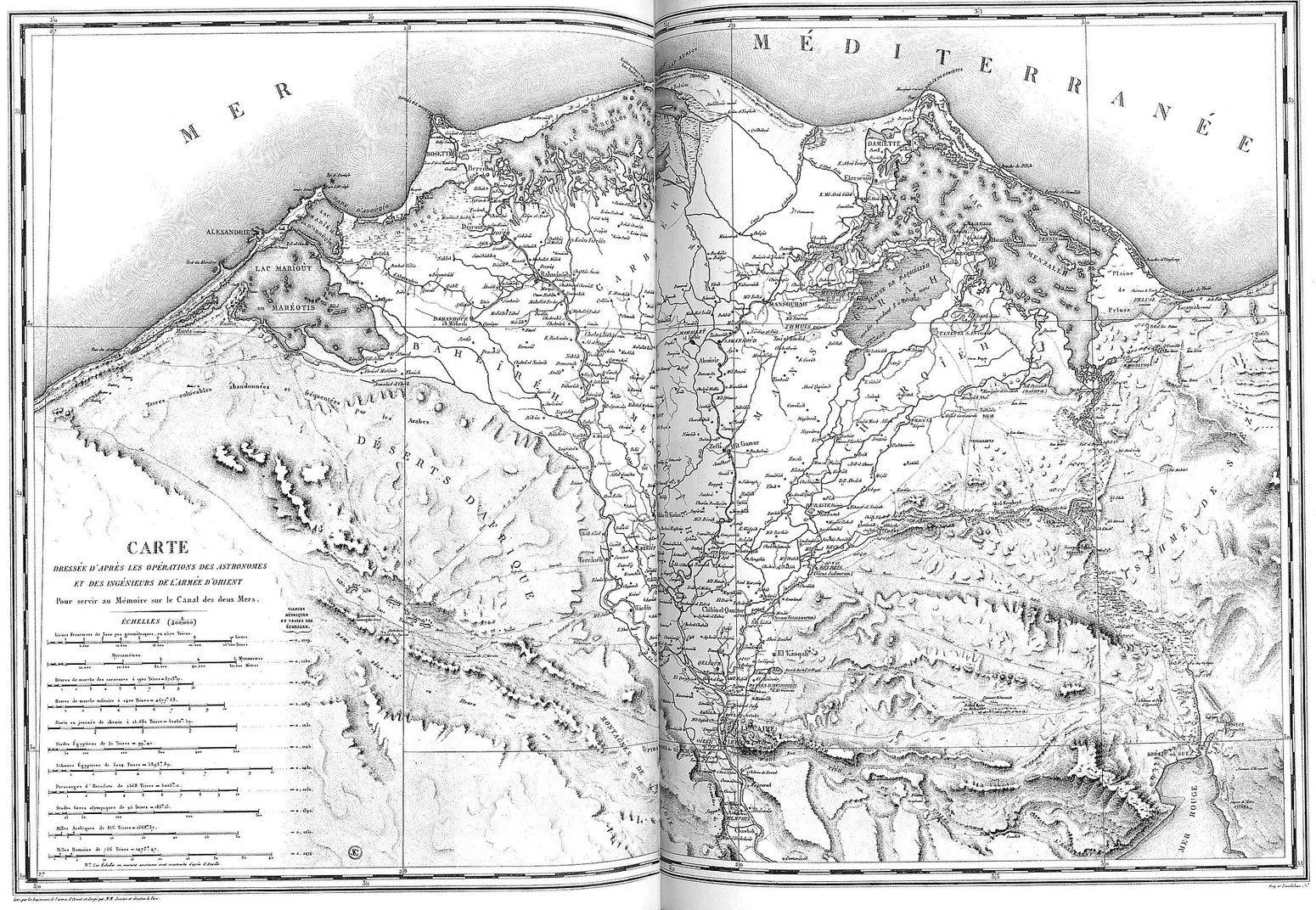
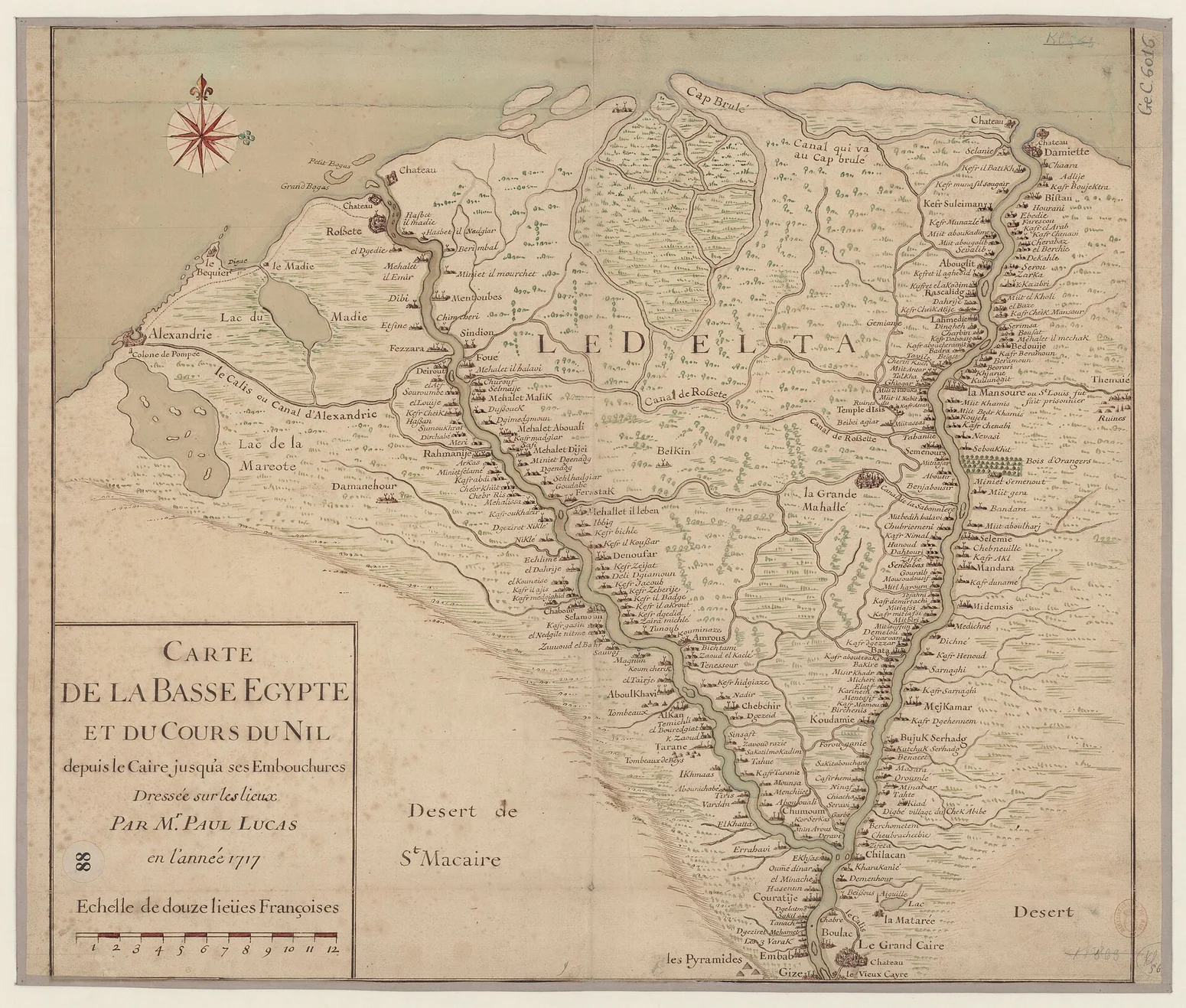
Menouf and its neighboring countryside formed part of a dense network of settlements, canals, fields and local roads. The history of an armed column moving north is therefore as much about routes and access as about the courage or cruelty of combatants. The two villages are described as neighboring places, but the modern naming and precise location of every approach should not be asserted solely from the Arabic narrative. The article includes an authentic map of the Nile Delta printed from the Description de l'Égypte project in the early nineteenth century. It helps readers understand the region's waterways while not identifying the exact battlefield. An older map prepared by Paul Lucas in 1717 shows the Delta before the French invasion and provides a second, independent historical cartographic perspective. Neither map is a photographic record of the 1798 fighting. This distinction is essential for a source-led page that refuses to turn geography into invented reconstruction.
The reported refusal to allow the troops through
According to Moro's account, the residents of Ghamrin and Teta took up arms and blocked the troops' passage. The French commander was reportedly unable to compel the villages to admit his column and requested reinforcements. This sequence may reflect the wording of al-Rafii, who in turn used material about the campaign. The basic story fits the broader reality of clashes between occupation forces and rural communities, but that contextual plausibility is not sufficient to establish every detail. It would be incorrect to supply names of individual village leaders or invent an ultimatum whose text has not been found. It is also possible that the practical meaning of closing a village to troops involved particular approaches rather than a single continuous city-style defensive gate. An editorially responsible reconstruction should therefore say 'the historical account reports' when presenting the blockade, distinguishing a narrative claim from an archaeological or administrative finding.
Fougières, the Menouf garrison and the request for help
The Egyptian narrative names a French general whose surname appears in Arabic as Fougières or Fougiéres and identifies another commander at Menouf as Zayonchek or a similarly rendered form. These transliterations should be treated as working identifiers until confirmed against French personnel and dispatch indexes. In the account, the first force asks for and receives support from Menouf, after which the combined units attack the settlements. The fact that Egypt's historians preserved such details is valuable: the clash is not depicted as a spontaneous isolated encounter without a military chain of command. Yet the composition, strength and movements of the units would need French unit records for precise verification. It would be misleading to supply exact battalion numbers or maps of maneuvers without such documents. The story instead raises questions about communication and logistics in a newly occupied rural district, where commanders could depend on nearby garrisons for support.
What the historical account says about the battle
Moro describes intense fighting, particularly within Ghamrin, after French reinforcements arrived. Residents are said to have fought in the village streets even after the attacking force entered. The narrative's dramatic phrasing reflects the tradition of patriotic military history and should not be reproduced as an independently verified battle report. Nonetheless, it makes a meaningful historical claim: the confrontation was not confined to a distant cavalry action between regular armies, but included civilian communities defending settlements. No excavated battlefield collection is identified in the sources used for this feature. Without such evidence, it is impossible to reconstruct where each barricade stood or which buildings were damaged. The responsible approach is to preserve the narrative with explicit attribution and explain what future archival or archaeological research could test. A detailed fictional battle scene might be exciting, but it would destroy the distinction between recorded testimony and the modern writer's imagination.
The often-repeated claim of 400–500 dead
Several retellings quote an alleged French captain, given in Arabic as Virus or a similar spelling, who claimed that the attackers killed approximately four to five hundred opponents after a fight lasting two hours. The same reported statement mentions women among those who resisted. This is a casualty claim attributed to a participant's letter, not an independently established demographic count. The specific French-language document has not been verified here by its archive reference or image. Casualty estimates made in battle can be inaccurate, politically motivated or based on incomplete observation. Repeating the number as a fact would therefore be irresponsible. The best formulation is to say that later Egyptian sources attribute this estimate to a French officer, pending retrieval of the original. The human suffering described should be taken seriously without replacing historical caution with a sensational invented total.
Women in the sources: testimony and its limits
The reported French officer's remark about women fighting is striking and has become central to popular accounts of the episode. If authentic, it would document an occupying soldier noticing women within the resisting population. It would not establish the number of female participants, their identities, their roles in preparations or every motive for involvement. Later patriotic writing can use such a line as a symbol of collective resistance, sometimes expanding the story beyond what the underlying document actually says. An evidence-based encyclopedia should respect the significance of the claim while tracing its transmission. It should not invent names, costumes, speeches or individual deaths. Women in Egyptian rural communities could act politically and economically, but reconstructing one specific battle needs better source access. The acknowledged uncertainty invites rather than closes research: who witnessed the action, which narrative traditions preserved it and whether local documents can add perspectives absent from military correspondence?
Reports that the villages were burned
Some Egyptian historical accounts state that the French force burned the villages after subduing resistance. Such a report is an allegation of a grave punitive act, and its documentary chain should be treated with care. Neither the supplied book nor repeated modern articles provides a complete archaeological survey demonstrating the damage at a securely identified 1798 layer. Burned structures can have many causes across generations, so even a find of ash would require contextual dating and interpretation. The larger French campaign certainly generated coercive orders and acts of violence in different localities, as reflected in the archival materials discussed by the French Ministry of Defence and the BnF. But an instance elsewhere does not independently prove the precise circumstances at Ghamrin. This article therefore attributes the burning allegation to the historical narrative rather than presenting it as a photographically or stratigraphically verified event. That is not an attempt to minimize suffering; it is a way to honor the distinction between testimony and evidence.
How al-Rafii and Moro frame resistance
Abd al-Rahman al-Rafii was an influential twentieth-century historian of Egyptian political struggle, while Muhammad Moro's later book presents the years 1798–1952 through a clear ideological interpretive framework. Both can be read as part of the history of how the Egyptian past has been narrated. Their use of the same episode is not equivalent to two separate French eyewitness accounts. Moro's page 51 reproduces the date, named commanders and violent encounter within a larger chapter on rural and urban resistance. Al-Rafii's earlier national history helps explain why these village stories became important symbols of opposition to foreign rule. A modern research article can draw value from this historiography without silently inheriting every rhetorical conclusion. The question is what these authors actually cite, how their accounts depend on earlier records and how much can be corroborated. Writing a source-led investigation is more original and useful than copying the most dramatic paragraph in smoother English.
French and Egyptian archives offer different perspectives
The French Ministry of Defence describes a major series of surviving expedition records containing orders, correspondence, administrative documents, reports and accounts. Its collaborative work with the Institut français d'archéologie orientale highlights nearly a thousand documents in Arabic and some in Ottoman Turkish, including petitions, complaints and correspondence from Egyptians themselves. These collections make it possible to move beyond European officers' summaries, although not every relevant text is digitized or searchable by one standardized village name. The project's description notes that the French often depended on translators in communicating with Arabic-speaking communities. That too affected how local voices entered official files. To verify Ghamrin and Teta fully, researchers should search the August 1798 military correspondence with French and Arabic name variants, then compare any recovered report with local records. The existence of an archive is not proof it contains the specific letter that later historians quoted.
Why historic maps cannot act as battle photography
No photographic camera recorded the events of August 1798 at these villages. Using a modern AI image of armed peasants as if it documented the clash would create false historical evidence. The two images in this feature are genuine maps: a Delta representation published in the Description de l'Égypte project from 1809 onward, and Paul Lucas's pre-expedition map dated 1717 in the Bibliothèque nationale de France. These maps can reveal how cartographers described river branches and the region during different periods. They cannot show who fought, who died or precisely where the troops stood on 13 August. Nor should the later French map be assumed neutral; it emerged from a massive project of representation associated with a colonial military expedition. A conscientious caption gives production date, archive and scope. Authenticity is valuable precisely when the limits of what an image can establish remain visible.
A comparison with Cairo-centered occupation narratives
The most commonly taught episodes of Egyptian resistance occurred in large cities, especially Cairo. That emphasis is partly a function of surviving records, scholarly attention and the political visibility of urban events. The Delta account suggests rural communities also confronted occupying forces very early in the campaign. It would be inaccurate to turn one incident into proof that every village followed a coordinated national command structure. Forms of resistance could be localized, defensive, religious, fiscal or connected with regional armed groups. Local alliances and motivations were likely varied, and the historian must avoid imposing a single later ideology on everyone who acted in 1798. Comparing the narrative with better-documented urban episodes is useful for asking why certain histories become famous while others remain in footnotes. The goal is not to diminish the importance of Cairo's uprisings, but to show why an encyclopedia of Egypt should also investigate the places missing from conventional chronological summaries.
A transparent conclusion and the next archival test
There is good reason to study the reported confrontation at Ghamrin and Teta on 13 August 1798: its names and date are preserved in more than one modern discussion, tracing back to a recognized Egyptian historiographical tradition. What has not been independently verified is the original French captain's letter, the exact casualty count or a physical battlefield site. The article therefore identifies these details as attributed claims, not settled facts. It gives a practical research path through French expedition correspondence, Egyptian petitions and the versions assembled by al-Rafii and Moro. This distinction is especially important when an account concerns alleged killings and punitive burning. Public history should not demand impossible certainty before discussing an event, but neither should it supply invented certainty to satisfy a dramatic headline. A cautious, document-aware account allows readers to appreciate how rural Egyptian history survived and why scholarly verification remains necessary.
Evidence at a glance
| Evidence | What can be concluded |
|---|---|
| 13 August 1798 | Date attributed in Muhammad Moro and narratives drawing upon al-Rafii, not fully independently checked against French operational records. |
| Village names | Ghamrin and Teta; variant renderings include Tana. Modern place identity needs localized verification. |
| Reported casualties | 400–500 attributed to an alleged French officer's dispatch; original archive identity not verified. |
| Reported punitive burning | Claim in Egyptian historical writing requiring additional source investigation. |
| Historical maps | Authentic 1809-era Delta map and 1717 Lower Egypt map, NOT battlefield photographs. |
Frequently asked questions
Did the villagers fight Napoleon personally?
The Egyptian narrative describes a clash with French forces under a different commander, not an encounter with Napoleon himself.
Is the 13 August 1798 date certain?
It is explicitly recorded in Egyptian historical accounts, but the exact French field dispatch and date have not yet been independently checked.
Were 400–500 people killed?
That is a figure attributed to an alleged French captain in later historical writing, not an independently audited casualty record.
Are the article images genuine?
Yes. They are original historical maps preserved through recognized archives and Wikimedia records, clearly labeled as contextual maps rather than photographs of the fighting.
Sources and image provenance
This article uses the historical source listed in the bibliography as a research starting point, specifically PDF pages Muhammad Moro, Modern History of Egypt 1798–1952, PDF pp50–52, citing earlier Abd al-Rahman al-Rafii narratives; corroboration still incomplete. Its historical rhetoric and older interpretations are not treated as conclusive archaeological evidence. The external museum and research records below are linked for independent checking.
- Egyptian historian's 2013 account of the Ghamrin-Teta events and attributed French captain report
- French Ministry of Defence: archival holdings of the Egyptian expedition 1798–1801
- Bibliothèque nationale de France: background to the French Egyptian campaign
- Scholarly article on memory and representation of the French Occupation of Egypt
- Public-domain map of the Nile Delta from Description de l'Égypte
- Gallica/BnF original 1717 Paul Lucas map of Lower Egypt
- 2025 secondary review citing al-Rafii's account and its limits
- Photograph: Original Nile Delta cartographic plate published in the Description de l'Égypte project beginning in 1809, showing regional waterways. Not a verified map of the Ghamrin-Teta battle positions., Historical map engraved and published in Description de l'Égypte, early nineteenth century, Public domain
- Photograph: Authentic Lower Egypt map of 1717 by Paul Lucas from Bibliothèque nationale de France (GE C-6016). This predates the 1798 fighting and cannot identify its precise troop movements., Paul Lucas, original 1717 map preserved at Bibliothèque nationale de France, Public domain