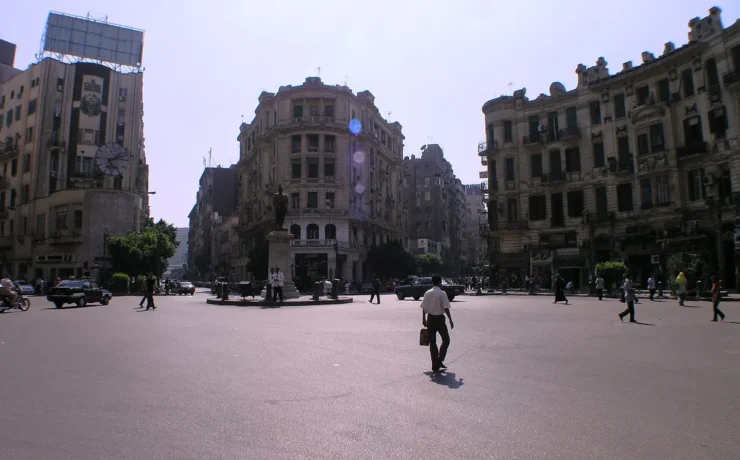
Decades before the Suez Canal opened, letters and passengers crossed Egypt between Alexandria and the Red Sea. The journey required steamships, river craft, agency offices, carts, labor and reliable arrangements for coal. Using the nineteenth-century historical account of Omar al-Iskandari and Selim Hassan together with the British Library's surviving India Office records, this research guide reconstructs how the corridor worked, who organized it and what its archives actually establish. It includes original period illustrations rather than made-up photographic scenes of the nineteenth century.
Editorial standard: Original historical analysis developed from Omar al-Iskandari and Selim Hassan's historical account of the overland route in Egypt, checked against British Library India Office postal archives and institutional records. The illustrated objects and historical representations are explicitly identified; contested interpretations are not presented as excavated facts.
The journey that existed before the canal
The Suez Canal opened in 1869, but correspondence between Britain and India was already moving across Egypt long before ships could sail through the isthmus. The route combined Mediterranean vessels, Egyptian inland transport and Red Sea shipping, making the transfer points just as important as the sea voyage. Omar al-Iskandari and Selim Hassan devote a short but unusually useful chapter to this overland connection in their history of Ottoman and nineteenth-century Egypt, PDF pages 198–200. They stress the commercial and diplomatic circumstances in which the route was revived. The British Library's India Office agency records allow a closer investigation of what that revival meant: staff were appointed, letters carried, accounts kept and supplies of coal moved from Alexandria toward the Red Sea. A modern account should not confuse the history of a trans-Egyptian mail corridor with the later, waterborne passage of the canal. The two systems had overlapping purposes but required different infrastructure.
Why the Cape of Good Hope was an unsatisfactory alternative
European ships could reach India around the Cape of Good Hope, and the journey was a critical element of imperial shipping long before an Egyptian postal service became regular. But this circuit was long, seasonal conditions could influence sailing schedules and important decisions in India often waited upon communications from Europe. In the early nineteenth century, governments, merchants and postal reformers therefore searched for faster arrangements. The older Arabic history associates the fortunes of Egypt's transit trade with the rise of the Portuguese Cape route. That helps establish a historical contrast, although it would be too simple to claim commerce through Egypt stopped completely or that the Cape route was always cheaper and safer for every cargo. The renewed route was especially attractive for letters, passengers and high-value items. It was not necessarily a universally economical path for heavy bulk goods, which were costly to unload, cross the desert and reload into another vessel.
Alexandria as an administrative doorway
At the Mediterranean end, Alexandria was more than a convenient port name printed on a map. Vessels arriving from European ports carried mailbags whose onward movement required agents, forwarding instructions and coordination with Egyptian transport. The British Library describes an Agency and Deputy Agency in Egypt, alongside packet agencies at Cairo and Suez. The records include letters received and sent and accounting books rather than merely commemorative sketches of famous pioneers. Alexandria connected maritime arrivals to inland navigation through the Mahmoudiya Canal and the Nile as well as to roads and later rail services. That infrastructure was neither timeless nor frictionless: changing water levels, vessel availability, officials and weather could interrupt a carefully designed connection. The practical achievement of an overland service was making repeated transfers reliable enough to support a schedule. A surviving envelope with postal markings can document part of that path, whereas a tourist view of the harbor alone cannot prove a particular dispatch took place.
Cairo and the passage across the isthmus
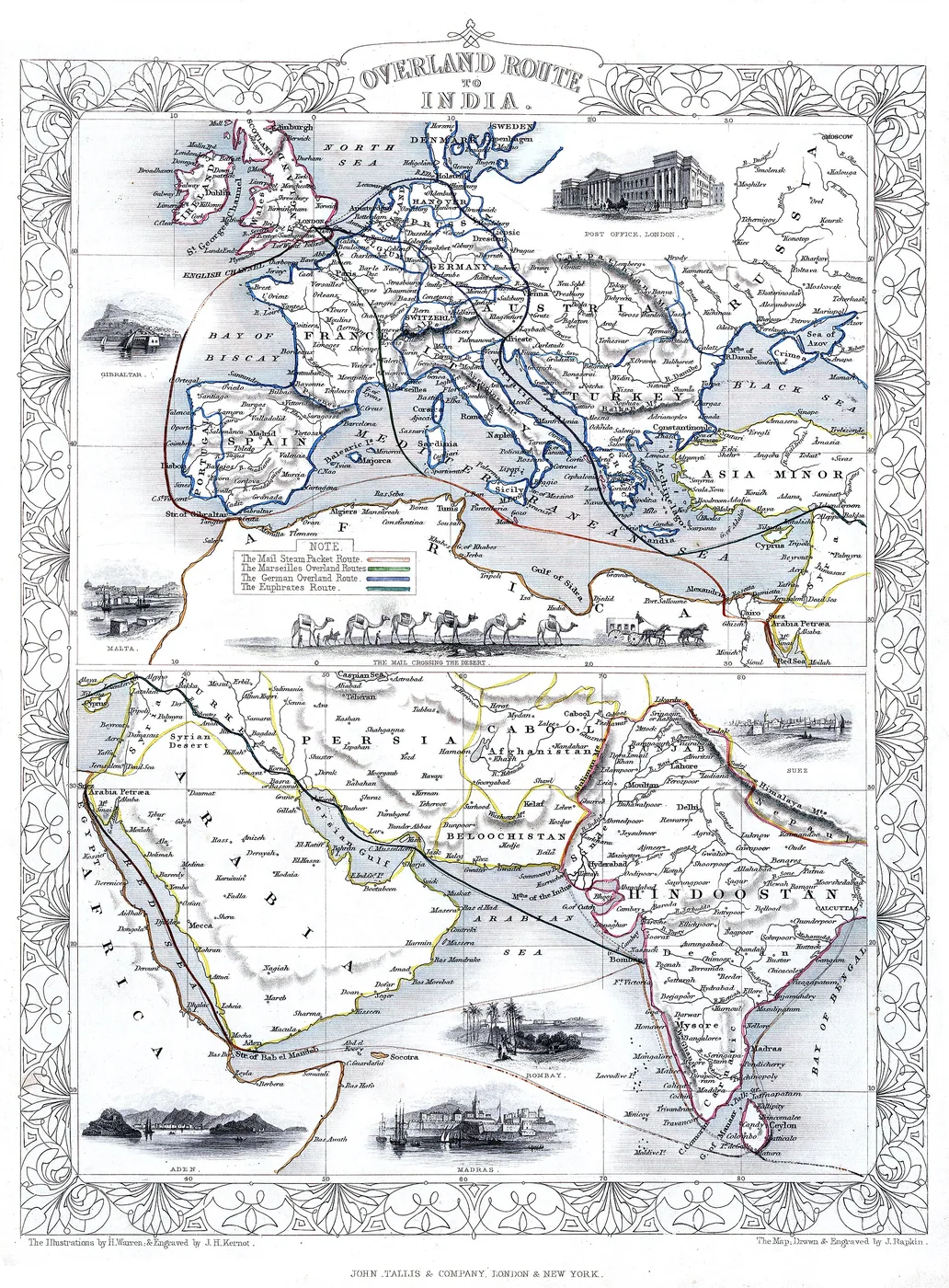
A traveler carrying mail from the Mediterranean to the Red Sea did not simply cross a line drawn between two ports. Routes could include river or canal segments to Cairo and a land journey toward Suez. Conveyances, camels, carts, fresh animals and stopping places mattered to the reliability of the service. Modern romantic descriptions often emphasize the desert alone, but a missing packet at the wrong time could be as damaging as the absence of a caravan. The 1851 printed Overland Route image reproduced from the University of Michigan provides a contemporary visual document of how a mid-nineteenth-century observer imagined these connections. It is not a surveyed map demonstrating the precise track of every traveler in 1835. Its date must be printed clearly in the caption. The historical corridor changed over time as companies, government agencies, steamships and railway development adjusted the balance between water and land travel.
Red Sea navigation and the role of coal
Suez provided the link to Red Sea vessels bound toward India, but the Red Sea was not an effortless extension of the Mediterranean. Sailing conditions, suitable harbors, fuel and ship maintenance shaped the prospects of a reliable service. Steam propulsion brought new advantages, yet a steamship was only as effective as its coal arrangements and the coordination of its refueling stations. The British Library records that India Office packet agencies handled supplies of English coal brought to Alexandria and moved overland to support Red Sea vessels. This is one of the most revealing details in the surviving archive. It demonstrates that a supposedly direct sea connection rested on a labor-intensive supply chain across Egypt. Some coal was later transported by other routes when those proved less expensive. Thus the documentary trail of fuel can tell historians nearly as much about the transition to regular steam shipping as a list of celebrated sailings.
Thomas Waghorn as an organizer rather than a solitary inventor
Thomas Fletcher Waghorn became strongly associated with the Egyptian overland mail. The older Arabic history praises his efforts to revive the route, while later postal literature records his forwarding activities. He was important, but the history did not begin with one man's sudden discovery of an empty desert crossing. Egyptian transport workers, merchants, official agents, ship crews and other private advocates had already made communication possible. Waghorn's impact lay in the drive to coordinate connections, publicize speed and persuade officials that the arrangement could operate regularly. The British Library's agency history is especially useful because it situates him among institutions: his private service became part of a wider network rather than remaining a permanent one-person undertaking. A careful biography must also distinguish his commercial claims from demonstrated performance. Advertised delivery times are not an unbiased record of all delays, and surviving celebrated letters represent only a fraction of mail that once moved.
A dated sequence of institutional decisions
The British Library's archive description supplies a chronology more precise than the usual story about entrepreneurial determination. On 27 February 1833 the East India Company appointed Patrick Campbell, the British consul-general in Egypt, as its agent. On 7 June 1837 the Company appointed Waghorn as packet agent under Campbell. By late 1837 the Egyptian network included Alexandria, Cairo and Suez, with other Red Sea agencies. These dates show how private initiative and official policy became connected. An 1837 appointment should not be misdescribed as the first moment anyone could send a letter through Egypt, nor should the office's establishment guarantee that every intended connection ran smoothly. The historical book's broad account gains greater value when these dates are placed alongside it. The surviving appointment and financial record series lets students test the chronology against an institutional archive instead of accepting a single heroic narrative as definitive.
The labor behind a 'fast' letter
The phrase fast mail hides a collection of jobs. Sailors handled cargo at Alexandria; boat crews and porters moved bundles inland; local guides and animal handlers negotiated land journeys; clerks kept registers and recorded expenses; repair workers maintained vehicles and supplies. The British Library specifically names Egyptian supporting staff within the agencies, although the summary does not provide individual biographies for every worker. This matters because standard biographies of European promoters can erase the people who did much of the physical work. Laboring conditions and wages would require examination of agency accounts, not invented scenes of exhausted anonymous men. Even a packet that arrived quickly was the product of a network. The opening of the canal would alter these working arrangements but not erase the need for ports, pilots, correspondence handling or material support. Logistics are historical evidence of collaboration and unequal power at the same time.
What the postal covers and agency accounts can prove
An old envelope with a forwarding mark may preserve a date, a named agent, a route indication or proof of a postal charge. A complete reconstruction still requires reading all its markings in context and tracing the recipient and sender where possible. The India Office collection IOR/R/19 is especially important because it preserves official correspondence from the Egyptian agencies, while a related accounts series, IOR/L/AG/50/11, records mail conveyance costs between Alexandria and Suez, coal expenses, salaries and other expenditure. Those documents can answer questions about how the service operated and what it cost. They cannot necessarily tell us the experiences of every traveler or calculate one universal transit time across decades. An encyclopedia should give these catalog references because they make the subject verifiable. When a historical illustration lacks its own postage or route marks, it should be described as context, not misleadingly labeled as a transported cover.
Who gained from faster communication?
The beneficiaries were not identical. The East India Company and British authorities wanted more effective communication with territories and trading concerns across the Indian Ocean. Merchants sought quicker prices and instructions, while some travelers used the route as transport services developed. Egyptian officials could earn revenue or strategic prestige, and local commercial operators found new work. Yet imperial political motives were woven into the route from the beginning. The British Library notes that company leaders initially hesitated because a shorter connection demanded investment and could weaken their control over passenger movement. This admission complicates the idea that all governments naturally welcomed every technical improvement. The older Egyptian textbook emphasizes Muhammad Ali's interest and hospitality toward English traders. Its celebratory language is part of the source's interpretation; modern readers should examine the actual arrangements and the changing bargaining positions of Egyptian authorities and external companies instead of assuming universal mutual benefit.
The river, railway and steam packet transition
A network established in one decade could look quite different twenty years later. Mahmoudiya Canal and Nile transport helped connect Alexandria with Cairo, while the Egyptian railway and improved overland conveyances progressively altered the journey. The British Library states that the Cairo packet agency was dissolved in 1859 because a rail link between Alexandria and Suez had made it unnecessary. This institutional closure captures a real transformation better than treating the 1869 opening of the Suez Canal as an abrupt invention of long-distance communication. A railway could shorten intermediate transfers without making maritime schedules irrelevant. At the same time, competing steamship firms changed the business model of the route. The postal network therefore evolved through substitutions and compromises, and the exact date of a railway segment or packet contract should be checked before creating a map that suggests an unchanging route across the whole century.
Competition, P&O and the changing role of private agents
As steam shipping expanded, the route through Egypt was no longer controlled by the entrepreneur most strongly associated with its early publicity. The British Library records the emergence of competing P&O services and a progressive reduction of the East India Company's extensive Egyptian agency establishment. Mokha's packet agency appears to have closed in 1839, and the Egyptian agent and deputy agent posts were combined in 1849. Mail to India passed under the General Post Office in 1858, while other offices were gradually discontinued. These shifts illustrate how a technical network can change ownership, purpose and administration even while the physical geography remains familiar. The historical chapter's contrast between Waghorn and Ferdinand de Lesseps reflects an older authorial judgment and should not be turned into a simple morality tale. Each operated within very different political, technological and financial arrangements. Their reputations cannot substitute for documents about their respective projects.
How to read the 1851 Overland Route illustration
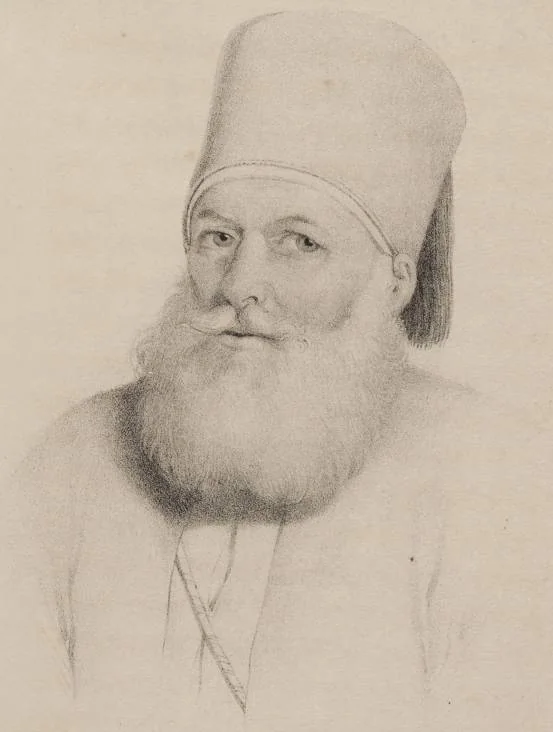
The featured historical illustration is dated 1851 and originates in a University of Michigan collection. It is genuine evidence of mid-nineteenth-century visual culture and route promotion. It does not document the appearance of an Egyptian camel caravan in a specific earlier year, nor does it supply a fully georeferenced reconstruction of postal stations. Its layout, captions and routes should be examined alongside documented administrative changes. The other portrait image shows Muhammad Ali, who ruled Egypt during the renewal of the route, drawn in the early nineteenth century. That image identifies political context but not the route's day-to-day operations. Captions must preserve these distinctions because an image can make an unsupported story appear certain. Students should learn to distinguish a portrait of a patron, a contemporary promotional illustration, a postal cover and a later historical reconstruction. Each answers a different question and needs a different kind of caution.
What historians still cannot calculate securely
It is tempting to claim an exact number of days saved by the overland service and to repeat one triumphant record as the permanent normal journey time. Such a figure depends on departure port, year, weather, timetable, type of letter and the state of connecting transport. The textbook recounts particular episodes of impressive transit, but those anecdotes should not be universalized. The British Library's letter series and agency accounts offer a better starting point for measuring schedules across individual periods. A full quantitative study would require sampling dated packets, matching them to ships and rail movements, and accounting for lost documents. This feature therefore describes the supported structure of the service rather than inventing an average travel time. It also avoids presenting the shortest possible advertised duration as the experience of ordinary passengers. An archival limit is part of a reliable historical explanation, not an invitation to fill gaps with guesswork.
Why the overland route changed Egypt before 1869
By the time the Suez Canal opened, Egypt had already become an indispensable corridor within many imperial, commercial and postal plans. The overland service helped establish a pattern of connected ports, agencies, fuel supplies and transport corridors that canal navigation later transformed. It should not be celebrated solely as a triumph of British ingenuity, nor reduced to an abstract sign of foreign influence. It was an Egyptian landscape traversed by sailors, officials, laborers, merchants and travelers, all operating within unequal power relations and under changing technologies. The most original way to tell the story is through the documented connections: an 1833 appointment, an 1837 packet-agent nomination, the expenses of coal moved overland, the 1859 closure of the Cairo agency and the arrival of the canal a decade later. Those fragments form a history of infrastructure and work rather than another repeated paragraph about a famous waterway.
Evidence at a glance
| Evidence | What can be concluded |
|---|---|
| Historical Arabic book, PDF 198–200 | A secondary narrative of the re-established Egypt-to-India route and Muhammad Ali's period. |
| IOR/R/19 | Packet agencies and letters in Egypt, including the 1833 and 1837 official appointments. |
| IOR/L/AG/50/11 | Actual agency expenses, mail passage and coal transport account records. |
| 1851 published illustration | Evidence of mid-century representation, not a surveyed route for every dispatch. |
| 1869 Suez Canal opening | Separate later technological development, not the birth of transit through Egypt. |
Frequently asked questions
Did the overland route exist before the Suez Canal?
Yes. Mail and travelers crossed Egypt from Mediterranean ports to Red Sea vessels in the decades before the canal opened in 1869, using inland water transport and a land journey.
Who was Thomas Waghorn?
He promoted and organized the overland mail service, later becoming a packet agent under the India Office's Egyptian network. Other agents and Egyptian workers were essential to the system.
Is the featured picture a genuine nineteenth-century source?
Yes. It reproduces an 1851 period illustration held by the University of Michigan collection. It must not be mistaken for a photograph of a particular mail convoy.
How do we know how the service operated?
British Library archival series preserve the correspondence and financial accounts of Egyptian packet agencies, including information about the movement of mail and coal between Alexandria and Suez.
Sources and image provenance
The page draws on the named historical source in the bibliography, specifically PDF pages 198–200 in Omar al-Iskandari and Selim Hassan, History of Egypt from the Ottoman Conquest. Its historical rhetoric and older interpretations are not treated as conclusive archaeological evidence. The external museum and research records below are linked for independent checking.
- British Library, India Office Records IOR/R/19, Agencies in Egypt
- British Library, Egyptian Agency Accounts IOR/L/AG/50/11
- Saudi Aramco World, Mr. Waghorn's Route to India
- British National Portrait Gallery, Thomas Waghorn archival biography
- Contemporary route illustration (1851) catalogued by Wikimedia Commons/University of Michigan
- Original 1841 illustrated travel publication, TIMEA archival image record
- Photograph: Original illustrated Overland Route to India, dated 1851, from a University of Michigan collection; an illustration of transport connections, not a photograph of an 1830s postal convoy., Unknown nineteenth-century artist; University of Michigan collection, Public domain
- Photograph: A genuine 1841 illustration of Muhammad Ali, from the Travelers in the Middle East Archive; political context for mail reforms, not a depiction of a postal dispatch., Illustration in the 1841 travel work of Mrs. G. L. Dawson Damer, TIMEA, CC BY-SA 2.5