Ottoman Egypt was not merely a quiet interval between the Mamluk sultans and Muhammad Ali. It was a period of imperial government, local competition, urban investment, commerce and changing social networks. The best explanations connect Cairo to Istanbul and the wider world without reducing Egyptian people to passive subjects of distant rulers.
The conquest of 1517 and the nature of provincial rule
The Ottoman defeat of the Mamluk sultanate brought Egypt under the authority of the Ottoman ruler in 1517. The conquest changed the political framework but did not erase every institution, household or military network formed under earlier dynasties. Egypt operated within an imperial system, yet governors and officials had to negotiate conditions on the ground. Later accounts sometimes contrast an idealised golden age of Mamluk Cairo with a uniformly declining Ottoman province; this is a historical judgment, not a substitute for evidence. The relationship between local government, taxation and central authority shifted repeatedly during nearly three centuries of Ottoman rule, and generalising from one decade to the entire period is misleading.
Mamluk households under Ottoman sovereignty
Mamluk military and political households remained influential in Egyptian society after 1517. Their changing positions within the province demonstrate why the label 'Ottoman period' cannot be treated as an explanation of every local power arrangement. Historians investigate patronage, officeholding, land revenue, military organisation and changing coalitions. The individuals involved could pursue interests that did not align neatly with central administration or with one another. This interaction shaped both episodes of conflict and practices of ordinary government. Political chronicles provide one view, while court records and property documents can add detail about how authority affected streets, markets and families.
The Ottoman conquest of 1517: an ending for one state, not for a social class
In 1517 the armies of Sultan Selim I defeated the Mamluk Sultanate and made Egypt part of the Ottoman imperial system. The event ended the independent Mamluk sultanate that had governed Egypt and Syria, but it did not eliminate every household, soldier or administrative practice associated with the Mamluks. Ottoman governors were appointed within a wider provincial organization, while military units, urban notables, religious institutions and the old military elite continued to shape events. Describing the whole period as a simple occupation by outsiders would overlook these negotiated arrangements and the Egyptian actors working within them. Nor should one imagine a single unchanging system lasting almost three centuries. Historians distinguish phases of central appointment, competition among military and fiscal actors, and the emergence of powerful households in the eighteenth century. A source-critical chronology begins in 1517 but asks how authority worked in particular decades, rather than assuming that an imperial label determines every local institution. This distinction is supported by the Metropolitan Museum's chronological survey and specialist histories of Ottoman Egypt.
A provincial capital, not an abandoned medieval city
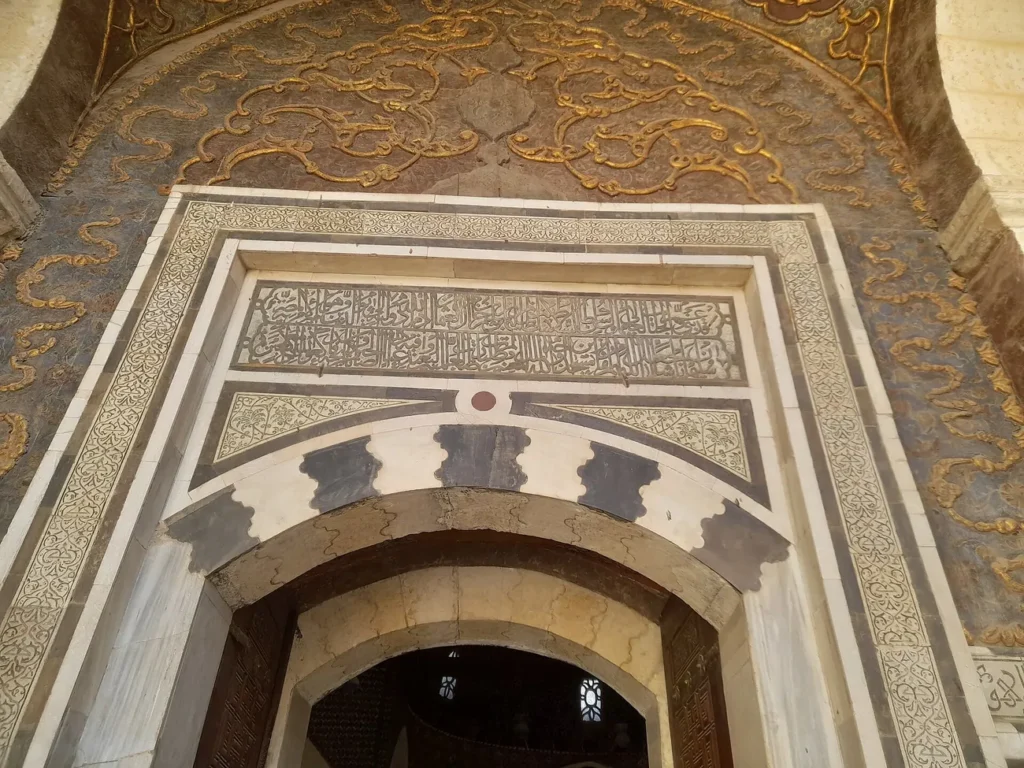
Cairo continued to be a major city and seat of provincial administration after 1517. Its residents supported religious institutions, markets, crafts and networks of scholarship, and patrons continued to endow buildings whose architectural vocabulary drew on both local Mamluk precedents and Ottoman imperial forms. The change of sovereign did not automatically produce a sudden replacement of Cairo's mosques or streets with Istanbul's urban design. The city's physical fabric developed over generations and was also altered by later conservation. A historian therefore looks at foundation inscriptions, architectural phases and waqf deeds before attaching a political label to a building. An Ottoman-period monument may stand beside much older Mamluk work; a later modification may imitate an earlier style. The Metropolitan Museum notes that local Mamluk forms continued initially before imperial architectural elements were increasingly integrated. The first photograph in this study presents one particular Ottoman-era foundation, not a generic image of every Cairo neighborhood. Such specificity is crucial when captions are used as historical evidence.
Sulayman Pasha al-Khadim mosque: a precisely dated early monument
At the Cairo Citadel, the Mosque of Sulayman Pasha al-Khadim offers an identifiable early Ottoman building rather than an artist's imagined sixteenth-century Cairo. The Egyptian Ministry of Tourism and Antiquities dates its construction to 935 AH / 1528 CE on the site of a Fatimid mosque. The complex includes a central dome, subsidiary half-domes, courtyard spaces and a minaret associated with the Ottoman architectural repertoire. It also holds material connected with later additions and restorations. The accompanying photograph documents the mosque's actual architectural fabric as photographed in 2026; it is not a visual reconstruction of the year 1528. A photograph cannot establish the date of every visible element. The official monument history explicitly mentions subsequent work, including nineteenth- and twentieth-century interventions. Researchers should therefore separate initial foundation date, surviving early materials and later conservation, using the government's site dossier alongside photographic evidence. The building demonstrates how provincial patronage and imperial style met within Cairo's inherited sacred landscape.
The governor, the garrison and the people who exercised authority
Egyptian provincial government cannot be understood by treating the Ottoman pasha as an absolute ruler able to act without intermediaries. Governors represented the imperial state, yet military corps, fiscal administrators, judges, merchants, scholars and local power brokers all participated in political life. The balance between them changed repeatedly, especially during periods of conflict or weak governance. Local negotiations over appointments, security, tax collection and military resources could matter more to everyday residents than formal titles in Istanbul. A household leader might possess influence through patronage connections and armed followers rather than a single constitutional office. None of these relationships should be mapped mechanically onto today's ministries or elected councils. Specialist studies of the eighteenth-century province show networks linking Ottoman authorities, notables and local groups. The historical challenge is to trace who actually collected revenue, commissioned buildings, controlled troops and resolved disputes at a given moment. Documents and inscriptions may support different parts of that reconstruction; general chronological tables alone are inadequate.
Mamluk households under Ottoman sovereignty
A Mamluk household was not simply an extended biological family. It could be a patronage and training network centered on a powerful master, with bonds formed by service, status, military education and personal loyalty. The former Mamluk military elite continued to play important roles after the fall of its sultanate, and new household configurations could rise within Ottoman institutions. In the eighteenth century, powerful beys and networks sometimes challenged the balance envisioned by appointed governors. One of the mistakes in popular summaries is to say that Mamluk rule ended permanently in 1517 and reappeared from nowhere centuries later. The continuity of a class and its changing political relationships is more complicated than that. A second mistake is to attribute every project or conflict to an undifferentiated 'Turkish' administration. Named actors, documented houses and dated events matter. Daniel Crecelius's study of eighteenth-century Egypt and archival research into Ali Bey al-Kabir demonstrate how provincial history becomes much clearer when relationships are investigated instead of reduced to a binary Ottoman-versus-Mamluk narrative.
Trade, taxation, grain and the limitations of a single prosperity story
Egypt's Nile agriculture, domestic exchange and connections through the Red Sea and Mediterranean made the province economically significant. Coffee arriving from Yemen, agricultural commodities and the movement of manufactured goods brought Cairo into networks extending well beyond the Egyptian countryside. Tax assignments and revenues were subjects of political competition among governors, military groups and local intermediaries. These facts do not justify sweeping claims that the whole Ottoman period was either uniformly prosperous or uniformly impoverished. Prices, harvests, military needs and the fortunes of different households varied. Nor can a surviving market street prove the precise volume of trade that passed through it three centuries ago. Historians use fiscal registers, chronicles, merchants' records and waqf documentation to build period-specific accounts. The Metropolitan Museum describes Cairo as a key regional center and noted source of tax revenue, while Cambridge research gives a more differentiated picture of eighteenth-century goods and exchange. Economic claims should carry a place, a date range and a source.
Cairo as a commercial and cultural centre
Cairo continued to function as a major urban centre with ties to Mediterranean, Red Sea and African commercial networks. Craft activity, scholarship, religious endowments and the maintenance of earlier monuments shaped the city. Historic Cairo's architectural landscape contains Ottoman interventions alongside surviving Fatimid, Ayyubid and Mamluk structures. Buildings were adapted, restored and reused, so a façade visible today may combine elements of different dates. UNESCO's Historic Cairo description emphasizes how Ottoman patrons enriched rather than simply replaced the medieval urban fabric. Studying endowment records, inscriptions and buildings together reveals urban investment more clearly than a simple list of governors.
Households, courts and everyday life
Most Egyptians did not experience the era as a sequence of imperial decrees. Urban and rural lives involved work, credit, family relationships, disputes, markets and religious institutions. Surviving records offer opportunities to investigate property, inheritance and charity, but these sources are not a comprehensive modern census. Their legal formulas and uneven survival require careful reading. A change in governor might have little to do with a household's daily priorities, while fiscal demands or food supply could matter greatly. The relationship between city and countryside is also essential: Cairo's markets depended on agricultural production and transport across the Nile Valley.
The French expedition and transition toward Muhammad Ali
French forces entered Egypt in 1798, and the expedition ended in 1801. European descriptions of the country produced during this episode are historically influential but were written within military and intellectual projects with their own purposes. They need critical comparison with Egyptian accounts and material evidence. Muhammad Ali rose to power in 1805 amid a complicated political aftermath, not as a simple consequence of one French departure. The early nineteenth century was a transition rather than a switch that instantly made every Ottoman institution irrelevant. Historical narratives should explain overlapping political claims and gradual reform rather than divide the story into sealed, unrelated eras.
Bayt al-Suhaymi: two construction phases and a surviving domestic setting
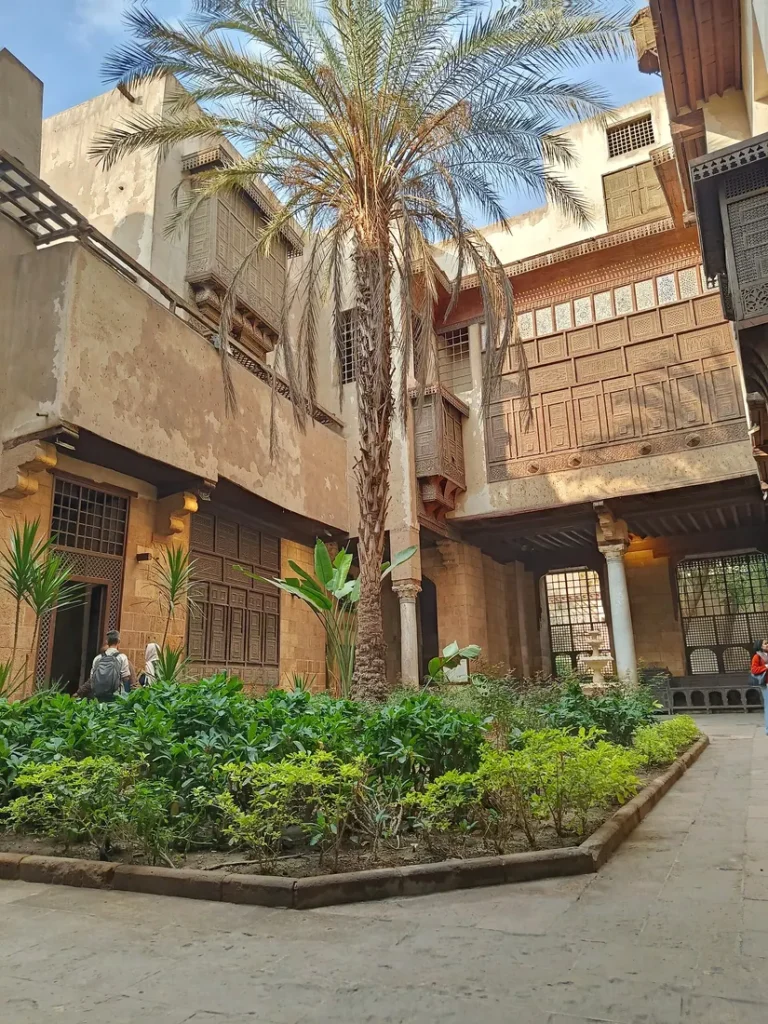
The second genuine photograph in this article shows the courtyard of Bayt al-Suhaymi, a real historic house in Cairo. The Egyptian Ministry states that the southern part was founded in 1648 by Shaykh Abd al-Wahhab al-Tablawi, with a northern extension built in 1796 by Haji Ismail Shalabi. The later house name reflects subsequent residents, and the buildings underwent later preservation. These phases are essential: a single photograph of the courtyard records a surviving ensemble, not a room whose every element was built in 1648. The building offers evidence of domestic architectural planning, enclosed spaces, wooden windows and the relationship between public and private areas. It does not tell us precisely how every Egyptian household lived. Elite urban houses differed from rural dwellings and modest residences. The photograph was taken in December 2025 and its source and CC0 status are documented separately. Using it carefully lets readers see real period-related architecture without presenting a modern photographic image as an untouched scene from the Ottoman centuries.
Waqf, religious foundations and the city as a built archive
Waqf endowments help historians investigate how patrons funded mosques, charitable provisions, schools and property management. They also illuminate relationships among urban wealth, piety, law and social status. A monument is rarely only an aesthetic statement; its original functions could be tied to revenue-bearing property and detailed conditions in foundation deeds. But the presence of a carved inscription or monumental entrance is not sufficient evidence that every originally intended service operated continuously for centuries. Documentary sources should be compared with surviving architectural fabric. Ottoman Cairo includes foundations established by provincial officials and influential local patrons whose political positions differed widely. Their structures make social history visible in stone and timber, while records reveal management decisions less easily photographed. A credible encyclopedic article identifies what the building itself proves and what must be learned from archival texts. This avoids romanticizing the entire urban landscape as one unchanged museum of 'Islamic Cairo' or attributing all surviving ornament to a single ruling dynasty.
Abd al-Rahman Katkhuda's sabil-kuttab: an eighteenth-century foundation
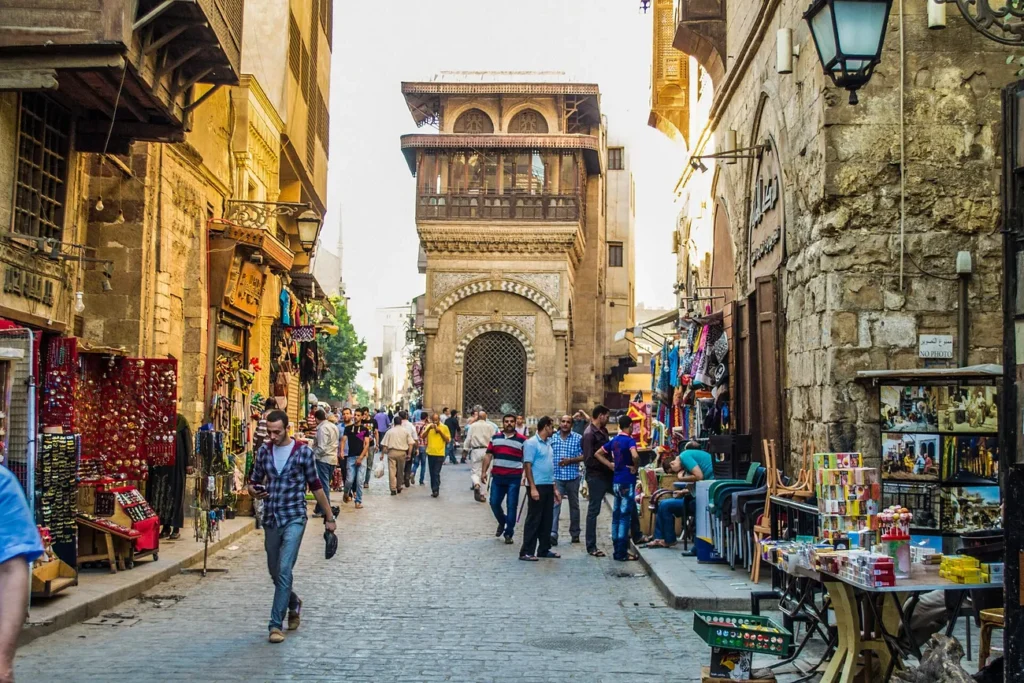
The third photograph documents the actual Sabil-Kuttab of Abd al-Rahman Katkhuda on al-Muizz Street. The Egyptian Ministry of Tourism and Antiquities dates its foundation to 1157 AH / 1744 CE and names Abd al-Rahman Katkhuda al-Qazdagli as patron. A sabil supplied drinking water, while the kuttab above formed part of an educational and charitable complex. The government's description distinguishes the facades, windows, marble basins, ornamental tiles and school rooms. These are useful architectural facts that can be connected to visible details and conservation documents. The photograph, by Ahmed Photographer, is a modern image of that named monument and is licensed CC BY-SA 4.0; it cannot be used to imply that the depicted street activity dates from 1744. The foundation illustrates the influence of prominent local patrons in the eighteenth-century city. At the same time, an urban building does not prove the precise extent of the patron's authority throughout the province, which requires political records.
Chronology of Ali Bey al-Kabir's challenge to the Porte
In the later eighteenth century, Ali Bey al-Kabir exemplified the power attained by a Mamluk leader in Ottoman Egypt. His challenge to the imperial government is commonly dated to the years 1768–1772, although specific military and political events must be traced individually rather than flattened into one four-year battle. His activities involved ambitions extending beyond Egypt and were shaped by relationships with other regional powers. Some popular accounts turn him into a straightforward national independence hero; others present him as merely a rebellious servant. Both framings are too narrow without reconstructing the contemporary political vocabulary and archives. University research drawing on Ottoman records shows the importance of alliances, provincial finance and rival household interests in understanding the crisis. This episode belongs to the distinctive eighteenth-century political history of Egypt, not to the sixteenth-century conquest. Students should label this phase separately on maps and timelines and avoid attributing sixteenth-century monuments to people who lived much later.
1798–1801: the French expedition as a disruption, not the whole story
The French invasion of 1798 and withdrawal in 1801 reshaped political and military circumstances in Egypt. It is historically misleading to treat the expedition as though it were the beginning of Egyptian historical awareness or as though centuries of Ottoman-era urban and intellectual life did not exist before it. The invasion is important for military conflict, administration and the production of European descriptions, but those descriptions themselves can reflect the concerns and biases of participants. The French expedition must also be located within wider conflict among France, Britain, Ottoman authorities and local Egyptian forces. A chronology that jumps directly from 1517 to Napoleon erases substantial social and political developments. Contemporary Egyptian chronicles, European expeditionary material and later archival interpretations should be compared. The Metropolitan Museum's chronological overview marks French rule from 1798 to 1801 and places it after a long eighteenth-century history of local power. Responsible presentation distinguishes reported events from the stories later nations constructed about those events.
The 1805 transition and what a date boundary means
The conventional end date of 1805 marks Muhammad Ali's emergence as governor, and it is a useful turning point for an article covering Ottoman Egypt. It does not mean that Ottoman imperial relationships or the influence of earlier military elites vanished instantaneously. In fact, important political conflicts involving Mamluk leaders continued into the nineteenth century. The date is therefore an editorial period boundary, not a switch that resets every institution, community or historical process. A historical timeline should show continuity and transformation at the same time. Cairo's buildings provide another example of overlapping chronology: an eighteenth-century house could still be in use or altered long after 1805. A museum caption or tourist sign may present a concise era label, but research writing should provide the detail behind it. Readers can connect this article with a separate modern Egyptian history dossier rather than folding the later nineteenth century into a generic conclusion. That distinction supports a more accurate understanding of both Ottoman provincial structures and Muhammad Ali's subsequent state-building.
Evidence comparison and key distinctions
| Topic | What the evidence establishes |
|---|---|
| 1517 | Selim I's conquest and the end of the independent Mamluk sultanate; former elites did not disappear. |
| 1528 | Mosque of Sulayman Pasha al-Khadim founded at the Cairo Citadel, an identifiable early Ottoman monument. |
| 1648 and 1796 | Documented phases of Bayt al-Suhaymi; the present building contains a history of modifications. |
| 1744 | Abd al-Rahman Katkhuda's sabil-kuttab foundation on al-Muizz Street. |
| 1768–1772 | Ali Bey al-Kabir's challenge to Ottoman authority, a distinct eighteenth-century political crisis. |
| 1798–1801 | French military presence in Egypt, interrupting rather than erasing wider provincial history. |
| 1805 | Conventional accession boundary for Muhammad Ali, not the overnight disappearance of older institutions. |
| Source distinction | Monuments establish material history; chronicles, waqf records and scholarship are needed for claims about governance and society. |
Frequently asked questions
Did the Mamluks disappear after the Ottoman conquest of 1517?
No. The independent Mamluk Sultanate ended, but Mamluk military households and political networks continued in changing forms.
Is every visible part of a sixteenth-century mosque original?
Not necessarily. The Ministry records later interventions at Sulayman Pasha's mosque; dates need to be assigned to specific construction phases.
Why is the Bayt al-Suhaymi photograph relevant to Ottoman history?
The surviving house includes dated 1648 and 1796 construction phases, with a documented present-day photographed courtyard.
Did Ottoman rule end instantly in 1805?
1805 is a conventional period transition associated with Muhammad Ali. Formal imperial ties and institutional continuities extended beyond the date.
References, museum evidence and photography credits
All cited providers and institutions should be consulted at their original sources. Photos document three named and dated surviving historic Cairo architectural structures and their modern condition. They are not modern reconstructions or proof that every feature belongs to the original construction phase.
- UNESCO — Historic Cairo and the Ottoman architectural period
- Egyptian Ministry of Tourism and Antiquities — Historical Periods
- Egyptian Ministry of Tourism and Antiquities — Sulayman Pasha al-Khadim Mosque, 1528
- Egyptian Ministry of Tourism and Antiquities — Bayt Al-Suhaymi's 1648 and 1796 phases
- Egyptian Ministry of Tourism and Antiquities — Abd al-Rahman Katkhuda's 1744 Sabil-Kuttab
- The Met — Egypt 1400–1600 CE art history timeline
- The Met — Egypt 1600–1800 CE art history timeline
- Cambridge University Press — Daniel Crecelius, Egypt in the eighteenth century
- University of Birmingham — Ottoman Egypt and Ali Bey al-Kabir archival study
- UNESCO World Heritage — Historic Cairo
- Sulayman Pasha al-Khadem Mosque (73214).jpg — Amr F.Nagy, CC BY-SA 4.0.
- Courtyard of Bayt Al-Suhaymi in Cairo.jpg — Saeed Mohammed zaman, CC0.
- Sabil Abd El Rahman Katkhuda.jpg — Ahmed Photographer, CC BY-SA 4.0.
Historical-source cross-check and further reading
Evidence and dating note (23 October 2026): Ottoman conquest 1517; Bayt al-Suhaymi first built 1648 with addition 1796; Ottoman and Mamluk households overlapped. 1805 is a conventional transitional date, not an instant end to all Ottoman ties.
Original institution or academic research record: https://egymonuments.gov.eg/monuments/bayt-al-suhaymi-house-of-suhaymi/
Scholarly reading / comparative reference: Michael Winter, Egyptian Society under Ottoman Rule, 1517–1798 (Routledge, 1992); Cambridge History of Egypt vol. 2.
Scope: a source comparison of the named historical point, not independent scholarly approval of every claim or every image in this article.