When did the Ottomans conquer Egypt? Selim I’s armies defeated the Mamluk state in 1516–1517, winning the Battle of al-Raydaniyya near Cairo in January 1517. Resistance continued under Tumanbay, who was executed in April. Egypt became an important Ottoman province, but existing Mamluk elites and Cairo’s artistic traditions did not suddenly vanish.
This source-led guide explains the fall of the Mamluk sultanate, Selim’s campaign, Tumanbay’s resistance and the new provincial government. It separates seventeenth-century interpretations from contemporary evidence and labels photographs of Bab Zuweila as modern site records, not pictures of the Ottoman army’s arrival.
1517: a turning point, not the end of Egyptian history
In 1517, the Ottoman ruler Selim I defeated the Mamluk sultanate that had governed Egypt and Syria. The battle for Egypt followed the fall of the Mamluks’ Syrian positions in 1516, and ended the existence of an independent Mamluk sultanate based in Cairo. The Metropolitan Museum of Art dates the transition to Ottoman rule to 1517 and emphasises that the new province remained a major cultural and economic centre. It did not cease producing art, writing or distinctive architectural traditions when its government changed.
This is a central episode in the long history of Egypt because it reshaped political sovereignty while preserving many local institutions and social elites. Describing it solely as a clash of two named sultans would hide the changes in trade routes, military technology, provincial administration and urban society. The genuine question is what changed in 1517 and what continued, not whether an entire Egyptian civilization disappeared overnight.
The Mamluk sultanate before the Ottoman advance
The Mamluk state had governed Egypt for more than two centuries by the early sixteenth century. Its rulers controlled a network extending into Syria and the eastern Mediterranean, and Cairo had developed extraordinary mosques, colleges, hospitals, commercial buildings and residential quarters under successive sultans. The late Burji or Circassian branch was challenged by political instability and competition over regional trade routes. Yet it remained a highly developed state with experienced commanders and institutions.
The Metropolitan Museum’s chronology identifies the later Mamluk line from 1382 to 1517 and notes the cultural patronage of Qansuh al-Ghawri. A history of the Ottoman conquest should acknowledge this earlier achievement rather than presenting the Mamluks as a people with no identity beyond their defeat. The Sultan Hasan architectural study and Qalawun complex dossier examine different episodes of Mamluk Egypt, not the 1517 transition itself.
Selim I and a conflict across the eastern Mediterranean
Ottoman power expanded in the late fifteenth and early sixteenth centuries, while the Mamluk state faced strategic challenges near its Syrian frontier. Selim I’s campaigns cannot be interpreted entirely through a narrow Egypt-only lens. Andrew C. Hess’s influential study in the International Journal of Middle East Studies places the 1517 conquest in a larger contest involving commercial routes, Portuguese activity in the Indian Ocean and the changing balance among Mediterranean and Middle Eastern powers.
That context matters because the Ottoman victory gave Istanbul access to important economic resources and placed the rulers of the region’s holy cities in a new political setting. This does not mean that everyone participating in the conflict shared the same commercial motive. Military commanders, provincial governors and local populations had different interests, many poorly documented in surviving sources. An accurate explanation connects large regional forces to named events without pretending to recover private intentions in every case.
Marj Dabiq in 1516 and the road toward Egypt
The decisive Ottoman campaign against the Mamluk sultanate began before the battle on Egyptian soil. In August 1516, Selim’s forces defeated the Mamluk army at Marj Dabiq, north of Aleppo, in a conflict that cost Sultan Qansuh al-Ghawri his life. The Ottoman takeover of Syria changed the strategic situation profoundly and removed a crucial northern line of defence. Egypt itself remained to be contested.
The UNESCO General History of Africa’s discussion of the conquest emphasises the larger prehistory and political tensions behind the campaign. Later histories debate the relative importance of weapons, command decisions, defections and the organisation of the two armies. Explaining the result as Ottoman cannon alone or a single dramatic betrayal is too simple. The verified transition from a Syrian defeat to the Egyptian campaign is more useful than invented details about the thoughts of every soldier.
Tumanbay and the defence of Cairo
After Qansuh al-Ghawri’s death, Tumanbay became a leading figure in the resistance to Selim’s advancing army. His role is sometimes reduced to a tragic final scene at Bab Zuweila. In fact, he led an extended effort to preserve the Mamluk state after the loss of Syria. Egyptian historical accounts and scholarly treatments place the major confrontation near Cairo at al-Raydaniyya in January 1517, followed by renewed fighting rather than an immediate, completely peaceful transfer of power.
Tumanbay’s political predicament was not simply a question of personal courage. He faced a transformed regional balance, commanders with differing loyalties and the logistical difficulties of defending the capital. Scholarship on early Ottoman Egypt stresses that administrative adaptation continued beyond the initial battlefield victory. A serious account should therefore give the resistance leader both a historical setting and his individual identity, without relying solely on later romantic biographies.
The Battle of al-Raydaniyya in January 1517
The Battle of al-Raydaniyya was fought near Cairo on 22 January 1517 according to standard modern chronologies. Selim’s army defeated the defending Mamluk forces, creating the conditions for Ottoman entry into the capital. The Cambridge History of Turkey describes the encounter and notes the death of the Ottoman grand vizier Sinan Pasha. The battle was significant but was not the last act of fighting associated with the conquest.
Military histories differ in estimates of casualties and in explanations for the Ottoman outcome. Precise figures recorded in much later summaries are not always independent counts. The secure point is that the defeat undermined the Mamluk ability to defend Cairo as the capital of an independent sultanate. The subsequent street fighting and attempts to regroup underline the difference between winning a battle and securing a major inhabited city.
Street fighting and the end of the sultanate
The entry of Ottoman forces into Cairo was followed by further resistance and violence, documented in scholarly narratives of the campaign. Historians describe fighting in the urban fabric and Tumanbay’s attempts to continue opposition beyond the initial defeat. Such struggles affected ordinary city residents and commercial life, although later military chronicles tend to preserve far more information about elite commanders than about specific households.
One must distinguish the end of the Mamluk sultanate from the disappearance of all Mamluk military households or artistic practices. Ottoman rule incorporated and negotiated with existing people and institutions in Egypt. That continuity helps explain why Cairo’s early Ottoman buildings could preserve familiar Mamluk architectural details even while new governors used imperial titles and arrangements. The conquest was a political rupture whose social and cultural consequences unfolded over time.
Bab Zuweila and the execution of Tumanbay
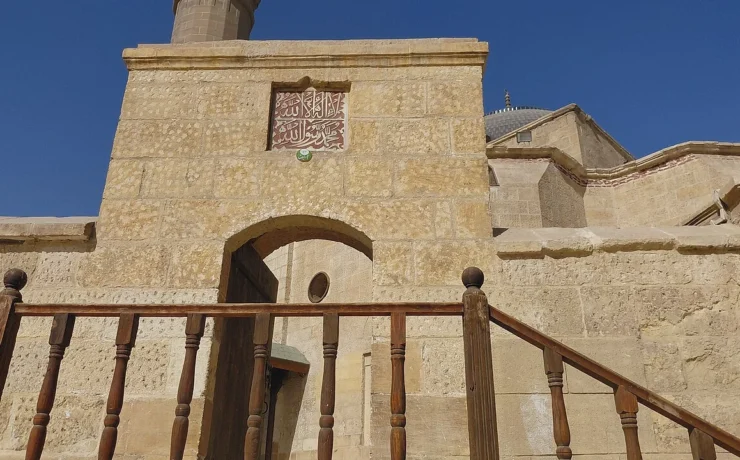
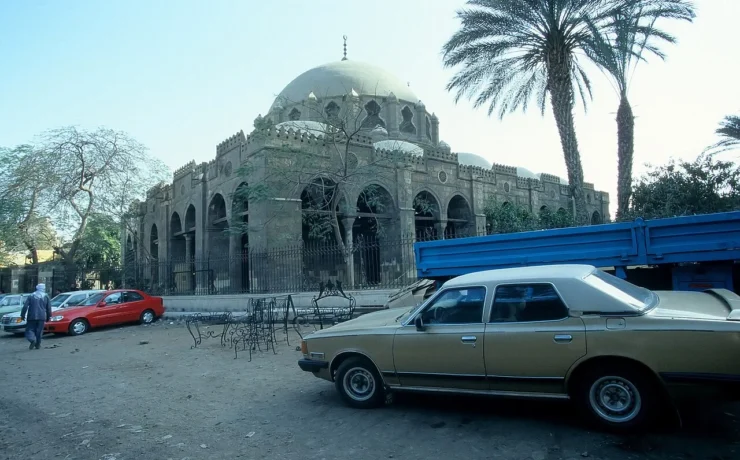
Tumanbay was captured and executed in Cairo in April 1517, in an episode widely associated with Bab Zuweila, the southern gate of the medieval walled city. The gate itself had been built centuries before this conflict, during the Fatimid era. It is a mistake to describe the structure as an Ottoman monument erected for the execution. Its story connects an earlier defensive city plan with a much later political event.
The first dated documentary photo here shows Bab Zuweila in 2019, long after the medieval and Ottoman periods. The second is an independent 2026 view of the same real landmark. Neither can show the execution or the appearance of the crowds in 1517. Their value is to identify an authentic place connected to the historical narrative. The Fatimid gates research offers the earlier architectural context, keeping the event and the gate’s original construction from being conflated.

Khayr Bey and the first Ottoman provincial government
After the conquest, the Ottoman government appointed Khayr Bey to administer Egypt, a figure who had been part of the Mamluk political world. The Egyptian heritage chronology published in the Aga Khan redevelopment materials identifies 1517 as the start of Ottoman rule with Khayr Bey as the first governor. This appointment captures a central feature of the transition: the new rulers did not replace every local political actor with unfamiliar personnel from Istanbul overnight.
The province’s administration involved a shifting balance between appointed officials, military formations, Mamluk households and local urban networks. Political arrangements changed over the centuries and could be contested by regional elites. It is inaccurate to portray Ottoman Egypt between 1517 and 1805 as an unchanging three-century system. The conquest created a new framework in which local Egyptian society continued to develop, negotiate and sometimes resist.
What changed in architecture and visual culture?
Egypt’s major artistic traditions did not stop in 1517. The Metropolitan Museum of Art explicitly notes that early Ottoman Egyptian architecture continued many Mamluk forms while gradually incorporating imperial influences from Istanbul. Buildings could combine local striped masonry and familiar spatial arrangements with new dome or minaret types. Cairo remained a centre of books, crafts, textiles and other forms of production.
The Suleyman Pasha mosque study examines a monument from 1528, shortly after the conquest, while the Sinan Pasha mosque article addresses later architecture. These works show the material results of Ottoman patronage without suggesting that the 1517 battlefield caused identical design decisions everywhere. The subject of this page remains the historical political transition and its wider consequences.
The wider impact on trade and imperial politics
Selim’s victory gave the Ottoman Empire a powerful position in the eastern Mediterranean and allowed it to play a larger role in Red Sea and Indian Ocean politics. Andrew C. Hess’s scholarly article argues that the conquest should be studied within a wider early modern history rather than as a remote local episode. The control of routes, revenues and religious legitimacy mattered to imperial planners, even though individual commercial outcomes changed over subsequent decades.
Egyptian merchants and artisans operated in evolving trade networks rather than simply disappearing from the economic record. Cairo retained important regional functions as the imperial political centre shifted to Istanbul. Historical analysis should not assume that every person gained or lost wealth uniformly as soon as Selim entered Cairo. The most useful questions concern institutions, taxes, movement of goods, changing alliances and the continued significance of Egypt’s agricultural production.

From 1517 to the age of Muhammad Ali
Egypt remained within the Ottoman imperial framework through the subsequent centuries, but political authority became contested and evolved over time. The French expedition of 1798–1801, the conflicts that followed and Muhammad Ali’s emergence in 1805 belong to a much later chapter. The label Ottoman Egypt is a helpful period marker, but it cannot imply that nothing changed between Selim’s conquest and the nineteenth century.
Kemet Vault has a separate study of Ottoman Cairo markets and coffeehouses and an article on Muhammad Ali’s cotton economy. Their different subjects allow visitors to follow the changing experience of trade and power over more than three centuries. A well-structured encyclopedia treats 1517 as a beginning of one era, not as the last significant event before 1805.
Sources, uncertainty and visiting the real places
The central chronology is secure: the Mamluk defeat in Syria during 1516, the battle near Cairo in January 1517, Tumanbay’s capture and execution, and the establishment of Ottoman provincial rule. More contested are exact casualties, explanations for individual defections and the private negotiations surrounding the campaign. Academic histories and heritage institutions should be used for these questions rather than relying on colourful unsourced anecdotes.
Visitors to Cairo can see Bab Zuweila and early Ottoman architecture, but they should distinguish a surviving monument from the historical event it later witnessed. A photograph of a medieval gate is not a photograph of a sixteenth-century battle. The purpose of this essay is to connect the documented transition to material places readers can still recognise, while leaving current operating hours and ticketing to official visitor sources that can change.
Scholarly and institutional references
See the Metropolitan Museum’s Egypt 1400–1600 timeline, Andrew C. Hess’s peer-reviewed 1517 conquest study, the Egyptian heritage chronology, and the Met’s seventeenth- and eighteenth-century overview. The dates of the surviving gate photographs, the political event and the later Ottoman building programmes are identified separately so that the images do not falsely reconstruct the conquest.