Who was Ali Bey al-Kabir? He was a powerful Mamluk leader who dominated Ottoman Egypt in the late 1760s, seeking effective autonomy from Istanbul by controlling Cairo, withholding tribute and extending military campaigns toward the Hejaz and Syria. His ambitions collapsed after a split with Muhammad Bey Abu al-Dahab, and he died in 1773.
This dossier examines a crucial but often overlooked chapter of eighteenth-century Egyptian political history. It separates documented rule from uncertain independence labels and shows two historical visual depictions whose provenance and public-domain terms are identified precisely.
An Egyptian ruler who challenged Ottoman authority
Ali Bey al-Kabir was a leading Mamluk political figure in eighteenth-century Egypt, a period when Egypt formally belonged to the Ottoman Empire but was governed through shifting balances among provincial officials and powerful local households. Around 1768–1769 he gained enough authority to challenge the usual relationship with Istanbul, eventually pursuing de facto autonomy and extending his ambitions beyond Egypt. His career demonstrates that Ottoman Egyptian history was politically dynamic rather than three centuries of uninterrupted central control.
Some brief summaries describe him as an independent sultan, while others emphasise that he remained a local ruler exercising unusual autonomy within an imperial framework. These labels reflect the difficulty of defining sovereignty in a state where fiscal authority, coinage, military force and diplomatic recognition could diverge. The Cambridge study of his rise and the research-based Islam Museum biography both document the complexity of his position. This article focuses on the named political career, not a generic account of Ottoman Egypt’s everyday life.
From enslavement to the Mamluk political world
The biography of Ali Bey is preserved through sources that disagree about aspects of his origin and family background. Later accounts commonly associate his early life with the Caucasus, especially Abkhazia, followed by his sale into the Mamluk system in Cairo. Details of his parentage vary among historical narratives and should not be repeated as incontrovertible fact without identifying their source. A person could rise within an elite military household and eventually become a major political actor despite originally entering that household through enslavement.
The word Mamluk in this context identifies a specific political and military social world, not a single ethnic group. Men from different backgrounds could develop authority through training, patronage and alliances. Ali Bey’s rise was unusual in scale but belongs to the wider institutional history of powerful military households. His life thus offers a case study of mobility, patronage and coercion within a system whose consequences should not be romanticised.
The role of shaykh al-balad
Ali Bey held the position known as shaykh al-balad, often rendered as a leading local political office in Ottoman Egypt. Scholarly chronologies place his growing influence in the 1760s, with interruptions and rivalries before his stronger return to power. The office was one channel through which Mamluk elites could exercise substantial control over government and military matters in Cairo. It should not be confused with the modern title of a local village leader merely because the Arabic expression uses familiar words.
Political power depended on relationships with other military households, the Ottoman provincial governor and control over revenue. Alliances that allowed one figure to rise could later fragment. The 1970s historical study of the accuracy of al-Jabarti’s chronicle shows why dates and descriptions of Ali Bey’s rise require careful comparison rather than unquestioned repetition from one later narrative. His temporary defeats and returns reveal unstable political coalitions, not a smooth hereditary succession.
December 1768 and the displacement of an Ottoman governor
A documented turning point came in December 1768, when Ali Bey gained the leverage to remove the existing Ottoman governor and consolidate control in Cairo. The research-based Islam Museum chronology associates this development with 11 December 1768. The larger context included war between the Ottoman Empire and Russia, which stretched imperial attention and opened opportunities for local actors seeking more independent control of provincial affairs.
An event such as the removal of a governor does not instantly create a modern nation-state with a universally recognised border and constitution. Authority still required control of military forces, taxes and relations with regional powers. The meaningful historical question is how much political autonomy Ali Bey could exercise and how long he could maintain it. It is more defensible to describe a period of effective autonomy than to declare that every resident of Egypt experienced an identical new sovereign regime on one calendar day.
Minting coins and withholding tribute
Ali Bey’s actions included reportedly minting coins in his own name and interrupting the annual flow of tribute to Istanbul. Such acts could have strong symbolic and practical importance in an imperial political system. Coinage communicates authority, while tribute illustrates the fiscal relationship between a province and its central government. The combined actions help explain why many historians characterise his rule as a serious attempt at independence rather than merely a quarrel among provincial officials.
A single isolated coin or later biographical claim does not reveal the complete scale of treasury revenues, military expenditure or the impact on ordinary households. More detailed research would need surviving numismatic catalogues and fiscal records. The available historical syntheses support the basic autonomy narrative, while the economic consequences require distinct evidence. This page avoids inventing a percentage of tax savings or claiming that all Egyptian peasants immediately benefited from the change.
The Red Sea, the Hejaz and the ambition of a regional state
Ali Bey’s ambitions extended beyond Egypt. His military commander Muhammad Bey Abu al-Dahab led operations connected with the Hejaz around 1770, and historical accounts describe a period during which Ali Bey’s authority was proclaimed in the holy cities. The campaign reflects the regional dimension of late Ottoman politics, where control of pilgrimage routes and legitimacy could matter as much as immediate control of Cairo.
These events should not be confused with the original Ottoman conquest of Egypt in 1517. More than two centuries separated Selim I’s victory from Ali Bey’s expansionist ambitions. Kemet Vault’s 1517 conquest dossier establishes the earlier transition, while this study concerns a later challenge from inside the Ottoman provincial system. The distinction helps preserve the chronology of Ottoman Egyptian political change.
The campaign into Syria
In the early 1770s, Ali Bey’s forces advanced into parts of Syria under Abu al-Dahab, with Damascus emerging as an important episode in the campaign. Scholarly accounts discuss the involvement of other regional actors and the relationships among Ottoman provincial authorities. The expansion showed both the reach of Ali Bey’s ambitions and the potential fragility of an army held together through personal allegiance and negotiated rewards.
Describing the movement as an uncontested liberation of Syria would erase the complexity of local politics and the interests of communities involved. The evidence supports military operations and changing control, but the population’s reactions varied and are less visible in summaries focused on the rulers. Historic accounts should be cautious about motives assigned to every participant. The strength of the story lies in its documented sequence of advances, reversals and shifting loyalties.
Muhammad Bey Abu al-Dahab’s change of allegiance
Muhammad Bey Abu al-Dahab became a central figure in the collapse of Ali Bey’s political project. The campaign in Syria was followed by a reversal of allegiance and military opposition to the ruler who had elevated him. Later narratives sometimes frame this purely as betrayal, but scholars also examine competing political incentives and circumstances that are difficult to recover with certainty. The outcome, rather than the private motives, is the more securely established part of the record.
Ali Bey could not rely indefinitely on personal authority when powerful commanders possessed their own troops, resources and connections. The fragmentation of his coalition helps explain why a seemingly successful bid for autonomy was short lived. It also demonstrates the importance of military households in Ottoman Egypt. A biography that reduces the episode to a single melodramatic scene misses the institutional context in which commanders could become rivals to their former patrons.
Exile, return and death in 1773
After his position weakened, Ali Bey sought support outside Cairo and attempted to regain power. Accounts link him with the regional leader Zahir al-Umar and describe his final military defeat near al-Salihiyya in 1773. He died after being wounded, with research biographies commonly giving 8 May 1773 as his death date. His attempt to establish an autonomous regime did not survive him.
The precise circumstances of his last journey and final words are treated differently in narrative histories. Those details should not be invented as dialogue for an educational article. The reliable sequence is his loss of control, attempt to return and death following defeat. This is enough to establish an important turning point within eighteenth-century Egypt. The political system continued to develop and later faced new challenges culminating in the French expedition and Muhammad Ali’s ascent.
Two genuine historical portraits, not modern fantasy art
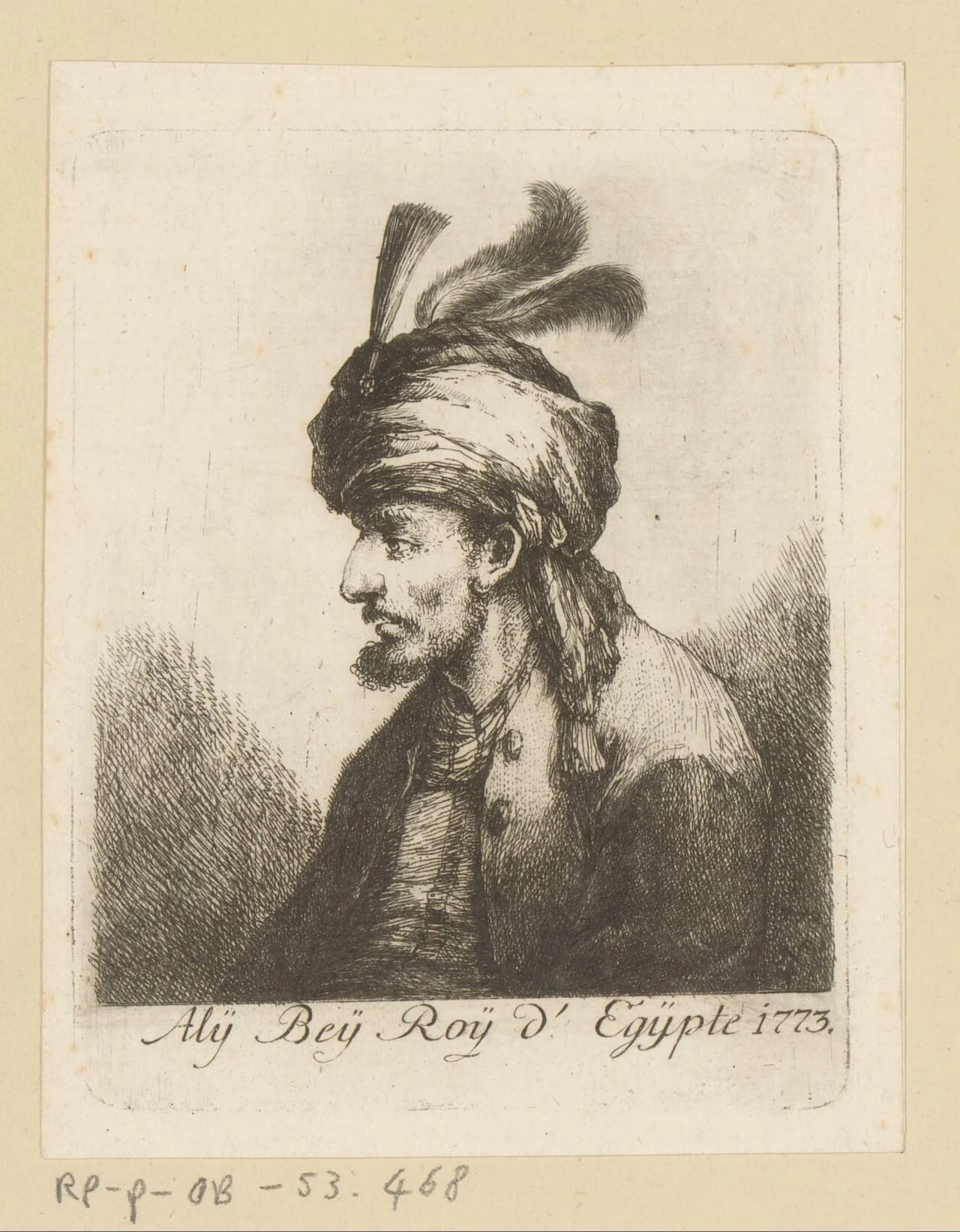
The first artwork reproduced here is a 1773 print titled Portrait of Ali Bey al-Kabir in the Rijksmuseum collection, catalogue RP-P-OB-53.468. The museum’s object record identifies Johann Andreas Benjamin Nothnagel as the printmaker, and its digital reproduction is released under a CC0 dedication. The print is a historic depiction, not a photograph taken during Ali Bey’s lifetime. Its artistic conventions and publishing history should be distinguished from a direct documentary likeness.
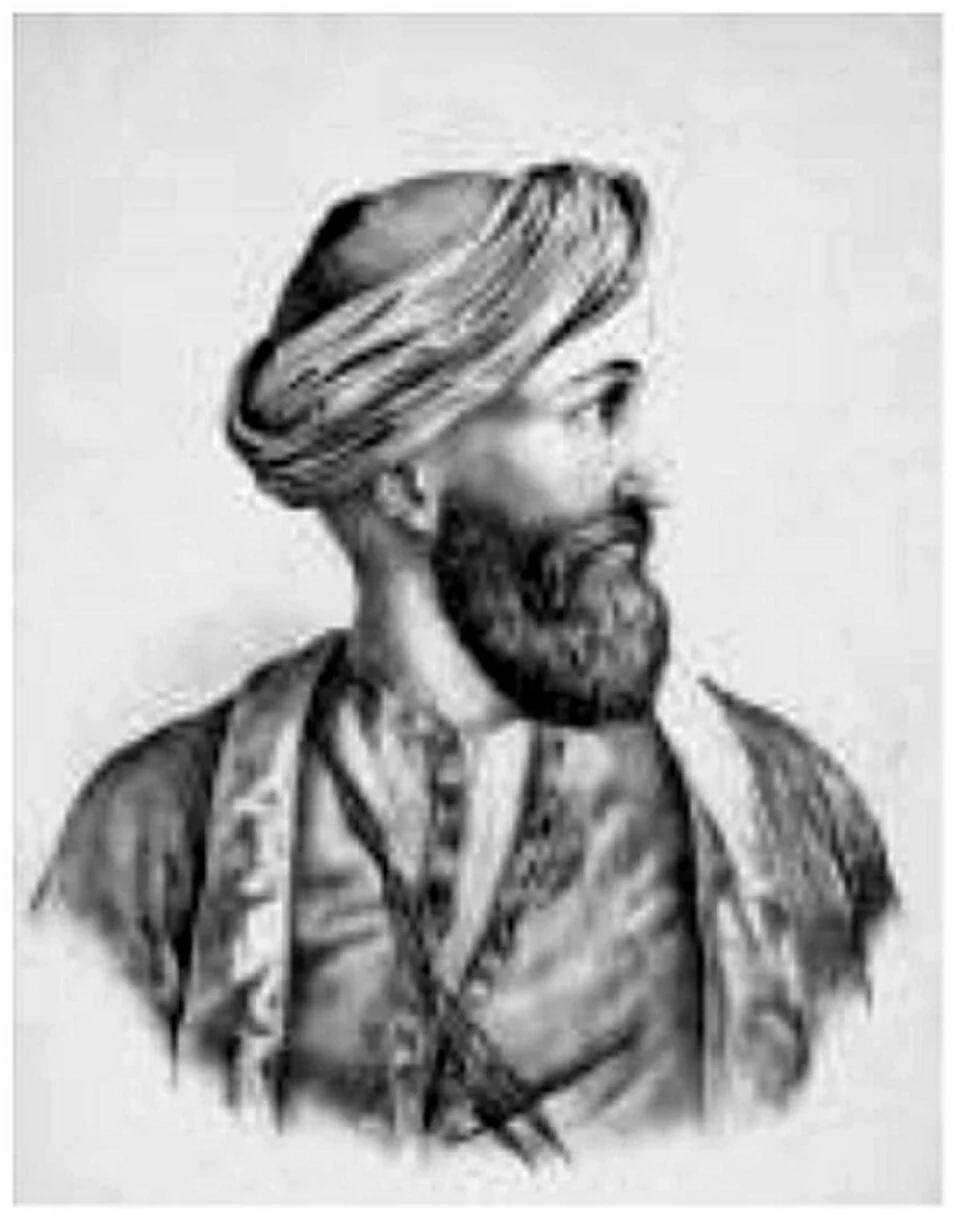
A second image is an older depiction of Ali Bey associated with the Hulton Archive and an original eighteenth-century work, provided in Wikimedia Commons as a public-domain reproduction. Its named source record and limited resolution are acknowledged. Showing two distinct period depictions rather than an AI-generated heroic portrait permits readers to see how the ruler was represented, while making clear that visual details may follow engravers’ choices rather than an authenticated eyewitness portrait.
A moment between the conquest and Muhammad Ali
Ali Bey’s ambitions occurred between two better-known political watersheds: the Ottoman conquest of 1517 and the rise of Muhammad Ali at the beginning of the nineteenth century. Those endpoints can make the intervening centuries appear empty in school-level summaries. In fact, Egyptian elites exercised significant agency, political rivalries unfolded within Cairo and regional expeditions involved forces based in Egypt.
Kemet Vault’s Ottoman Cairo markets and coffeehouses study explores the social and economic environment in which such political careers developed. The political portrait of Ali Bey and an urban economic history offer complementary evidence. Neither should be reduced to the same paragraph under a different keyword. This kind of connection makes the historical encyclopedia more complete without defaulting to ancient pharaohs for every new story.
Why historians disagree about aspects of his career
Accounts of Ali Bey rely in part on chronicles, biographies, European diplomatic reports and later scholarly syntheses. The Cambridge article on the accuracy of al-Jabarti’s narrative specifically raises questions about dating and sequence. Different kinds of sources may emphasise military achievements, Ottoman legitimacy, local rivalry or outside perceptions. Disagreement is not a reason to discard the history, but it should guide how confidently a date or motive is stated.
A responsible page identifies the broad chronology firmly while qualifying details where surviving reports diverge. It also avoids conflating Ali Bey al-Kabir with later travellers who adopted the name Ali Bey. The historical Egyptian ruler lived from approximately 1728 to 1773, whereas a Spanish explorer known as Ali Bey el-Abbassi belonged to a later era. Similar personal names do not indicate the same individual.
Ali Bey and the larger history of Egyptian identity
The career of Ali Bey illustrates how authority in Egypt could change within an imperial system. His governing ambitions, military campaigns and failed bid for lasting autonomy form part of the country’s long history of institutions and political contestation. It is misleading to treat Ottoman Egypt only as a passive interval before modern nationalism or to interpret eighteenth-century events entirely through twentieth-century political categories.
Historical study should link people with their documented setting and identify the limits of sources, including museum images. Ali Bey’s story has significance whether or not every modern biography agrees about his exact degree of independence. It opens questions about military households, local economic resources and relationships with neighbouring regions. Those are questions that belong alongside the architecture, literature and urban life of Ottoman Egypt as part of the history of the whole country.
Independent historical and museum sources
The historical sequence is checked against Cambridge University’s study of the accuracy of al-Jabarti’s Ali Bey chronicle, the historically referenced Islam Museum profile and the Rijksmuseum print catalogue. The dated 1773 print and a separate eighteenth-century portrait are historical representations, not modern documentary photographs; both carry individual archival sources and rights declarations.