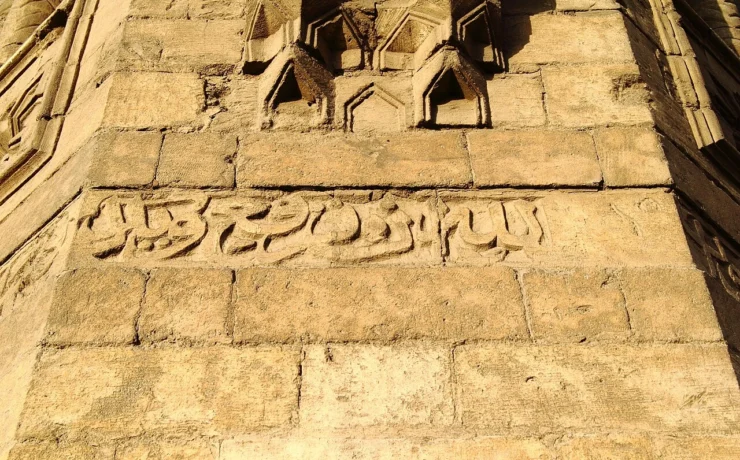
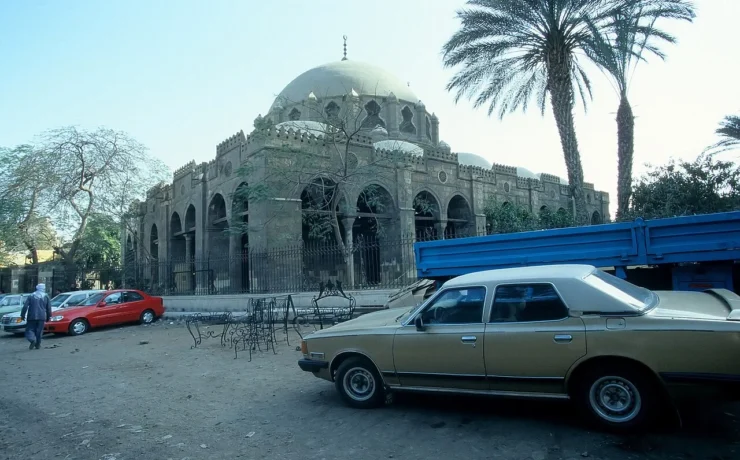
What is special about Sulayman Pasha al-Khadim Mosque? Built in 1528 inside Cairo’s Citadel, the Mosque of Sulayman Pasha al-Khadim is identified by Egypt’s monuments authority as the first Ottoman-style mosque built in Egypt. Its domes, pointed pencil minaret and older Fatimid site context make it a precise example of architectural change after the Ottoman conquest.
It is easy to confuse this mosque with the much larger nineteenth-century Mosque of Muhammad Ali, which also stands inside Cairo’s Citadel. They belong to different dates and patrons. This study focuses on the earlier sixteenth-century Ottoman monument, its construction over a prior Fatimid mosque, its prayer hall and courtyard, and the later work that preserved it. Identifying the exact building matters for both historical accuracy and travel guidance.
Compare this evidence with the later Sinan Pasha mosque in Bulaq and Mamluk Cairo religious architecture; these are separate periods and research questions, not duplicate articles.
The Ottoman conquest and a new governor’s building
The Ottoman conquest of Egypt in 1517 changed the country’s imperial administration, while the Cairo Citadel remained central to governance. Sulayman Pasha al-Khadim served as governor during the reign of Sultan Suleiman the Magnificent. His mosque, completed in 935 AH or 1528 CE, gave architectural form to the new ruling environment. The precise date is recorded by Egypt’s Ministry of Tourism and Antiquities, making it possible to relate the building to the first decades of Ottoman authority in Egypt.
The monument should not be read as proof that Cairo’s earlier Islamic culture abruptly disappeared. Mamluk monuments, institutions and artisans continued to shape the city’s built environment. The distinctive architectural forms of the Sulayman Pasha mosque represent one visible part of change, not the replacement of every earlier building. Studying the monument alongside the Citadel’s other mosques makes that longer urban continuity visible.
Why it is called the first Ottoman-style mosque in Egypt
Egypt’s official monument catalogue calls the Sulayman Pasha al-Khadim mosque the first Ottoman-style mosque built in Egypt. The distinction concerns a recognizable architectural type, not the first mosque used by Ottoman residents or the only religious building of the 1520s. Its compact domed prayer hall and pointed pencil minaret make the Ottoman formal vocabulary clear in an Egyptian setting. The monument thus offers a useful chronological reference for the beginning of this architectural mode.
The phrase ‘Ottoman-style’ should not mean every detail was imported unchanged from Istanbul. Building crafts, materials, earlier architecture and local urban needs influenced construction in Cairo. The mosque can be classified by its overall forms while still being part of Egyptian history. Its setting within an older fortress also matters: the builders were adding a new monument to a city where rulers had been constructing important mosques and institutions for centuries.

The earlier Fatimid mosque beneath its history
The present mosque was built on the remains of an older Fatimid mosque, according to the Egyptian Ministry of Tourism and Antiquities. That fact gives the site a longer chronology than its famous Ottoman domes. It does not establish that the surviving prayer hall is itself a tenth-century Fatimid building. What remains from the earlier mosque, what was reused, and what was newly built should be examined through institutional architectural reports rather than assumed from the location alone.
The official account also names Abu Mansur Qasta, associated with the earlier Fatimid foundation, whose burial is connected with a mausoleum in the northwestern portico. This demonstrates how a new Ottoman building could incorporate memory of an older sacred site. The resulting monument is historically layered, but the layers are not interchangeable. A photograph of an Ottoman courtyard cannot automatically illustrate the precise structure of the prior Fatimid mosque.
The plan of the prayer hall and its central dome
Egypt’s official description identifies a square prayer hall covered by a central dome, with three surrounding spaces roofed by half-domes. The overall composition is compact but visually clear, emphasizing an enclosed place of worship organized around domed forms. Compared with the vast courtyards of some Mamluk institutions, this arrangement can offer a different spatial impression. Yet architectural comparison should use accurate plans rather than a modern photograph taken from a single viewpoint.
The arrangement of openings, supports and the shape of the dome had both structural and aesthetic implications. A domed hall organizes circulation and light while producing a distinctive exterior silhouette. It is important not to assign every visible stone surface directly to the original 1528 construction, because repair and restoration can change finishes. The principal design remains historically meaningful even where later conservation has affected how the surfaces are experienced.
The pencil-shaped minaret as a dateable form
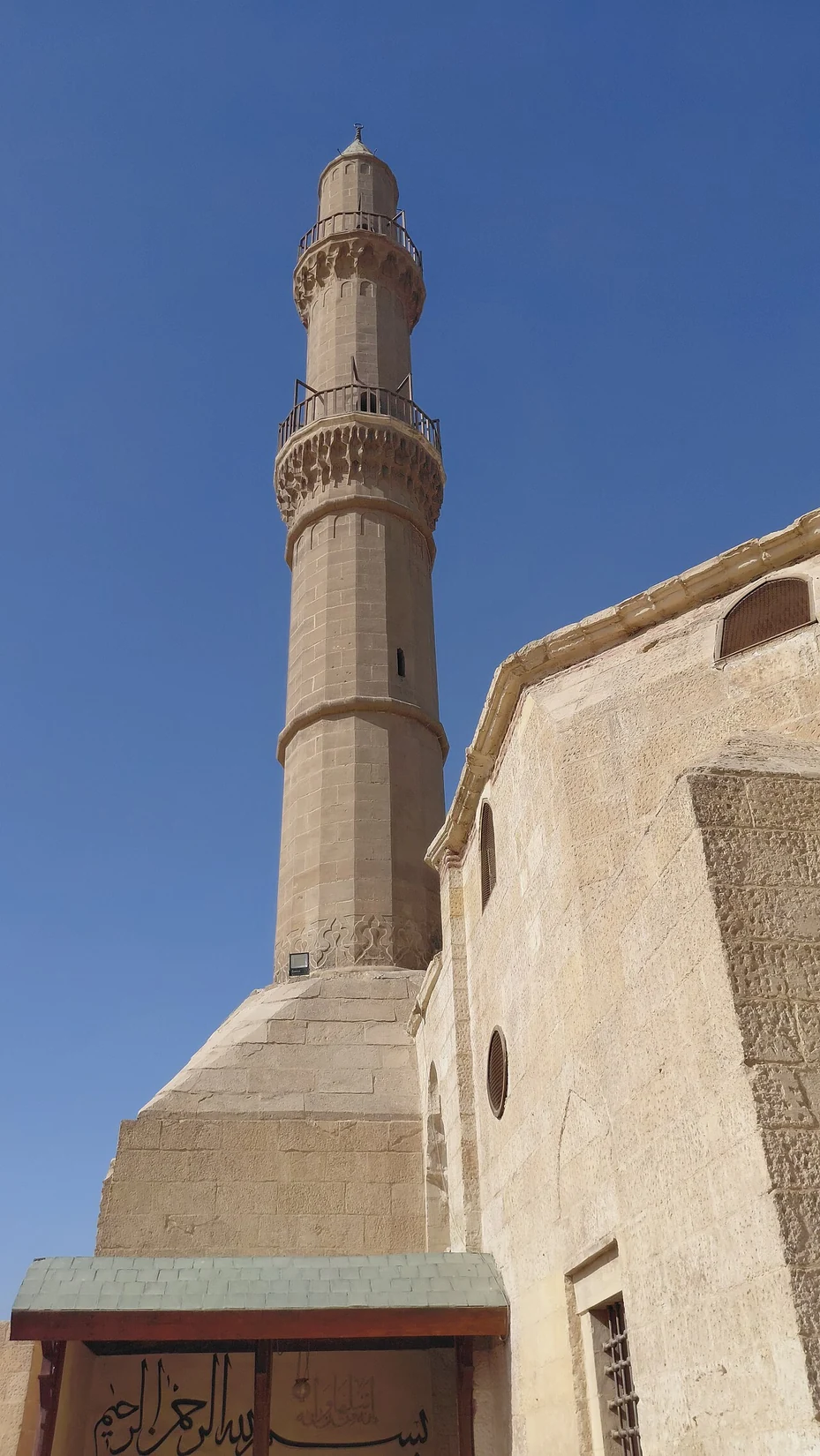
One of the mosque’s most recognizable features is its slender minaret ending in a pointed conical top, frequently compared to the shape of a pencil. This form is associated with Ottoman architectural practice and helps distinguish the building from earlier Cairene minaret traditions. It is especially useful for orientation within the crowded skyline of the Citadel, where more than one major mosque can appear in a photograph.
Visual recognition does not replace a dateable monument record. A pointed minaret may be a useful typological clue, but it would be incorrect to identify every minaret of that form in Egypt as this building. The historical name, location and structural context determine the correct attribution. For visitors and researchers, labeling the minaret accurately also prevents confusion with the taller nineteenth-century minarets of Muhammad Ali Mosque elsewhere in the fortress.
Courtyard, domed arcades and the sundial
The courtyard is placed to the northwest of the prayer hall and is bordered by canopied spaces with shallow domes. Egypt’s Ministry notes that it contains a sundial. This detail shows how an architectural feature can connect daily timekeeping with the organization of religious and social life. Yet a preserved sundial is not evidence that every aspect of early Ottoman public timekeeping took place at this one mosque, nor does its presence date every courtyard surface automatically.
A visitor examining the courtyard should attend to the relationship between the open center, shaded arcades and access to the prayer hall. Unlike a generic ‘Ottoman mosque’ stock illustration, a source photograph from this actual building can show those specific relationships. Still, modern images cannot reveal exactly how sixteenth-century congregations used the space, because the historical pattern of ritual and gathering must be established through appropriate records.
Marble pulpit and architectural ornament
The prayer hall preserves a marble pulpit decorated with floral and geometric elements, along with a platform associated with the muezzin, according to the official Egyptian monument description. These details show the combination of architectural form and interior craftsmanship. Ornament need not be read as an encrypted political statement. Its workmanship, material and relation to the prayer space are valuable historical information in their own right.
To study the pulpit carefully, an observer should first identify the actual material and record whether parts are original, altered or restored. A modern reference may call every patterned surface ‘Turkish’, but stylistic labels alone cannot establish who carved it. The larger story includes both Ottoman patronage and the skilled trades working in Cairo. This is why precise documentation of the built object is more helpful than repeated descriptions of a supposedly exotic style.
Tombs and memories within the mosque precinct
The mosque complex includes funerary elements connected with its longer sacred landscape. The official monument account mentions a mausoleum for Abu Mansur Qasta and other notable Ottoman-period tombstones and marble structures. The presence of burials does not turn the entire mosque into a royal mausoleum, nor does it establish that every interred person was part of the governor’s own household. Distinct names, inscriptions and dates must be studied separately.
Within Cairo’s architectural history, mosque precincts could accumulate commemorative functions as well as worship spaces. These physical traces are particularly valuable because a monumental patron’s name can otherwise dominate a site’s history. Tombstones offer evidence for later individuals and phases that are easy to overlook in a simplified narrative of one building’s foundation. Respectful preservation and accurate identification of these objects are essential to the credibility of any digital guide.
Restoration and additions under later rulers
The Sulayman Pasha mosque did not stop changing in 1528. Egypt’s monument authority documents an entrance addition in the age of Muhammad Ali Pasha, restoration activity by the Committee for the Preservation of Arab Antiquities in 1891, and later renovations during the reign of King Farouk. These interventions are part of the monument’s recorded life. They help explain why current appearances may differ from descriptions in older travel books or historical photographs.
Modern conservation projects have continued to focus on the mosque. Official reporting in 2023 discussed restoration work at Sarayat al-Jabal. A dated government report should be treated as a record of what the project had reached at that time, not an automatic guarantee of access or exact surface condition years later. Good heritage writing respects both the original sixteenth-century design and the efforts by later custodians that have kept the structure standing.
Do not confuse it with Muhammad Ali Mosque
The best-known mosque in the Citadel today is often the large nineteenth-century Mosque of Muhammad Ali Pasha, also called the Alabaster Mosque. It is visually prominent and frequently used in photographs of Cairo. That building is not the Sulayman Pasha mosque of 1528. Their patrons, dates, architecture and locations within the Citadel must be distinguished. An article that uses the wrong building as a featured image makes every later architectural discussion less reliable.
The actual photographs chosen for this study identify Sulayman Pasha al-Khadim Mosque specifically, and both have source records with the photographer’s name and Creative Commons permission. Comparing the two mosques can help demonstrate changing uses of Ottoman architectural ideas over time, but not by treating them as the same historical phase. This is also why the Sulayman Pasha mosque deserves its own canonical article rather than a generic ‘Cairo Citadel mosque’ page.
Cairo Citadel as a historical setting
The Citadel began under Saladin in the late twelfth century and was developed under subsequent rulers. By the Ottoman period it remained an important center of political authority. Its buildings can therefore illustrate several distinct dynasties and administrative frameworks within one fortified landscape. The Ministry’s Citadel overview identifies Mamluk, Ottoman and Muhammad Ali-era monuments among the things that give the site historical depth.
Research on the mosque should be set beside that chronology. The fact that the building stands inside a medieval fortress does not make it a medieval mosque, and the presence of later museums does not change its 1528 foundation date. Recognizing different layers lets readers interpret the site as a sequence rather than a collage of unrelated monuments. It also supports more accurate internal linking to other Cairo research without inventing a single cross-century story.
Visiting and photographing the monument responsibly
Visitors should consult the current Egyptian Ministry of Tourism and Antiquities page for access hours, restrictions and ticket arrangements. Official visitor details may change with conservation work, and a historical article cannot promise that every internal room will be open on the date of a visit. The mosque is within the broader Citadel complex, so site-level access rules may apply. Travelers should distinguish visiting logistics from the architectural facts established by the monument record.
A responsible visit pays attention to the compact domed hall, courtyard, conical minaret and surviving furnishings without touching fragile surfaces or crossing closed areas. Photographs need the exact monument name; panoramic shots of the Citadel can include several mosques. Anyone sharing a picture should avoid tagging it as Muhammad Ali Mosque unless that is actually what it shows. Sound historical labels make digital collections useful long after a visit.
What this mosque establishes about Ottoman Egypt
The Sulayman Pasha al-Khadim Mosque offers strong evidence for Ottoman patronage and architectural change in Cairo soon after the conquest of Egypt. Its 1528 foundation, pointed minaret, domed prayer hall and incorporation of an older Fatimid site are recorded by official Egyptian heritage authorities. The building also bears the traces of later restoration, which should be acknowledged rather than treated as damage to an imagined untouched original.
The monument cannot tell us all about Ottoman Egypt. It represents one governor’s architectural patronage within a specific political and religious landscape. The most useful comparison is with later Ottoman Cairo buildings such as Sinan Pasha Mosque in Bulaq, and with earlier Mamluk architectural complexes. This gives readers a chronology of real objects and locations, keeping sixteenth-century administration separate from the nineteenth-century Muhammad Ali state.
Evidence table: what survives and what it proves
| Evidence | Secure conclusion | Limit |
|---|---|---|
| 935 AH / 1528 CE foundation | A documented early Ottoman-style mosque inside the Citadel | Not the larger nineteenth-century Alabaster Mosque |
| Older Fatimid mosque remains | Site reuse and earlier sacred history | Not proof that all standing structures are Fatimid |
| Central dome and pencil minaret | Characteristic Ottoman architectural form | Style alone does not identify every detail’s date |
| Tombstones and mausoleum | Later commemorative layers | Not all burials belong to the founder |
| Later conservation | Documented 1891, Muhammad Ali-era and twentieth-century additions | Current appearance is not untouched from 1528 |
Original records and research sources
Institutional documentation supports dates, patronage and architectural interpretation. The site photographs identify the actual monument at their own modern dates; they are not contemporary evidence for every phase of its construction.
- Egyptian Ministry of Tourism and Antiquities: Sulayman Pasha al-Khadim Mosque
- Egyptian Ministry: Cairo Citadel historical context
- Egypt State Information Service: restoration of Sarayat al-Jabal, 2023
Continue reading the later Sinan Pasha mosque in Bulaq and Mamluk Cairo religious architecture. Last evidence review: November 2026.