Why is the Tomb of Petosiris at Tuna el-Gebel unusual? The late fourth-century BCE tomb of Petosiris, a high priest of Thoth near Hermopolis, looks partly like a small temple. Its inscriptions and carved reliefs combine Egyptian religious forms with artistic features associated with Greek traditions during a time of political transition.
The funerary monument of Petosiris is one of the most revealing sites for studying how Egypt changed near the beginning of the Hellenistic era. Its architecture evokes an Egyptian temple, its inscriptions preserve the voice and family memory of a powerful priest, and its reliefs bring different artistic traditions into one carefully designed space. Rather than label every detail simply ‘Greek’ or ‘Egyptian’, archaeological research examines individual scenes and their contexts. This study draws on Cambridge University Press, the German archaeological research project at Tuna el-Gebel, the Egyptian Museum in Cairo and a peer-reviewed analysis of the reliefs. The real photographs show the tomb itself; an object in the museum is separately described as a detached artifact, not passed off as a wall still in the sanctuary.
For context from other eras, compare later religious and social life in an Egyptian Roman oasis and the political transition and foundation of Ptolemaic rule. This study concerns the named priestly tomb rather than a generic Ptolemaic history.
Tuna el-Gebel, Hermopolis and the cult of Thoth
Tuna el-Gebel lies in Middle Egypt near ancient Hermopolis Magna, a religious and urban center associated with the god Thoth. The German Archaeological Institute’s research portal identifies the necropolis as a large and varied archaeological landscape with religious structures, house-shaped tombs and animal burials. Much of the standing and excavated material belongs to the Ptolemaic and Roman periods, though the history of the area is not restricted to those centuries.
Petosiris’ monument stands within this wider setting, and its association with Thoth helps explain the role of a powerful priest at the site. The god’s cult drew on longstanding Egyptian traditions, but the late fourth-century date places the tomb in a period of political transition. Interpreting a wall scene requires attention to local religious language as well as to the artistic contacts that developed across the eastern Mediterranean.
Who was Petosiris, and what did the title mean?
Petosiris is identified in his biographical inscription as a high priest of Thoth at Hermopolis Magna. Marjorie Susan Venit’s study, published by Cambridge University Press, discusses his titles, lineage and role. The inscription refers to family relationships and to his concern that the names of relatives should be remembered. This is an unusually personal source for an Egyptian tomb, but it remains a formal funerary autobiography written in a conventional commemorative setting.
A priest of this rank held a religious office connected with rituals, property and the temple community. His surviving monument signals significant social status and resources, yet an inscription praising its owner cannot be treated as a neutral audited account of every decision he made. Egyptologists compare the claims with other texts and with the archaeological context. The monument provides evidence for how Petosiris wanted himself and his family to be remembered as well as for how he lived.
Dating a tomb during the end of the fourth century BCE
Scholarly dating usually places the tomb of Petosiris in the final quarter of the fourth century BCE, around the transition from late independent Egypt through Macedonian and early Ptolemaic control. The period cannot be reduced to one exact year accepted without debate. A 2022 peer-reviewed study notes that proposed dates vary within a relatively narrow range, and historical arguments depend on the inscriptional, stylistic and political context.
This chronology gives the tomb exceptional significance because artistic and religious traditions intersected when forms of external rule were changing. Yet a Greek-looking detail is not by itself proof that a specific Greek artist traveled to the site in a particular year. Dating has to consider architectural plan, textual references, carving technique and relationships to other monuments. The main value of the date range is that it places a real priestly burial into a moment of cultural negotiation.
A tomb designed to resemble a small temple
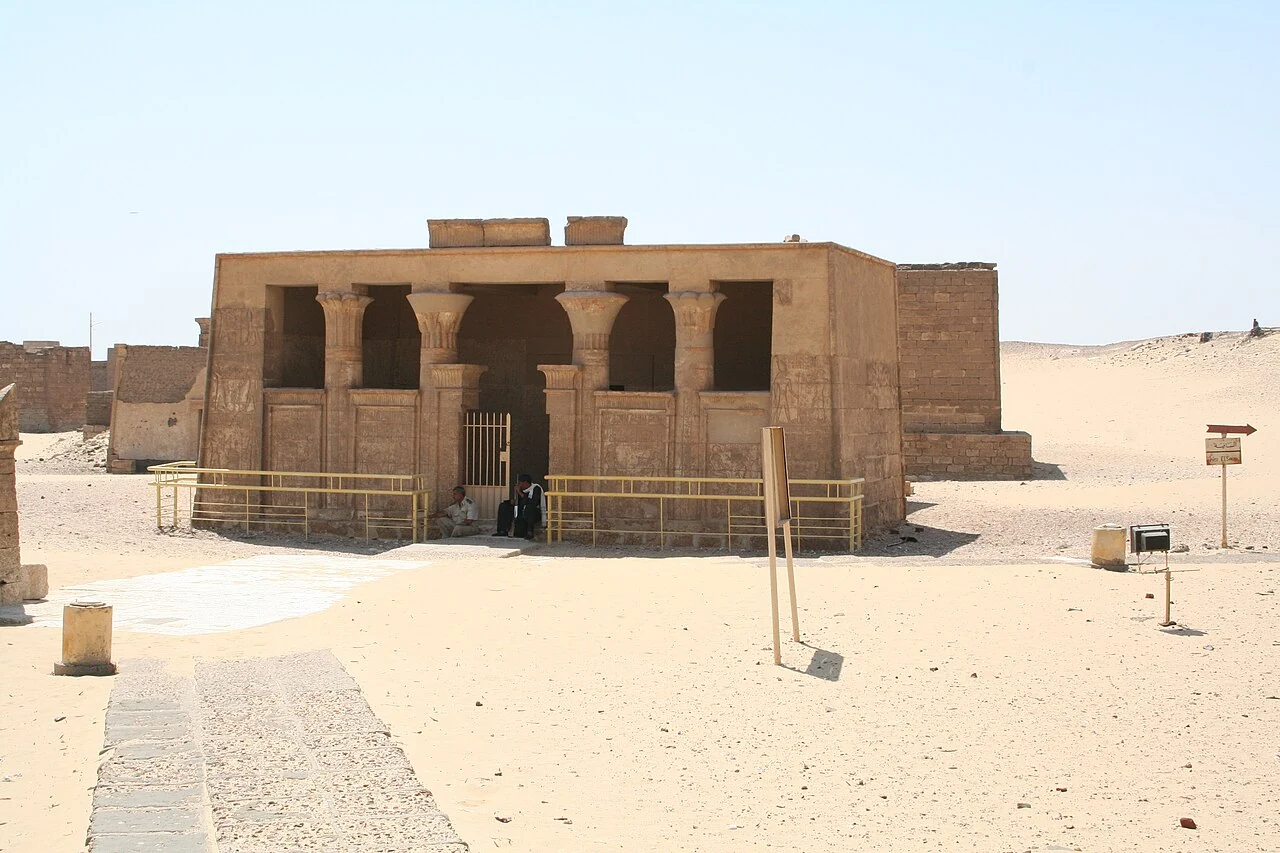
The structure includes a decorated entrance, a pronaos or front hall and an inner chamber, which give it a temple-like appearance. Cambridge’s architectural discussion describes this deliberate arrangement, while specialist analyses compare its plan with forms used in Late Period Egyptian religious architecture. The design made the funerary monument more than a simple underground burial container: it presented its owner through a ritualized space with imagery and writing.
Calling the monument a temple should not obscure its purpose as a tomb. Its design borrows sacred architectural forms, yet the dedication, burial equipment and commemoration are tied to Petosiris and his family. The photo of the surviving façade establishes that this hybrid architectural type can be seen at the actual site. It does not provide a full reconstruction of lost roofs, furnishings or painted colors in their original state.
The pronaos and its unusually detailed reliefs
The pronaos carries carved scenes of activities and figures whose style has been central to scholarship on early Hellenistic art in Egypt. The peer-reviewed study by Valeria Kuvatova argues that the decoration draws on both Egyptian and Greek artistic traditions, as well as earlier Egyptian conventions. That means the scenes need to be examined individually: how human bodies are posed, what activities are depicted and how figures relate to the architectural space.
The second photograph in this article is an authentic image of the tomb’s pronaos. Its reliefs are physical evidence, but the photograph cannot identify every person or read every text without epigraphic work. Researchers distinguish the visual composition from the inscription’s language, then ask how they complement each other. The tomb’s complexity is lost when every unusual hairstyle or garment is labeled a foreign fashion without contextual analysis.
Egyptian and Greek artistic choices on one monument
Greek influence is visible in certain artistic treatments, while the broader funerary framework remains deeply connected with Egyptian concepts of cult, family memory and the afterlife. This mixture is not simply the result of one culture replacing another. Artists can adopt selected ways of rendering figures and everyday scenes while continuing to work within an Egyptian ritual program. The effect is a distinctive visual composition that cannot be explained by a single modern label.
Scholarship therefore treats ‘hybrid’ as an analytical description, not proof that the owner had a particular ethnic identity or that Greek rule compelled a uniform architectural design. The patron’s local religious position, the artists’ choices and the availability of different conventions all matter. A rigorous museum page should specify which features appear in the reliefs instead of offering broad claims that every Egyptian monument suddenly became Greek after Alexander.
Reliefs of work and productive life
Among the tomb’s scenes are representations of practical activities and social roles. Such images can illuminate how late Egyptian artists depicted labor, food preparation and other aspects of life, but the images belong to a funerary building made to preserve the memory and status of an elite family. They are not a census of every resident in Tuna el-Gebel. A scene of work may express abundance, skill and the proper order of a household as much as it records observed tasks.
The comparison with Old Kingdom mastabas is useful because productive scenes appear in Egyptian elite tomb art across many centuries. Mereruka’s tomb at Saqqara, for example, belongs to a much earlier historical period and uses different artistic conventions. The Petosiris monument shows how traditional subject matter could be presented in a changing visual environment, rather than serving as evidence that all ancient Egyptian daily routines remained identical for two millennia.
The biographical inscription and the wish to preserve names
Petosiris’ extended inscription emphasizes family ancestry, religious devotion and the act of building his tomb. Cambridge reproduces an abridged translation expressing the desire that the names of his father and brother be pronounced, linking remembrance with continued life. Those statements illuminate a key Egyptian funerary concept: preserving the name and identity of the dead through ritual and commemorative text.
Such a declaration is not an everyday diary and should not be read as an unfiltered personal confession. Formal autobiographical inscriptions followed traditions that shaped how a powerful person presented himself. The correct historical question is what values the text communicates and how they relate to its chosen setting. Scholarship on Egyptian wisdom and memory also identifies ethical claims in these inscriptions, but translating them requires a precise ancient-language source.

The inner chamber and religious decoration
The tomb’s inner spaces contain additional reliefs and inscriptions concerned with the owner’s religious status, offerings and journey beyond death. The interior should be interpreted in relation to the entrance and pronaos, rather than as an isolated room in which every carved object has one simple meaning. Spatial sequence contributes to how the funerary program works, placing public commemoration and more restricted religious imagery into a designed whole.
The exact original display of color, movable objects and burial equipment is difficult to reconstruct completely from modern photographs. Conservation and the removal of objects may have altered what visitors can see. A description that confuses the present photograph with the entire late fourth-century setting would erase that history. Architectural records and studies of inscriptions are needed alongside images of surviving surfaces.
Books of the Netherworld at Tuna el-Gebel
Researchers have identified an excerpt from the Book of the Twelve Caverns in the tomb of Petosiris. A specialist article in the Bulletin de l’Institut Français d’Archéologie Orientale analyzes how the composition was adapted to the monument. This is an example of why Egyptian funerary literature cannot be understood entirely from a general summary of the Book of the Dead. Texts had specific transmission histories and could appear in varied media.
The presence of such a text is not proof that every line of it was known to every ancient Egyptian or that all monuments contained identical magical recipes. Its value lies in a particular attested composition in a particular location. Students should follow the original scholarly edition rather than relying on internet pages that assign generic underworld captions to unrelated reliefs.
Petosiris’ coffin and the problem of dispersed objects
The Egyptian Museum in Cairo preserves an anthropoid coffin catalogued as belonging to Petosiris, found at Tuna el-Gebel. The museum identifies an Egyptian-Greek-Persian mixture in the broader tomb’s artistic program and describes colored glass inlays and hieroglyphic inscriptions on the wooden coffin. It connects the object with the owner’s name and with Chapter 42 of the Book of the Dead, offering a different physical type of evidence from the carved walls.
A coffin displayed in Cairo must not be presented as though it still lies in the burial chamber at Tuna el-Gebel. The museum record establishes object type, material, discovery place and present gallery location. Such provenance allows readers to connect the site with the wider collection while keeping the separation visible. That practice avoids one of the most common errors in digital Egyptology: labeling a detached museum artifact as an untouched original site installation.
The wider necropolis of tomb houses and sacred animals
The German Archaeological Institute’s research project describes a broad necropolis containing house-shaped graves, religious structures and connections with animal worship. Archaeological work has investigated funerary spaces from multiple eras, using excavation, architecture, geophysical survey and archival photography. Petosiris’ monument is particularly famous, but it is not the sole tomb in the landscape nor a complete summary of every grave at Tuna el-Gebel.
The surrounding cemetery can also help scholars compare differences in wealth, style and chronology. A Greek-influenced image in one tomb does not prove a uniform artistic standard across every burial. The broader project shows why individual monuments and their landscapes are best studied together: architecture gives one kind of information, texts another, and excavation context helps relate both to the people who created them.
Preserving archival photography and excavation history
Modern projects at Tuna el-Gebel include efforts to digitize historic photographs and excavation records. The German Archaeological Institute’s Arachne project describes archival documentation assembled by earlier archaeological teams, including records of painted tomb houses. Such images can be essential where material has been weathered, altered or made inaccessible since the original fieldwork.
Historical photographs, however, also reflect the conditions and perspectives of the photographer. Archival dates, object labels and positions need to be checked. The two Creative Commons photographs in this article show the actual tomb and its pronaos, with creators and licenses identified. They are documentary site photography rather than invented reconstructions of the original colors. Their provenance is one reason they can be useful alongside the academic literature.
How to visit and study the monument responsibly
Tuna el-Gebel is an archaeological site in Middle Egypt, and the Tomb of Petosiris is part of a larger funerary area. Visitor access, photography rules, conservation work and ticket arrangements may change. A scholarly article should not promise entry to every room or a guaranteed opening time without current authorization. Researchers and travelers should consult the appropriate Egyptian heritage authority and obey site protection measures.
The most informative way to examine the tomb is to begin with the temple-like exterior, then observe the relationship between the pronaos and inner sanctuary, identifying reliefs in their exact locations. The biographical inscriptions and the museum-held coffin require additional research beyond what can be inferred from a simple tour. An informed visitor can distinguish original archaeological material from modern signs, barriers or conservation features.
Why Petosiris changes the story of Greek Egypt
The tomb of Petosiris shows a powerful Egyptian priest presenting his religious status and family memory in architecture associated with longstanding Egyptian sacred traditions while incorporating artistic choices that specialists connect with Greek and other influences. It demonstrates that political and artistic transition did not require a uniform abandonment of local forms.
The interpretation is strongest when tied to named evidence: the surviving building at Tuna el-Gebel, the biographical inscription, dated scholarly studies, the Cairo museum coffin and the larger excavation project. None alone proves the entire history of Hellenistic Egypt. Together they form a richer picture of one patron, one regional cult and the varied ways people and artists negotiated change.
Evidence: the tomb, the priest and the historical limits
| Record | Supported interpretation | Important caution |
|---|---|---|
| Petosiris inscription | Named high priest of Thoth, lineage and commemoration | Formal autobiography rather than private diary |
| Late fourth-century BCE dating | Transition-era funerary monument | Proposed absolute dates vary by scholarship |
| Temple-like façade and pronaos | Specific architectural forms preserved at Tuna el-Gebel | This remains a tomb, not simply a public temple |
| Egyptian-Greek artistic features | Visual conventions coexist in one program | Does not settle a patron’s ethnicity |
| Cairo Museum coffin | Named owner, inlay and Book of the Dead inscription | Now a detached museum object, not in situ |
| German archaeological project | Wider necropolis evidence and archival documentation | One tomb does not represent all burials |
Research bibliography and photograph records
Research and original photographs independently checked on 4 November 2026. The article relies on the named specialist excavation project and published scholarly records, not an invented modern reconstruction of the tomb.
- Cambridge University Press: Visualizing the Afterlife, Tomb of Petosiris excerpt
- German Archaeological Institute Arachne: Tuna el-Gebel research project
- Egyptian Museum Cairo: Coffin of Petosiris
- Valeria Kuvatova, 2022, stylistic traces in the Tomb of Petosiris
- University of La Laguna: Book of Twelve Caverns in Petosiris’ tomb