What is the Coptic language? Coptic is the final historically attested phase of the Egyptian language, written mainly with Greek alphabetic letters plus signs inherited from Demotic. Its varieties include Sahidic and Bohairic, and its surviving manuscripts and everyday documents extend Egyptian language history through Roman, Byzantine, medieval and modern religious traditions.
This article identifies the language, not a single church or building. It compares the alphabet with older Egyptian scripts, examines literary and everyday material and explains how scholars use Coptic to understand ancient Egyptian pronunciation. Two genuine dated museum objects show the difference between an everyday letter and a decorated manuscript.
Coptic is a stage of the Egyptian language, not a different foreign language
Coptic is the latest historically documented phase of the Egyptian language, which had been written for millennia using hieroglyphic, hieratic and demotic scripts. Its alphabet is predominantly based on Greek letters with additional characters drawn from demotic to represent Egyptian sounds not expressed by the Greek alphabet alone. University College London’s Digital Egypt project makes that relationship explicit. The change in script did not erase the language’s ancestry: a Coptic sentence is not simply Greek written by an Egyptian Christian.
That distinction is essential when studying Egypt beyond the pharaohs. The written Coptic record gives historians access to the language as spoken and written during Roman, Byzantine and medieval periods, and it helps linguists understand earlier Egyptian pronunciations. Christianity shaped the language’s surviving literary use, but the language developed through the long history of Egypt itself. One should not identify every Coptic inscription as a direct quotation from the era of pyramid construction, nor assume it originated entirely outside the Nile Valley.
How the writing system changed
Earlier Egyptian scripts generally did not record vowels in the same explicit manner as Coptic. The Greek-based alphabet changed that, allowing scribes to represent a fuller range of sounds. James P. Allen’s Cambridge University Press treatment of ancient Egyptian phonology identifies Coptic as the most transparent phase for the study of historical sound values, precisely because the alphabet marks phonological distinctions more directly than the older writing systems.
A reader who knows the shapes of Greek letters may recognise much of the Coptic alphabet while still being unable to read its vocabulary and grammar. Additional demotic-derived letters supplied sounds absent from standard Greek representation. The result was a writing system adapted to Egyptian speech in a changing Mediterranean cultural environment. The process had predecessors sometimes called Old Coptic; therefore it is inaccurate to assign the entire alphabet’s invention to one anonymous monk on one particular day.
Was Coptic created after Christianity arrived?
Coptic became especially important in the translation and composition of Christian religious literature, but alphabetic experiments in writing Egyptian preceded the emergence of the mature literary corpus. Cambridge’s linguistic discussion places earlier antecedents centuries before the third-century emergence of more developed Coptic writing. Some early experiments occurred in settings very different from later monastic libraries. Christianity became a major force in preserving and expanding the written language; it did not cause the Egyptian language itself to appear.
The historical record is a continuum, not a switch. Demotic texts continued into the Roman period, and different forms of writing could coexist before one became increasingly dominant in certain religious communities. A useful account distinguishes the ancestry of the language, the development of an alphabet and the growth of a literary tradition. Those three developments have overlapping but not identical timelines, which is why a simple date labelled invention of Coptic is not a defensible answer.
The major dialects: Sahidic, Bohairic and others
Coptic was written in several regional forms. The principal named dialects in scholarly references include Sahidic, Bohairic, Akhmimic, Fayumic, Lycopolitan and Oxyrhynchite, although classification and labels are not always uniform across publications. Allen’s work explains that these forms differ especially in phonology, with certain grammatical variations. This geographic diversity makes the Coptic corpus valuable evidence for the many ways Egyptian was spoken across the Nile Valley and Delta.
Sahidic developed into a major literary standard, especially in earlier written Christian sources, while Bohairic became important in the later church’s liturgical tradition. That does not mean all people in Upper Egypt used exactly one standard or that the modern church preserved an unchanged everyday spoken dialect across seventeen centuries. The labels identify manuscript traditions and linguistic patterns, not a permanent map of every individual’s language in every generation.
Coptic texts beyond worship
University College London notes that most surviving Coptic literature is religious but that substantial numbers of private documents also survive. Letters, lists, accounts and other everyday records illuminate economic and social practices often absent from monumental histories. A short note on pottery may tell us about a delivery or a personal request. Such a source provides a different window into the past from a carefully prepared biblical codex or illustrated parchment manuscript.
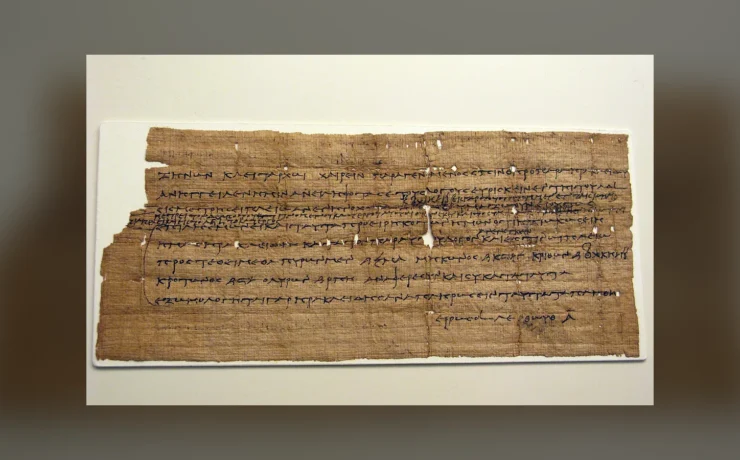
The first original object photograph accompanying this article records a limestone ostracon with a Coptic letter, dated about 580–640 CE and catalogued by the Metropolitan Museum of Art as accession 14.1.195. Its specific museum number and date matter: it is a real material document, not a decorative reproduction of an invented Egyptian alphabet. The photograph demonstrates that everyday writing could appear on inexpensive surfaces as well as valuable books.

Script and language are not the same thing
An Egyptian text can be written in more than one script over long historical periods, and one script can be used for more than one language. Coptic makes this separation especially clear because many of its signs are visually related to Greek, while the grammar and most of the vocabulary belong to Egyptian. It would be incorrect to translate a Coptic manuscript by reading each letter as though it spelled a modern Greek word. Reading requires knowledge of the underlying Egyptian linguistic system.
This matters for the interpretation of tomb inscriptions, museum labels and searchable digital archives. An object catalogue may identify the script as Coptic, the language as Egyptian and the setting as Christian, each describing something different. Kemet Vault’s Demotic writing dossier helps explain the earlier historical stage, while its Rosetta Stone study explores the much wider scholarly process of recovering Egyptian scripts.
Manuscripts and monastic libraries
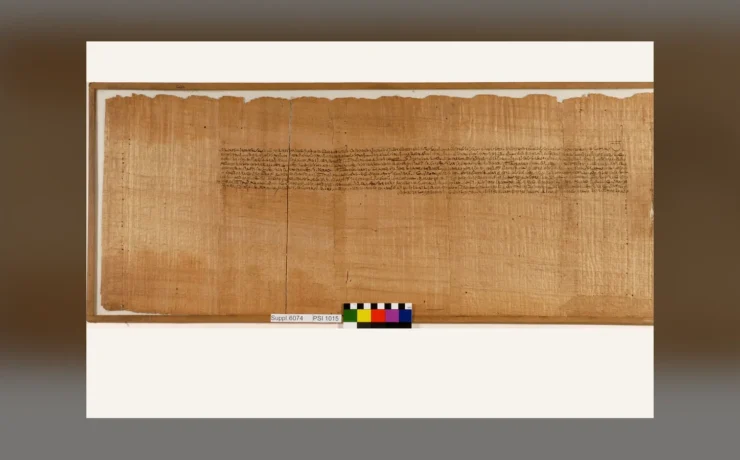
Coptic manuscripts survive from monasteries, churches, archaeological settlements and later collecting histories. They can be written on papyrus or parchment, illustrated with coloured inks, and organised as codices rather than only long rolls. The photograph of a Coptic manuscript dated approximately 700–900 CE, now in the Metropolitan Museum, has a possible rather than certain provenance from the Monastery of Dayr al-Suryan in Wadi Natrun. That distinction is printed in the caption because the museum record does not support stronger certainty.
Wadi Natrun’s monastic traditions are an important part of the story of Egyptian Christian scholarship, but a manuscript photographed today was not necessarily produced in the exact building displayed on a tourism website. Provenance may involve transfer, collection and restoration. Kemet Vault’s Coptic Museum study gives related context on how Egyptian Christian material has been gathered and conserved. The language and the institution are related subjects, not the same search intent.

The Nag Hammadi manuscripts and literary diversity
The fourth-century Nag Hammadi codices are a famous example of Coptic manuscript culture because they preserve writings associated with a range of late antique religious movements. They do not represent every Coptic work, nor does their discovery prove that all Egyptian Christians shared the same beliefs. Scholars examine the codices’ physical construction, linguistic dialect, original composition and later translation history to understand the complicated transmission of individual texts.
The fame of Nag Hammadi can overshadow ordinary documents and mainstream Christian literature, which form a very large part of the surviving record. Historians should distinguish the original language in which an individual work was composed from the language of the particular surviving copy. A Coptic translation of a text first written in Greek remains valuable evidence for how Egyptian readers encountered the material. It does not prove that its author originally wrote in Egyptian.
The rise of Arabic and the continuation of Coptic
After the Arab conquest of Egypt in the seventh century, Arabic gradually became increasingly important in government, social exchange and written culture. The transition was uneven over centuries, with Coptic continuing in different forms, especially in Christian communities and liturgical practice. It is not accurate to claim that every Egyptian stopped speaking Coptic in the year 641, or that the language immediately disappeared when Arabic government records expanded.
Language change occurred through social, administrative, geographic and religious processes. People could move between different written and spoken traditions, while monasteries preserved documents in older forms. This later medieval history is why Coptic belongs not only in the study of Byzantine Egypt but also in the history of Islamic Egypt. A modern account should present the transition without reducing either language to a political slogan or implying uninterrupted everyday use of a single unchanged dialect into the present.
How is Coptic used today?
Coptic remains important in the liturgy, scholarship, hymnody and cultural memory of Egyptian Christian communities. Bohairic plays a prominent role in contemporary Coptic Orthodox worship. This is a continuity in a religious and educational tradition, not evidence that Coptic is the normal first language of most people in contemporary Egypt. Arabic has long been the principal language of everyday communication in the country, while dedicated learners and specialists continue to study Coptic.
The distinction between a liturgical language and a widespread household language is common in world history. It permits appreciation of cultural preservation without inventing present-day population statistics. Different communities and educational programmes may use different teaching materials and pronunciation conventions. Scholars working on historical phonology also distinguish modern ecclesiastical pronunciation from reconstructions of speech in earlier periods.
Why Coptic helped decipher ancient Egyptian
Coptic was an essential comparative resource for scholars studying the structure and vocabulary of older Egyptian. Its clearer vowel notation and known later lexical forms allowed linguists to test readings proposed for hieroglyphic and demotic words. It is therefore connected to, but distinct from, the famous Rosetta Stone, which presents inscriptions in hieroglyphic, demotic and Greek. Coptic is not one of the three scripts engraved on that stone.
This point is frequently misstated in introductory articles. The Rosetta Stone provided a multilingual comparison, while Coptic supplied knowledge of the language’s later development. Together with royal names, other inscriptions and sustained scholarship, these resources contributed to the modern recovery of ancient Egyptian writing. A responsible explanation never turns Coptic into a secret key that can automatically translate any old inscription without grammar or context.
How to identify a genuine Coptic artefact
A good museum record names the object, material, date or dating range, findspot where known, inscription and collection accession number. In this article, the everyday ostracon from about 580–640 CE and the illustrated parchment manuscript dated about 700–900 CE are deliberately different types of source. The former helps show private written communication; the latter illustrates codex and artistic manuscript practice. Their dates and current collections are explicitly stated.
A generic image captioned ancient Coptic script may be a modern decorative font rather than a documented historical source. Museum records reduce this risk. They also make it possible to distinguish a photograph taken by a modern visitor from the age of the artefact itself, and a possible monastic provenance from an archaeologically confirmed location. Accuracy is not an obstacle to a compelling story; it makes the objects more informative.
Where Coptic belongs in the full history of Egypt
Coptic is a bridge across several periods. Its linguistic ancestry reaches back into ancient Egyptian history; its written literary corpus flourished through late antiquity and medieval Christian scholarship; and its modern religious use continues in a changed linguistic environment. Studying the language challenges any simple division between an ancient Egypt that ended abruptly and later Egyptians who somehow had no relationship to the older language.
The most useful path through Kemet Vault connects Greek, Roman and Byzantine Egypt with medieval Egyptian history and the site’s older writing-system guide. The pages answer different questions: one concerns political and cultural eras, another scripts, and this one a particular continuing language. That separation is how a genuinely comprehensive history of Egypt can be both connected and precise.
References and object-provenance notes
The linguistic identity and uses of the language are grounded in UCL Digital Egypt: Coptic and James P. Allen, Ancient Egyptian Phonology, Cambridge University Press. The named early Byzantine-period Metropolitan Museum Coptic ostracon (14.1.195) gives a documented everyday written object; the second image has a probable but not confirmed monastic provenance. The language’s continued liturgical role is distinguished from claims about how widely it is spoken daily.