Menkaure is frequently introduced as the builder of the smallest of Giza’s three principal pyramids. That description is correct but incomplete. His funerary complex and its remarkable sculpture tell a fuller story of royal representation, unfinished work, material choices and religious institutions in Egypt’s Fourth Dynasty. The unfinished seated image of Menkaure discovered near his valley temple is especially valuable: a partly worked statue can sometimes teach more about artistic procedure than a flawless finished masterpiece.
This encyclopedia dossier treats the pyramid, its temples and royal sculpture as archaeological sources rather than a sightseeing checklist. It explains what the material remains establish, why approximate reign dates differ among institutions, and how the sculptures help researchers understand ideas of Egyptian kingship. For current admission and travel, use the separate Giza cultural visitor guide.
Menkaure at a glance
1. Menkaure in the Fourth Dynasty royal sequence
Menkaure followed the line of builders associated with the great pyramids of Giza. Egypt’s Ministry considers him most likely a son of Khafre and therefore a grandson of Khufu. That family relationship should retain the Ministry’s qualified language where the evidence warrants it. The sequence of kings and monuments is clearer than every possible detail of the royal family tree.
The Greek form of Menkaure’s name appears in later classical traditions and historical discussions. Such later accounts are valuable evidence for how Egyptians and outsiders remembered the royal past, but they do not replace contemporary inscriptions, excavations and royal monuments as primary evidence. Students should not construct a biography based solely on later stories of the king’s personality.
His monument is a distinct royal funerary complex within the broader Giza cemetery. It links royal mortuary ritual with architectural choices and a sculptural program that is especially well represented in museum collections.
2. The Third Pyramid: small only in comparison
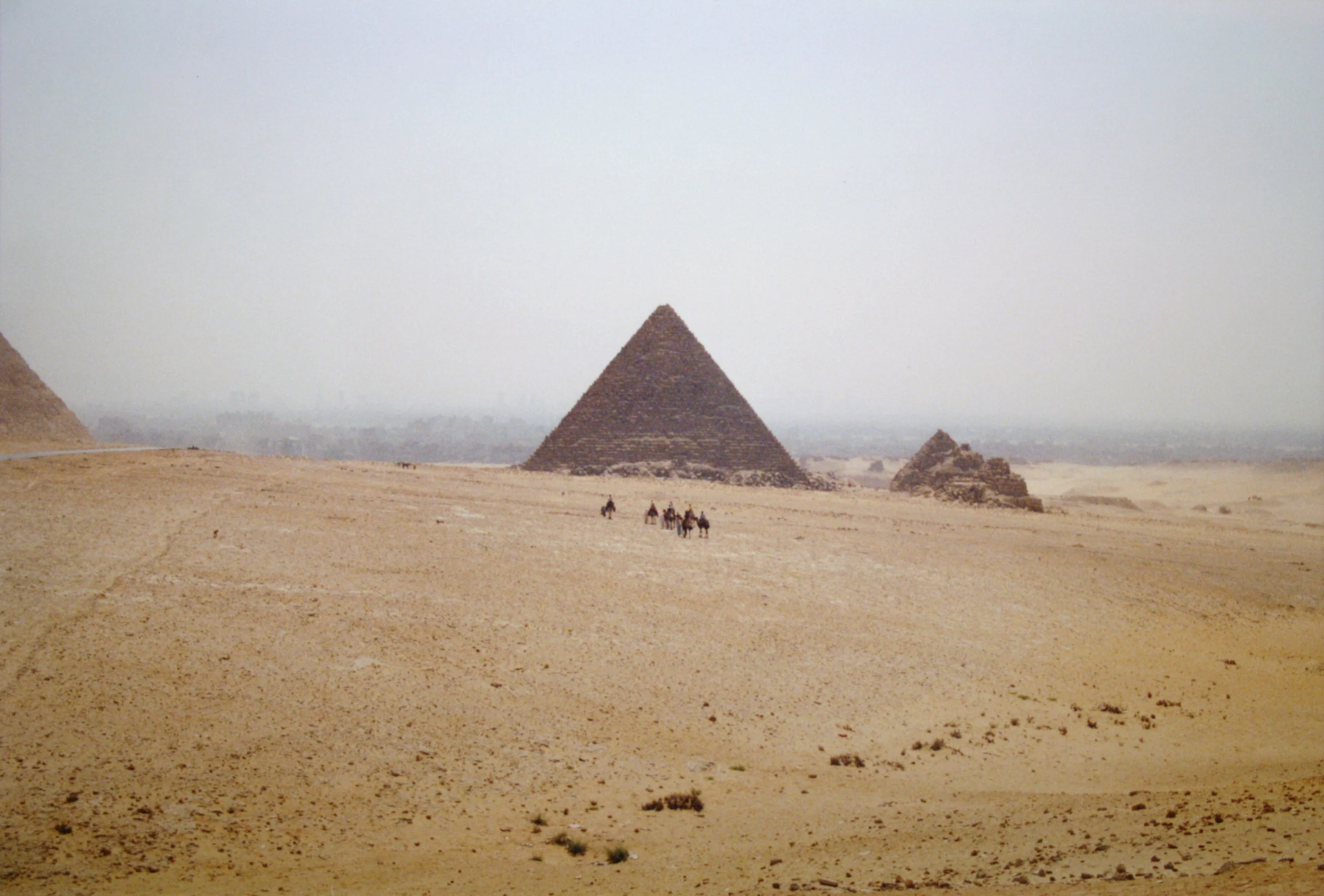
Menkaure’s pyramid was about 65 meters high originally, substantially shorter than the neighboring pyramids built for Khufu and Khafre. The Ministry notes its base area was less than a quarter of that of the larger royal pyramids. In isolation, however, a structure of this size still demonstrates substantial architectural skill and coordinated investment.
Comparisons need more than measurements. The third pyramid occupied its own setting and required construction, temple planning, ceremonies and maintenance. A smaller pyramid might reflect available ground, construction choices, ritual priorities and other circumstances. Treating its dimensions as a direct numerical measure of Egypt’s political strength is a historical argument that needs independent evidence.
The surfaces visible now were altered by the loss of casing and other changes over the centuries. The original monument cannot be reconstructed simply by extending the rough appearance of present-day masonry over every missing face.
3. Why granite matters at Menkaure’s monument
Unlike the surviving better-known limestone casing of some neighboring pyramids, Menkaure’s complex included large quantities of granite in lower casing courses. The Ministry explains that this granite was transported from Aswan, more than 800 kilometers away. Granite is substantially harder to work than limestone, and its use suggests conscious material investment even as the pyramid itself was smaller.
Not all of the original intended casing was granite. The ministry describes the lower quarter as granite, with limestone used higher up. Later changes, quarrying and damage complicate attempts to reconstruct the finished appearance. Students should avoid repeating the simplified statement that the entire outer pyramid was built solely of granite.
Stone selection can connect religious display with supply networks and craftsmanship. Sourcing granite implied quarrying, river transport, skilled handling and shaping. We may infer organizational effort without possessing a complete accounting document covering each ancient shipment.
4. The valley temple and its workshops
Menkaure’s funerary landscape included temples and connecting spaces as well as the pyramid. The valley temple became particularly important archaeologically because it yielded major royal sculpture. Discoveries there help reconstruct aspects of the artistic and ritual investment that went beyond the monumental stone pyramid.
Excavations by a joint Harvard University and Museum of Fine Arts, Boston, expedition explored the complex beginning in the early twentieth century. The museum context of individual objects is not simply a matter of where they sit in a gallery today. Findspots near the valley temple, workrooms or statues in secondary contexts can change how a scholar interprets their original roles.
Temple programs may have included permanent or recurrent acts of remembrance, offering and representation. An altar, a royal statue and a building fragment do not by themselves reconstruct an entire lost ceremony. Archaeology establishes surviving spaces and objects; interpretation reconstructs what may once have happened there.
5. A unique look at sculpture in progress
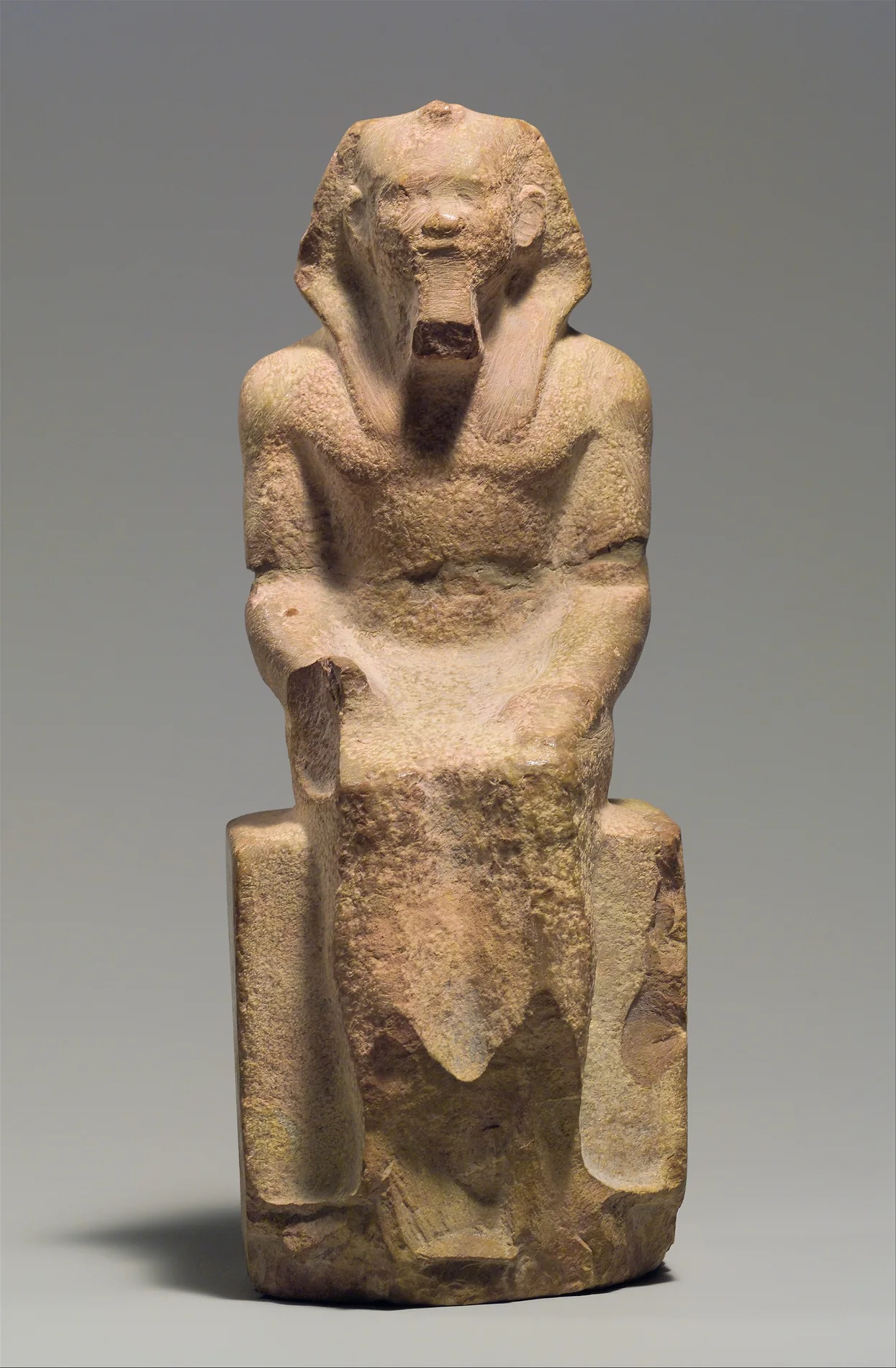
One of the clearest objects for studying Menkaure is an unfinished seated statuette of the king now held by The Met, accession number 37.6.1. The catalog places it in a sculptor’s workshop connected with the valley temple. It was among fourteen unfinished royal statuettes found in the area, an unusually valuable group for understanding the stages of artistic production.
Its incomplete condition preserves stages that a finished sculpture would normally conceal. The figure’s basic proportions and some bodily modeling were carved, while other parts remain missing or unfinished. The headcloth, royal beard and intended throne decoration express formal conventions of Egyptian royal image-making. A student looking closely can distinguish block-like preparation from more delicate finishing.
The Met notes that the throne would have been decorated with the sema-tawy, a symbol of the union of Upper and Lower Egypt. Because the piece is unfinished, this is an interpretation of an intended program, not a claim that every missing mark can be seen on the statue today.
6. Sculpture as a political and religious language
Ancient Egyptian royal statues were more than lifelike portraits in stone. Crowns, a formal seated pose, the royal false beard and relationships with divine figures communicated kingship as an enduring institution. Such iconography made the king’s identity recognizable across media and religious settings, even if a sculpture did not attempt a photographically exact likeness.
Menkaure’s surviving sculptural repertoire includes highly regarded works showing him beside divine or royal figures in temple contexts. These images helped present royal authority through divine relationships and idealized bodies. A sculptural group could be both a work of fine craftsmanship and a participant in cult practice.
When comparing figures across collections, use institutional object records to identify which king is shown. A statue closely resembling another ruler is not evidence of a historical identity until inscriptions, findspot and other features have been evaluated. A photograph that simply looks “Egyptian” is not enough for a precise caption.
7. Comparing Menkaure with Khafre’s royal portraits
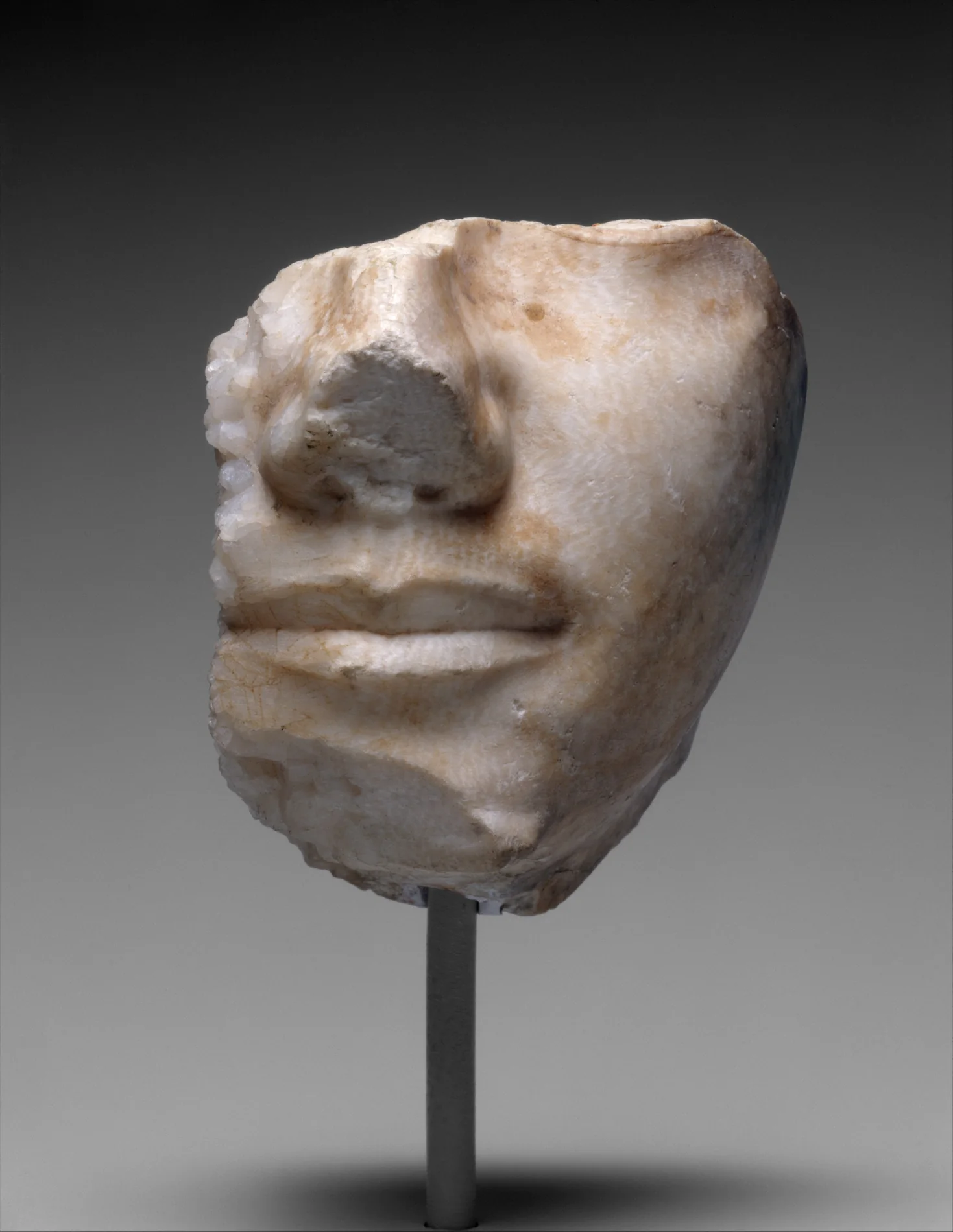
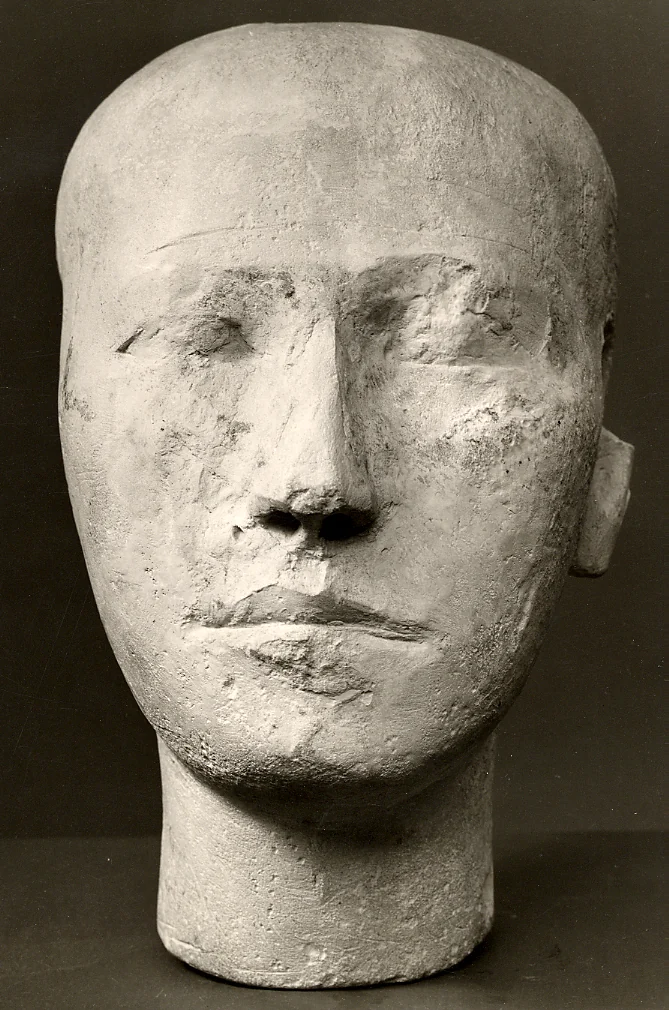
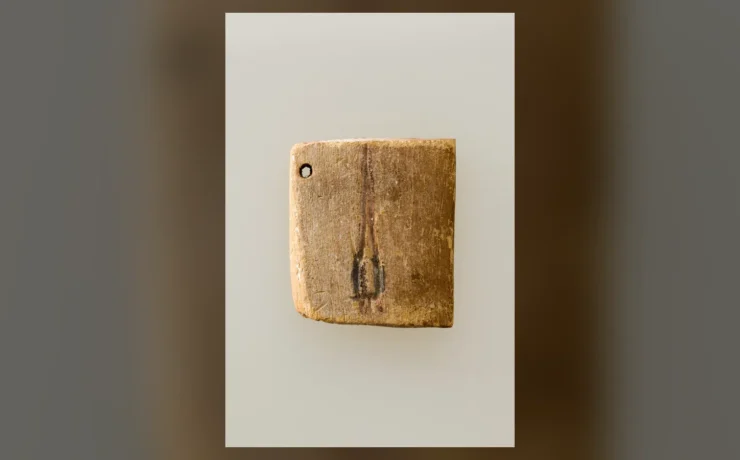
These two comparison objects make an important methodological point: royal statuary, funerary portrait forms and artistic conventions can resemble one another without all representing one named individual. The Met’s Khafre fragment is cataloged as a portrait of the king, while the reserve head from the eastern cemetery is not identified as Menkaure.
Read the material, dimensions, excavation or acquisition history and attribution notes together. Artistic technique also provides clues, but it does not override inscriptional evidence or solve every ambiguity by itself. The unfinished Menkaure statue’s secure workshop context is one of the strongest reasons it makes an educational centerpiece.
8. A royal complex that extends beyond the pyramid
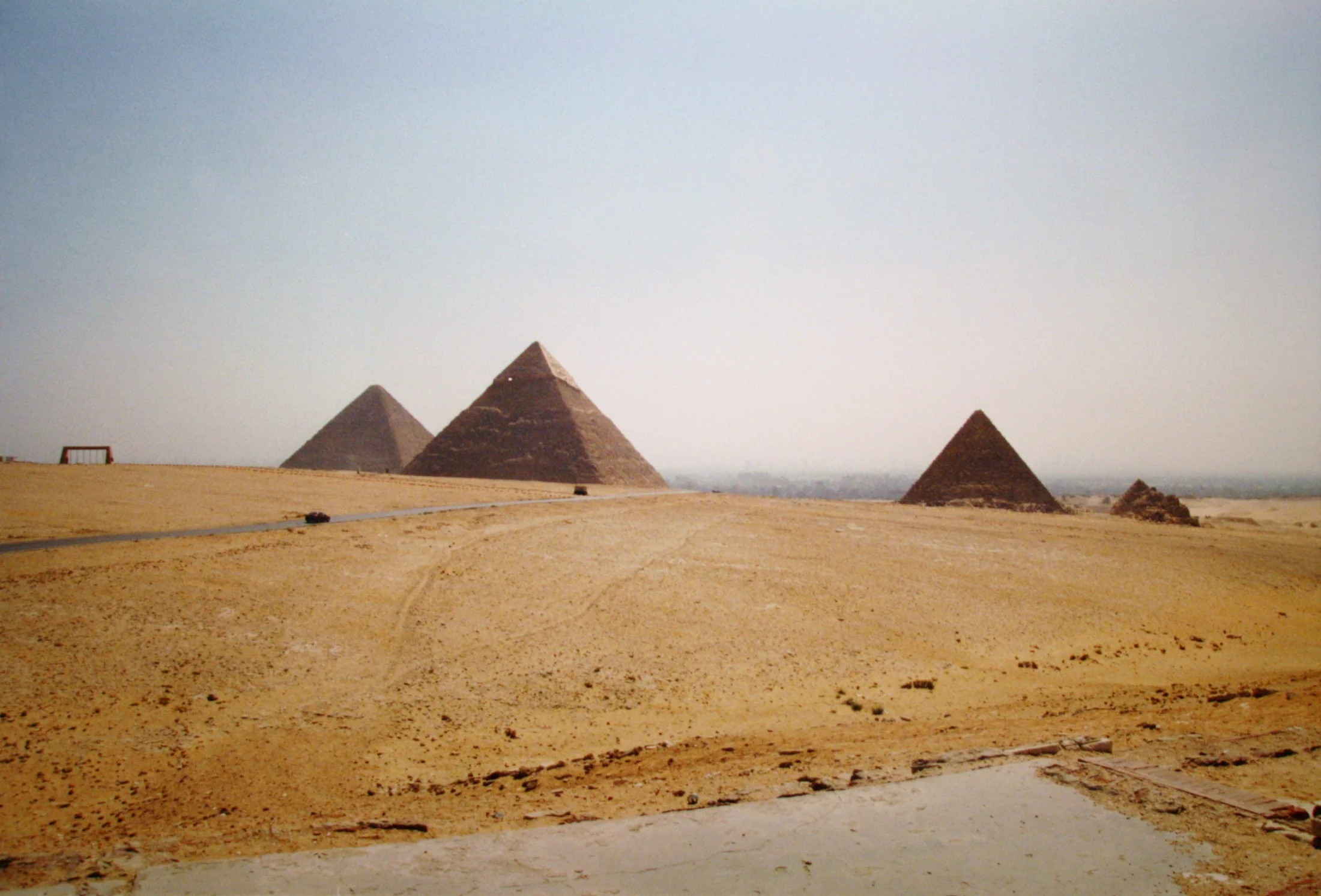
Menkaure’s pyramid stood amid a larger funerary setting with subsidiary pyramids, mortuary spaces and related structures. Comparing it with the surrounding complexes highlights continuities in sacred architecture, not simply differences in height. The temple and sculpture program suggest that the religious presence of the king required significant attention even when the main pyramid’s dimensions were smaller.
The meaning of a building depends partly on how it was approached and used. Surviving foundations, stone courses and excavated sculpture can help reconstruct relationships between the funerary temple and the wider necropolis. Lost upper structures and decorations remain points at which the scholar should mark uncertainty rather than supply an imaginative narrative without evidence.
9. Unfinished royal monuments and the limits of an explanation
Several architectural and sculptural features associated with Menkaure have unfinished aspects. The Met’s workshop finds offer direct visual evidence of incomplete sculptures. That does not necessarily justify explaining every unfinished feature in the complex with one event or one cause. Changes of reign, construction schedules, resources and subsequent damage must be considered separately.
The Ministry discusses the granite program and variations in the monument’s state. Historical interpretations may differ about the original intended scale of some adjoining structures. Good research distinguishes what has been excavated from a proposed restoration of the building’s design.
A useful question is not simply “Why is this unfinished?” but “What exactly is unfinished, how do we know, when did work stop, and what other processes might explain what survives?” This method reduces the temptation to turn archaeological evidence into a dramatic but unsupported biographical story.
10. Chronology and the museum-date problem
Different institutions can place Menkaure at different absolute BCE dates. The Ministry’s monument description uses approximately 2532–2503 BCE, while The Met’s catalog for the seated statue uses roughly 2490–2472 BCE. These numbers belong to differing chronological systems. They are not two independent lifetimes of Menkaure.
Ancient chronology relies on the comparison of royal lists, archaeological sequences and other records. The relative relationship of Menkaure’s project to the better-known neighboring pyramid complexes can be described confidently without forcing the date of every individual artifact into a single modern year.
Students should use the museum’s own dating language in object captions and state which chronological reference framework they are applying when building a comparative table or timeline. Kemet Vault’s Old Kingdom timeline illustrates the broad period without pretending every ruler’s modern year is fixed beyond debate.
11. Does a small pyramid prove declining royal power?
The size of Menkaure’s pyramid is sometimes used to claim a simple political decline from Khufu onward. That interpretation cannot be established from height alone. Granite casing required considerable labor and long-distance supply, and the associated sculpture and temples represented substantial investment in cult architecture and royal ideology.
Evaluating royal authority would require evidence about administration, resource distribution, elite inscriptions, trade, temple foundations and patterns across more than one ruler. A smaller structure can reflect changed priorities, site constraints, religious conceptions or limitations whose relative importance is not fully recorded. The argument remains more complex than a ranking of three famous monuments.
Comparing Khufu’s original pyramid, Khafre’s valley temple and sculpture and Menkaure’s work reveals the diversity of Fourth Dynasty choices. The full dynastic guide places them in a broader royal context.
12. What the excavations teach about artistic workshops
Finding a sculpture in a workshop setting is especially informative because it can preserve traces of production rather than only display. Art historians can study how large volumes were reduced into blocks, how bodies and features were established, and how smoothing or polishing changed the surface. The presence of multiple incomplete royal figures can suggest stages of a sculptural program.
However, an archaeological find does not automatically prove that every individual sculpture had the same intended location or ritual function. A careful student distinguishes the shared find area from the original architectural placement and final purpose, which may not be equally well documented.
Material details require direct inspection or accurate museum records. In digital reproductions, changes in light can obscure incised guidelines or polished areas. This is why the article preserves a link to The Met’s catalog in addition to displaying its first-party licensed image.
13. A student worksheet: interpreting Menkaure’s statue
Identify the exact object
Begin with The Met 37.6.1, not with an unattributed internet image of a seated king. Record its material, size, findspot and stated date.
Describe the workmanship
What has been shaped, what remains rough, and which elements are broken or missing? Distinguish visible evidence from the museum’s interpretation of what the finished statue might have displayed.
Connect artwork to archaeological context
Why does discovery in a sculptor’s workshop matter? Consider whether it allows stronger claims about production than a finished work found without an excavation record.
Compare a different king
Use Khafre’s carefully attributed facial fragment to compare representation without assigning every Fourth Dynasty portrait to Menkaure.
Explain uncertainty
Do not assume the statue tells us Menkaure’s character, personal appearance or the exact reason why the object was never finished.
14. Frequently asked questions
Who built the third pyramid at Giza?
Menkaure, a Fourth Dynasty king, built the third and smallest of the major royal pyramids at Giza.
Was Menkaure a son of Khafre?
The Egyptian Ministry considers that relationship most likely. Scholarly writing should preserve appropriate qualification rather than assuming all family relationships are equally documented.
Why is granite important in Menkaure’s pyramid?
Granite from Aswan was used in part of the casing, especially the lower sections. Transporting and working this material required significant logistical and technical effort.
What is special about The Met’s Menkaure statuette?
It was recovered in a workshop context and remains unfinished, preserving evidence of ancient sculptural practice and formal royal representation.
Why do museum catalog dates differ?
They may follow different modern reconstructions of Egyptian absolute chronology. The secure Fourth Dynasty attribution does not depend on one universal calendar date.
Did the smaller pyramid mean the dynasty was failing?
Not necessarily. Architectural scale alone cannot measure political power, particularly when the building includes substantial granite work and an important sculptural program.
15. Further reading and sources
Continue with the Giza archaeological atlas, the Giza research overview and the Fourth Dynasty encyclopedia hub. Tourism logistics, tickets and practical access belong in the site’s separately published visitor guide.
- Egyptian Ministry — Pyramid Complex of Menkaure.
- Egyptian Ministry — Giza Plateau.
- The Met 37.6.1 — Seated Statue of King Menkaure.
- The Met 26.7.1392 — Khafre fragment.
- The Met 48.156 — Unidentified reserve head from Giza.
Image provenance: museum Open Access CC0 originals and documentary Giza photos stored under Kemet Vault’s owner-managed archival system. Object identity, find context and uncertainty are preserved; no reconstruction is presented as archaeological photography.