The Fayum mummy portraits are real faces from Roman Egypt, painted in wax or tempera and originally used with the dead. For roughly the first three centuries of the Common Era, families in Egypt commissioned remarkably expressive portraits in a world that combined Hellenistic painting traditions with Egyptian burial. The paintings show people with specific ages, clothing and ornaments, but not all of their names or biographies have survived. Their modern stories include nineteenth-century excavation, dispersed collections, scientific imaging and the return of some objects to Egypt.
This Kemet Vault feature uses peer-reviewed conservation studies, the British Museum, the Egyptian Museum in Cairo and the Metropolitan Museum’s current object records. It examines the difference between realistic painting and historical evidence, why panels were fitted into mummy wrappings, and what the 2022 return of a famous blue-mantle portrait teaches about provenance. Three authentic Met Open Access photographs document three separately identified objects, including a complete mummy whose panel remains in position.
Roman Egypt and the human faces at the boundary of two artistic worlds
A wooden portrait from Roman Egypt can feel astonishingly immediate. The eyes meet ours, the face is shaped by light and shadow, and the sitter may wear a colored tunic, earrings or a gold wreath. Yet these panels were made for a funerary context, not as framed paintings for a modern gallery wall. The people depicted lived in Egypt under Roman rule, while their painters worked within Greco-Roman traditions of naturalistic portraiture and their families preserved a recognizably Egyptian practice of preparing the dead for an enduring afterlife. This is why the familiar phrase “Fayum mummy portraits” needs explanation instead of being used as if it named one ancient school with a known headquarters. Museums date the strongest group to roughly the first through third centuries CE, with some examples and developments extending into the fourth. The surviving paintings are important for cultural and social history as well as art: they preserve clothing, jewelry, conventions for showing age and individual facial characteristics. Their modern biographies also reveal excavation, dispersal, restoration and debates about provenance. An encyclopedia should treat these layers separately. The portrait does not tell us the sitter’s spoken language, personal beliefs, legal status or family history just by looking lifelike.
Why are the paintings called Fayum portraits if they were found elsewhere?
The name comes from the Fayum region, an oasis-and-agricultural landscape west of the Nile where prominent groups of mummy portraits were recovered. Hawara and er-Rubayat, near ancient Philadelphia, became especially associated with nineteenth-century discoveries. The Met’s museum publications stress that the term is conventional: important related portraits have also been found at Antinoopolis, Memphis, Thebes and other Egyptian sites. Calling every painted Roman Egyptian face a portrait “excavated at Fayum” would therefore be an archaeological mistake. Some surviving objects lack a dependable original findspot because they entered museums through the antiquities market or early collecting rather than recorded excavation. The museum record may simply say “from Egypt,” and that is the proper level of precision for the object. The agricultural and social worlds of the Fayum were complex, with settlements and cemeteries connected to wider Roman Egyptian economies. Portraits mostly tell us about funerary investment among households that could afford these items. They cannot be used as a demographic sample of the entire province. The name’s popularity reflects discovery and collecting history as much as the painter’s workshop or the owner’s origin. This study identifies exact accession numbers for the illustrations instead of assuming that geographical terminology supplies undocumented provenance.
First to third centuries: dating an art form that had no single founding year
Art historians usually place most familiar panel mummy portraits in the first three centuries CE, with the wider practice continuing in changing forms. The Met dates a young woman in red to approximately 90–120 CE and an older woman with a wreath to 100–125 CE. Those ranges come from curatorial analysis of style, costume, materials and related objects rather than from an inscription giving a calendar day. Some portraits remained embedded in mummies that can provide additional context, while isolated panels may lack the associated human remains entirely. Scientific dating of wood or pigments can offer fresh constraints, but radiocarbon results must be interpreted in terms of the age of the material sampled. A tree cut earlier can yield a date older than the painting applied to its wood. Recent spectroscopic and accelerator mass spectrometry studies show why assumptions based solely on facial fashion sometimes need reconsideration. As in other archaeological fields, the earliest surviving object is not necessarily the moment a tradition began. Nor should historians project a neatly dated “end” when different communities continued using related masks, shrouds and painted coverings. Approximate chronology provides a framework, but the exact production histories of many individual panels remain imperfectly documented. Museum dates are best treated as ranges supported by evidence and subject to further revision.
The person, the mummy and the wooden panel: one funerary assembly
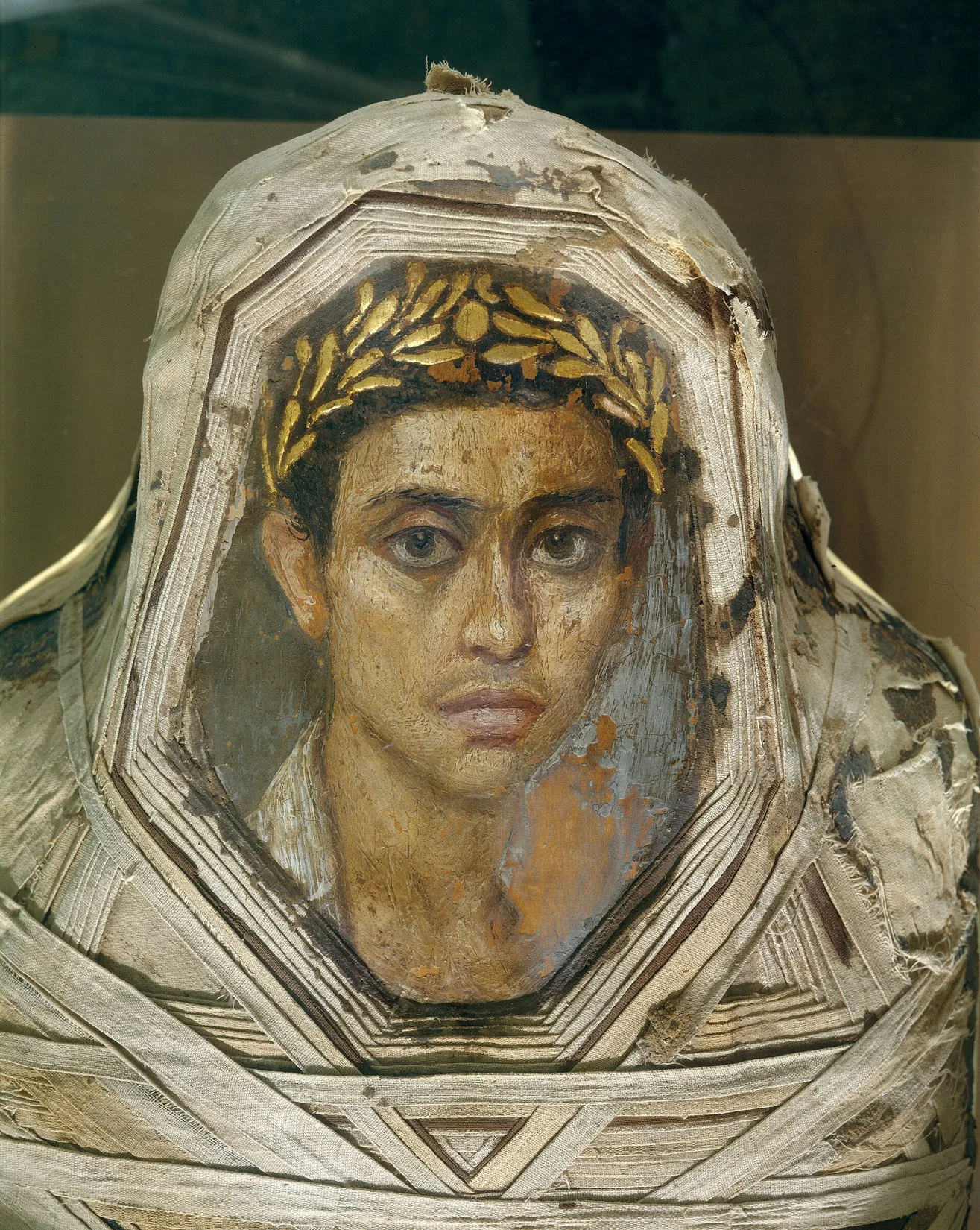
A portrait’s original use is easiest to understand when the mummy and panel survive together. The Metropolitan Museum’s accession 11.139 is a mummy from Hawara, dating to 80–100 CE, with a portrait of a young man set over the face within the linen arrangement. It was excavated in 1910–1911 and remains an unusually direct demonstration of function. The panel did not necessarily hang on a wall for decades before death. The Met notes that most studied examples may have been made at or near the time of death; an earlier assumption that portraits began as domestic paintings is no longer accepted as a universal account. One possible use was to present the person’s image during funeral display or procession before fitting the panel into the mummy wrappings. Such suggestions are meaningful but not proven for every isolated portrait. The wider funerary construction might include carefully arranged linen, cartonnage decoration and other protective elements. A portrait is therefore one component of a material treatment of the dead, not a free-floating token of identity. Seeing the real mummy provides an immediate safeguard against the common online error of showing an isolated painted panel without mentioning the body it was intended to accompany.
Wax, encaustic painting and the challenge of describing a technique
Many renowned portraits were painted in encaustic, a technique using pigments suspended or dispersed within a wax-based medium. The method could produce dense, luminous colors and complex modeling of skin, hair and textiles. Museum labels sometimes describe visible brush marks and worked wax in places, and paintings can vary considerably in texture. Yet not every painting of the tradition was encaustic. Tempera methods also occurred, with binders such as glue or other aqueous materials; some portraits were painted on linen rather than rigid wooden panels. The contrast is an art-historical classification, not permission to infer the complete chemical recipe from one photograph. Conservation science can examine wax composition, pigments, binding medium, layers and later restoration material. Recent research using microscopy and multispectral methods has expanded understanding of how painters prepared grounds and built images. A panel’s apparent shine may be changed by age, museum lighting or conservation treatments. The Met’s collections give material descriptions for each accession so that “wax portrait” is not applied automatically where evidence supports a different medium. The most reliable way to understand the technique is to combine the visible brushwork with those independently documented material studies.
Limewood, cedar and the trade in painting supports
Thin wooden panels were not all made from one Egyptian tree. The Met’s research on the portraits identifies a range of local, imported and possibly regionally available woods, including lime, sycamore and several conifers or hardwoods. These details matter because a painting support can speak to trade and craft infrastructure beyond the painted face. Thin panels had to be cut, shaped and eventually fitted into a three-dimensional mummy wrapping arrangement. Some portraits taper toward the lower end or curve at the top because of that final use. A trained conservator can study grain direction, wormholes, preparation layers, cut marks and old joins for clues about manufacture. It is tempting to look at a smooth varnished surface and conclude that the tree grew near the cemetery, but determining geographic origin requires much more. Wood species alone may not identify a precise commercial shipment, and reused boards could complicate interpretation further. Some materials moved over long distances through the Mediterranean and Nile economies, connecting workshops to regional exchange. Rather than inventing a specific merchant for a particular panel, an evidence-led account explains what wood analysis can establish and what it cannot. The famous portraits were the end product of multiple crafts: harvesting, transport, preparation, painting, embalming and burial.
A young woman in red: the evidence inside accession 09.181.6
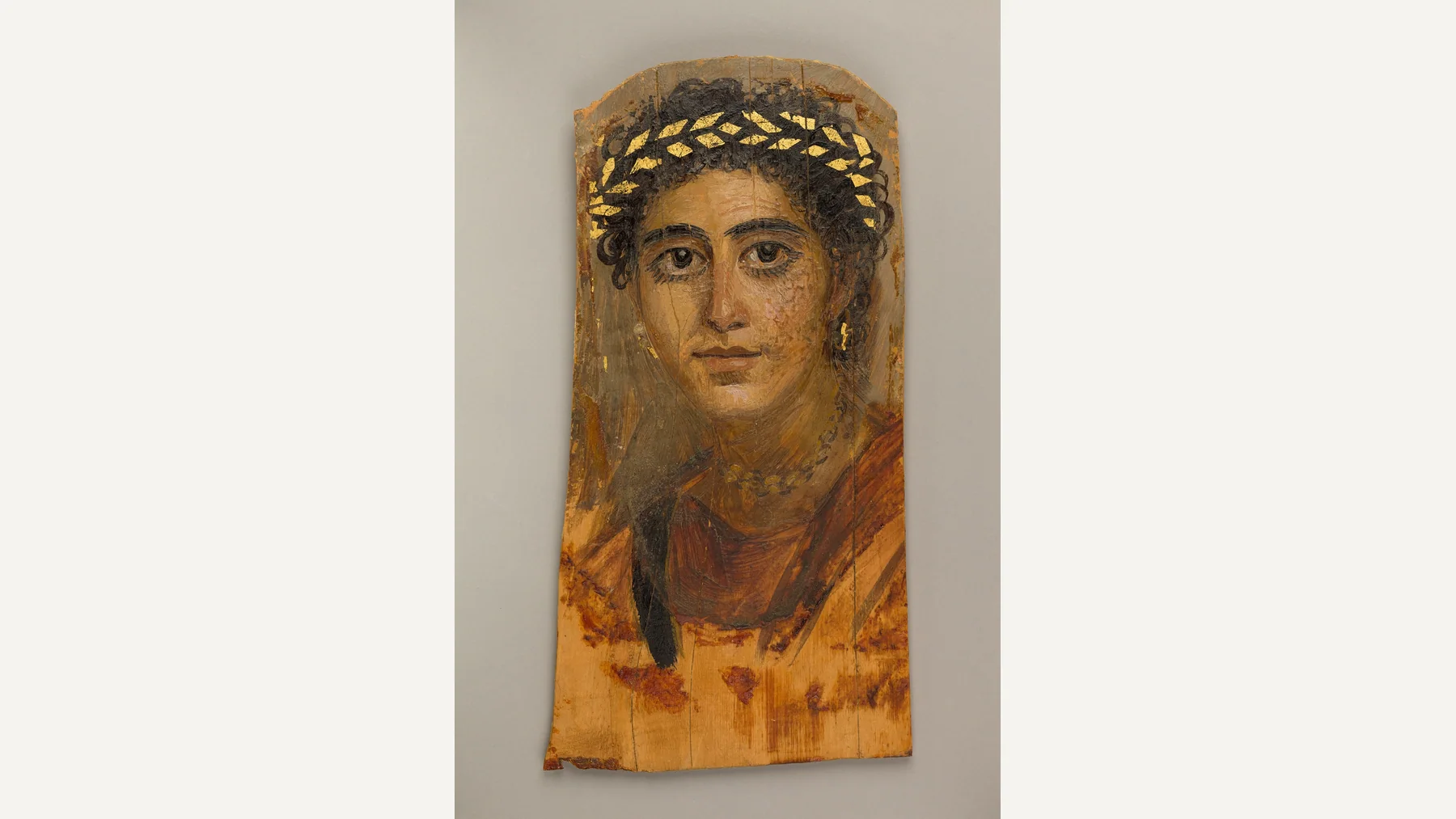
The Met’s portrait of a young woman in red, accession 09.181.6, has an estimated date of 90–120 CE. The museum describes encaustic paint on limewood with gold leaf. The figure wears a red garment and an elaborate gold-colored wreath, and the shape of the eyes, brows and curls reflects the painter’s attention to modeling and expression. Although the face seems personal and immediate, the surviving museum record does not supply an ancient name or a documented biography. It would be deceptive to label her as a named princess merely because she wears valuable-looking ornament. Nor does a wreath necessarily prove that the sitter was a priestess of a particular deity. The visual choices can be compared with other painted panels and with Roman-period dress, but such comparisons remain interpretive. This is a separate object from the older woman portrait 09.181.5 and from the youth’s mummy 11.139. That accession discipline is crucial because web search images are often detached from their collection catalogues. Our illustration shows the authentic painting, not an AI face generated to look ancient. Readers can use the original museum link and CC0 source to inspect its details for themselves. This image illustrates the purpose of the broader collection without being misrepresented as evidence for every Roman Egyptian woman’s attire.
An older woman with a gold wreath: age and the limits of portrait realism
The woman’s gray curls and mature facial structure in Met accession 09.181.5 make a striking comparison with 09.181.6. The museum dates her image to 100–125 CE and observes that her hairstyle does not closely follow some imperial court fashions. Her face has been modeled with a careful sense of age rather than reduced to a standardized youthful ideal. That variety is one reason the portraits invite questions about likeness and personal identity. But the apparent individuality should not be confused with a modern photographic record. Painters worked within conventions; idealization, client preference, available workshop styles and later damage all affect what we see. Some features may reflect recognizable traits of actual people, while others served aesthetic and funerary purposes. Scientific study comparing panels with surviving mummified bodies has also prompted the Met to suggest that most portraits were produced close to death, rather than necessarily being commissioned years earlier for domestic display. The older woman’s image might once have been viewed by living relatives, but her specific social and family history is not documented. Even the wreath should be interpreted in connection with wider funerary visual habits, not converted into a certain statement about a military honor or official rank. The portrait is a rare, powerful human encounter precisely because its identity remains both visible and partly unknowable.

Clothing, gold and social display: what a tunic can tell us
Painted clothing offers historians evidence of fashion and the ways people chose to present themselves or loved ones in death. Tunics can be rendered in pale, red or darker colors; gold leaf can heighten wreaths or ornaments; earrings and necklaces may be carefully differentiated. Scholars study these details alongside surviving textiles from Roman Egypt and the wider Mediterranean. Yet an artist’s depiction is not necessarily an inventory of an individual’s wardrobe. Clothing could be idealized, symbolic or shaped by workshop convention. A richly adorned portrait does not prove that every family member wore imported jewelry every day, and a relatively plain portrait does not confirm poverty. Portrait production itself implies resources, making the surviving corpus uneven as evidence for social classes. There is also variation in the way older and younger sitters are painted, and hairstyles can be useful chronological clues when compared with other material. But fashions did not change simultaneously in every Egyptian town, and local preferences could persist. An art historical estimate that a hairstyle resembles a certain emperor’s reign should not become a firm inscriptional date. The portraits are best understood as selected statements made for funeral use, within communities already interconnected with Greco-Roman visual traditions and Egyptian mortuary rituals.
Greek style, Egyptian ritual and the danger of ethnic labels
The portraits are often described as blending Greek, Roman and Egyptian elements. The combination is real, but it does not allow a viewer to assign an individual’s ethnicity from eye shape, skin tone or hairstyle. Egypt under Rome was home to people who participated in various linguistic, legal and cultural networks. Some families had Greek names or civic status, while many lived in local Egyptian traditions, and the boundaries between identities could be flexible. The naturalistic painting style is associated with Hellenistic and Roman visual culture, whereas the use of the portraits on mummies follows an Egyptian funerary practice. That tells us how traditions interacted, not the ancestry of every sitter. The label “Greco-Roman Egyptian” is a useful historical and cultural descriptor when carefully applied to the period. It is not a biological classification. Museum records sometimes preserve Greek inscriptions or funerary associations that provide additional information, but a silent wood panel without a name cannot do the same work. The National Archaeological Museum in Athens describes these portraits as products of an unusually connected society, while the British Museum’s collection entries reveal the diversity of findspots and materials. Historians should resist narratives in which a supposedly “foreign” painting technique erased Egyptian afterlife ideas. The two dimensions often coexisted in a single object.
How were portraits fitted to linen and cartonnage?
The final form of a mummy portrait depended on the funerary construction it joined. A wooden panel might be cut or trimmed to fit over the face or into a linen framework; some examples survive with edges that reveal this modification. The Met notes that cutting may have taken place close to the moment of insertion into the wrappings rather than during painting. The mummy could be wrapped in linen arranged in bands or geometric patterns, and painted cartonnage might add additional imagery and protection. Not all mummies were assembled in the same fashion. British Museum object EA13595, for example, retains an encaustic portrait inserted into linen wrappings with elaborate diamond patterns and gilded accents. That specific object is important for comparison even though our article does not reproduce its photograph without checking separate reuse rights. The technical sequence was complicated: body preparation, the shape and thickness of the panel, linen arrangement and any decorated coverings had to work together. A surviving isolated portrait can reveal the artist’s technique but may no longer show precisely how the wrapping was arranged. This is one reason it is so valuable that Met accession 11.139 preserves the mummy and panel together: the object records use, not only visual appearance.
The Hawara youth: a rare panel still in its original position
The young man’s mummy in the Met, accession 11.139, dates to 80–100 CE and was excavated at Hawara during the 1910–1911 campaigns. The museum identifies the body as a male with a portrait showing unusually youthful features and early facial hair. It discusses possible social connotations of a first moustache in a Greek-educated environment, while stressing that his actual name is unknown. The panel remains in place over the face, allowing visitors and researchers to see how an image related to the body for which it was prepared. Such evidence is stronger than a museum portrait panel separated from its wrappings, though it does not reveal the person’s thoughts, profession or exact cause of death. The preservation of human remains also requires care in display and interpretation. This is a real deceased individual, not a prop or a generic emblem of an entire ancient population. The photograph under this section shows the original specimen; the museum’s collection record provides dimensions, archaeological recovery and material descriptions. By using a complete mummy image alongside isolated panel portraits, the article helps readers understand that the painted face was part of a funeral process and an Egyptian religious response to death.
Are these true likenesses? What the human gaze can and cannot establish
One of the most frequent questions about mummy portraits is whether the faces look exactly like the people buried beneath them. Their naturalistic treatment is striking, with varied wrinkles, eyes, hairlines and facial hair. Some comparison between facial characteristics and surviving mummified remains has been attempted, and museum scholars recognize signs of individual variation. Nonetheless, the artist was not operating a camera, and portraits may contain idealization or standardized workshop features. Researchers cannot identify every sitter or verify a full facial match from the panel alone. An emotional impression of direct eye contact is a response by a viewer two thousand years later, not documentary proof that the subject made a similar expression in life. The panels also served social and ritual purposes. A family might have wished to represent a person with beauty, dignity or a particular age ideal, especially in a funeral setting. What is historically important is the presence of a representational tradition allowing recognizable difference among individuals. The interpretation does not need a dramatic claim that we can read each person’s personality from painted eyebrows. A truthful portrait study can appreciate artistry while recognizing that the gap between an individual and their surviving image will never disappear completely.
Hawara, Petrie and nineteenth-century collecting
One reason some Fayum portraits have strong excavation data is the work at Hawara associated with Flinders Petrie, although modern historians also examine the assumptions and collecting practices of the period critically. Portraits and other funerary objects entered European and American collections through excavation divisions, purchases and private collections. That movement sometimes separated panels from mummies or disrupted the context that would allow a clear reconstruction of burial practices. Museum records preserve parts of this history, including acquisition years and earlier ownership, but do not always provide a full chain of custody. The popularity of the portraits in nineteenth-century exhibitions helped form public taste and the very name “Fayum portraits.” Later collecting and cataloguing sometimes reshaped how the objects were interpreted. This is why an accession number and published provenance are essential rather than optional details in a history website. The young woman’s red portrait is documented as acquired by the Met through the Rogers Fund in 1909, and the Hawara youth mummy through the same fund in 1911, with named excavation provenance. That does not tell us the ancient names of the people, but it helps us distinguish the modern museum story from the ancient funeral one. A robust encyclopedia should report both rather than treating museum displays as timeless.
Scientific imaging: pigments, layering and repairs invisible to a visitor
Museum conservation research has introduced techniques that go beyond visible-light photography. Infrared reflectography, spectroscopy, microscopy and radiocarbon testing of selected materials can reveal underpainting, pigment mixtures, binding media and later restorations. A study published in the Journal of the Walters Art Museum examined two portraits with high-resolution imaging and spectroscopy, documenting distinct approaches to painting despite their shared funerary purpose. The Getty’s APPEAR research initiative brought together museums to compare results across collections, helping move beyond purely stylistic dating. Scientific instruments can answer targeted questions, but they do not automatically decode an uninscribed sitter’s personal identity or prove a panel was painted on one specific day. Radiocarbon testing dates organic material, which may be older than the act of painting, and interpretation must account for possible contaminants or restored components. Similarly, an infrared image revealing an underdrawing is evidence of workshop practice, not a recording of the artist’s internal decisions. The most valuable research combines these methods with excavation context, historical comparison and close examination of materials. This is one reason some older assumptions about the corpus have been refined: new tools allow researchers to study the physical paintings more directly.
The woman in a blue mantle and the ethics of restitution
One unusually important contemporary chapter concerns the Met’s panel of a woman in a blue mantle, dated by the museum to 54–68 CE. The museum acquired it in 2013 and later returned it to Egypt in February 2022. Its online collection record explicitly states that it is no longer in the Met’s holdings. Some old web pages, museum catalogues and image categories still reproduce photos that were made while the panel belonged to the New York museum. A trustworthy 2026 encyclopedia should not present the work as currently located there or treat an old collections entry as proof of present ownership. This article links directly to the up-to-date Met record rather than republishing an image whose current museum distribution rules are more restrictive. The return illustrates a broader question in ancient Egyptian heritage: collections have changing legal and ethical histories, and scholarly metadata must keep up. Restitution does not change the painting’s Roman date or its artistic qualities, but it changes a crucial modern fact about where the object belongs and how its image is distributed. That makes the provenance history relevant to public education, not a distracting legal footnote.
Why many portraits lack full findspot documentation
The surviving corpus includes works excavated under better-documented conditions and others recovered during eras of uncontrolled digging or entering private markets. The Walters Art Museum’s published research observes that the original archaeological location of many portraits was not recorded adequately. That limitation affects dating, knowledge of associated burial objects and comparisons of workshop style. A piece painted in wood and wax may still be culturally informative even if its tomb number is lost, but we should not fill the void with invented assertions about a cemetery or wealthy villa. A modern collection page can identify the recorded acquisition history and material analysis, while the ancient burial place might remain uncertain. This is especially important when using search engines, where an evocative photograph may acquire a fictional title or description through repetition. Kemet Vault’s editorial captions identify each Met object by accession, date and description; the images are not used as generic illustrations of a named person’s life. The uncertainty about provenance is part of the ancient history that survives, and it can also shape modern questions about ethical collecting and legal ownership. A reliable curator should explain what would have been learned if a portrait had remained attached to its mummy in a documented tomb.
The relationship to older Egyptian coffins and afterlife texts
The painted panels arrived late in a much longer history of Egyptian material care for the dead. Earlier periods used wooden coffins, tomb walls, masks, cartonnage, inscriptions and other ways to provide an enduring form or protection. The Roman portrait panels did not replace every one of those practices throughout Egypt. Instead they show a particular method of presenting a human face within a broader funerary tradition that continued changing. A New Kingdom royal gold mask and an encaustic portrait of a Roman-period inhabitant were created in different circumstances, with different materials and social audiences. That does not make one more “truly Egyptian” than the other. Both belong to the long history of people negotiating identity and death through objects. To compare developments without flattening the chronology, see Kemet Vault’s history of Egyptian coffin types and evidence-led account of mummification. These articles describe other material practices, while the present study keeps its focus on Roman-period paintings and the museum evidence for them.
What Fayum portraits add to the wider study of Roman Egypt
Roman conquest altered Egypt’s administration, taxation, urban economies and relationships to the Mediterranean empire. The mummy portraits offer a close-scale view of individuals and households who lived within those systems. Although many were made for the dead, they remain among the most affecting survivals of ancient panel painting. Their technique shows the circulation of artistic expertise and materials; their use within mummies records how Egyptian funerary custom endured and adapted; and their modern collecting histories reveal the growth and limitations of archaeology and museums. What they cannot do is represent the daily lives of every Egyptian in the Roman province. The paintings reflect people with particular access to trained artists and funerary investment. For broader historical background see Roman Egypt under Augustus and later imperial structures. The conversation between the two articles matters: one explains institutions and power, the other considers the art and burial of identifiable but mostly unnamed individuals. Together they make the Roman centuries a central part of Egyptian history, not a faint interlude after Cleopatra.
How to read a museum portrait without turning it into fiction
Start with the accession number. Then read the curator’s recorded date, material, findspot, acquisition and current status. Inspect what is visible: a wood edge, a gold wreath, linen attachment, cracking or pigment losses. Separate that evidence from statements that merely sound plausible, such as the sitter’s profession, romantic life or original room. A painting can convey emotion to us without proving how the individual felt while alive. If a collection has changed through restitution, update the current location rather than repeating an obsolete exhibition label. If an image was distributed under the Met’s CC0 Open Access policy, retain the exact object name even though attribution is not legally required; scholarly clarity is worth more than the minimum legal obligation. Finally distinguish the photographed object from historical commentary about it. This article’s three figures are separate genuine museum accessions: a young woman 09.181.6, an older woman 09.181.5 and a mummy with inserted portrait 11.139. None is an invented face, and none is misidentified as the restituted blue-mantle painting. Curatorial precision makes visual history more trustworthy and more useful to students, visitors and researchers.
Documented object comparison
| Museum accession | Secure description | Date and location caution |
|---|---|---|
| Met 09.181.6 | Young woman in red; encaustic, limewood and gold leaf | 90–120 CE; recorded as from Egypt, not a documented named tomb |
| Met 09.181.5 | Older woman with gold wreath; encaustic on limewood | 100–125 CE; portrait not identified by an ancient personal name |
| Met 11.139 | Mummy with attached portrait of a young man | 80–100 CE; Hawara excavations of 1910–1911 |
| Former Met 2013.438 | Woman in a blue mantle; encaustic on wood | 54–68 CE; formally returned to Egypt in February 2022; not still at Met |
Source library and media provenance
https://www.metmuseum.org/art/collection/search/547860; https://www.metmuseum.org/art/collection/search/547859; https://www.metmuseum.org/art/collection/search/547697; https://www.metmuseum.org/art/collection/search/591557; https://www.metmuseum.org/exhibitions/listings/2000/mummy-portraits; https://www.metmuseum.org/it/press-releases/ancient-faces-mummy-portraits-from-roman-egypt-2000-exhibitions; https://www.britishmuseum.org/collection/object/Y_EA13595; https://www.namuseum.gr/en/collection/fayum-portraits/; https://egyptianmuseumcairo.eg/artefacts/fayoum-portrait-of-a-boy/; https://journal.thewalters.org/volume/74/note/the-walters-portrait-mummies/; https://pmc.ncbi.nlm.nih.gov/articles/PMC8433800/. Museum object records are used for accession dates, material and provenance. Walters conservation research and the peer-reviewed radiocarbon study support claims about material examination and chronological uncertainty. Each of the three photographs links to a genuine Met CC0 original from a different accession; no photograph of a museum object is captioned as a living Roman-Egyptian person. Scientific and historical review: 25 October 2026.
Frequently asked questions about Fayum mummy portraits
Were all Fayum mummy portraits found at Fayum?
No. The name became conventional because of major finds in the Fayum region, but similar panel portraits occur at several sites across Roman Egypt.
Were the paintings intended to hang in living rooms?
There is no basis for assuming that all were domestic portraits later repurposed. Museum research suggests that many were made near death for display or attachment to mummies.
What is encaustic painting?
It is a method of applying pigment using a wax-based medium. Some Roman Egyptian portraits instead used tempera or painted linen.
Can we recognize the people by their portraits?
The images may preserve individual features, but many sitters remain unnamed. A painter’s image is not the same as an identifiable modern portrait photograph.
Is the blue-mantle portrait still at the Metropolitan Museum?
No. The Met’s current catalogue states that its former blue-mantle panel was returned to Egypt in February 2022.