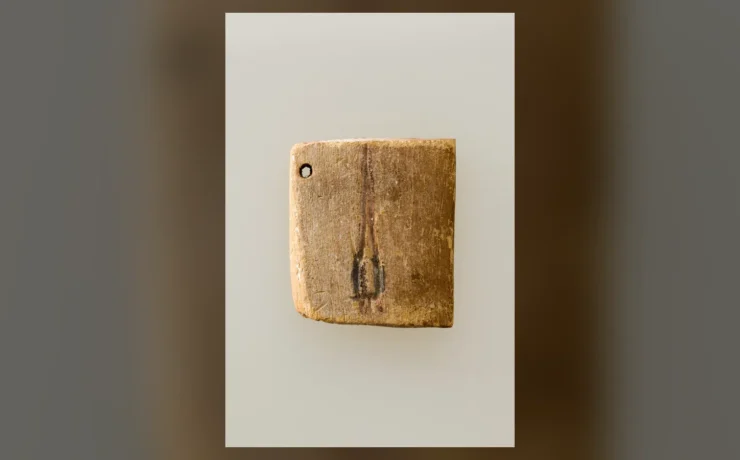
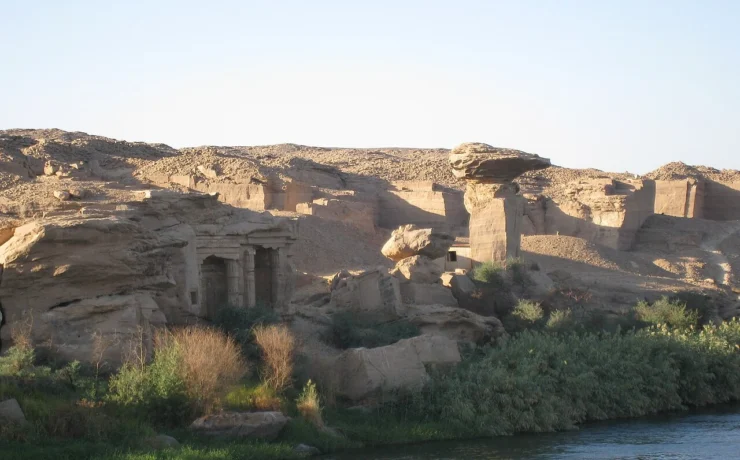
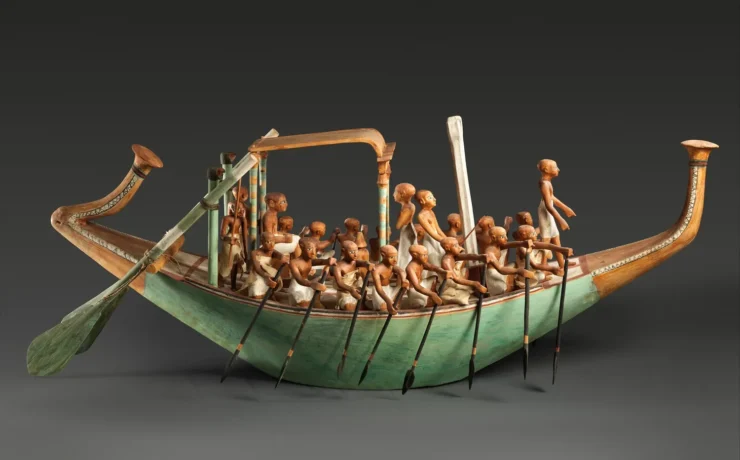
In 30 BCE Egypt lost its independent Ptolemaic monarchy and became part of the Roman imperial system. But Roman Egypt cannot be understood through conquest alone. Its history includes prefects, soldiers, grain taxes, Alexandria, trade with distant regions and remarkable funerary art that brought Egyptian and Mediterranean traditions together. This article examines the political occupation and the lives lived within it, using authenticated museum evidence rather than imperial slogans.
Roman Egypt: essential chronology
1. The end of the Ptolemaic kingdom
Egypt’s transition to Roman rule followed a long period in which the Ptolemaic dynasty governed from Alexandria. The political crisis involving Cleopatra VII, Mark Antony and Octavian culminated in the naval Battle of Actium in 31 BCE and the capture of Egypt in 30 BCE. The distinction between these dates matters: victory at Actium preceded the formal annexation. Roman rule was not simply one army crossing a border; it was a transformation of government, fiscal power and Egypt’s place in Mediterranean politics.
The Met dates the beginning of Roman administration to 30 BCE and emphasizes Octavian’s removal of the old monarchy. Egyptian institutions and local religious life did not disappear overnight, but the ultimate locus of political authority shifted to the Roman emperor.
2. Octavian, Augustus and imperial power
Octavian, later given the title Augustus, made Egypt a province administered in a way designed to reduce competing Roman claims to its wealth. A prefect governed on the emperor’s behalf. Roman officers and officials could serve far from home, but the practical administration also depended on local personnel with knowledge of language, landholding and taxation.
A royal image on a temple wall might continue older Egyptian visual conventions even when its ruler was a Roman emperor. Political conquest and continuity in religious display are not opposites. They express how Roman authorities used established institutions while changing the ultimate chain of command.
3. Why Egypt mattered economically to Rome
Egypt was valuable for agricultural productivity, especially grain, but also for its trade routes, craft production and resources. The Nile Valley’s agricultural calendar created the basic conditions for land revenue, transport and storage. Roman imperial needs made the province strategically important, while the consequences of taxes and state obligations were experienced by communities far from Alexandria.
It is an oversimplification to say Egypt produced only grain or became economically frozen as a warehouse for Rome. The Met notes commerce with Africa, Arabia and India, as well as the movement of stone, glass, papyrus and other products. Different districts and occupations participated in these networks unequally.
4. Roman provincial government and the prefect
The prefect was a governor appointed from the Roman equestrian order rather than a local pharaoh. His administration dealt with security, taxation and the wider requirements of imperial order. Below that level, cities, villages, officials and landowners played roles in implementing state demands. Documentary papyri allow scholars to investigate how administration worked in particular cases.
Roman legal and bureaucratic structures did not create perfect uniformity. Egypt had inherited Greek-speaking institutions from the Ptolemaic period, and Egyptian languages continued in different settings. A statement about official procedure in Alexandria cannot always be applied without qualification to a farming village.
5. Soldiers, rebellions and occupation
After the annexation, Roman forces were stationed in Egypt to support imperial control. Garrisons mattered militarily and politically, especially in the first decades of rule. Yet the experience of foreign power varied: tax collection and land administration could shape daily life more continuously than a visible battle. A history of occupation must therefore include fiscal structures, jurisdiction and responses from local communities.
A military victory is not the same as complete social domination. Egyptians and communities with Greek cultural backgrounds retained many local practices while confronting new imperial obligations. Some inhabitants advanced within changing institutions; others carried burdens imposed by them. The evidence often survives unevenly, so caution is essential.
6. Alexandria as an imperial metropolis
Alexandria was a major port and intellectual city connected to the wider Mediterranean world. Its location helped channel trade, grain shipments and administrative communications. Under Roman rule it remained important rather than becoming a deserted monument. The city’s social groups and institutions, however, were subject to hierarchical distinctions and sometimes serious political tension.
A student should avoid imagining one homogeneous “Roman Egyptian” identity. People might speak different languages, follow different religious traditions and hold unequal legal statuses. Ancient descriptions of Alexandria are shaped by the ambitions and biases of their authors and should be checked against papyri, archaeology and epigraphy.
7. Greek, Egyptian and Roman identities
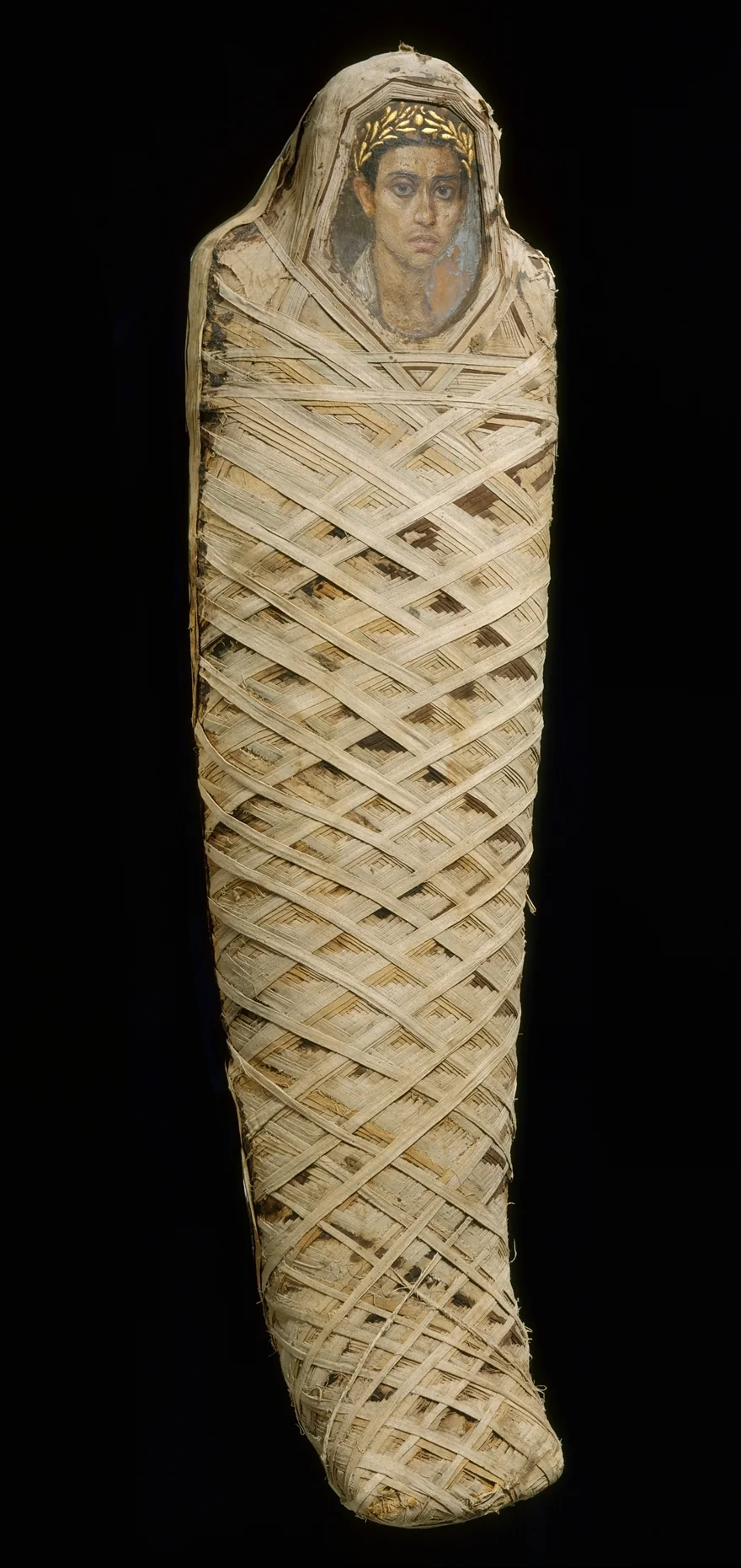
Roman Egypt’s culture developed through interaction rather than wholesale replacement. Greek writing and urban institutions remained important; Egyptian temple traditions continued; and Roman objects and practices became part of daily life. Some funerary forms combined Egyptian mummification with portrait styles associated with Greco-Roman artistic methods. The combination is visible in genuine archaeological artifacts.
These hybrid forms do not imply that everyone shared exactly the same beliefs. A mummy portrait made for a particular burial is evidence about funerary choices in a particular social context, not a population census or a visual definition of every inhabitant.
8. Fayum mummy portraits and the problem of identity
Painted panels from Roman-period Egyptian burials show individual faces using sophisticated techniques such as encaustic. Many examples are associated with the Fayum region, although the group is wider than a single modern administrative district. The Met documents a mummy with a panel portrait still in position over its face, as well as separate portraits dated to different decades.
Students should examine the original excavation context, painting method, clothing and jewelry. A portrait’s style is evidence of artistic conventions and self-representation, not a reliable modern racial classification. The Met also notes troubling later uses of some images in racist publications, an important reminder that the history of interpretation can be ethically charged.

9. Burial and religious continuity
Mummification and Egyptian funerary traditions continued in some Roman-period communities while new visual conventions were adopted. A person might be prepared for burial according to an established Egyptian custom and represented by a painted panel with Hellenistic and Roman affinities. Cultural continuity and innovation operated together.
No single burial represents an entire province. The presence of a portrait does not establish a standard rite used by all social classes, just as the persistence of an Egyptian deity in a temple does not imply that Roman rule had no effect on religion.
10. Isis worship and the Roman world
The cult of Isis continued within Egypt and spread widely beyond it. Greek and Roman communities sometimes encountered the goddess through local ritual forms that differed from earlier Nile Valley settings. The Met’s Roman Egypt overview specifically notes the goddess’s influence on the wider empire. This does not justify treating every Roman image of Isis as a direct illustration of an Old Kingdom myth.
Use the companion deity dossier on Kemet Vault to distinguish religious attributes, object dates and varying regional contexts. The history of Roman annexation and the history of Isis worship intersect, but should not be conflated into one identical story.

11. Trade through the Red Sea and beyond
Roman-period trade in Egypt connected the Nile, desert roads and Red Sea ports with regions across the Indian Ocean. Products and people moved through systems of merchants, transport networks and customs obligations. Egyptian geography became a strategic part of imperial commercial activity, while local communities provided labor, services and agricultural output.
Explaining trade requires more than a list of exotic goods. Archaeologists study ports, ceramics, inscriptions and written transactions to understand changing exchange. The presence of an imported item at a site shows contact, but not necessarily the identity or journey of the person who brought it.
12. Was Roman Egypt simply enslaved?
The word occupation can describe Egypt’s loss of sovereign monarchy and its incorporation into an empire. It does not mean the population experienced one uniform legal or social status. Different communities occupied different positions in tax systems, urban institutions, farming arrangements and the army. Some gained opportunities, some suffered constraints and many daily activities continued in altered conditions.
Avoid celebratory accounts that erase coercion, but also avoid narratives that depict every local inhabitant as identical and powerless. Regional evidence and changes over time are necessary to understand the province.
13. Later developments and the end of the period
Roman rule in Egypt continued through administrative and religious changes across centuries. The political history of the later empire, including the growth of Christianity and shifts in imperial centers, altered the province. Egyptian official chronologies vary in how they label the transition from Roman to Byzantine administration. Such labels should be explained rather than treated as the precise moment at which everyone changed identity.
A complete study of late antique Egypt belongs to further specialized articles on administration, religion and material culture. This overview concentrates on the initial conquest and its lasting structural consequences.
14. Evidence hierarchy: coins, portraits and papyri
The most useful source depends on the question. An imperial edict or papyrus may record an administrative obligation; a mummy portrait documents funerary art; an archaeological port shows the infrastructure of exchange. A portrait alone is not evidence for a prefect’s tax rate, and a Roman historian’s sentence does not reveal the thoughts of every farmer.
The four authenticated Roman-period portraits used here illustrate culture after the annexation, not Octavian’s actual military campaign. Each image has its own date and museum accession. This explicit labeling prevents decorative photos from becoming false historical claims.

15. Frequently asked questions
When did Roman occupation begin? In 30 BCE, after Actium in 31 BCE. Who ended the Ptolemaic monarchy? Octavian’s conquest brought the dynasty to an end. Did Egyptian culture disappear? No; religious practices, languages and artistic traditions evolved within imperial structures. Why was grain important? Egyptian agriculture was a major resource for Rome. Are Fayum portraits Roman paintings of Cleopatra? No; the surviving portraits are dated to Roman-period private funerary contexts. Was Roman rule uniform? No, experience varied among regions and social groups.
undefined
16. Study further
The strongest classroom essay explains the political sequence from Actium to annexation, the prefectural administration and economic priorities, then tests broad claims against an actual document or object. Students should keep their categories clear: conquest, taxation, religion, identity and burial are connected topics, but one cannot stand in for all the others.
Follow the chronology in Kemet Vault’s historical timeline, and consult the museum’s independently dated Roman portraits for material culture.
Research sources and related reading
The Metropolitan Museum of Art: Roman Egypt; Egyptian Ministry: Roman Period; The Met: mummy with inserted panel portrait; Kemet Vault historical timeline; Isis in Egyptian religion. All portraits are accurately presented as later Roman Egyptian material rather than pictures of Octavian’s conquest.