When did Egyptian Radio begin? Egypt’s national radio broadcaster began transmitting on 31 May 1934, under King Fuad I, with a ceremonial programme that included Sheikh Muhammad Rifaat, Umm Kulthum and other prominent performers. Private broadcasting preceded the official service; Maspero’s modern building was not the original 1934 opening venue.
Egyptian Radio is a history of technology, public culture and institutions, not only famous voices. This dossier uses Cairo Governorate’s own chronology, distinguishes radio from later television, and illustrates the broadcasting institution with dated photographs of its later headquarters that are never presented as lost 1934 archive footage.
May 31, 1934: the moment official Egyptian Radio began
Egypt’s national broadcasting service officially began transmission on 31 May 1934, during the reign of King Fuad I. Cairo Governorate’s historical account records the ceremonial inauguration in the courtyard of the Ministry of Communications on Ramses Street, followed by programming that included religious recitation and well-known singers. This date marks a major institutional development in Egyptian cultural history: a centrally organised state broadcaster became an important means of reaching listeners beyond the audience of a theatre, newspaper or live concert.
That does not mean radio suddenly appeared in Egypt in 1934. Small private and local stations had operated earlier, and the official service followed attempts to organise and regulate a growing medium. The precise distinction is between broadcasts taking place in Egypt and the foundation of the national service. Visitors looking at the much later Maspero broadcasting building should not identify it as the site of that first 1934 event. This page follows the origins, early programming, language and public significance rather than claiming the headquarters opened in the same year.
The voices heard at the opening
The governorate records Qur’anic recitation by Sheikh Muhammad Rifaat, followed by performances involving Umm Kulthum, Salih Abd al-Hayy and Muhammad Abd al-Wahhab among other contributors. The inaugural programme also reflected the political and literary elite, including speeches and poetry. These names demonstrate how rapidly radio drew upon existing musical, religious and literary networks. Broadcasting did not invent their artistic careers; it changed how their voices could travel to homes and cafés across the country.
The famous introductory phrase associated with the Egyptian broadcasting tradition has become part of cultural memory. However, recorded reminiscence and published schedules do not automatically establish that a modern audio clip is the unedited sound of the entire 1934 programme. The source-backed claim is the institution’s opening chronology and the musicians named by the official archive. If a clip is attached in future, its date, ownership and chain of preservation must be checked independently. A live performance described in a written account is not necessarily a surviving sound recording.
What existed before the national broadcaster?
Early twentieth-century Egypt experienced experiments with private radio stations and a wider growth in electric media. These stations were varied in reach, ownership and programming and did not necessarily operate under the uniform standards associated with later national broadcasting. Histories of Egyptian radio distinguish that fragmented early landscape from the decision to establish a public service supported by formal government structures. The 1934 inauguration therefore belongs to a longer technological transition.
The distinction matters for questions such as Who started radio in Egypt? One can answer the question differently depending on whether it refers to the first wireless transmission, the first privately organised service or the first national broadcaster. An accurate article names the category instead of manufacturing one definitive pioneer for every development. The documentary evidence for the 1934 public broadcaster is much clearer than many anecdotes about private stations operating decades before official regulation.
King Fuad I and the early broadcasting administration
The official opening occurred under King Fuad I, in a constitutional monarchy with ministries and public institutions shaped by Egypt’s complicated relationship with British influence. The Cairo Governorate account describes an organisation initially associated with four stations and changing administrative supervision, including the Ministry of Communications. It was not a timeless public corporation with exactly the same legal powers as a twenty-first-century media authority.
Institutional histories are useful because their dates reveal transitions between ministerial departments and specialist governing bodies. They can also tell us when broadcasting functions became more directly administered by Egyptian professionals. Political association should not be confused with authorship of every programme; the service relied on announcers, technicians, performers and editors, many of whose contributions rarely appear in a short official overview. The government inauguration and the daily work of making radio were different layers of the same history.
The Marconi relationship and the 1947 Egyptianisation
Cairo Governorate’s history records cooperation with Britain’s Marconi company during the early national broadcasting era and a change in 1947, when a new Egyptian-led phase of administration was established. This was part of a wider history of developing professional broadcast capacity within Egypt. The year should be associated with changes in management and organisation, not incorrectly presented as the date broadcasting began or as proof that every piece of technical equipment was replaced overnight.
Foreign technical relationships affected numerous communications projects of the era, while Egyptian radio staff developed expertise in announcing, production, music programming and engineering. It would be misleading to describe this institutional shift as purely symbolic or entirely complete in one day without consulting individual administrative records. The surviving public chronology establishes the transition, but specific contracts, personnel and transmission technologies deserve research in the broadcasting archive. This is also why histories of radio should not rely solely on photographs of later studio buildings.
Umm Kulthum and a new culture of listening
Umm Kulthum’s association with Egyptian radio became central to the story of twentieth-century Arabic musical culture. Broadcasts allowed listeners far from Cairo’s major theatres to hear renowned performers and participate in a shared cultural occasion. Her concerts became recurring events in social memory, but a chronological profile should distinguish her presence at the 1934 inauguration from the later consolidation of monthly broadcast performances.
The effect of broadcasting was not restricted to music. Radio carried religious programmes, poetry, drama, news, educational material and political addresses, bringing different forms of public speech into homes. Some listeners heard programmes on privately owned receivers, while others gathered around shared sets in cafés or communal spaces. Audience practices changed over decades and differed by income and location; a nostalgic image of an entire country listening to one programme at the same instant is a story worth investigating, not a statistical result established by the opening schedule.
Radio, language and the formation of a common public
A national broadcasting service helped circulate varieties of Egyptian and standard Arabic across a wide listening audience. Announcers and actors developed recognisable styles, while musical and religious broadcasts reinforced particular forms of formal public speech. This did not eliminate local dialects, nor did every region or household gain a receiver at the same moment. The history of broadcasting is also a history of uneven access to technology.
The appearance of a public medium mattered to people who could not regularly attend a theatre or buy all the printed newspapers they wished to read. Public radio could give listeners access to national events, though editorial decisions determined which voices were aired. Institutional history therefore intersects with cultural history and questions about power. A responsible treatment describes the capacity of the technology without claiming that a central broadcasting service automatically represented every social group in the country.
A different medium from Egyptian cinema
The Egyptian film industry expanded in overlapping decades, particularly after the 1927 success of the feature film Laila and the inauguration of Studio Misr in 1935. Radio and cinema shared musicians, actors, scripts and audiences, but they required different production technologies and business models. A radio performance could be distributed through transmission to many receivers; a film had to be photographed, edited and projected in cinemas. Their development should be studied together without making one simply a branch of the other.
Kemet Vault’s history of the Khedivial Opera House describes an even earlier performance culture that radio later helped transform. The opera house’s physical audience and the radio receiver are not interchangeable spaces. Linking them allows readers to see how musical institutions and public culture changed across periods rather than reading three near-identical articles about the same performers. Egyptian Radio deserves its own page because its central subject is transmission and the birth of a national institution.
The Nile-side Maspero building is a later landmark
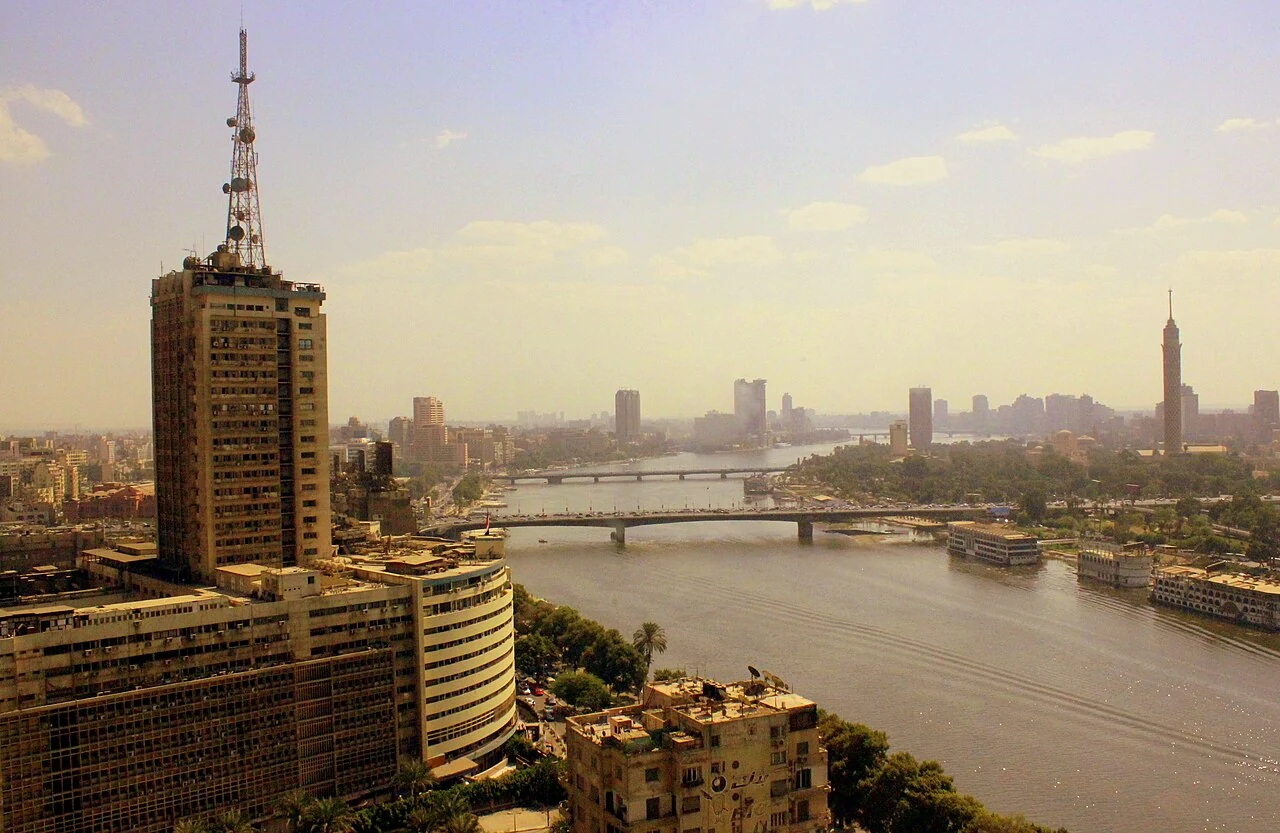
The first documentary photograph accompanying this article shows the Maspero television and radio headquarters as it appeared in 2015. A separate original photograph from 2009 records the same Nile-side complex from another perspective. Both pictures are accurately credited to their photographers and have their own Creative Commons licences. They are valuable visual evidence of an institution’s later architectural setting, but neither was taken at the 1934 inaugural ceremony.
The Maspero building belongs to a subsequent phase of Egyptian radio and television, when broadcasting had become a much larger technical and administrative enterprise. Presenting its modern exterior as if it were a 1934 studio would manufacture a false visual chronology. The article therefore uses authentic documentary photographs with explicit dates. Future archival material might illustrate the early broadcast equipment more directly, but its legal permission and genuine date would need to be verified before reuse.

Radio and the political changes of the mid-century
Egyptian broadcasting evolved during the monarchy, the revolution of 1952 and the republic that followed. Radio became an especially influential medium for public addresses, political statements and cultural programmes. Historians must distinguish changes in a broadcaster’s structure from broader shifts in the country’s political institutions. One famous speech does not sum up the experience of the entire medium, and a technical modernisation is not identical to political editorial freedom.
Kemet Vault already has a separate evidence-based account of the July 1952 Revolution and the 1956 Suez Crisis. They explain distinct political events. The radio page’s contribution is to trace a communications system that carried programmes across successive governments. This separation prevents a modern-Egypt archive from becoming an endless repetition of the same political narrative.
Radio, television and the danger of merged founding dates
Egyptian television broadcasting developed later than radio. Maspero is associated with both media, and modern institutional names often include radio and television together. That combination can tempt writers to assign a single foundation year to two different technologies. The national radio service opened in 1934; public television has its own later Egyptian history. An exterior photograph of a building housing both cannot establish the opening date of both.
Technology also changed what audiences could receive and how content was preserved. Sound-only transmission required different production conventions from television news and drama. Separate programme archives, engineering records and audience surveys would be needed to reconstruct the changing balance between the two. For a first introduction, the essential facts are the 1934 national radio inauguration and the earlier private activity that preceded it. The later Maspero photographs are context, not evidence of the original studio location.
Where to find stronger primary evidence
The most directly accessible official foundation account is Cairo Governorate’s Arabic history of Egyptian Radio, which gives the opening date, ceremony and named performers. Further research should consult archived contemporary newspapers, original programme schedules, historic radio annual reports and securely dated recordings when these are available through a lawful archive. A newspaper announcing the event and an original broadcast schedule could answer different questions about what listeners were expected to hear.
A modern website describing a familiar first phrase may be quoting a later anniversary programme rather than a first-hand 1934 recording. Source criticism matters particularly in audio history, where recordings can be edited, recreated or misdated. Crediting named performers is possible from the official account, but attributing a particular audio sample to the original broadcast requires more proof. The methods are straightforward: establish the item, its storage history, catalogue identity and recorded date.
What the 1934 inauguration tells us about modern Egypt
Egyptian Radio offers a compelling way to understand modern Egypt beyond kings, military events and monumental buildings. It highlights institutions, entertainers, technicians, language, public information and the changing ways citizens encountered a national culture. The evening of 31 May 1934 was a particular point in a longer process; the next decades brought administrative changes and new relationships between radio, society and politics.
For visitors and researchers who want a broader view of the period, Egypt’s earlier railway history shows a different technological transformation, while the Cairo Metro history documents a later urban project. Both support the same argument without duplicating the radio article: modern Egyptian history is the history of infrastructure and everyday cultural life as well as dynasties and battles.
Sources, photographic provenance and research limits
Dates, named artists and the 1947 administrative transition follow Cairo Governorate’s official history of Egyptian Radio. A related modern cultural context appears in Dartmouth College’s Egyptian cinema research guide. The two images document Maspero’s modern external building rather than an unverified 1934 event. Broad claims about privately owned receivers, programming and political influence are contextual analysis, not counted audience statistics or original audio transcripts.